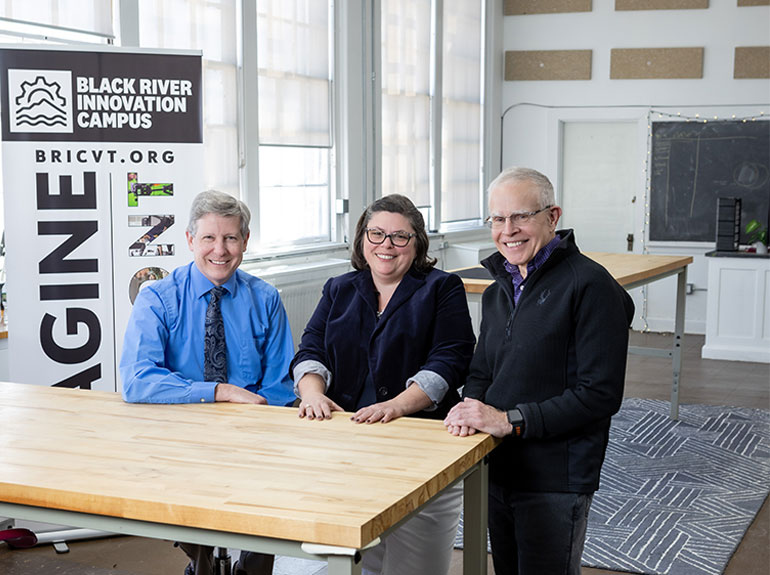
Photo: Windsor County power players, from left: Bob Flint, executive director at Springfield Regional Development Corp.; Havah Armstrong Walther, executive director at Hartford Area Chamber of Commerce; and Vin Fusca, executive director at Black River Innovation Campus. Photo: Baldwin Photography.
Windsor County’s economy is strong despite housing and workforce challenges. Still, organizations prepare to weather ripple effects of federal upheavals
Windsor County businesses had one of their best years in 2024.Restaurants and retail stores in Windsor and the Upper Valley saw their bottom lines increase, and the pandemic was finally in the rearview mirror.
“I would say it’s chugging along,“ said Kevin Geiger, chief planner at the Two Rivers-Ottauquechee Regional Commission.
“I don’t see any booming happening, but I also don’t see any busting happening.“
Echoed Tracy Hutchins, president of the Upper Valley Business Alliance, “2024 felt like we had returned to pre-pandemic times.“
Havah Armstrong Walther, executive director at the Hartford Area Chamber of Commerce, offered an even more optimistic view of the region’s economy, noting that Upper Valley businesses were reporting “a gangbuster summer, a record-breaking fall and a very nice holiday season.
“It was interesting because that was in opposition to a lot of information going out from other chambers in the country, and even regionally in New England,“ she said.
Projects that have been in the planning and preparation stages for years are finally moving forward. In downtown Springfield, work on prominent buildings like the Odd Fellows Building on Main Street is adding excitement to the area. Taylor Drinker, executive director at the Springfield Regional Chamber of Commerce, said that these projects represent dreams becoming visible.
Chambers themselves are also seeing updates in the form of new leadership and member benefits. Meanwhile, regional planning commissions are deeply involved in updating land use maps in accordance with Act 181.
According to the U.S. Census Bureau, Windsor County’s population of 58,101 people has a median income of $75,247. This amount was slightly lower than the state median. The area’s unemployment rate, according to the state Department of Labor, is 2.4%, in line with the state’s overall rate. Approximately 9.9% of residents live in poverty, close to the state average of 9.7%.
The Windsor County economy, however, is larger than its borders. When factoring in the Upper Valley, the economy spans two states and multiple counties, becoming what Hutchins described as a micropolitan area.
Workforce and housing remain an interconnected challenge for the county. Housing that is affordable for workers in entry-level jobs is needed most of all.
Establishing workforce housing is no longer just a concern for larger ski resorts. Armstrong Walther has noted that seven chamber members have recently become landlords.
Community capacity, whether through paid staff or volunteers, is stretched thin. As running municipalities becomes more complex, smaller towns with limited staff require assistance.
The potential impact of federal changes in February on the region’s economic trajectory remains to be seen. However, Erika Hoffman-Kiess, executive director at the Green Mountain Economic Development Corp., suggests that new collaborations may offer a silver lining to these challenges. Municipalities, businesses and organizations are increasingly turning towards each other to explore new partnerships and initiatives.
Adjusting to a Possible New Normal. Again.
Organizations that had successfully navigated the pandemic and multiple flooding events in the region now face a new set of uncertainties. Many Windsor County and Upper Valley businesses, for example, are grappling with the potential impacts of changes made in the early days of the Trump administration in areas such as diversity, equity and inclusion, climate change, federal funding, and other pressing issues.
“It’s not just a few organizations in niche markets,“ Armstrong Walther said. “It affects wide swaths of businesses and the most vulnerable populations.“
She added that some organizations have expressed concerns about potential government retaliation for using improper language in their materials or pushback from donors who may reject the concept of inclusion.
“What does that mean for them,“ Armstrong Walther asked, “if the idea of including their populations in the community in meaningful ways is now considered un-American?“
Hutchins noted that businesses are adopting a cautious “wait-and-see“ approach regarding the funding changes, potential tariffs, and other cases moving through the courts. A decrease in Canadian tourism due to these factors would negatively impact the industry.
“Businesses really do not like uncertainty,“ she said. “It’s difficult for a lot of businesses to react quickly. So uncertainty is really their enemy.“
Approximately 50 Upper Valley Business Alliance members are nonprofits that receive some form of federal funding, Hutchins noted. However, nonprofits are not alone in this regard.
Local municipalities and businesses involved in research, development and health care also receive federal funds or interact with federal agencies like the U.S. Department of Agriculture. Additionally, the auxiliary businesses supported by these impacted organizations, such as restaurants frequented by employees or companies providing supplies, are also affected.
“It feels a little bit like the start of the pandemic,“ Hutchins remarked, “because of the uncertainty — not knowing what the outcome is going to be.“
Drinker said that the Springfield chamber has not experienced any direct impacts, but anticipates feeling a ripple effect. Springfield serves as the region’s social services hub, and a portion of the local economy relies on social and state organizations. She estimates that 20 Springfield chamber members are nonprofits.
Bob Flint, executive director at the Springfield Regional Development Corp., agreed with Drinker, stating that organizations are apprehensive. While the SRDC itself is unlikely to be directly impacted by the federal cuts, its partners who receive federal funding may be. This could complicate the funding stack for ongoing projects, he noted.
Geiger, of the Two Rivers-Ottauquechee Regional Commission, worries about future projects. Along with funding, it seems the Trump administration is freezing information and federal agencies’ ability to communicate. What will it mean to fill out a flood mitigation grant application without using the term climate change?
Hoffman-Kiess, of the Green Mountain EDC, worries about the federal upheaval adversely impacting the region’s international development sector. Some of these organizations’ remote workers live in Vermont and New Hampshire. Given Windsor’s proximity to Dartmouth College and Dartmouth Hitchcock, she has concerns about the ripple effect on research and health care. Tariffs may also have a chilling effect on the economy, she said.
She’s telling co-workers, “Just assume that when we get to it, the bridge will be there at the next river.“
For now, making informed decisions based on the information at hand is the best they can do, Hoffman-Kiess added. If the GMEDC stops work, that’s not helpful to anyone.
When asked about federal funding, Jason Rasmussen, executive director at the Mount Ascutney Regional Commission, chose his words carefully, “Well, it’s leading to a lot of uncertainty,“ he said.
In the long term, Rasmussen worries about Vermont’s ability to complete community projects like housing, flood mitigation, water and sewer infrastructure, or revitalizing abandoned buildings without federal funds.
“We have so many towns that if we have any hope of building housing, revitalizing that old store or doing anything similar, we really need infrastructure,“ he said. “A lot of the infrastructure money comes from the federal government, so hopefully, that will not be drastically impacted by this. But time will tell.“
Communities Need More Capacity
Several towns in Windsor County have reached maximum capacity. Towns in the MARC region are discussing co-hiring staff as a way to share the workload, increase capacity and retain workers. The commission has entered into memorandums of understanding with several towns to provide services like flood permitting and grant management, but Rasmussen said communities need more help.
“We try to fill some of those gaps where we can,“ he said. “But I think more and more it’s a very complex world, and our smallest towns need a little bit of help with capacity.“
“The need for service support at the town level is huge,“ Geiger agreed.
He said the regional commission is exploring the idea of sharing staff with towns to help them function better at an administrative level.
Geiger likened running a town to becoming an airplane mechanic. “We’ve essentially kidnapped five people off the street and told them they’re aircraft mechanics, and we call them a selectboard,“ he said. “And they’re very civic-minded people, so they’re like, ’Well, I’ll give it a try.’“
He continued, “Running a town is complicated, and the people who do it are wonderful. But they need some help.“
In Geiger’s opinion, municipal leadership should make value decisions on behalf of the community, but they need professional technical help to bring those efforts to fruition.
He also feels that towns could collaborate more. For example, instead of five towns creating five separate requests for proposals to insulate their municipal buildings, they could create one joint RFP. The biggest barrier to such cooperation, he said, is what he calls “the psychological alps of Vermont.“
At the risk of mixing geological metaphors, for too long each town has operated as an island.
MARC: Updating Land Use Maps, River Work and Brownfields
Rasmussen said the Mount Ascutney Regional Commission is in the early stages of updating its land-use maps to comply with Act 181. The commission hired a consulting firm to assist with the updates. Once this phase is complete, it will conduct community outreach to determine if the proposed maps align with its communities’ vision, he said.
Passed last year by the Legislature, Act 181 was designed to encourage the building of more housing and updates Act 250. Rasmussen said Act 181 gives the new maps and regional plans more legal significance.
A benefit for towns and villages in the state’s designated downtown program will be the ability to maintain their membership without the need to reapply every few years, providing they meet certain criteria, he added.
Rasmussen hopes local communities understand they have a stake in the Act 181 updating process because it will determine where development can happen.
Brownfield work is keeping the commission busy. It has provided support for the Windham & Windsor Housing Trust’s Central & Main housing project in Windsor, which saw the renovation of a vacant building into 25 units of mixed-income housing, and provided a loan to the Benn High redevelopment project, a mixed-use redevelopment of the former high school in Bennington. According to Rasmussen, MARC decided to fund a project outside its region because doing so allows it to save brownfields grant monies for local projects. The federal government provides brownfields monies with the stipulation that some must be used as a revolving loan fund and some as grants.
Several communities are working with MARC around hazard mitigation. The commission is working with Stone Environmental, a consulting firm, on a study of the Black River. The intention is that the study will identify river corridor improvements that can increase resiliency and reduce future flooding. That report is due in December.
TRORC: Turning Pipes Back Into Rivers
The state has contracted with the Two Rivers-Ottauquechee Regional Commission on a project called Resilience Initiative for Vermont Empowerment and Recovery, which is designed to reduce flooding. TRORC is also leading five other regional planning commissions to develop flood-reduction project applications for the Federal Emergency Management Agency.
More than $1 million for planning and engineering technical support has come from the Vermont Housing Conservation Board and Vermont Emergency Manage–ment. Geiger anticipates work will focus on channel and floodplain restoration. The goal is to slow rivers down and give floodwater space to spread out, instead of spreading into downtowns and homes.
“People want to dig out the (river) channel and make the river function better as a pipe,“ he said. “Rivers aren’t pipes, and that kind of leads to bad things, typically.“
Areas TRORC is working with include Western Jamaica, Londonderry, Ludlow, Bridgewater, Woodstock, Plymouth, Barre, Berlin, Montpelier, Johnson, Cambridge, Wolcott, Barton and Glover. TRORC is working with the area’s local planning commissions. Applications need to be submitted to FEMA by April.
GMEDC: Trust Is Key
The Green Mountain Economic Development Corp. serves 30 communities across the northern part of Windsor County and part of Orange County. Hoffman-Kiess said the 2023 floods mostly bypassed her region. Still, she is surprised at how much the region is focusing on resilience, recovery, rebuilding, and relocating.
Conversations are happening much quicker than she expected, and communities are asking what changes they can make now because there will be a next time.
It’s exciting to see how much support is coming down from the state and organizations such as the Vermont League of Cities and Towns to help towns access infrastructure funding, she said.
GMEDC is participating in the Agency of Commerce and Community Development’s relocation and outreach effort called ThinkVermont. Thanks to recent grant funding, the development corporation has hired a staff member devoted to supporting people interested in relocating to Vermont.
Construction of a new child care center at the Orange County Parent Child Center’s Woodlands Campus in Randolph, was slated to begin in late February or early March. The new facility will provide family support and early childhood education to 16 central Vermont communities. The multiphase project will start in 2025 with the capacity to serve 62 children ages 6 weeks to 5 years. By 2026, additional work will expand capacity to 88 children.
However, the federal government is footing $6 million of the project’s $6.5 million budget, and so things may change.
Hoffman-Kiess hopes the federal funding remains in place, allowing the Woodlands Campus to be completed on time. But for her the project also represents economic development and community faith. Most of the building contracts had been agreed to and signed. Terminating them slows the economy, but it can also endanger community trust, she said.
SRDC: Increasing Workforce Participation
Springfield Regional Development Corp. is the lead organization shepherding the Springfield Area Working Community Challenge, or SAWCC. The effort continues to evolve in its support of the local workforce with a new initiative called Know Your Workforce, Flint said.
According to Flint, Know Your Workforce engages employers in addressing systemic obstacles that stand between low- and moderate-income earners and quality jobs. The initiative also promotes investment in the workforce development pipeline.
Know Your Workforce has three components:
A two-year research study of employee experiences and the barriers they face, such as transportation, child care and housing.
The Know Your Workforce Guide to help employers and other partners understand the challenges facing the local workforce and strategies to help overcome them.
Employer investment, which asks employers to invest in the community by implementing the strategies outlined in the guide.
Flint said one benefit of the pandemic is that employers realized that workers aren’t interchangeable widgets. Instead, employees have needs and concerns that deserve to be addressed.
SAWCC recently completed an intranet for social service providers. The project takes a “no wrong door“ approach to accessing services, meaning that if someone contacts a provider that doesn’t handle their needs, the provider is equipped to connect the person to the correct resource.
Increasing workforce participation is SAWCC’s primary goal. According to Flint, the area’s workforce participation rate is lower than the rest of the country. According to the U.S. Bureau of Labor Statistics, America’s civilian labor force participation rate was 62.6% in January.
In 2020, Springfield received a Working Communities Challenge grant. According to SRDC’s website, the three-year, $300,000 grant was provided by the Federal Reserve Bank of Boston and supported by the state of Vermont and several philanthropic organizations. Flint estimates that 35 organizations, businesses and agencies participate in the SAWCC.
On the business front, Blake Hill Preserves is close to completing an expansion that will double the size of its Windsor plant. Flint said this warms his heart, because he remembers Blake Hill’s early days when it had only a handful of employees. He has enjoyed watching the company grow to approximately 50 employees. This number should increase with post-plant expansion, he added.
Flint also highlighted the success of VT Dry & Cure Technologies, which operates out of the Springfield Industrial Park. The company builds drying equipment for the cannabis industry.
More towns are interested in creating Tax Increment Financing districts or TIFs, as a way to finance infrastructure projects. However, TIFs have a high administrative burden, said Flint, and there’s hopes that the Legislature may tweak the program to become more nimble and easier to manage.
Business ownership transitions is a big issue for the local economy. Ensuring that heritage businesses operate after their founder retires has highlighted how badly potential entrepreneurs need access to capital.
According to Flint, his part of the state lacks the private investors that other areas of the state can call upon.
“On any of this stuff, even economic development, we don’t wave a wand and things just happen,“ he said. “We try to support people and businesses to help put them in positions where they can make things happen.“
Springfield Regional Chamber: Updates for the 21st Century
Learning, changing and updating were the 2024 themes at the Springfield Regional Chamber of Commerce.
Drinker spent the year updating the chamber’s bylaws, reconfiguring the organization’s dues into a tiered membership and hiring a part-time staff member to take over the Young Professionals Group.
New member benefits include a web presence analysis, helping connect people to marketing, and setting up a website.
No more businesses with only a Facebook page, said Drinker. In short, she wants to pull business owners into the 21st century.
“There’s a handful of people that I can’t find an email for them anywhere,“ she said. “You can call their cell phone. That’s the only way of contacting them. Really. They’re doing business off their personal cell phone. They’ve been doing it for 40 years.“
According to Drinker, the Springfield community tends to use Facebook to connect with local issues. Instagram is used to connect with visitors. Drinker expects to spend more time on LinkedIn to entice business owners to relocate to Springfield.
Springfield has a plethora of commercial spaces ready for businesses, she said.
Promoting the chamber’s successes is a goal for 2025. According to Drinker, the organization has shied away from tooting its own horn.
“I think it’s a Vermont thing,“ she said.
Members have shared that they need employees to possess stronger soft skills such as communication, the ability to adapt and time management.
Another need is to improve workers’ digital literacy. A number of community members need help understanding computers, printing resumes and setting up email accounts, she said. In response, the chamber has worked with Working Communities Challenge staff to host a popular series of digital literacy workshops.
Several such workshops, led by Working Communities Challenge coordinator Amanda Sidler, were completely full, and Drinker said he has received several requests for additional workshops.
In the meantime, the chamber has received sponsorship funds from VTel to help revamp the Young Professionals Group, which Drinker said fizzled last year due to a lack of staff to manage it. In 2025, Young Professionals can look forward to a series of speakers and workshops.
Drinker highlighted two renovation projects in the downtown area: the Odd Fellows and the Foundry buildings.
The chamber’s 2024 Business of the Year, Sarrazin Architecture, of Port Chester, New York, was recognized for its redevelopment of the Odd Fellows Building on Main Street. According to Drinker, the building sat in disrepair for years. Renovations are complete for the front half of the building.
The Edgar May Health and Recreation Center’s foundry building, on Clinton Street, is moving forward. Last year, the town received funding from the Environmental Protection Agency for Phase I of the three-phase project, environmental remediation. The project includes expanding the center by 31,000 square feet to add an indoor walking track, indoor field, basketball and pickleball courts and a licensed child care center as well as increase the size of its locker rooms.
“It’s nice that they’re starting to be visible,“ Drinker said. “I think a lot of times we talk about this stuff — the Park Street project or the J&L project — but there’s something about actually seeing the building come down or the trees come down. It’s like, ’Oh, this is actually happening.’“
New Leadership at Hartford Area Chamber of Commerce
The Hartford Area Chamber of Commerce’s new executive director, Havah Armstrong Walther, has used her first year at the organization listening and learning from members.
Members have told her that they benefit from the chamber’s business mixers and networking events.
“I love when businesses are able to do more and do better, because they’re relying on each other,“ she said.
Several municipalities and working groups invited her to provide a business perspective on community issues. She recently participated in the town of Hartford’s update of the economic development chapter of its Town Plan.
Armstrong Walther began work at the chamber on Dec. 1, 2023. She credits the successful transfer in leadership to time spent with outgoing Executive Director PJ Skehan before he departed.
“PJ was a fabulous leader, and to be able to come in behind him wasn’t a matter of cleaning up a disaster. I didn’t have to come in as a fixer. I got to come in as a second act,“ she said.
The chamber has instituted new member tiers, benefits and a la carte services. The newly introduced institutional membership level entitles members access to data tracking. The software data mines already collected information from cell phones and GPS systems, Armstrong Walther explained.
The software enables businesses to track in their area and determine the distance their customers have traveled to get there. This type of information is important for loan and grant applications, Armstrong Walther said.
Most businesses must hire consultants to obtain this data, which can cost as much as $1,000 and take 18 months to receive. Armstrong Walther said she can run similar reports in a single afternoon.
The chamber sponsors the Downtown White River Junction Business Association. The organization works with downtown businesses owners to make collaborative decisions about using the state downtown program grant funds to promote the district.
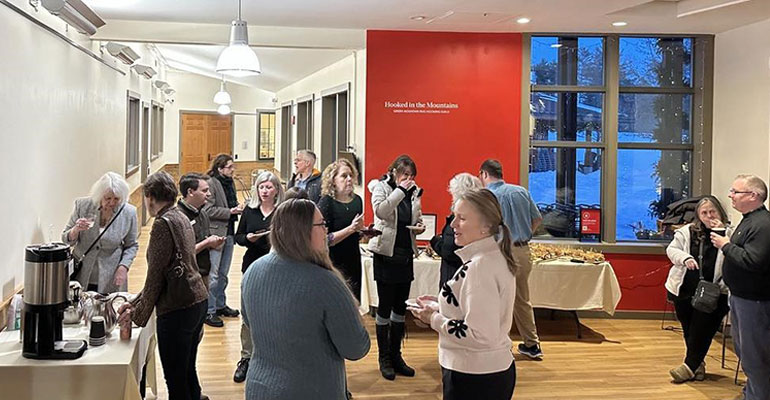
Photo: One of the Hartford Chamber’s business mixers and networking events. Courtesy photo.
by Olga Peters. Vermont Business Magazine
Armstrong Walther explained the chamber staffs the project “so that it’s not reliant on really passionate volunteers, but we actually have some infrastructure to the organization that can support it.“
Dedicated staff is an important component of a successful organization, she added. This is how organizations survive beyond passionate volunteers.
The need for consistent staffing demonstrates a trend Armstrong Walther has noticed.
Volunteerism has yet to fully rebound since COVID. People are busier and retirees are still wary of getting sick from attending public events. Armstrong Walther said the dip in volunteers drives home how important it is for organizations to ensure volunteers understand their value.
She said more people are likely to volunteer when they know the impact of their actions.
Business leaders must teach their staff the value of volunteering and donating to the community, Armstrong Walther added.
Volunteers and sponsorships have made it possible for the chamber to host the Quechee Hot Air Balloon Festival. Entering its 45th summer, the festival doubles as a fundraising event that allows the chamber to provide scholarships and sponsor community events.
This year’s balloon festival will happen from June, 20 to June 22.
UVBA: Many Towns, One Economy
Hutchins reported a strong economy in the Upper Valley, with restaurants thriving post-pandemic and new businesses emerging.
“There’s a lot that’s positive that’s going on. Our economy, for the most part, is chugging right along,“ she said.
Several new businesses have moved into the region, and her office has received multiple inquiries about launching new businesses. Restaurants had a great fall and have remained busy even into the traditionally slower midwinter.
2024 stood out for Hutchins as the year when most businesses had reached a full post-pandemic recovery. Their ledgers reflected pre-pandemic numbers, she said.
However, she highlighted concerns about staffing, housing costs, and childcare.
The sense of unknown created by the federal government feels a little like starting over after finally recovering from the pandemic, she said.
Hutchins is keeping an eye on a steady flow of retirements leading to businesses closing. According to her, several business owners had decided to weather the pandemic and kept operating until they reached recovery level. Now they are in the process of closing and some have sold.
Out of a membership of almost 500, she estimates 10 businesses have recently changed hands or closed which feels significant for the economic flavor of the Upper Valley.
Hutchins noted that many of the businesses she works with continue to offer hybrid office and remote work models.
They have found the hybrid models allow them to hire the right person for the job regardless of where they live, she said.
In February, the UVBA promoted local restaurants hosting a contest called the Upper Valley Burger Battle. In March, UVBA will host their annual economic outlook breakfast. A topic for discussion will be changing demographics and how this impacts the regional workforce. Guests include Vermont Treasurer Mike Pieciak and we have two speakers from the New Hampshire Fiscal Policy Institute.
The UVBA has multiple ongoing initiatives focused on workforce retention and recruitment which happen through its Upper Valley BIPOC Network, Upper Valley Arts Alliance, and Upper Valley Young Professionals groups.
“We have several companies that do recruit heavily from other areas of the country and relocate people here,“ Hutchins said. “So how do we make this area as welcoming and a great place to raise a family, have a business and retain those people?“
As communities move into 2025, they are acknowledging the uncertainty of federal changes and looking towards potential collaborations.
No matter what 2025 brings, Geiger trusts his community.
“Keep the faith and trust your neighbor,“ he said. “Under all situations, it’s always a good idea.“
Olga Peters is a freelance writer from southern Vermont.
To support vital journalism, access our archives and get unique features like our award-winning profiles, Book of Lists & Business-to-Business Directory, subscribe HERE!