A Weekly State House Recap
by Maggie Lenz and Nick Charyk on behalf of Atlas Government Affairs
Shaping the Clay
Education reform in Montpelier is finally starting to take shape. After months of plans, counterplans, and more questions than answers, lawmakers have their hands in the clay. Governor Scott’s sweeping January proposal set the wheel in motion, calling for major district consolidation, a statewide school choice lottery, and a new funding formula. Since then, the House and Senate have each worked their own approach, and they are not exactly aligned with each other, or with the Administration.
That raises the very real possibility of a contentious conference committee in the near future. And without a Democratic supermajority, there will be three parties at the table this time, not two. The House and Senate will have to hash out their differences while keeping an eye on whether the governor will sign or veto whatever deal they are able to land on.
Still, the work is moving. In the House, the Education Committee is now focused on a proposal to create a School District Boundaries Subcommittee under the Commission on the Future of Public Education. They want a deliberate process, using data and community engagement to come up with recommendations by the end of this year. Alongside that, they are working on proposals for minimum class sizes and debating whether private schools receiving public dollars should have to follow the same rules as public schools. They are not drawing maps yet, but they are setting the groundwork.
Down the spiraling staircase in the Senate Education Committee, Senator Seth Bongartz (D-Bennington) is still semi-pushing a proposal that would consolidate Vermont’s school districts down to nine. The plan notably preserves tuitioning regions served by Burr and Burton Academy, Lyndon Institute, St. Johnsbury Academy, and Thetford Academy. Bongartz served on the Burr and Burton board for nearly two decades. He has framed the plan as a necessary response to rising costs and financial pressures on the system.
Senator Kesha Ram Hinsdale (D-Chittenden Southeast) raised strong concerns in Senate Education last week that rushed consolidation could deepen inequities between districts. As a reminder, she was the sole vote on her committee against confirming Secretary of Education Zoie Saunders earlier this month, a signal of her skepticism about the broader direction of the Scott Administration’s proposals for education reform.
Discussions on Thursday in Senate Education got prickly during testimony by the Vermont Superintendents Association (VSA). Senator David Weeks (R-Rutland) pushed back on the VSA referring to “private schools” rather than using the term “independent schools,” as the schools themselves prefer. It was one of several tense moments in a conversation that felt like a proxy for a deeper disagreement over the VSA’s position that any school receiving public funds should be held to the same standards and accountability as public schools.
The VSA has offered an alternative approach: a phased, research-based plan that would finalize district boundaries in 2026, with full implementation by 2029. Their plan includes statewide collective bargaining, school designation reforms, and a clear definition of "small by necessity" to clarify exemptions. It calls for accountability for and oversight of private schools taking public dollars. It appears to have traction in the House and among some members of the Senate, though Bongartz continues to pull up his redrawn district map during their discussion. His proposal is still on the table, and he is presenting it as some sort of middle ground between the Governor and Democrats.
Meanwhile up on the second floor, the House Commerce Committee took the week to consider whether to create a single statewide Tech Center aka CTE district. There was agreement that any changes to CTE governance need to align with the larger governance reforms, and that local high school coordination and transportation funding must be addressed.
While the structural debates continue, lawmakers on the third floor of the statehouse in the House Ways and Means Committee have been scrambling to manage property taxes for the current year. On Friday, the Committee advanced its version of the Yield Bill, which sets the key tax rates that determine how much Vermont property owners pay in school property taxes each year. They are using $77 million in one-time money to buy down what was expected to be a 6 percent property tax increase. If all goes to plan, the average increase should land closer to 1 percent.
The vote was not unanimous, though. Rep. Rebecca Holcombe (D-Norwich) voted no, warning that the buy-down amounts to putting property taxes on a credit card without addressing the underlying cost drivers. Rep. Jim Masland (D-Thetford) also voted no, citing long-term sustainability concerns. Reps. Marty Feltus (R-Lyndon) and Bridget Burkhardt (D-South Burlington) voted yes but expressed deep reservations and called on their colleagues to focus on lasting reforms.
Senate President Pro Tem Phil Baruth (D/P-Chittenden Central) has promised that the Senate will do its part to protect taxpayers this year, but Senate Finance Chair Ann Cummings (D-Washington) has cautioned that the scope of any buy-down may be limited by federal uncertainties.
Which brings us to the grand finale. The federal picture is bleak and not making things easier. President Trump’s executive order to begin dismantling the U.S. The Department of Education has sparked anxiety about the future of federal education funding. With staff already being cut and responsibilities shifting, Vermont lawmakers are keeping a close eye on Washington. If federal funds dry up, the state’s budget challenges will only get harder.
So. Three proposals. One veto pen. And a shrinking pool of federal support. This session doesn’t need to end with a grand bargain. But it does need to end with some direction.
Curiosities: a weekly peek at the odd and intriguing happenings under the Golden Dome
Landing on Her Feet
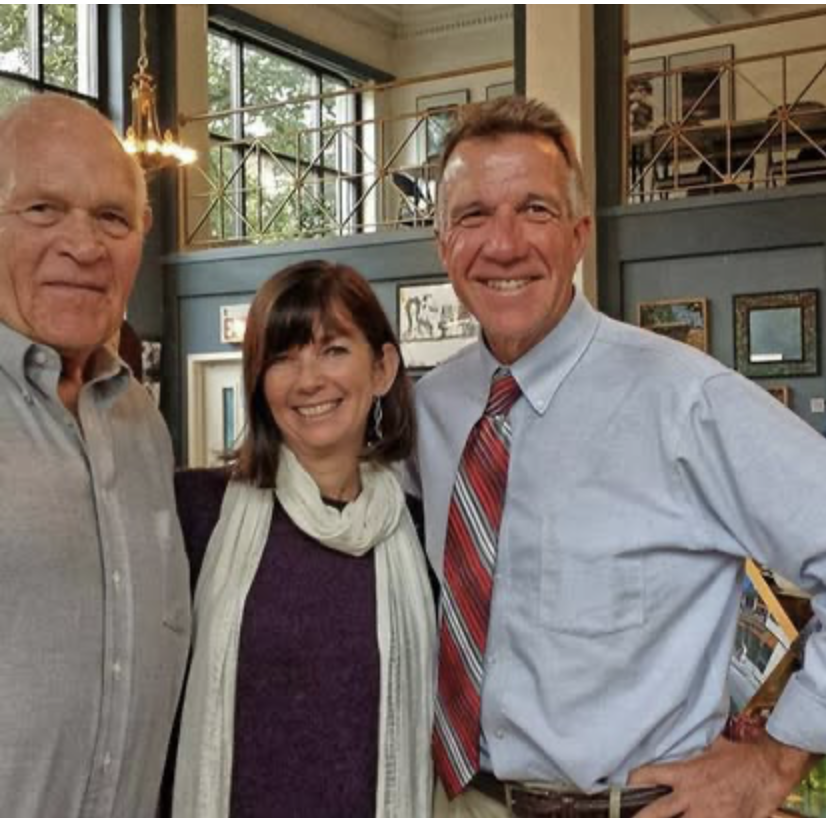
Rep. Patti Komline with the late Senator Dick Sears (D-Bennington) and Phil Scott, then running for lieutenant governor and now serving as Vermont’s governor.
Before marriage equality was the law of the land, it was a veto override vote in the Vermont House. And before Patti Komline was a lobbyist known for working in bright high-top sneakers, she was the Republican Minority Leader standing in the middle of one of the most consequential debates in Vermont history.
In 2009, Vermont was poised to become the first state in the country to legalize same-sex marriage through legislation. The bill had passed, but Republican Governor Jim Douglas had vetoed it. The House was one vote away from overriding that veto. Reaching the two-thirds threshold meant exactly 100 votes were needed. When the final tally was announced—100 to 49—the bill became law. Vermont had made history. It was the first state to grant marriage rights to same-sex couples through legislative action, not a court ruling.
For Komline, the decision to vote yes was never in doubt.
"Professionally, it was the most impactful accomplishment I’ve ever experienced," she says. But she knew the fallout would be difficult. As Minority Leader, she had spent six years encouraging her caucus to “vote your conscience, your constituents, and your party, in that order.”
When the marriage equality vote came to the floor, she followed her own advice.
During the debate, Komline offered to step down as leader but was asked to stay.
"There were concerns about optics," she says. After the vote, the strain within the caucus became clear. "Having failed as Republican leader, I then went on to find success on a more independent course," she says.
Komline left the legislature in 2016 but did not leave Montpelier. She returned as a lobbyist, representing a wide range of clients and issues. In Vermont’s citizen legislature, where lawmakers juggle other jobs and limited staff, she believes lobbyists are a critical part of the process.
"Lawmakers have 500 things going on at all times," Komline says. "I used to go stand in a bathroom stall just to be able to get some peace and settle my brain." She calls lobbyists "an incredible asset to the legislative process," but adds. "Sometimes we can add to the pressure without meaning to. It’s important to remember what lawmakers are juggling."
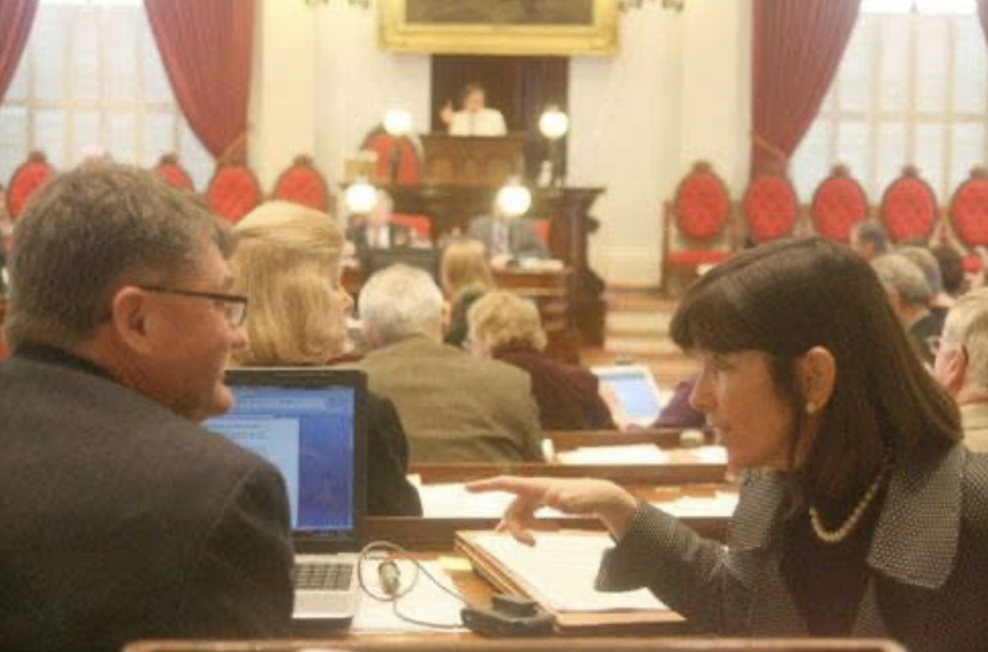
Patti Komline with her successor as House Minority Leader, the late Rep. Don Turner (R-Milton).
These days, some of the issues Komline works on, like gun safety reform and housing, are often viewed through a partisan lens. But she brings a different perspective, shaped by years of working on both sides of the aisle.
"It astounds me that these conversations are considered partisan at all," she says. "When people set aside the 'slippery slope' arguments, there’s usually a lot of common ground to make society safer, healthier, and stronger."
It is the kind of long view that comes from experience. Her advice now is to go easier on yourself.
"The wins and losses really aren’t that significant in the long run. These are all problems to be managed, not to be solved."
And mistakes?
"Don’t be afraid to make them," she says. "They’re great learning opportunities. I’ve made some pretty big ones on the House floor and in press conferences. But people see you bounce back. It gives them space to do the same."
Which brings us to the sneakers.
Komline is known for them now. Bright, stylish high-tops have become her signature look as she moves between committee rooms. She traces the idea back to the movie Fried Green Tomatoes, where Jessica Tandy’s character wore high-tops.
"I remember thinking, ‘When I’m old, I’m wearing those,’" Komline says. "This year, I realized… this is my time."
And these days, Patti Komline walks the Statehouse on her own terms. Still showing up, still doing the work, and still charting her own course.
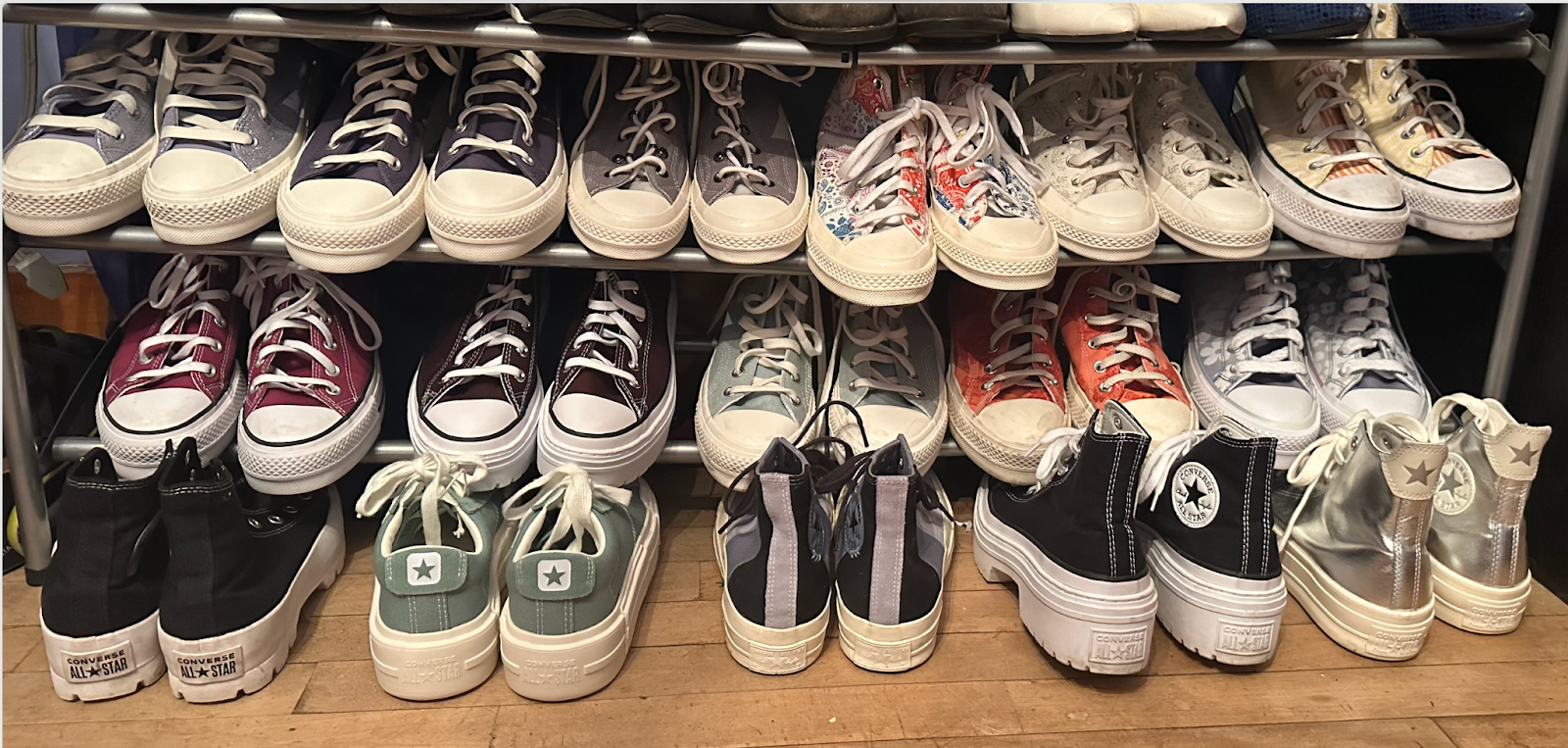
Some of Patti Komline’s Signature Sneakers
3.23.2025. Atlas Government Affairs
To support vital journalism, access our archives and get unique features like our award-winning profiles, Book of Lists & Business-to-Business Directory, subscribe HERE!