


Photo: Snow making earlier this year at Stowe Resort. Courtesy photo.
Lamoille County communities prepare for growth, infrastructure and the future
by Olga Peters, Vermont Business Magazine
After weathering the coronavirus pandemic and two historic flooding events in successive years, communities in Lamoille County are focused on rebuilding and future planning.
Several communities are updating their town plans with an eye toward resilience. The town of Johnson has launched Re-Imagine Johnson, an initiative to consider and prioritize future development (see story Collectively generating ideas for the future’). Manufacturing Solutions Inc. is two years into permitting a multimillion industrial site in Morristown. And Johnson Woolen Mills is under new ownership (see story Entrepreneurs tackle substantial projects in Lamoille County).
Tourism continues to drive the county’s economy.
Communities like Johnson, Morristown and Wolcott are finding ways to incorporate more outdoor recreation and take advantage of their proximity to the Lamoille Valley Rail Trail. According to the Lamoille Economic Development Corp., the largest industries in the county are accommodation and food services; government; health care and social assistance; and retail.
The LEDC’s executive director, Patrick Ripley, described the state of the economy as “business as usual“ — a nice change after several years of upheaval.
Ripley noted that the tourism and retail sectors are normalizing and showing a slight dip in receipts. The pandemic had helped boost these sectors to above-average levels.
“The data is telling us that we’re getting back to pre-pandemic levels, which makes sense,“ Ripley said.
According to the Vermont Department of Labor, the county’s seasonally adjusted unemployment was 2.9% in November. Its labor force participation rate, which measures the percentage of the population within working age who are either employed or actively seeking employment, was 69.2%.
“For a long time, we’ve been the second-fastest growing county outside of Chittenden,“ said LCPC Executive Director Tasha Wallis. “But like everywhere else in the state, we’re just facing tremendous constraints on growth due to housing shortages.“
Lamoille County’s population stood at 26,530 as of 2023, an increase of 1,200 residents, or 4.7% over 2018 figures, according to the LEDC. It is projected to grow by an additional 1,838 people over the next five years.
Affordability is on the minds of many Lamoille County residents this year. Ripley and Stowe Town Manager Charles Safford said a lack of housing and the cost of living are making life tough for residents.
“I, like most Vermonters, am willing to pay a little bit extra for quality of life, and we get it,“ Safford said. “We want to do the right things, but at some point we all reach a breaking point. We want to make it so people can afford to live here, not just visit here.“
McKee Macdonald, owner and broker of the Smith Macdonald Group at Coldwell Banker Carlson Real Estate in Stowe, said the pandemic has shone a spotlight on Vermont as a special place to live. This has meant an increase in property values and tax revenues as well as an influx of people — a situation he describes as both a benefit and a challenge.
“Just because all that money is coming in doesn’t mean we don’t have the same problems that every other community has, where there’s an issue with affordable housing, schools that are crumbling or transportation,“ Macdonald said.

Photo: Lamoille Valley Bike Tours. Courtesy photo.
Updating Town Plans
Want to understand a community’s vision for the future? Check out its town plan, available on most city, town and county websites.
These documents typically include information about a community’s current conditions, goals and proposed plans for the future. They also include information about how the town will use its land, transportation, utilities and facilities.
Though not legally required by the state, town plans support individuals, municipalities and businesses applying for federal funds, and must be updated every eight years.
“It’s an aspirational document, a kind of a roadmap for the future of the community,“ Wallis said.
In January, the LCPC board reviewed town plans for Cambridge and Johnson town and village.
Johnson’s planners listed 10 core objectives in the draft town and village plan. These included:
- Expanding economic opportunities and supporting initiatives that make Johnson a place where people want to live, work and recreate.
- Increasing owner-occupied housing and a regional distribution of subsidized and affordable housing.
- Identifying natural and historic resources, along with encouraging the efficient use of energy and renewable energy.
- Facilitating access to educational opportunities across all ages.
- Including flood resiliency when evaluating the costs and benefits of projects.
Stowe launched a community outreach effort late last year to update its town plan, titled “Stowe 2050.“ The municipality asked residents to envision what type of community they envisioned 15 years from now. The planning commission released a summary of the survey results in January, which will help inform a discussion about community core values scheduled for Annual Town Meeting.
As of Jan. 6, 538 people had responded to the survey. Of those, approximately 65% identified as full-time residents, the majority of whom were female and between the ages of 40 and 60. Respondents listed Stowe’s scenic beauty, outdoor recreation offerings, traditional village center and living in an engaged community as major strengths of the town.
Respondents’ top three items they wanted addressed were affordability and the general cost of living; property taxes; and managing Stowe’s growth and development pressures.
Morristown recently completed updating its town plan, an important milestone for the town and village. Having the document in place will help the community regain its Downtown Designation, which will make it eligible to receive funding, technical support and other benefits from the state.
According to Town Manager Brent Raymond, Morristown lost its Downtown Designation a few years ago after the LCPC did not approve its town plan.
“However, we are excited to share that the selectboard, village trustees, planning council and I have worked closely with the Lamoille County Planning Commission to address their concerns,“ Raymond wrote in an email. “This collaborative effort paid off in November when the LCPC officially approved our updated town plan.“
Municipalities aren’t alone in making updates. Regional planning commissions are also reviewing their plans and land use maps per Act 181, which the Legislature approved last year. These maps show how town land is currently used and may be used in the future. But the characterization of a parcel is subject to interpretation.
“Is a ski area an enterprise area or a natural resource-based economic activity,“ Wallis said. “Under Act 181, the regional planning commissions are working together to ensure they’re using consistent definitions. This process will be followed by community outreach to ensure the new maps align with their communities’ vision.“
As part of its update process, Lamoille’s planning commission is paying extra attention to addressing housing and flood resiliency. The commission is also reviewing its mission and vision elements and conducting extensive public outreach.
Balancing Economic Development, Housing and Future Flooding
Wallis highlighted the conflict between smart growth principles, which advocate for development in town centers, and the reality of flood risks in Vermont’s downtown and village areas. She emphasized that while development is encouraged, it shouldn’t occur in areas prone to flooding.
Flood mitigation efforts can be implemented through a range of approaches, including retrofitting buildings, relocating infrastructure and restoring floodplains.
The LCPC is currently supporting active restoration projects in Wolcott and Johnson. Wallis anticipates additional projects following the completion of the FEMA buyout process.
In Wolcott, Selectboard chair Linda Martin is assisting nine homeowners through the buyout process, noting that most of the structures involved are single-family homes situated in the village center.
The buyout process in Lamoille has presented both relief and concern. While property owners find relief in gaining financial resources to relocate from flood-prone areas, municipalities are concerned about the potential shrinkage of the tax base due to these buyouts.
“That’s an important conversation,“ Wallis said. “There’s a lot of challenges around how we move forward with making the community more resilient and more economically viable.“
For Wolcott, Martin emphasized that a significant wastewater project is essential for the town’s flood resilience and development initiatives. Additionally, the town has sought mitigation funding to increase the size of culverts and replace an undersized bridge on School Street.
Town of Stowe/Stowe School District — Budgets and Taxes Collected — 1978 Through 2025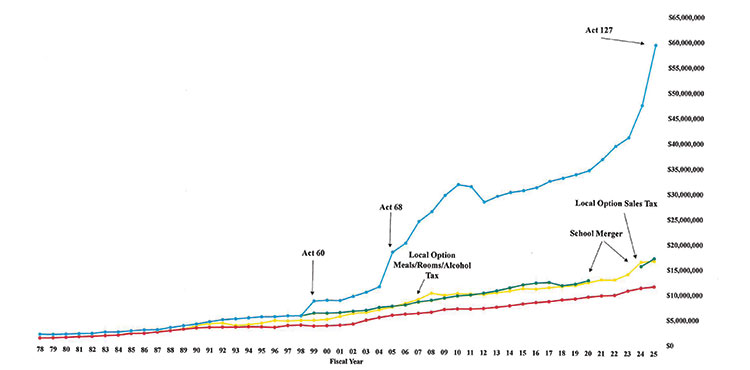
— Municipal General Fund Budget — Municipal Property Tax Collected
— Stowe School District General Fund Budget — Education Property Tax Collected
Source: Town of Stowe/Stowe School Districts Annual Reports, 1986 — 2024
Wastewater and Economic Development
Wallis emphasized that the lack of wastewater infrastructure is a significant obstacle to development. As communities plan for new housing or business attraction, the availability of wastewater infrastructure will likely play a crucial role in determining where that development can occur. While discussions about Vermont’s wastewater infrastructure shortcomings predate the pandemic, the influx of American Rescue Plan Act funds has enabled more communities like Wolcott to initiate projects to address these issues.
Three years ago, the Agency of Natural Resources launched the Village Water and Wastewater Initiative, backed by ARPA funding, to address the lack of community wastewater systems in over 200 villages and public municipal water systems in more than 100 villages. The 2023 flooding in Lamoille County underscored the urgency of this issue, as floodwaters devastated Johnson’s treatment plant and submerged Morrisville’s main drinking well.
Wolcott has secured funding for a decentralized wastewater system. This system will utilize a communal leach field near the school to filter liquids, while solids will be directed to septic tanks on individual properties. Martin explained that user fees will partially cover regular septic pumpouts.
Additionally, the septic tanks will incorporate a ballast system to prevent solids from being washed out during floods. Although voters have approved a bond for the project, Martin stated that sufficient funding has been obtained to cover the costs without incurring debt.
According to Martin and the town’s website, funding for the wastewater project includes approximately $4 million in ARPA funding, an anticipated $250,000 loan forgiveness through a Vermont Department of Environmental Conservation Village Wastewater Planning Grant, and a secured $640,000 Community Recovery and Revitalization Program grant. Due to the ARPA funding, the project must be completed by summer 2026.
Martin reported that engineers recently submitted their draft 30% design for review by the Department of Environmental Conservation. She anticipates that the project will undergo its environmental and historic preservation reviews (Section 106) in the spring.
Martin confirmed that a five-member wastewater commission is ready, bylaws are in place and a draft ordinance and fee schedule were to be presented to the Selectboard at the end of January. The municipality has initiated discussions with potential ratepayers — households and businesses — regarding connection to the system and their expected usage.
“When the engineers did testing, they found that we had the ability to have more capacity than originally thought, due to the soil,“ Martin said.
The town office, library, garage, fire station and town hall will all be connected to the new wastewater system. Martin added that the town has not yet decided whether to reserve capacity for future development.
While acknowledging that creating new businesses or housing is beyond the municipality’s direct responsibility, Martin emphasized that by providing essential infrastructure, the town has equipped entrepreneurs with the tools necessary to pursue new development projects.
“I’m hopeful that the private sector will see this opportunity and come in and create something,“ she said.
Workforce and the Cost of Living
LECD Executive Director Ripley said that securing and retaining a skilled workforce remains a persistent challenge for businesses across all sectors in Lamoille County, mirroring a statewide trend. When questioned about the driving forces behind the workforce shortage, Ripley acknowledged the complexity of the problem but emphasized the high cost of living in Vermont as a major contributing factor.
Data from the LEDC indicates that the county’s regional employment currently stands at 14,505 jobs, having increased by 289 over the past five years and projected to grow by 1,176 in the next five years. However, the 2022 median household income of $69,900 fell below the national median.
“In terms of salaries, businesses have stepped up,“ Ripley said. “They’ve raised salaries significantly over the last three or four years, and it does help get workers, but there’s more to the story.“
Many businesses have also stepped up to provide training and additional benefits, such as child care, but more needs to be done, Ripley said.
“A business can only afford to pay what they can afford to pay,“ he said. “If you overpay, you don’t have a business anymore.“
Similar to other Vermont counties, Lamoille faces an aging population and a high rate of workforce retirements, with insufficient younger workers to replace them. Ripley believes that attracting and retaining younger workers depends on making the county more affordable.
Despite the housing shortage hindering economic development, Ripley also identified it as a positive aspect of the economy, with multiple private and public housing projects in progress. Although more housing will be needed to meet demand, he expressed optimism about the current developments. However, construction costs remain high, a situation Ripley hopes the market will stabilize once demand is satisfied.
Morristown Town Manager Raymond wrote in an email, “Morristown has also experienced significant growth in residential housing projects. This development has not only provided much-needed housing but has also contributed positively to our grand list, supporting the town’s economic vitality.“
Municipalities Look Toward Growth While Struggling With Infrastructure
Raymond described Morristown as a “vibrant and diverse community that serves as the economic and cultural hub of Lamoille County.“
Morristown boasts a high quality of life, diverse community and cultural events, is family-friendly, and “prides itself on its neighborly spirit and willingness to come together for common goals, whether through volunteerism, local initiatives or shared celebrations,“ Raymond said.
The local economy consists of agriculture, small businesses, tourism and a few emerging sectors, such as green energy.
“The town demonstrates a balanced mix of industries, from manufacturing and retail to professional services and tourism, creating a resilient and adaptable economy,“ Raymond said.
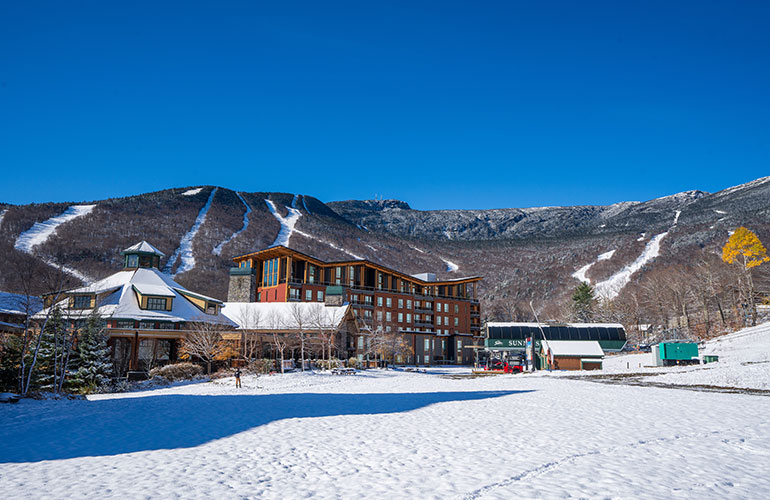
Photo: Stowe Resort. Courtesy photo.
Despite recent growth, Raymond said a lack of affordable housing and staffing shortages still challenge the community.
In response to recent legislation like S.100 (Act 47), which aims to increase housing accessibility through zoning and programming, Morristown’s Planning Council and planning director proposed zoning bylaw changes. Raymond noted that the initial changes were not approved by the Selectboard and Village trustees, but a new set of updates will soon be presented to both governing bodies for consideration.
Raymond said the flooding experienced by the community in 2023 and 2024 created “significant hardships“ for both residents and the town.
“Like other Vermont municipalities, we are also struggling to fund infrastructure maintenance and needed projects resulting from aging infrastructure, environmental warming and state and federal mandates,“ he said. “We require proactive support and solutions from our state and federal leaders to address this growing challenge effectively.“
Public officials in Stowe, who are currently overseeing a robust economy, are also seeking additional state support to safeguard against potential economic downturns in the future.
“We used to consider one-third (of residents) as year-round and two-thirds of our housing stock as second homes,“ Town Manager Stafford said. “But we’re starting to see a downward slide of the year-round population, which is concerning because we don’t want the town to be ghosted.“
Safford suggested that, considering both infrastructure requirements and the recent town-wide reappraisal, Stowe could benefit from retaining a larger portion of the tax revenue it generates, rather than sending as much to the state.
“Obviously, we’re facing some gentrification, and we’re also facing some infrastructure challenges to meet the demand for housing and other development within Stowe,“ he said. “This should be concerning to the region and the state because we’re a major economic engine for the region and the state. If they want us to continue to build housing, we need the infrastructure to do that.“
Safford explained that while Stowe’s drinking water contains perfluorooctanoic acids, or PFOAs, below state regulatory limits, the town is actively seeking a new water source. However, new water infrastructure requires funding, as exemplified by the planned $5 million pump station replacement. Although Stowe and Vail have collaborated on transportation, the town’s road system still needs updates and expansion, which also demands significant capital investment, according to Safford.
“We’re beginning to realize that capacity isn’t limitless,“ Stafford said. “Along with sewer infrastructure, we require investments in some of our older infrastructure to ensure future reliability and capacity.“
Income Sensitivity and Gentrification
In Stowe’s latest property reappraisal, the average R1 property (a house on less than 6 acres) was valued at over $1 million. The average R2 property (a house on more than 6 acres) was appraised at over $2 million.
“I’ve been in the workforce for 37 years and do reasonably well for myself, but I’m not buying that house,“ Safford said. “I’ve got an assistant manager who is just out of his master’s program, but has a new baby and a family, and he’s not buying that house.“
The U.S. Department of Housing and Urban Development considers housing to be affordable if its occupant is paying no more than 30% of their gross income for housing costs. Households paying more than 30% are considered cost-burdened, and those paying more than 50% are considered severely cost-burdened.
According to town data, Stowe’s homeowner cost burden in 2022 exceeded the state average. Approximately 26% of Stowe homeowners allocated 30% to 49% of their household income to housing costs (compared to 14% statewide), while 23% of homeowners paid over 50% of their income towards housing (compared to 10% statewide).
Safford emphasized the importance of socioeconomic diversity within a municipality, both inherently and for economic health. He expressed concerns that rising housing costs are diminishing Stowe’s economic diversity, highlighting the issue of property taxes and post-COVID property value increases outpacing wage growth for most residents.
In 2022, the Selectboard asked the state to raise the caps on income sensitivity. With the new property tax rates, Safford said the Selectboard worries residents on fixed incomes whose property values have jumped after the reappraisal won’t be able to afford their property taxes.
Under state statute, homeowners can receive a credit on their property taxes if they meet certain income and property value thresholds. The household income limit for tax year 2024 was $115.000.
Safford expressed support for the statewide education fund, emphasizing the necessity of a strong education system for a healthy democracy and economy. However, he expressed concerns about the disparity between the tax revenue a municipality sends to the state and the amount it retains. He also criticized the state’s assumption that the “gold town“ label implies unlimited financial resources.
“I have to tell people, including some of my peers, we don’t have the money. The state has the money. Everyone thinks money is not an object. I’ve had legislators tell me that, well, if you need intersection improvements, you just pay for them,“ he said.
According to Safford, Stowe’s spending on its local schools has remained relatively flat while it is sending increasing amounts of tax revenue to the state — revenue that could pay for infrastructure.
“When we collect this fiscal year, we’re going to collect $70 million in taxes; $41.5 million of that is going to the State Education Fund,“ Safford said. “Compared to 2014, Stowe was paying $38 million in property taxes, and $19.5 was going to the State Education Fund. That’s a 113% increase.“
If Vermont were a home-rule state, Stafford asserted, towns could have their own taxing authority, enabling them to fund more infrastructure and housing projects.
“Of course, people are looking for us to do that — not just our citizens, but the state is looking for municipalities to take on more without necessarily expanding the fiscal capacity available for us to do those things,“ he said.
Real Estate
Real estate broker Macdonald reported that the real estate market remains relatively strong, even with mortgage rates around 7%. Although housing prices and new listings have both decreased by 5-6%, the average days on the market have increased by 67%, and even more for medium-priced homes (150%). Macdonald attributed this to buyers actively searching for and negotiating favorable prices.
Owner Households by Housing Costs as a Percentage of Household Income
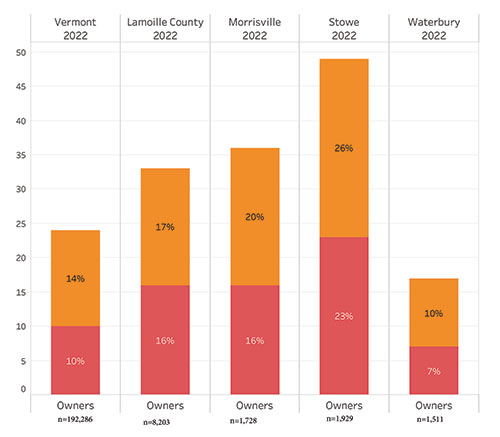
Paying 30%-49% income Paying 50% income or more
This table shows homeowner households by housing expenses as a percentage of monthly household income. A housing unit is defined as owner occupied if the owner or co-owner lives in the unit, even if it is mortgaged or not fully paid for. Housing expenses can include mortgages, real estate, taxes, various insurances, mobile home costs and/or condominium fees as well as the estimated average monthly cost of utilities. The federal standard of housing affordability is 30%. When households spend more than 30% of their income on rent, it can be difficult to afford other basic necessities such as food, transportation and health care. Households spending more than 30% are considered cost-burdened, and households spending more than 50% are considered severely cost-burdened.
Source: U.S. Census Bureau: American Community Survey five-year estimates.
“Lamoille County had 86 houses sold in 2024,“ he said. “That’s a healthy number of houses, but certainly not enough to fill the existing need. I think there’s a continued stagnation of options in Vermont.“
Macdonald said that the Stowe area is primarily a second-home market, maintaining high prices. However, outside of Stowe, elevated interest rates have exerted downward pressure on the market.
“We had a healthy amount of inventory going into late fall, which is typically when we slow down,“ he said. “But we had a spurt of activity that has resulted in even tighter inventory in the first quarter of 2025.“
Macdonald added that the entire region could benefit from increased inventory in all price ranges, except for ultra-luxury properties.
“But when you bring something on if you’re a seller, and you price it right, there are buyers out there, and they’re ready to transact, whether it’s on the second home front or primary home front,“ he said.
Carlson Real Estate’s Q4 2024 real estate report, covering Stowe and Lamoille County, revealed notable trends. In Stowe, single-family home sales rose 4% in 2024 compared to 2023, while median sold prices dropped 10.7%. The report also indicated a decline in new listings, attributed to reduced inventory.
Stowe’s condo market, however, experienced a jump in sales and new listings. Like single-family homes, the median sold price for condos decreased by 7.3%.
Sales of single-family homes in Lamoille County as a whole increased, but, like the Stowe market, the median sold price also dropped. Again, Macdonald attributed some of these price decreases to the real estate market leveling out after the pandemic rush.
For the county as a whole, the report noted a few trends:
- Morristown: Properties sold rose by 93%, with a 4.6% increase in the median sold price.
- Johnson: Properties sold increased by 267%, and the median sold price climbed by 28%.
- Hyde Park: A 133% increase in sales was observed, though the median sold price fell by 5%.
Macdonald has signed on as chair of Stowe’s newly formed Housing Task Force, which the Selectboard created in the summer of 2024. The task force is charged with developing solutions to Stowe’s housing shortages from affordability, missing middle and rental standpoints.
The seven-member task force, which meets twice a month, comprises a cross-section of community members, perspectives and experiences. The group will present a full report and recommendations to the board in July.
“One thing that is common across every member is that we’re not interested in just getting more information that says we have a housing problem,“ Macdonald said. “We’re all aware of that. We want actionable items that we can deliver to the town.“
Macdonald said the local market has stagnated. Several households looking to downsize also hold mortgages with 3% interest rates. A new house might mean taking on a new mortgage with a 7% rate.
“They may buy a cheaper house, but their payment may be twice as much as what they’re paying in a bigger house,“ he explained.
He added that some seniors living in large homes would also like to downsize, but there is no place for them to go. Macdonald feels that municipalities are in a reactive mode trying to respond to recent legislation. The intention to increase housing is good, he said; however, not all towns have the staff to manage a wave of new construction or infrastructure pressures.
“Does your town have to allocate another $75,000 — or whatever engineers earn — to hire a new employee, and then, if you’re doing that, does that take away from being able to renovate part of your school or fix a road or bridge that was washed out in the July floods?“ he asked.
Looking towards the future, Macdonald described a crossroads many Lamoille communities are considering.
“I see in Vermont a real resiliency and desire to provide a fantastic experience for those that either are coming here as guests or have a second home, but also a more heightened awareness of how we can better affect the local communities to serve the people that live here full time,“ he said. “And I think that there are big, hard questions out there that will need really hard answers.
“Hopefully,“ he added, “we can get there as a communal state.“
Olga Peters is a freelance writer from Southern Vermont.