

Re-Imagine Johnson task forces tackle community priorities
by Olga Peters, Vermont Business Magazine
The Johnson community is crafting its future. With support from the Vermont Council on Rural Development, the community has completed a revisioning process that included outreach, three community-wide convening, and the identification of five top priorities and resulting task forces.
Called Re-Imagine Johnson, the effort comes after two consecutive summers of flooding which cost the community its grocery store, shifts in the Vermont State University - owner of the Johnson Campus - and a statewide housing shortage.
The five task forces and their volunteers are divining in to tackle these issues.
The task forces are:
- Reconfigure and redevelopment Johnson’s downtown
- Develop a housing strategy
- Bring a grocery store to town and increase awareness and access to food
- Capitalize on and increase recreational economic opportunities
- Enhance and strengthen the town/college connection
Johnson’s new Community and Economic Development Specialist, Randall Szott, asked the Vermont Council Rural Development to launch the community conversations.
Szott took over as the development specialist in October 2023. As a new hire, he wanted to better understand the community's visions, aspirations, and concerns.
Szott said the highly attended in-person meetings began in 2024. While he acknowledged every community conversation of any type will have its blind spots, he praised VCRD’s outreach efforts. The council expanded the definition of community member to include people working in the town or people displaced by the floods.
“They are really trying to have a very broad understanding of what it means to be a community because your community can also stretch outside the bounds of your town,” he said.
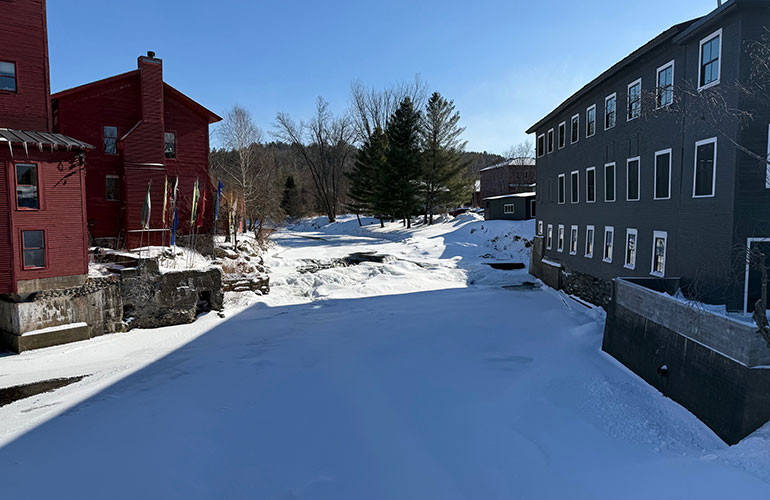
Photo: Johnson Woolen Mills. Courtesy photo.
After the community conversations, participants whittled down the discussions to the community's top five priorities, and the task forces were born.
Laura Cavin Bailey, VCRD's climate economy program manager, explained that during the Re-Imagine Johnson process, VCRD acted as a neutral third party that allowed the community to identify its vision for the future.
VCRD also facilitated the collection of written and online comments.
Bailey estimates that VCRD has convened more than 90 community processes in the past 30 years.
Asking for community input and actually getting people to the table is a big feat. Bailey said the VCRD has learned over the years that doing a process well takes effort and time. Communicating goals and inviting people requires repetition, saturation, and direct invitations. VCRD staff and community volunteers directly call community members and personally invite them to meetings. Gatherings must also be accessible. The VCRD offers childcare and food and holds meetings at different times of the day to ensure as many people as possible can attend.
Bailey said between 10 - 20 percent of the community will engage with the process, which is a lot in a small town.
As Bailey describes, the process builds a regenerative cycle by shifting negative public narratives toward community assets. In turn, people build positive momentum by focusing on community priorities.
For example, a community may know it needs to upgrade its wastewater infrastructure. This is an expensive undertaking that can easily be passed over in favor of less costly actions. However, when a community identifies wastewater as a collective priority, then the Selectboard knows it has the backing to undertake the project.
“The outcomes are more rich and fulfilling when the community is part of the process,” Bailey said.
Szott agreed with the importance of robust community engagement. Every community effort needs as many perspectives at the table as possible, he said. A few skeptics questioning the process is valuable, he added. However, in some communities, this skepticism takes root, and the community develops a culture of “no.”
“For me, the thing that drives economic development is this sense of possibility that people can come up with an idea and have the faith that the community is going to embrace it,” Szott said.
Economic development is less about maintaining spreadsheets and more about cultivating a vibe or a culture, he said. What he really appreciates about Re-Imagine Johnson is that it highlighted how much his definition of economic development and the community’s matched.
As Szott explained it, Johnson has what he calls a “culture of Yes.”
He shared a story of a business owner he heard speak at a conference. The business owner was considering two communities in which to launch his latest business. The first community asked how many square feet he wanted, his projected bottom line, and the number of potential employees—very numbers-based, very spreadsheet-based questions. In the second community, people said, "Tell me about your business. What are you excited about? Where do you expect it to be 10 years from now?"
These questions excited the business owner, so he chose to locate in the second community.
According to Szott, economic development based on what he calls “soulless numbers " makes all communities look identical. The community’s vibe determines whether anybody is excited about a business, whether they will support it, and the quality of the business/community partnership.
Passion is what drives economic development, he said. “Ultimately, economic development is about people in the community.”
A Grocery Store To Feed The Community
Johnson residents have lived without a local grocery store since the 2023 summer floods destroyed Sterling Market. Instead, they have found food at local gas stations or traveled to another town.
Property owner Ernie Pomerleau of Pomerleau Real Estate worked to replace the grocery store, even reaching an early understanding with Shaw’s grocery stores. Shaw’s eventually decided to pass on the property.
Business partners, spouses, and new parents Mike Mignone and Haley Newman___ are working to fill the grocery gap.
Mignone has a long history in the food industry. He owned a couple of catering companies and Sterling Mountain Organics, which started six years ago as a CBD company that has transitioned into a medicinal herb company. Newman’s background is in mental health counseling. She is a private practice therapist.
The couple is renovating a building on Lower Main Street into a general store and deli.
Twenty years ago, Mignone visited friends at Johnson State from New York City and never left.
At the time, there were far more students on campus than there are now, and he feels that Johnson's population has declined over those two decades.
“We've had some issues in between the college enrollment taking a toll on our population, and then also with the floods in 2023 where we lost our grocery store, and there's been a few businesses that have just left over the years,” he said. “I feel like a grocery store is the backbone of the community. So once we lost our grocery store, things have kind of been rough in town for us.”
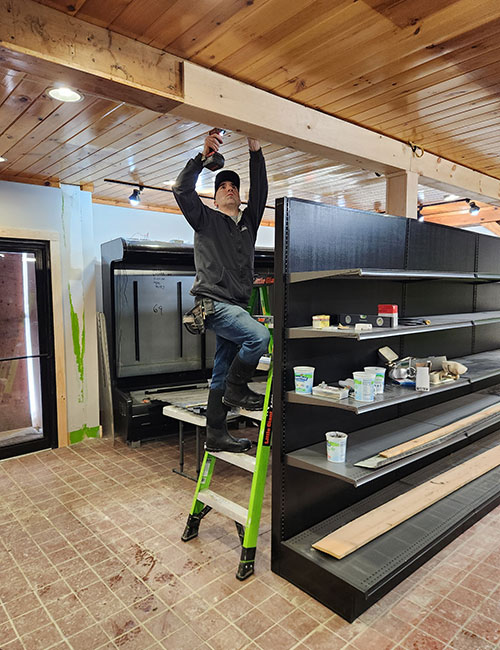
Photo: Mike Mignone makes renovations at the new general store in Johnson, which he owns with his wife, Haley Newman. Photo: Haley Newman.
Mignone explained that Johnson General Store is a multi-phase plan that includes basic groceries and a deli counter focusing on grab-and-go meals. Eventually, the couple hopes to bring in more general store items.
“[Grab-and-go] is definitely the rage these days, and everybody's on a tight schedule with time, and we recognize the need for quick, affordable food options,” Mignone said.
The couple had aimed to open the store in early 2025 but hit some renovation roadblocks in January. They needed to redo their bathroom and front entrance to comply with ADA specifications. The project also has a few fire safety needs that he must address.
“It’s been a bit more financially draining than anticipated. So right now, we're trying to figure out some other finance options, trying to work with the Economic Development Committee and with the town again to maybe get a loan to finish the renovations and to be able to open, which we're hoping to do, maybe early March, if we're lucky,” Mignone said.
Mignone and Newman have financed approximately $50,000 of the project out of their pocket. They also received a $50,000 loan from the Village of Johnson's revolving loan fund. Roughly $60,000 worth of kitchen and store equipment has also come from the couple had stockpiled. The Food Access task force has launched a GoFundMe fundraiser that raised $3,938 of its $25,000 goal as of the end of January. Mignone has also applied to the Town of Johnson’s revolving loan fund.
Despite the recent setbacks, Mignone said the project has progressed quickly.
Mignone always wanted a brick-and-mortar store. Before the flooding, the couple tried to find a property in Johnson. Nothing materialized, so they launched a food truck.
The idea made sense. A truck could be pulled away in the event of a flood, and it could be taken to other events to supplement income. However, the food truck ultimately only ran for nine weeks.
The couple got started late in August. Permitting and obtaining licensing took longer than they had expected. They also discovered running a full kitchen was challenging in a small truck. Most food trucks offer a handful of menu items.
“And we were trying to do the opposite. We had a pretty extensive menu, and we were running in a town that just doesn't have a pretty big population,” he said.
Mignone considered the food truck a placeholder until he found a brick-and-mortar location.
Most people agree that Johnson desperately needs a grocery store and a place to buy eggs and other items not at the local gas station. Mignone, however, learned during the Re-Imagine Johnson process that many community members lack transportation.
“The amount of people that are unable to travel to get their groceries was surprising, whether it was elderly folks or just people that don't have transportation,” Mignone said. “So, really learning that helped me see why it was so important for so many people to have a grocery store in town within walking distance.”
For him, opening this store in Johnson, rather than in another community, was really about being part of the Johnson community and recognizing the need for something like this to happen.
“I’ve been here 20 years, and although the money aspect is important - we are looking to make a living - it’s just we in Johnson needed this,” he said. “Somebody had to step up.”
Several friends and community members convinced the couple to do the project and said that they would be a good fit.
“I’m hoping that if we can get this project off the ground and open our doors, that it will be the catalyst that will incite change in the town,” Mignone said.
Newman said one thing that keeps her hopeful is the level of community support she has witnessed. People have wrapped themselves around the project and pitched wherever their skill sets allow.
“I think if we can just keep banding together and working together to make this what we want it to be like, we will,” Newman said. “A group of people is almost always unstoppable. It's when we work alone that things don't work out.”
Mapping Johnson
Adrienne Parker has thrown herself into the Johnson community.
She serves on the planning commission, chairs the Beautification Committee, is on the town's pizza oven committee, the Lamoille Valley Rail Trail committee, and the Downtown Reconfiguration and Redevelopment Task Force for Re-Imagine Johnson. She co-chairs the task force with Paul Warden, who is also the chair of the planning commission.
And she running for the Selectboard in the spring.
“It’s kind of addicting once you get involved,” she said. “I got involved in the planning commission first, and then I was like, oh, Beautification Committee sounds fun because my wife and I like to garden, which sounds interesting. And then I was like, wow, the pizza oven, you know, it just steamrolls into other things.”
Parker serves on the Redesigning and Redeveloping the Downtown Task Force. The group is investigating creative solutions to reconfigure the downtown and reduce flooding. This work echoes much of what the planning commission is working on. Sometimes, she wonders if the task force’s work should be incorporated into the commission's.
Navigating Johnson’s town and village governments is an interesting part of initiating change.
“It can kind of put hiccups into our thinking on problem-solving and just what is possible and what's not possible,” she said.
Mapping the downtown has become critical to the task force’s work. Parker has made a rudimentary map of the area and properties undergoing the federal buyout process. Meanwhile, she’s waiting for the LCPC and FEMA to produce more detailed maps.
According to Parker, a FEMA staff member attended the task force’s meetings and offered to create a new flood map for downtown.
“It's really interesting trying to get these maps created while things unfold in real-time,” Parker said.
Johnson is moving quickly on flood mitigation projects, she said. But she wishes the pace could slow a little until the maps are completed. This way, the community could make fully informed decisions.
For example, the Johnson Public Library received an almost $1.69 million grant from the Vermont Department of Libraries to move the library building from the flood-prone Railroad Street to the higher elevation of Legion Field next to the elementary school. Parker said the location is good but wonders if there may have been better options.
“If we were able to step back for a second and create a map together, I wonder if there would have been a better location or just more coordination happening before we had to make a staff decision,” she said.
She also points to the federal buyouts happening throughout the town. A more accurate map of these properties might help Selectboard decide whether to purchase the land rather than FEMA.
Once a property completes the buyout process, a community loses control over that parcel and can no longer put any vulnerable infrastructure on it, such as electricity or plumbing.
One aspect of the task forces Parker wishes differed is how the committees can feel separate. Like many volunteer-driven efforts, the volunteer numbers start dwindling, and then they can become even more siloed. She is unclear what the solution to this is, but she would love to make the task force meetings more accessible to the community, such as setting up better video conferencing options. She thinks that making meetings more accessible could keep people engaged.
“I think all of our businesses right now have been really resilient in how they're dealing with the flooding,” Parker said. “I think Jenna's Cafe has been doing a great job so far, and the Woolen Mills has been doing really good with their new ownership. We just had the Johnson Jubilee recently, which highlights all of our businesses, and it was one of the most successful jubilees we've had in a long time.”
Parker and her wife moved to town in 2021 by way of Missouri, Wisconsin, Rhode Island, and the pandemic. The young couple had graduated art school and found jobs in Rhode Island when the pandemic hit.
The couple decided that they were probably going to work remotely forever, so they spent several weekends scouting different towns and stumbled upon Johnson.
Parker enjoys problem-solving. It’s what her day job as a graphic designer and community service have in common.
She feels Johnson’s outdoor recreation options are unique. She also loves how the town sits in the middle of the Lamoille Valley Rail Trail. Even though the town has experienced flooding lately, she does feel that the Lamoille and the Gihon Rivers converging in the downtown is really a beautiful, special thing.
“I’ve met some of the coolest, most inspiring people that I've met in my life here,” Parker said.
Connecting to the Lamoille Valley Rail Trail
The Lamoille Valley Rail Trail (LVRT) runs past Johnson and is one of the assets community members want to grow.
“I call it the vein. It's like a vein pumping blood through these rural communities of Vermont that have never seen tourism, and it's going to pump life, development, and vitality into northern Vermont,” said local business owner Yva Rose.
Rose serves on Johnson’s Rail Trail task force and represents business owners on the Vermont Outdoor Recreation Economic Collaborative (VOREC).
VOREC is under the umbrella of the State Agency of Natural Resources Department of Forests, Parks and Recreation. Johnson has received one of the collaborative’s community grants. Rose said the rail trail task force is working on a scoping project to evaluate the possibility of adding bike lanes to Johnson’s roads to lure riders from the Lamoille Valley Rail Trail (LVRT) into town.
“What does the impact of recreation in this area have on our community and our economy? It's certainly growing, and it's still in its infancy, but I see a lot of potential,” Rose said.
Rose co-owns Lamoille Valley Bike Tours and shuttle service with her husband, Jim. The couple launched the business in 2016 when the LVRT was still in its infancy, with approximately 20 miles open to the public. Avid cyclist Jim Rose suggested introducing electric bikes, or e-bikes, to the community. She suggested offering rentals and tours. The Lamoille Valley Bike Tours continues to work to connect the LVRT, local businesses, and visitors.
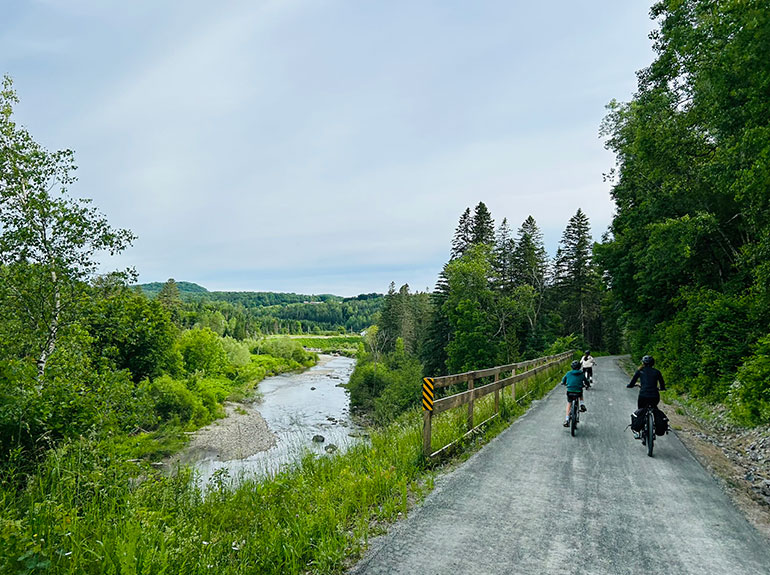
Photo: Lamoille Valley Rail Trail. Courtesy photo.
“The beauty of electric bikes is that they allow a much wider user group to go for many miles without getting tired. So it's really a wonderful opportunity. Our challenge was that while recreation is abundant here in Johnson, in these rural towns, the tourism is not there. Instead, the tourists are in Jeffersonville, smugglers notch area, and in Stowe,” she said.
The Roses started out with a mobile business. The couple would drive a small trailer with about seven bikes and two cargo bikes into different areas and conduct tours. As part of their service to cyclists, Lamoille Valley Bike Tours also offers trail guides. The guides inform riders about the towns along the trail and places to eat, lodge, and shop.
The business is entering its 10th year and is finally based solely in Johnson.
The Roses have wanted a brick-and-mortar location for years, but because a building takes up so much overhead, the business operates as a mobile tour company, Rose said. Recently, they purchased a property from the former Parker and Stearns building supply company.
They rented the property for a year before the owner sold it to them.
“I mean, we are just forever grateful for that, the way that sort of fell into place,” she said.
Prior to the 2023 flooding, the Roses created a shuttle service to take advantage of the full LVRT. The service is specifically aimed at people who are traveling the entire trail but don't want to cycle back. Rose said the demand for the shuttle service is low. The couple is still trying to determine what schedule works for most riders.
Some of the businesses’ goals have stalled due to the flooding. The couple is trying to expand its shuttle service and develop travel packages that include lodging and food. The business lost almost a whole year of revenue when the LVRT flooded in 2023, its inaugural year that the entire 93 miles were open.
Unfortunately, they didn't qualify for an economic injury loan.
“Had we done our shuttle as a nonprofit, it would have been a much easier and less stressful endeavor to get off the ground, and we would have been much easier to make it successful, especially with the flood,” she said.
She feels supported as a Vermont business owner working in the outdoor recreation sector. However, as a for-profit business, she does feel the state has more support mechanisms, tax breaks, and funding for nonprofits. Looking back, she thinks they should have launched the shuttle business as a nonprofit.
“I know a lot of people feel isolated and like you're hacking it on your own when you're a for-profit,” she said.
Because the LVRT is relatively new, many communities along the rail trail lack some of the basic logistics that would allow end-to-end packages. For example, most lodging opportunities are short-term rentals that require a minimum of two nights.
“Rail Trail goers are used to convenient amenities that most established rail trails have, like end-to-end packages and seamless travel, where your rooms are booked for you, your meals are booked for you, and your rides are booked. You get on your bike, and you go, and that's one of our goals,” she said.
According to her research, trails that are under 100 miles attract 6 million users annually. Longer trails, like the 200-kilometer “Le P'tit Train du Nord,” get about 20 million users a year, and only about 5 percent of visitors are from outside Canada.
Despite setbacks, Rose feels confident that the LVRT will become a favorite rail trail among cyclists.
Reconnecting The College And The Community
A stronger connection between the Vermont State University’s Johnson campus and the Johnson community is an economic win-win.
Sonja Kivela chairs the Enhance and Strengthen the Town/College Connection task force. She is earning her second degree in holistic health from Johnson and is one of four students on the task force. Other members include folks from the community and college.
The relationship between the college and the community has undergone strain in recent years.
“As of recently, to be really frank, it is sad. It's disconnected. It hasn't always been that way,” she said.
According to Kivela, when the school was still Johnson State, it was very intertwined with the larger community. The relationship remained close when the school became Northern Vermont University.
“Then there was a huge hubbub over the transformation,” and some of the changes announced - getting rid of the library or changing athletic teams - felt like a “slap in the face to the broader community,” Kivela said.
She added that both decisions have been reversed, but the connection is still being rebuilt.
“I feel like there's a lot of possibility, and there's definitely people on campus and in the community that are fighting for this. This is why I'm on the task force. This is why we have 25 people on the task force. It's a very important thing, and we all know it could be better,” she said.
So far, the task force has generated various ideas and projects. The simplest one was establishing a weekly post of campus events open to the public.
She said that sometimes people posted these events on social media, and sometimes they were not, which was a little haphazard. She makes it a priority to post a list of events every Monday on Front Porch Forum.
“I get emails from all kinds of folks down in Johnson thanking me and asking questions, and it's really gotten some conversations going,” Kivela said. “So that was the simplest, smallest thing we thought we were doing, but it wasn't concise. So now it's very clear, and we've seen a lot more community folks coming up to campus for different events.”
She said other initiatives will take more time and money to implement. One example is establishing community education workshops, such as a monthly pottery class open to the public.
She said such workshops are a little tricky because they involve staffing issues, insurance, and many moving parts to get an order. They're also looking at having more community events held on campus and allowing places like the school’s theater to be rented for community events. Think film festival or trivia nights, Kivela said.
Launching a Welcome Wagon program is planned for the start of the next academic year. The hope is that it will build friendships between students and community members.
One connection that the university already has in place and that the task force is helping to expand is volunteering. All student clubs must provide some community service as part of being an approved club. The task force is collecting data and creating a list of all the places that could use volunteers.
When asked if the campus/community relationships served an economic benefit, Kivela answered, “Definitely, like 1,000 percent.”
“To break it down to the simplest terms,” she continued. “If we have students that are connected to the community. They're going to shop in our community. That's going to bring in money, right?”
“If we have students that are happy in the broader sense of community and being here, they're going to refer other students. So, businesses in Vermont are getting more sales and can get employees. A lot of our students need jobs, right? On the other hand, the university can grow its student base. So it's a win-win for everyone,” Kivela said.
Kivela said the campus has greatly supported the task force’s work.
Vermont State University President David G. Bergh
Bergh holds a place in his heart for the Johnson campus and community. He worked on the campus for 19 years early in his career. He is a former member of the Johnson Planning Commission and represented Johnson on the Lamoille County Planning Commission.
“I see the role of the university as really informing and assisting with the work of each of the subcommittees,” he said. “I’ve really made it clear that we're open to talking about any and all ideas about how the campus can be a partner in the future, recovery, growth, and really the development in the community.”
Whether that's putting a grocery store on campus, helping with municipal functions, moving the post office on campus, or housing—senior housing, flood recovery, family—the college is open to considering how it can assist in any such initiatives.
One ongoing conversation around the Johnson campus concerns congressionally directed spending from Senator Bernie Sanders's (I-VT) office. The university is speaking with partners about potentially converting one of the campus’s unused buildings on the lower part of the campus into senior housing.
Vermont State University recently finished a master planning process for all five campuses. The master plan has helped Vermont State University understand which buildings it can use for new projects. The master planning, in connection with the Re-Imagine process, also helped the university understand community needs.
He hopes to identify partners that can work with the college on different fronts.
“The futures of the campus and the community are inherently interlocked. We succeed if we succeed together. The community needs our students and our employees supporting its businesses and its tax base. And in order for us to be able to recruit students and employees at Johnson, there needs to be a vibrant community with necessary services and offerings there, so we need each other,” he said.
He said the college is open to all suggestions and conversations. However, it does have some guardrails, mainly that it wouldn't want to do anything that would detract from its core work, the student experience, or the safety and security of the campus.
One exciting project slated for the Johnson campus this summer: construction is slated to begin on a new nursing lab.
“I say this all the time, and it sounds hokey, but Johnson is magical,” Kivela said. “There's such a beauty to the community here, and really being able to foster and grow with that is everything I didn't know I wanted.”
Olga Peters is a freelance writer from Southern Vermont.