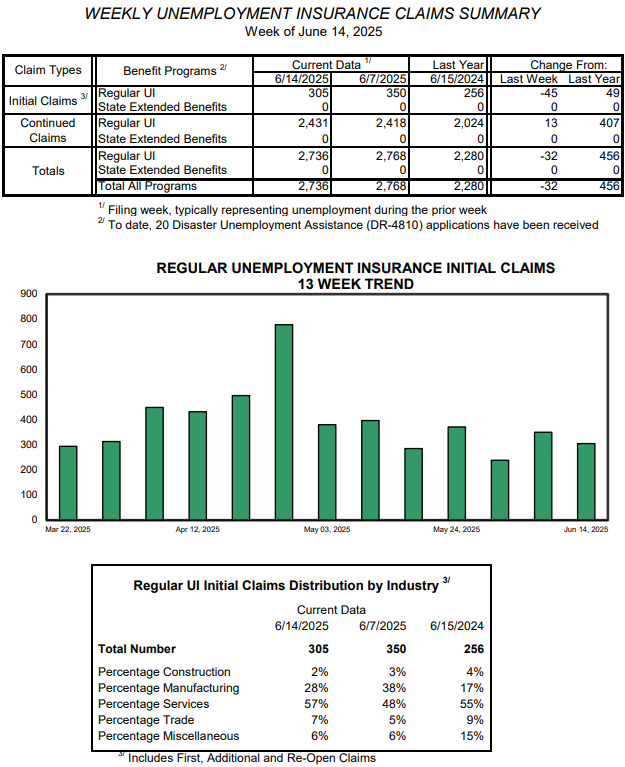
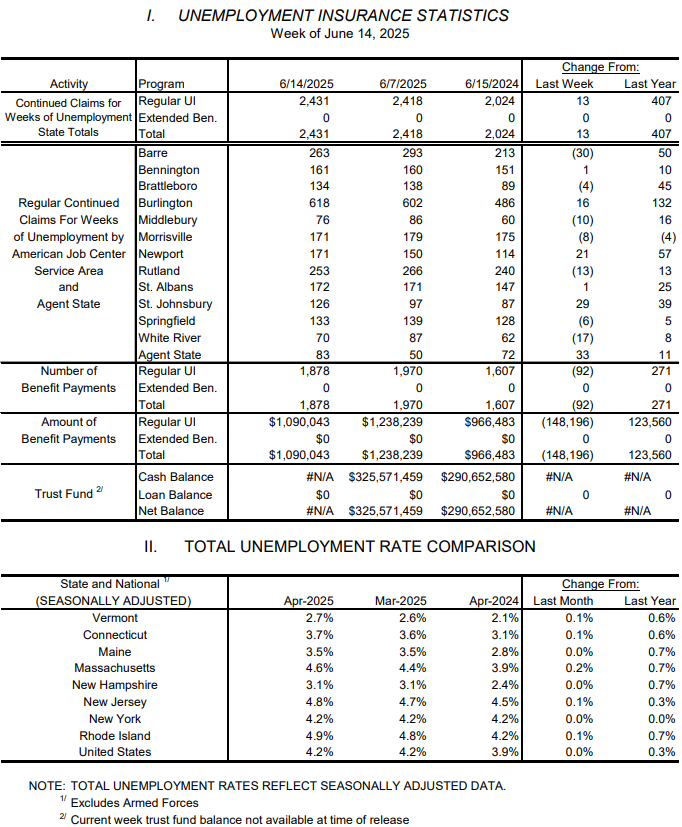
by Timothy McQuiston, Vermont Business Magazine Vermont weekly unemployment claims for the week ending June 14, 2025, fell back close to 300, to a level similar to much of the spring. New claims this week were 305, down 45 claims from the week before and up 49 from last year at this time. Claims, which are lowest in the summer, were 181 at the end of September 2024.
In Vermont for the weekly report, the Service industry accounted for the most claims last week with 57%, up 9 points from the previous week. Construction was 2%, down 1 point. Manufacturing accounted for 28% of claims, down 10 points.
For the week, Vermont total unemployment insurance claims were 2,736 (down 32 for the week and up 456 from this time last year).
The Vermont Unemployment Trust Fund is well capitalized. As of the most recent data, there was $325.6 million in the Trust Fund, up about $35 million from the previous week (as claims are paid out on one side, employers are contributing to the fund on the other). The pre-pandemic Trust Fund balance on March 1, 2020, was $506.2 million.
According to the US DOL, in the week ending June 14, the advance figure for seasonally adjusted initial claims was 245,000, a decrease of 5,000 from the previous week's revised level. The previous week's level was revised up by 2,000 from 248,000 to 250,000. The 4-week moving average was 245,500, an increase of 4,750 from the previous week's revised average. This is the highest level for this average since August 19, 2023 when it was 246,000. The previous week's average was revised up by 500 from 240,250 to 240,750.
The recent upswing to mark the fifth highest reading since August of 2023, according to a report from Trading Economics. In the meantime, outstanding unemployment claims were at 1,945,000 in the previous week, remaining close to the over three-year high of 1,951,000 from the last week of May. The results consolidated the view that the US labor market is softening from its initial resilience to injections of economic uncertainty this year. Initial claims filed by federal government employees, which have been under scrutiny following recent dismissals by the Department of Government Efficiency (DOGE), fell by 26 to 535 in the first week of June.
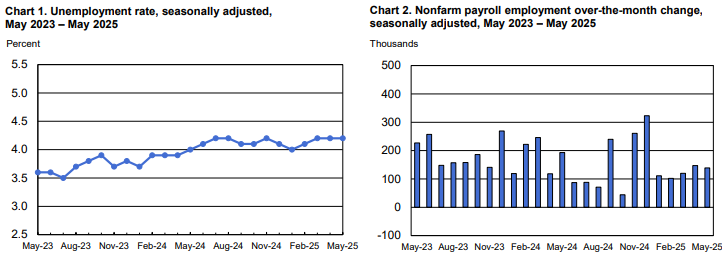
Total US nonfarm payroll employment increased by 139,000 in May, and the unemployment rate was unchanged at 4.2 percent, the U.S. Bureau of Labor Statistics reported June 5, 2025. Employment continued to trend up in health care, leisure and hospitality, and social assistance. Federal government continued to lose jobs.
The US unemployment rate held at 4.2 percent in May and has remained in a narrow range of 4.0 percent to 4.2 percent since May 2024. The number of unemployed people, at 7.2 million, changed little over the month.
In May, the employment-population ratio declined by 0.3 percentage point to 59.7 percent. The labor force participation rate decreased by 0.2 percentage point to 62.4 percent.
The continuing attack by Israel on Iran, and the counter-attack, sent stocks bouncing around. Concerns remain over the budget Congress is considering, which likely would increase the national debt substantially.
The S&P, which most closely tracks the overall economy, fell by less than a quarter point to 5,967.84 Friday after a down week (peaked 6,144 in February 2025). The Dow, which peaked at over 45,000 in December, was up slightly 0.08% to 42,206.82, while the volatile NASDAQ, which peaked at over 22,408 also in December, was down 0.51% to 19,447.41, but managed a small gain for the week.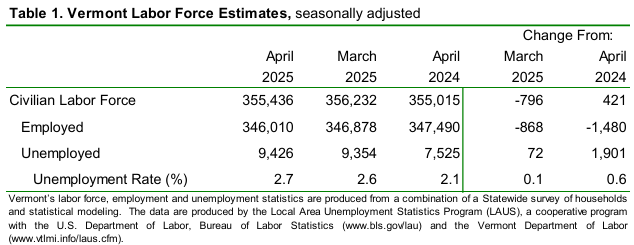
April Unemployment Rate Up One-Tenth
The Vermont Department of Labor reported that the seasonally adjusted statewide unemployment rate for April was 2.7 percent. This reflects an increase of one-tenth of one percentage point from the prior month’s revised estimate. The Labor Force and the number of Employed both fell, while the number of Unemployed increased slightly. The civilian labor force participation rate was 65.1 percent in April, a decrease of two-tenths of one percentage point from the prior month’s revised estimate.
Vermont now is tied for the third lowest jobless rate in the US, after being second lowest for many months. Vermont is tied with Montana and is below South (1.8%) and North Dakota (2.6%). Nevada continues to have the highest rate (5.6%). The comparable United States rate in April was 4.2 percent, no change from the revised March estimate.
Michael Harrington, Vermont Labor Commissioner, said: “The start of 2025 has shown downward pressure on Vermont’s labor force. This is likely driven by the number of mature workers who are retiring, leaving great career opportunities for job seekers and young Vermonters entering the workforce. As the school year ends, it is a great time to engage youth in these conversations, and the Vermont’s Most Promising Jobs brochure is a great starting point: https://www.vtlmi.info/pathways.pdf.
"Additionally, the Department of Labor’s Job Centers provide support services, mentoring, and paid on-the-job training opportunities for youth to highlight these pathways. Learn more about the Vermont Youth Employment Program by visiting: https://labor.vermont.gov/VYEP.”
Harrington announced earlier this month that he is stepping down as commissioner in July.
The seasonally adjusted Vermont data for March show the Vermont civilian labor force decreased by 927 from the prior month’s revised estimate (see Table 1). The number of employed persons decreased by 1,051 and the number of unemployed persons increased by 124. The change to the number of employed was statistically significant in the seasonally adjusted series.
The March unemployment rates for Vermont’s 14 counties ranged from 2.1 percent in Chittenden County to 5.7 percent in Orleans County (note: county unemployment rates are not seasonally adjusted – see Table 2). For comparison, the March unadjusted unemployment rate for Vermont was 2.8 percent, a decrease of two-tenths of one percentage point from the revised unadjusted February level and an increase of seven-tenths of one percentage point from a year ago.
The seasonally adjusted data for March reported an increase of 900 jobs from the revised February data. There was an increase of 100 jobs between the preliminary and the revised February estimates due to the inclusion of more data. The seasonally adjusted over-the-month changes in March varied at the industry level. The industry with a notable increase was Administrative & Waste Services (+500 jobs or +3.7%). The industry with a notable decrease was Other Services (-200 jobs or -1.9%).
To support vital journalism, access our archives and get unique features like our award-winning profiles, Book of Lists & Business-to-Business Directory, subscribe HERE!