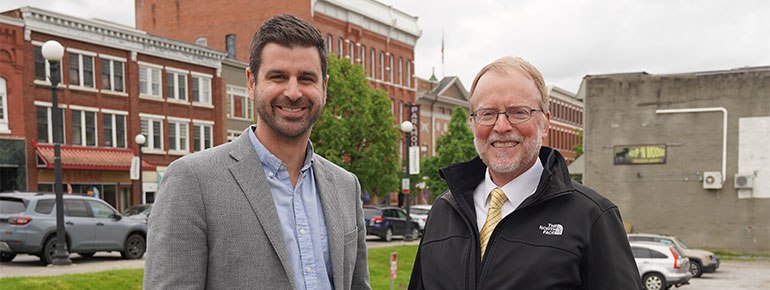
Devon Neary, executive director at the Rutland Regional Planning Commission, left, and Lyle Jepson, executive director at the Chamber & Economic Development of the Rutland Region, and Devon Neary, executive director at the Rutland Regional Planning Commission. Photo courtesy to CEDRR.
Yet, organizations brace for federal funding cuts and potential losses
by Olga Peters, Vermont Business Magazine
Things are hopping in Rutland County these days. From one side of the county to the other, its communities are buzzing with renewed energy and enthusiasm. Here are three recent examples:
Bernie Carr, executive director at the Brandon Area Chamber of Commerce, marvels at Brandon’s revitalized downtown. Driving home on a recent Saturday afternoon, he stops at a new intersection and is amazed by the number of people enjoying the area after years of construction and the pandemic. “I’m looking around and seeing people scurry here and there, and the parking spaces are full, and I’m like, ’We’re finally here!’,“ Carr says.
Vermont State University President Dave Bergh is focused on the governor. While loading up his car for a trip to Castleton for the Bring Back the Trades Expo, he apologizes to a reporter for having to rush. “I think I’m introducing the governor, which is one reason I can’t be late,“ Bergh explains.
Real estate broker Nathan Mastroeni is building furniture. On a phone call with a reporter, he explains why a particular date won’t work for a virtual interview. “I’m working on building some of the furniture at our new office in Killington that day,“ he says, “so I probably won’t be presentable for Zoom.“
Jeff Weld, vice president of communications at Casella Waste Systems, observed the various projects underway in the county, ranging from large initiatives like Killington Forward to smaller enhancements like new signage in downtown Rutland, and emphasized their cumulative impact.
“Residents should be optimistic about the investments happening here. The work being done doesn’t always have to be big and flashy to make a difference,“ he said.
Indeed, this year has seen numerous stories of ongoing efforts that are gradually reversing previous downward trends.
Devon Neary, executive director at the Rutland Regional Planning Commission, noted, “Instead of waiting for state or federal assistance, we are actively creating local and regional solutions by leveraging our significant human and local capital.’ However, challenges beyond local control remain.“
Lyle Jepson, executive director at the Chamber and Economic Development of the Rutland Region, pointed out that "fluctuating federal tariffs and executive orders create economic uncertainty at the local level.“
“Economic development relies on consistency,“ he said.
TIFs Are Helping to Spur Growth
According to Jepson, community action and the establishment of two tax increment financing districts, or TIFs — tools that municipalities can use to finance public infrastructure projects — are most responsible for spurring growth in Rutland County.
Specifically, the municipality of Killington is using one TIF to expand water and sewer infrastructure and implement road improvements as part of the Killington Forward initiative.
Rutland City is leveraging the other TIF for redesigning Center Street and upgrading its wastewater and water system, which Jepson described as “ancient.“
The focus of this renovation will be transforming “The Pit,“ a long-standing blighted lot at the corner of Center and Wales streets where the Berwick Hotel once stood, into a vibrant new development. This ambitious project will feature a 99-room hotel, 26 apartments, a charming rooftop beer garden and a welcoming lounge and restaurant on the ground floor.
For more than 50 years, since the original hotel was destroyed by fire, numerous attempts have been made to revitalize this site. The current project’s realization is due to a strategic combination of tax increment financing, interim Act 250 exemptions and Brownfields cleanup funding, all facilitated by the planning commission.
Notably, the Berwick plot required approximately $5 million in cleanup due to historical industrial contamination. The Rutland Regional Planning Commission worked closely with state and federal partners to secure the necessary funds, ensuring the site’s successful cleanup and preparation for redevelopment.
“Seeing our corrective action plan implemented this spring is going to be such a significant achievement and win for our Brownfields reuse program,“ Neary said.
In support of regional growth, the Central Economic Development Region of Rutland is undertaking significant infrastructure improvements, including the installation of a new water line at the Rutland Airport Industrial Park in Clarendon to facilitate the expansion of manufacturing facilities.
Additionally, CEDRR’s Real Rutland program has successfully aided more than 200 individuals in relocating to the county. This initiative offers invaluable support to newcomers through information, advice and connections to a team of dedicated concierge volunteers who provide community support during their transition.
The Real Rutland program’s efforts have been recognized and further bolstered by a GROW grant (Grants for Relocation Outreach Work) from the state Department of Tourism and Marketing.
“It is the collaborative spirit, with everyone working together towards a common goal, that is truly driving these positive changes,“ Jepson said.
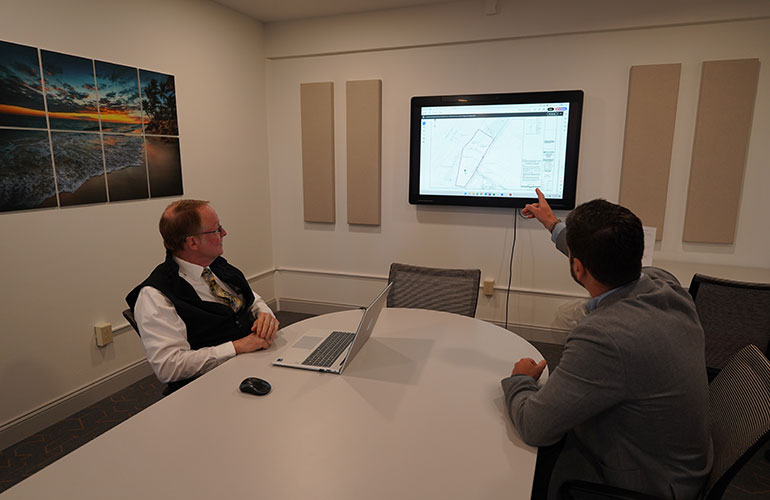
Lyle Jepson, left, executive director at the Chamber & Economic Development of the Rutland Region, and Devon Neary, executive director at the Rutland Regional Planning Commission, discuss development plans. Photo courtesy to CEDRR.
Time, Investment, Money and Effort
Neary expresses strong optimism about Rutland County’s economic future.
“There’s a palpable new energy and level of active participation in redevelopment efforts that we simply haven’t witnessed in decades,“ he said.
Among the commission’s significant undertakings are the comprehensive updates to its regional plan and land use maps. According to Neary, municipal leaders are increasingly reaching out for support.
“Local governments are facing capacity challenges in keeping pace with the evolving municipal landscape, which includes a multitude of new regulations and complex issues,“ he explained, highlighting the urgent need for regional assistance and resources.
Towns require improved mechanisms for resource sharing, Neary emphasized. Last year, the Vermont Legislature directed regional planning commissions across the state to examine various models of regional governance. This research, conducted in collaboration with the National Association of Development Organizations, highlighted the Councils of Governments model as a potentially effective solution.
In February, the Vermont Association of Planning & Development Agencies and NADO jointly released a report to the Legislature outlining their findings. (An executive summary of this report is available at https://shorturl.at/HE9FL
).
Neary further explained that COGs enable municipalities to pool resources and staff, which can often lead to reduced costs for individual towns. He cited the Franklin Regional Council of Governments in Franklin County, Massachusetts, as a successful example. (See https://frcog.org
).
“The COG model is scalable,“ Neary noted. “It can be implemented incrementally, starting with shared municipal services, staffing, purchasing power and bulk purchasing — all of which make logistical sense and will ultimately reduce costs and tax burdens for our local communities.“
Neary emphasized the need for more high-paying jobs and affordable housing to strengthen the regional economy, noting that many young people are leaving the area due to a lack of affordability.
He added that a recent three-year grant from the U.S. Department of Labor will facilitate internships for recent high school graduates; those who complete the program will be guaranteed a job interview for a permanent, full-time position.“
“Creating a homegrown pathway to employment with our local high school students is a sustainable, successful model to really support our struggling businesses,“ Neary said.
Housing: Real Estate and Mergers
Rutland County needs between 2,707 and 4,065 units of new housing by 2030 to meet current and future demand, according to the 2025 Vermont Housing Needs Assessment. Rutland City Mayor Mike Doenges has the goal of adding 1,000 new homes in the city by 2028.
A 2024 market study of the subsidized housing realm determined the region needed 2,700 new affordable housing units by the end of spring to keep pace with current demand.
A Very Different Market
Nathan Mastroeni, a realtor on the Elevations Real Estate Team at REAL Broker in Killington, describes the Rutland County housing market as healthy, though house sales have slowed slightly from their peak. Homes still sell within a two-week window, he noted, but the intense competition of multiple all-cash offers is gone.
This calmer pace allows buyers time for financing and inspections, which Mastroeni believes is better for them. Prices have plateaued and remained consistent, and while inventory has increased, Mastroeni suggests more homes are needed.
He’s happy to see the return of first-time homeowners who now have more breathing space to organize financing and aren’t competing with numerous all-cash offers, despite higher interest rates and housing prices compared to the beginning of the decade.
Mastroeni said that finding affordable housing in the Killington area remains challenging, a common problem in resort towns. The Vermont Association of Realtors’ latest public report indicates that in April, the median sales price of homes in Rutland County saw a significant 68% increase over the previous 12-month period.
“If you put a property on the market and it’s reasonably priced,“ he said, “it’s still selling in basically that two- to three-week window.
Great Gulf’s Killington Village project, a large-scale, multiphased development at Killington Ski Resort, is a major point of interest with would-be homebuyers, Mastroeni noted. He said he receives frequent inquiries about its potential impact on real estate values in the region.
Building a Bigger Bench
To expand and maintain affordable housing and homeownership services in Rutland, Bennington and Addison counties, three key housing organizations — the Housing Trust of Rutland County, NeighborWorks of Western Vermont and Shires Housing of Southwest Vermont — recently joined to form Cornerstone Housing Partners. CEO Mary Cohen sees this merger as “building a bigger bench“ to enhance capacity, resilience, create efficiencies and take on larger housing projects.
Cohen asserted that many in the community are unaware of the number of people who qualify for subsidized housing, including professions like waitstaff, nurses and entry-level office staff. While she observes economic stability and tenant security at the local level, first-time homebuyers face challenges.
Cohen said Cornerstone’s down payment assistance program has not kept pace with rising housing prices. She emphasized that affordability is central to Cornerstone’s mission, starting with cost control in development, construction and maintenance. Factors like the Act 250 permitting process and material costs significantly impact long-term affordability.“
Several Developments Underway:
Cornerstone is actively working to expand affordable housing options in Rutland County through several key development projects. These initiatives aim to provide much-needed housing for the community, utilizing renovations and new construction to increase availability and improve living conditions. Here are some examples of their current developments:
- Marble Village, West Rutland: Construction began in August 2024, with a target leasing start date of September 2025, with Naylor & Breen as contractors.
- Maplewood Commons: In late May, Cornerstone and its partners broke ground on this 30-unit project in Rutland. Work is anticipated to take a year, with leases expected to open in spring 2026.
- East Creek Commons: This is a scattered site project encompassing four properties in Rutland and one in Castleton, which will result in a total of 35 new and renovated units.“
Bring Back the Trades
Vermont State University and the Chamber & Economic Development of the Rutland Region collaborated with the New Hampshire nonprofit Bring Back the Trades to host a career expo on VTSU’s Castleton campus. Bring Back the Trades focuses on increasing awareness and providing opportunities within the trades through events and scholarships.
On May 20, BBT, along with 70 companies, gathered 2,000 high school students in Castleton. They heard from speakers including Gov. Phil Scott; John Casella, CEO at Casella Waste Systems; Mike Solimano, president of Killington Resort & Pico Mountain; and VTSU president Bergh. CEDRR awarded 10 training scholarships of $2,500 at the expo.
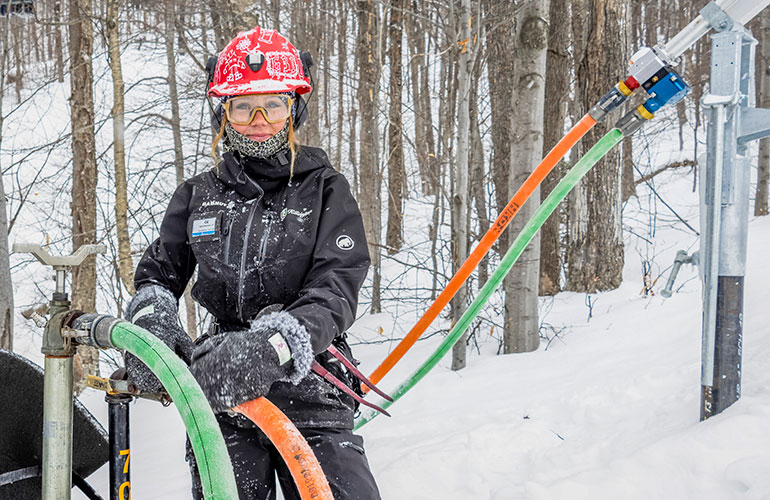
Resort & Hospitality Management student working a snowmaking machine. Courtesy photo.
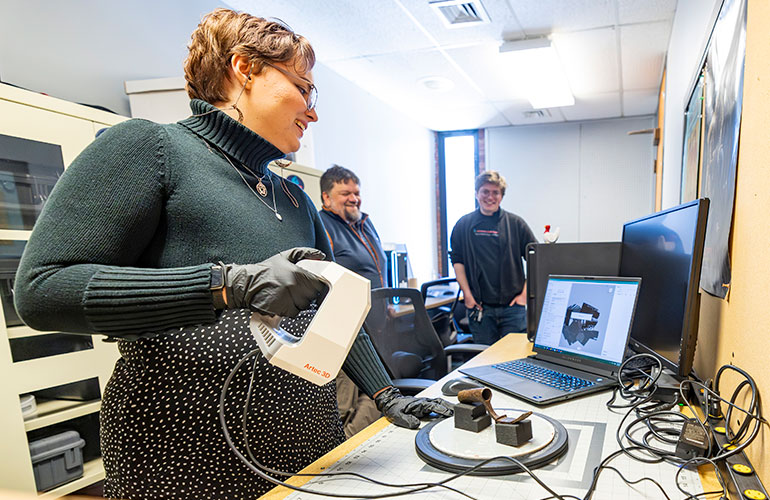
Students 3D scanning artifacts from Fort Ticonderoga. Courtesy photo.
Jepson emphasized that further education is crucial for high school students to build their careers and that the community must support all forms of continuing education, including technical centers, online courses, universities, apprenticeships and on-the-job training.
Neary’s research for the 2026 regional plan revealed that high school students who do not pursue postsecondary education represent a significant untapped resource in the region’s younger adult population. These students have the potential to make vital contributions to the local workforce, including constructing new housing and participating in industrial manufacturing.
Three days prior to the expo, Vermont State celebrated the graduation of 1,400 students. This included 105 electricians and 80 licensed plumbers from the university’s apprenticeship program. Enrollment deposits for the 2025-26 academic year have increased by 15% for the second consecutive year.
The university currently has a record 880 apprentices enrolled in its four-year program, managed by the Workforce, Community and Economic Development division, Bergh said.
“I think this shows remarkable and continued progress in enrollment, recovery and growth for the institution,“ he said. “The entire state benefits when that’s the case, but especially the regions in which our core campuses are located.“
“In addition to successful apprenticeship programs, the university offers numerous hands-on learning experiences. These include a three-year resort and hospitality management program with students living and working at Killington Resort, and archaeological digs at the Granger House on the Castleton campus for history and archeology students.“
Killington on the Move
Killington is currently seeing a rise in infrastructure projects tied to the municipality’s Killington Forward initiative and Great Gulf’s Killington Village. Last year, individual investors bought a stake in the Killington Resort and Pico Mountain.
“We’re up and coming,“ said Beth Sarandrea, president of the Killington Pico Area Association and owner of Liquid Art Restaurant. “I feel like we’re doing a lot of investing in infrastructure right now and that we have an exciting future in front of us.“
Killington Forward is the municipality’s multiphase infrastructure plan. Phase 1, launched in October 2023, includes significant improvements to Killington Road and the installation of a municipal water system. Later phases include the construction of workforce housing.
The infrastructure will also support the development of Great Gulf’s Killington Village, featuring more than 720 condominiums, luxury townhomes and single-family residences. Plans for the village include dining and retail spaces. The Crystal, an 85,000-square-foot lodge, will replace the Snowshed and Ramshead lodges.
Last year, Killington Independence Group purchased a majority stake in Killington & Pico from POWDR. Lead investors Phill Gross and Michael Ferri of Great Gulf, along with 16 other investors, have announced plans for $30 million in improvements. The group has agreed not to sell the resorts for a period of 10 years.
POWDR retains a minority ownership stake and holds a seat on the board.
“That’s a big investment,“ said Sarandrea. “It shows a lot of faith in the fact that this is really going to make a big difference for our town, and we are so dependent on those tourist dollars.“
“Alongside the enthusiasm for local development, Killington’s economy faces challenges, including rising business costs and fewer Canadian visitors.
“One of our members recently came into the Welcome Center saying that half of their ordered goods did not show up at their shop,“ Sarandrea said. “Supply chain issues are going to continue being a big challenge for them.“
Sarandrea has observed a decline in midweek business during winter months compared to previous years. To address this, the chamber has rebranded the Killington Wine Festival as Killington Uncorked, broadening its scope to include wine, spirits and the arts. This event is scheduled for July 18-19 at the K1 Lodge.
The chamber is creating a photo spot outside its Welcome Center, spelling out “Killington“ with donated skis and snowboards, and featuring a heart-shaped “O.“
“I feel that we are very lucky to have the community that we have,“ Sarandrea said. “They’re always willing to help each other when something goes wrong.“
Feeling Normal Again
Bernie Carr is highly impressed with the positive impact of the town’s multiyear road project on downtown Brandon.
“I never dreamed we’d see the place looking this good,“ the Brandon Chamber director said.
Brandon has significant natural and commercial assets, including outdoor recreation and a vibrant dining scene. The Agency of Transportation’s $28 million, two-year Segment 6 road project, which redeveloped Route 7 and the downtown, was the crucial “missing piece.“ The project transformed the downtown into a beautiful and functional space with new sidewalks, water and sewer infrastructure, buried utility lines and two stoplights.
“All those other things were here over the years, but we were just this sad, broken downtown with old crummy buildings,“ he said. “Getting that face changed was the final piece to the puzzle.“
Businesses in Brandon have recovered their stability following the disruptions caused by the roadwork and the COVID pandemic, he added
“People have had time to get their footing and see what the new normal is,“ he said.
Carr points to the increase in the 1% local option tax as a sign of Brandon’s strong economy. Town Manager Seth Hopkins reported that Brandon received more than $66,000 as a quarterly payment for this tax.
“This is usually the weakest quarter of the year, but this amount is the highest amount collected for that quarter of any year since the inception of the tax, in 2017,“ Hopkins said in an email. “Our next quarterly payment will put the aggregate total benefit to the town at over $2 million.“
Brandon’s future relies on new entrepreneurs as some established business owners, including Carr, are preparing to sell their businesses and retire.
“A few of us here have been doing this for a long time. We’re up in our 60s, and we’re saying, ’OK, we’ve done ours, and hopefully new and exciting people and ideas come into town,“ Carr said. That’s what’s going to keep us fresh and strong.“
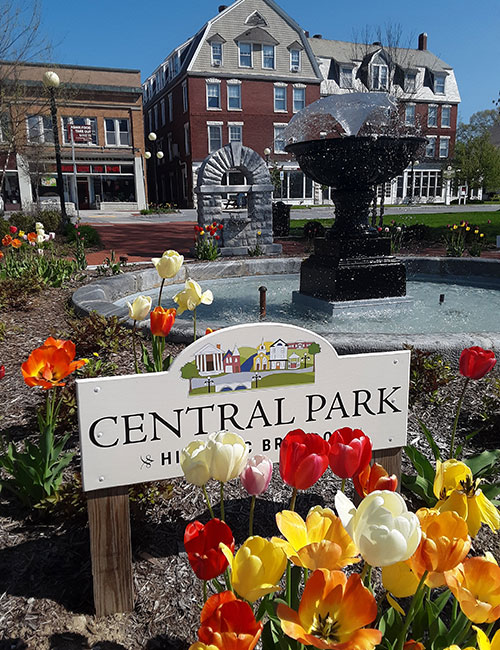
Photo: Brandon, VT. Courtesy photo.
Brandon: Feeling Normal Again
“I never dreamed we’d see the place looking [this good],” said Bernie Carr, executive director of the Brandon Chamber of Commerce.
To Carr, downtown Brandon is a town transformed by a multi-year road project.
Brandon possessed natural and commercial assets, including outdoor recreation and an active dining scene. The Agency of Transportation’s Segment 6 project, however, was the “missing piece” that redeveloped the downtown into a beautiful and functional space.
The two-year, $28 million road project, Segment 6, overhauled Route 7 and the downtown. The work included new sidewalks, water and sewer line infrastructure, buried utility lines, and the installation of two stoplights.
“All those other things were here over the years, but we were just this sad, little broken, little downtown with old, crummy buildings that had slumlords,” he said. “And to get that face changed, it was the final puzzle piece.”
Business regained their equilibrium after upheaval from Segment 6 and the COVID pandemic.
“People have been able now to have the time to get their footing, see what the new normal is,” he said.
Carr points to increases in the 1% local option tax as an indicator of Brandon’s strong economy.
Town Manager Seth Hopkins noted in his manager’s report for April 29 - May 9 that Brandon received $66,720.54 as a quarterly payment for the 1% local onion tax.
“This is classically the weakest quarter of the year, but this amount is the highest amount collected for that quarter of any year since the inception of the tax in 2017,” he wrote. “Our next quarterly payment will put the aggregate total benefit to the Town at over $2 million.”
Brandon’s future will depend on fresh blood.
Carr said a few established business owners are selling their businesses. In a couple of cases, this includes real estate. Carr and his wife, Beth, have operated Carr’s Gifts for 47 years and are preparing to “slow down” and retire.
“A few of us here have been doing this for a long time. We’re up in our 60s, and we're saying, Okay, we've done ours, and hopefully new and exciting people and ideas come into town, and that's what's going to keep us fresh and strong,” he said.
Poultney: Shifting Its Economy To Outdoor Recreation
Losing Green Mountain College made for a few tight years, but the situation shifted. The economy is shifting towards outdoor recreation. People new to the area are giving it a “more youthful vibe,” and the town is seeing growth, said Sarah Pelkey, Poultney’s Community Development Director.
“We've got new businesses, new restaurants, and it's amazing to see people investing in some of the buildings [throughout the town] that we're starting to fall into a state of disrepair,” she said.
It took time for the community to transition its identity from a college town to an outdoor rec community, but Pelkey said the change is working.
Poultney sits in Vermont’s Lake District. Companies such as Slate Valley Trails provide recreational opportunities. The trail network comprises over 50 miles of multi-use trails. The area tends to have a lower cost of living than other areas of the state, she added.
Pelkey understands that not all jobs are created equal in terms of the level of pay or benefits offered. In that light, has outdoor recreation presented itself as a clear economic driver to replace GMC?
“I tend to take an approach to the work as primarily about healthy communities more so than the economy,” she said. “And really, one of the most exciting things that I think that's happening in Poultney is really about community building.”
Poultney benefits from a strong social fabric. People rally around local projects. Local industries focused on slate and manufacturing were not impacted by the college leaving, she added.
The municipality is upgrading its water and wastewater systems. Last year, the Town to Trails Steering Committee began investigating the construction of a recreation hub. The hub would be situated on a plot of land adjacent to the high school and the Poultney River. The town garage, currently located in the spot, would be relocated to a new site.
According to the town’s website, the national organization Outdoor Recreation Roundtable awarded a grant to Poultney to create redevelopment scenarios and architectural renderings for the hub.
The town has also spent several years building its internal capacity, she said. At one time, the town manager also worked as the town and village manager, zoning administrator, and health officer.
Too many hats.
Thanks to a series of grants and community interest, the municipality has increased its resources, allowing it to focus on economic and community development, Pelkey said.
Rutland Regional Medical Center: Resilient And Cautious
Due to a heavy schedule providing testimony to the Legislature, RRMC’s Chief Financial Officer Jennifer Bertrand responded to questions from VBM via email.
While one of the more urban areas in Vermont, Rutland is still a rural community with unique challenges “such as a limited labor pool, population decline, adaptation to modernization, and higher costs for goods and services, but we are also seeing growing collaboration among businesses and nonprofits to address systemic issues,” Bertrand wrote.
And. Housing.
“The availability of safe, affordable housing is severely limited in Rutland and across the state, affecting not only individuals and families but also our ability to attract and retain healthcare professionals,” Bertrand wrote. “This shortage is creating a ripple effect across the economy and remains a critical barrier to long-term growth and stability.”
Within this larger economic framework, RRMC’s finances are stable. The hospital, like many healthcare organizations, faces several challenges.
“RRMC is facing persistent financial pressures driven by rising labor costs and evolving reimbursement models,” she wrote. “Recruitment and retention of skilled healthcare professionals remains a top concern, particularly in specialized clinical areas.”
The healthcare landscape has prompted RRMC to make proactive investments.
“We have made deliberate efforts to invest in operational efficiency, retain talent, and improve care delivery. While the landscape is challenging, our financial position remains stable, and we continue to prioritize long-term sustainability,” she wrote.
As a place that cares for the community’s health, the hospital often witnesses the impact economic stress has on patients. More clients are requesting financial assistance.
“Over the past year, there has been a measurable increase in requests for financial assistance and in the volume of unpaid patient balances,” Bertrand wrote. “More patients are proactively discussing cost concerns and asking about payment options.”
She adds, “These patterns are anecdotal but consistent, and they reflect the broader economic pressures many families are facing in our region.”
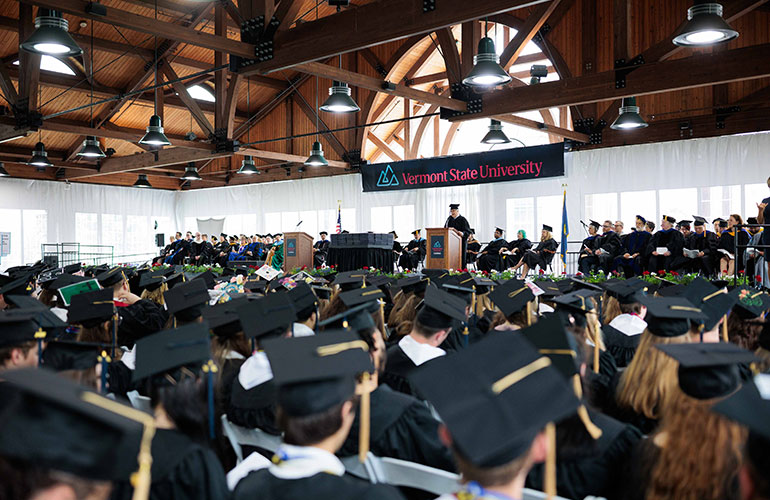
John Casella delivers the keynote address at VTSU Castleton commencement May 17. Courtesy photo.
Casella: And The Power Of Education
Casella Waste Systems operates across more than 40 states, employs over 5,000 people, and calls Rutland County home.
The solid waste and recycling company launched a training program at the former campus of the College of St. Joseph. Casella purchased a portion of the campus two years ago. The company is also developing plans to renovate the former dorms into workforce housing, said Jeff Weld, VP of Communications.
Casella operates a CDL driver and mechanic school at CJS. The company waives the course costs for students who take positions with Casella after graduation, provided they make a two-year commitment.
Weld said the company aims to offer future employees a “debt-free career path.” The program is “earn while you learn.”
So far, 300 drivers have completed Casella’s 10-week CDL course. Weld said the program has a 98 percent graduation rate and has improved employee retention.
The mechanics course is 16 weeks.
“So we're already seeing it pay off, in a sense, where they're deciding up front, they're committing, we're committing to them,” he said.
On-site training offers the benefit of integrating individuals into the company culture, he said. Safety and customer service improve the longer someone remains with the company.
Weld said the waste and recycling industry has undergone significant changes since Doug Casella founded the company in 1975. Technology has eliminated many physical requirements, opening the sector to a broader range of people.
Education is powerful and has many paths, including traditional higher education, apprenticeships, GEDs, and on-the-job training, Weld said. “People thinking that it's all either one path or another are missing the boat.”
Casella outlined its Q1 earnings. The company’s revenues were up 22.3 percent compared to Q1 2024. The company had seen a net loss of funding due to a series of acquisitions.
Key highlights from Casella’s press release:
- Revenues were $417.1 million for the quarter, up $76.1 million, or up 22.3%, from the same period in 2024.
- Solid waste pricing was up 5.6% from the same period in 2024, driven by 5.8% collection price growth and 5.5% disposal price growth.
- Net loss was $(4.8) million for the quarter, down $(0.7) million, as compared to $(4.1) million for the same period in 2024.
- Adjusted EBITDA, a non-GAAP measure, was $86.4 million for the quarter, up $15.4 million, or up 21.7%, from the same period in 2024.
- Net cash provided by operating activities was $50.1 million for the quarter, up $42.4 million from the same period in 2024.
- Adjusted Free Cash Flow, a non-GAAP measure, was $29.1 million for the quarter, up $31.5 million from the same period in 2024.
- Year-to-date, we have completed four acquisitions with approximately $50 million in annualized revenue.
“We had a strong first quarter to start the year, with both revenue and Adjusted EBITDA up over 20% year-over-year, as we continue to execute successfully on our operating and growth strategies,” said John W. Casella, Chairman and CEO of Casella Waste Systems, Inc. “Notwithstanding heightened uncertainty in the overall economy, our business is performing well, and our guidance for the year remains unchanged.”
Casella continued, “Acquisitions remain a key strategic priority, and year-to-date, we have acquired four businesses with approximately $50 million in annualized revenue, including a recent tuck-in in the western New York market.”
The company is adopting a "cautious approach" for the remainder of the year, given the economic and policy uncertainty in the country.
In the company’s press release, Casella Waste highlighted its estimates for the rest of fiscal year 2025:
- Revenues between $1.775 billion and $1.805 billion;
- Net income between $10 million and $25 million;
- Adjusted EBITDA between $410 million and $425 million;
- Net cash provided by operating activities between $320 million and $335 million; and
- Adjusted Free Cash Flow between $165 million and $180 million.
Bracing For Tariffs And Other Federal Cuts
Most businesses have yet to experience direct hits from changes at the federal level.
Still, they are bracing for impact.
Is Rutland Regional Medical Center concerned about changes at the federal level?
“Absolutely.”
That was Jennifer Bertrand, RRMC’s Chief Financial Officer, initial response.
She continued, “Federal policy changes, especially those tied to Medicare and Medicaid reimbursement, have a direct impact on RRMC’s financial health.”
“As a rural hospital, we rely heavily on these funding streams, and any fluctuations or delays in federal support will disrupt our ability to plan and invest effectively and would significantly affect our bottom line,” she wrote.
For RRMC, however, threats to funding and program changes also come from the state.
“At the state level, we are also deeply concerned about several healthcare-related bills currently under consideration in the Vermont legislature,” she wrote. “If enacted, these measures could have detrimental impacts on RRMC’s financial viability and ability to meet our community’s growing healthcare needs.”
The hospital leadership is monitoring any developments and advocating “for solutions that balance cost containment with the preservation of high-quality, accessible care in rural Vermont,” Bertrand said.
Cohen is holding her breath.
The Trump Administration’s proposed budget would make several cuts to the US Department of Housing and Urban Development (HUD), including the Section 8 Voucher program.
Thirty-five percent of Cornerstone’s tenants pay their rent with federal vouchers.
According to Cohen, without Section 8 vouchers, rents are no longer affordable for those tenants, and they risk eviction.
The effects of Section 8 tenants losing their housing will vibrate through the whole organization, Cohen said. Cornerstone relies on rental income to maintain its properties. No rent means no maintenance, which means even tenants without vouchers suffer.
Neary said most planning commissions derive about half of their revenue from federal sources.
The Trump Administration canceled a few of the RRPC’s smaller grants. The community will miss the work those climate, equity, and energy efficiency grants funded. Still, the grants did not total enough to hurt the organization financially.
“We're bracing for what is being proposed for federal cuts, which absolutely will impact regional planning commissions because we do have a diverse funding stack,” he said.
For example, the Essential Air Service Program is in danger of cuts. The federal subsidy supports rural commutes where commercial air service is not economically viable.
The Rutland Southern Vermont Regional Airport is the only state airport where a commercial air service, Cape Air, operates three flights a day to Boston, thanks to the subsidy.
As of the end of May, the Trump Administration is proposing to cut the funding in half.
“If Rutland loses that service, that will be detrimental to the region, both for our economy, for our workforce, and for the future success and utilization of the airport, which is such a vital resource,” he said.
He remains hopeful that people will voice their concerns to Congress.
“Because rural regions are apolitical, right? We come from all sides and walks, and if we are all being impacted at the same scale, then I hope that enough folks will voice those concerns,” he said.
Jepson feels confident that local projects will remain on schedule despite federal upheavals.
Jepson said, “I sense that we'll get through all that, and that a calming period is coming, and that we'll all get back to business.”
Olga Peters is a freelance writer from Southern Vermont.
To support vital journalism, access our archives and get unique features like our award-winning profiles, Book of Lists & Business-to-Business Directory, subscribe HERE!