

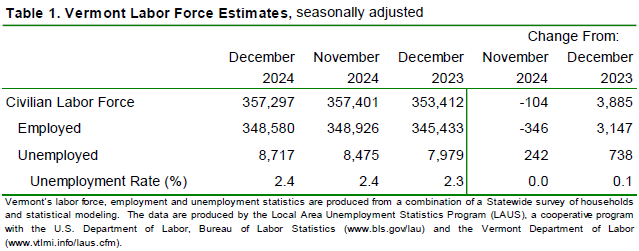
by Timothy McQuiston, Vermont Business Magazine Today, the Vermont Department of Labor released data on the Vermont economy for the time period covering December 2024. According to household data, the seasonally adjusted statewide unemployment rate for December was 2.4 percent. This reflects no change from the prior month’s revised estimate. Vermont has the second lowest rate in the nation behind South Dakota (1.9%). Nevada again has the highest rate (5.7%). The comparable United States rate in December was 4.1 percent, a decrease of one-tenth of one percentage point from the revised November estimate.
The Labor Force and number Employed both fell, while number of unemployed increased. All three data points were not considered "significant."
The civilian labor force participation rate was 65.5 percent in December, no change from the prior month’s revised estimate.
Labor Commissioner Michael Harrington said: “The preliminary data for 2024 has now been released by the Department of Labor. Over the next two months, staff will refine this data through a federal review process, with updated historical figures expected in March and April. Throughout 2024, data findings indicate significant trends, including an expanding labor force and an increase in jobs within Vermont’s economy.
"While the overall statewide trajectory has been positive, these gains appear to be concentrated in larger economic areas of the state. Additionally, other barriers to employment, such as available housing, have slowed the growth of Vermont’s labor force. The Department remains committed to improving educational and employment outcomes statewide, including Vermont’s more rural communities.
"This February is Career & Technical Education (CTE) Month, highlighting the importance of CTE programs in providing critical skills and pathways to meaningful employment with Vermont businesses who are actively hiring. To learn more about CTE or Registered Apprenticeships, visit https://labor.vermont.gov or contact one of our employment specialists at 802-828-4394.”
The seasonally adjusted Vermont data for December show the Vermont civilian labor force decreased by 104 from the prior month’s revised estimate (see Table 1). The number of employed persons decreased by 346 and the number of unemployed persons increased by 242. None of the changes were statistically significant in the seasonally adjusted series.
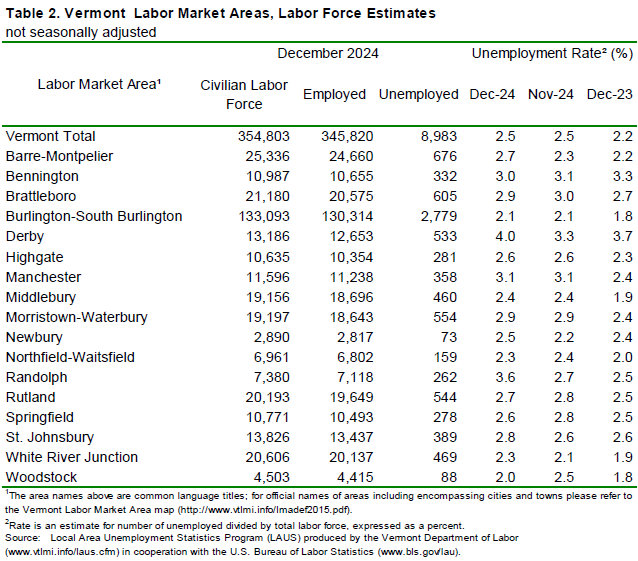
The December unemployment rates for Vermont’s 17 labor market areas ranged from 2.0 percent in Woodstock to 4.0 percent in Derby (note: local labor market area unemployment rates are not seasonally-adjusted – see Table 2). For comparison, the December unadjusted unemployment rate for Vermont was 2.5 percent, no change from the revised unadjusted November level and an increase of three-tenths of one percentage point from a year ago.
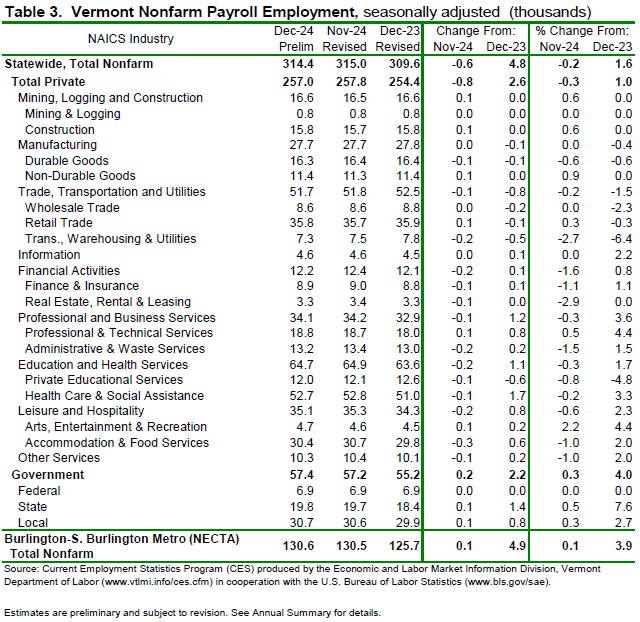
Seasonally Adjusted (Table 3)
The seasonally adjusted data for December reported a decrease of 600 jobs from the revised November data. There was an increase of 500 jobs between the preliminary and the revised November estimates due to the inclusion of more data. The seasonally adjusted over-the-month changes in December varied at the industry level. There were no industries with a notable increase. The industries with a notable decrease were: Transportation, Warehousing, & Utilities (-200 jobs or -2.7%), Administrative & Waste Services (-200 jobs or -1.5%), and Accommodation & Food Services (-300 jobs or -1.0%).
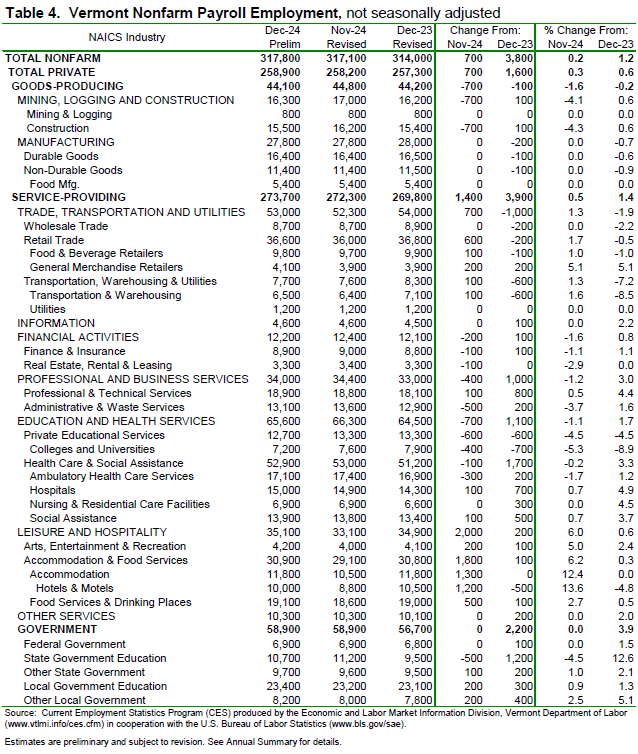
Not-Seasonally-Adjusted (Table 4)
The preliminary ‘not-seasonally-adjusted’ jobs estimates for December showed an increase of 700 jobs when compared to the revised November numbers. As with the seasonally adjusted data, this over-the-month change is from the revised November numbers which experienced an increase of 600 jobs from the preliminary estimates. The broader economic picture can be seen by focusing on the over-the-year changes in this data series. As detailed in the preliminary notseasonally-adjusted December data, Total Private industries increased by 1,600 jobs (+0.6%) over the year and Government (including public education) employment increased by 2,200 jobs (+3.9%) in the past year.
| State | December 2024(p) rate |
Rank |
|---|---|---|
|
South Dakota |
1.9 | 1 |
|
Vermont |
2.4 | 2 |
|
North Dakota |
2.5 | 3 |
|
New Hampshire |
2.6 | 4 |
|
Nebraska |
2.8 | 5 |
|
Connecticut |
3.0 | 6 |
|
Hawaii |
3.0 | 6 |
|
Virginia |
3.0 | 6 |
|
Wisconsin |
3.0 | 6 |
|
Maryland |
3.1 | 10 |
|
Montana |
3.1 | 10 |
|
Iowa |
3.2 | 12 |
|
Maine |
3.2 | 12 |
|
Alabama |
3.3 | 14 |
|
Minnesota |
3.3 | 14 |
|
Mississippi |
3.3 | 14 |
|
Oklahoma |
3.3 | 14 |
|
Arkansas |
3.4 | 18 |
|
Florida |
3.4 | 18 |
|
Utah |
3.5 | 20 |
|
Wyoming |
3.5 | 20 |
|
Kansas |
3.6 | 22 |
|
Pennsylvania |
3.6 | 22 |
|
Tennessee |
3.6 | 22 |
|
Delaware |
3.7 | 25 |
|
Georgia |
3.7 | 25 |
|
Missouri |
3.7 | 25 |
|
North Carolina |
3.7 | 25 |
|
Arizona |
3.8 | 29 |
|
Idaho |
3.8 | 29 |
|
Massachusetts |
4.1 | 31 |
|
Oregon |
4.1 | 31 |
|
Texas |
4.2 | 33 |
|
West Virginia |
4.2 | 33 |
|
Colorado |
4.4 | 35 |
|
Louisiana |
4.4 | 35 |
|
New Mexico |
4.4 | 35 |
|
New York |
4.4 | 35 |
|
Ohio |
4.4 | 35 |
|
Indiana |
4.5 | 40 |
|
Washington |
4.5 | 40 |
|
New Jersey |
4.6 | 42 |
|
Rhode Island |
4.6 | 42 |
|
Alaska |
4.7 | 44 |
|
South Carolina |
4.7 | 44 |
|
Michigan |
5.0 | 46 |
|
Illinois |
5.2 | 47 |
|
Kentucky |
5.2 | 47 |
|
California |
5.5 | 49 |
|
District of Columbia |
5.5 | 49 |
|
Nevada |
5.7 | 51 |
|
Footnotes |
||
|
Note: Rates shown are a percentage of the labor force. Data refer to place of residence. Estimates for the current month are subject to revision the following month. |
||
Last Modified Date: January 28, 2025
The Unemployment and Jobs Report for January is scheduled to be released on Monday, March 17, 2025, at 10:00 a.m. The time lag is to rectify the 2024 annual numbers.