Tom Salmon, Vermont's 75th governor, died Tuesday, January 14, 2025, in Brattleboro at 92.
by Chris Graff
Anyone searching for hopeless causes in the summer of 1972 need only look at Vermont’s Democratic race for governor.
In July of that year it looked as if there would be no race at all. A state senator had announced his candidacy but then withdrew because of a lack of support.
Finally, in August, Tom Salmon of Rockingham stepped forward. He was the definition of an underdog.
It was too late to start a winning campaign; Salmon’s only previous statewide campaign, a 1970 race for attorney general, had been a disaster, and the Republicans had two strong candidates vying for the party nomination.
And then there was George McGovern. The Democratic Party’s presidential nominee seemed too far left to excite a large number of Vermonters, who ended up strongly backing the re-election of President Richard Nixon.
But Salmon had his finger on the pulse of Vermont and struck a chord with an anti-development theme and a compelling catchphrase that was unequivocal: “Vermont is not for sale.”
“People were genuinely alarmed,” Salmon recalled in a 1989 television interview. “There was an overwhelming perception that out-of-state interests were going to gobble up and buy up the state.”
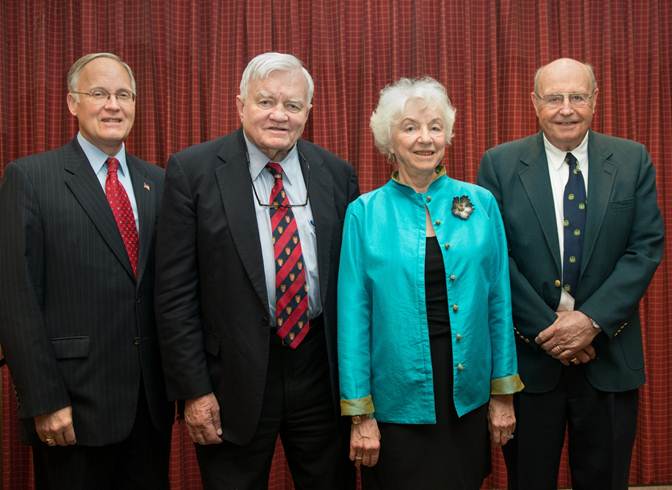
Former Vermont Governors Jim Douglas, Tom Salmon, Madeleine Kunin and F. Ray Keyser at a Business Roundtable event in 2012. VermontBiz file photo..
He called for a land speculation tax on the profits being made by developers and a program to ensure that Vermonters paid no more than a certain percentage of their income on property taxes.
Time and time again on the campaign trail Salmon would thunder, “We’re not going to change our laws. They’re going to have to change their ways.”
Salmon won even as Republicans swept all other statewide offices.
He enacted the land gains tax, a tax that remains on the books and is credited with dampening land speculation in the state.
In 1974 Salmon won re-election as a recession hit the state, prompting him to propose tax increases, which the legislature rejected.
“The tide ran out on us,” he said.
A defeat in a U.S. Senate race in 1976 provided the final blow: Tom Salmon’s career was over.
No one told Salmon, though, and with the same irrepressible spirit that won him the governor’s office, he built a law practice, helped to rescue Green Mountain Power from disaster when he took over as chairman, and then served as president of the University of Vermont, taking over at troubled times and helping to restore public trust in the institution.
Ironically, but in a truly Vermont moment, Fred Hackett, the man Salmon defeated for governor in 1972, was the person who led the search committee that chose Salmon to head UVM.
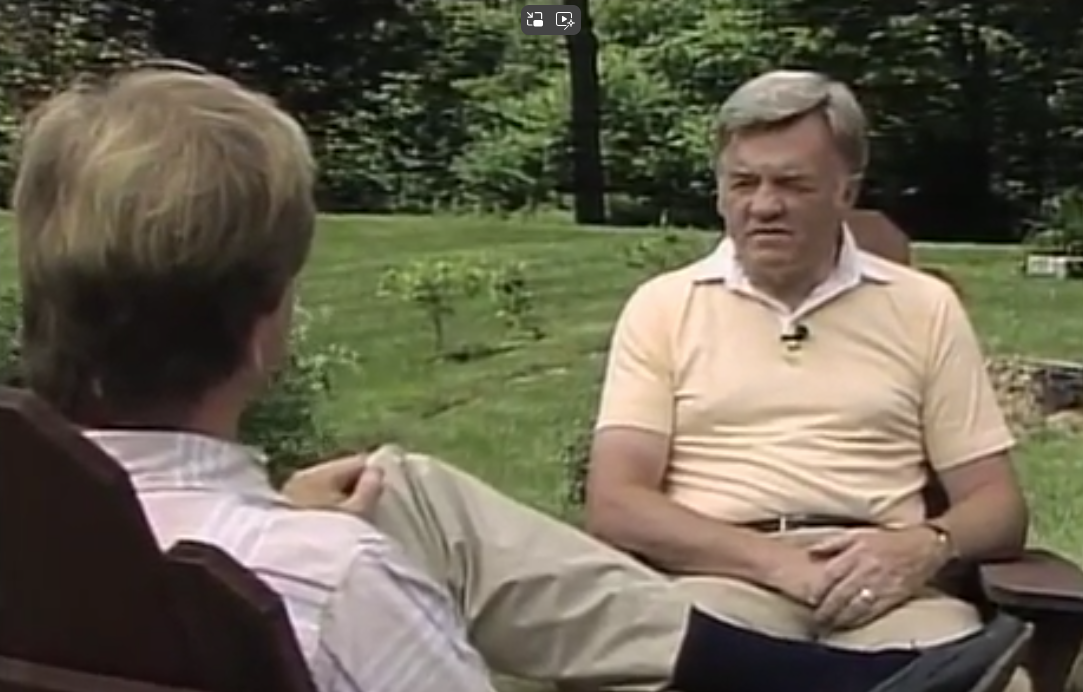
Then AP Bureau Chief and future "Vermont This Week" host Chris Graff sat down with Tom Salmon in 1989 in Rockingham to discuss Salmon's unlikely victory in the 1972 governor's race. Vermont Public screen shot.
Chris Graff is a former journalist and historian who covered the Samon administration and interviewed Tom Salmon in 1989 for a television series “The Governors” for Vermont ETV, (now Vermont Public).
To support vital journalism, access our archives and get unique features like our award-winning profiles, Book of Lists & Business-to-Business Directory, subscribe HERE!