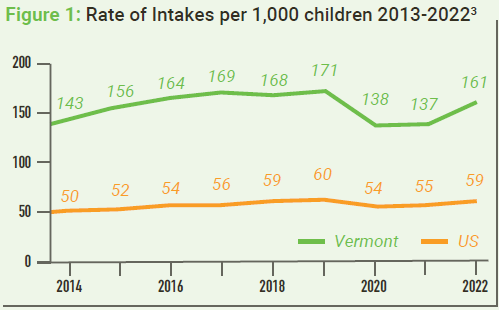
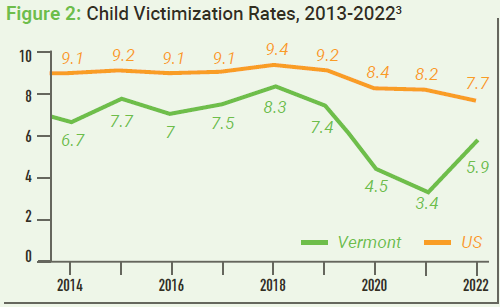
Figures 1 and 2, Vermont’s rate of intakes has been between 2.5 and 3 times higher than the national average, while the actual rate of child victimization consistently falls below the national average. BBF charts.
Vermont Business Magazine Building Bright Futures today released its yearly report, The State of Vermont’s Children. The report provides an objective, data-driven assessment of the state of well-being for young children and families in Vermont. The report highlights data on pressing issues such as the cost of living, housing and homelessness, substance use during pregnancy, children with mental health conditions, expansion of the Child Care Financial Assistance Program (CCFAP), UPK enrollment for 3- and 4-year-olds, and school readiness and third grade assessments.
Recommendations include: Enact a Paid Family and Medical Leave Insurance program; immediately stand up critically needed safe, accessible, non-congregate emergency solutions for sheltering families and children in crisis; and ensure Vermont’s Universal Prekindergarten Education (UPK) program continues to lead the country by maintaining universal access for 3- and 4-year-olds in a mixed-delivery system (school-based, center-based, and home-based programs) and centering the developmental needs of young children and their families.
See all recommendations below.
The mission of Building Bright Futures (BBF) is to improve the well-being of children and families in Vermont by using evidence to inform policy and bringing voices together across sectors and within regions to discuss critical challenges and problem-solve. Building Bright Futures (BBF) is Vermont’s early childhood public-private partnership, charged under Vermont Title 33 § Chapter 46 and the Federal Head Start Act (Public Law 110-134) as Vermont’s Early Childhood State Advisory Council (SAC), the mechanism used to advise the governor and Legislature on the well-being of children in the prenatal period through age 8 and their families. BBF’s Network infrastructure includes 12 Regional Councils, seven VECAP Committees and the State Advisory Council. BBF maintains the vision and strategic plan for Vermont’s Early Childhood System. Learn more at buildingbrightfutures.org.
These annual Policy Recommendations of Vermont’s Early Childhood State Advisory Council Network are developed using the VECAP, up-to-date data, and the most pressing feedback and challenges being faced in the early childhood system collected throughout the year. The annual Policy Recommendations identify the current gaps and needs in policy, promote action in strategic areas for the coming year, and aim to be measurable.
2025 Policy Recommendations of Vermont’s Early Childhood State Advisory Council Network
The SAC is the state’s governor-appointed, primary advisory body on the well-being of children from the prenatal period through age 8 and their families. Each year, in partnership with Vermont’s Early Childhood Action Plan (VECAP) Committees and Regional Councils, the SAC sets priorities and strategic direction for statewide initiatives by endorsing a series of Policy Recommendations.
ACCESS TO BASIC NEEDS
(VECAP GOAL 1)
Enact a Strong Paid Family and Medical Leave Insurance Program
• Enact a Paid Family and Medical Leave Insurance program for Vermonters seeking to take time off to care for a family member or themselves while welcoming a new child into the family, while navigating an illness or injury, or after experiencing a loss. Ensure that the benefit through this program covers all caregivers in the case of a two-parent household, and that the benefit is sufficiently generous for low-income families to utilize the program. Renewed Policy Recommendation (2024)
Invest to Ensure Families Have Access to Safe and Secure Housing in the Immediate and Long-Term
• Immediately stand up critically needed safe, accessible, non-congregate emergency solutions for sheltering families and children in crisis. Provide quality services and service coordination to support families accessing these shelters who are navigating a variety of complex needs (special health care needs, mental health conditions, substance use disorder, etc.). Ensure there is a long-term plan to continue to shelter families with young children as needed and sufficient funding to sustain this strategy.
• Prioritize data collection related to the demographics of those navigating homelessness to inform outreach and mitigation efforts, and to recognize the racial disparities embedded in our systems impacting families with young children.
• Support families navigating housing instability with a continuum of services that move them into more consistent housing. Invest in strategies that support families in finding and affording safe and stable housing, including funding for the HOME voucher program for families and a potential expansion of the Family Supportive Housing program.
• Prioritize significant and sustained investments in the creation of new housing units to alleviate the housing crisis, which has only been exacerbated by extreme weather events. When creating new housing units, invested parties should aim to locate housing in priority areas and near services needed by families, including transportation, schools, and child care, but outside of areas at high risk for flooding. Priority should be given to creating or rehabilitating housing that is designed to be permanently affordable.
FAMILY PARTNERSHIP AND RESILIENCE
(VECAP GOAL 2)
Enact Best Practices Statewide for Elevating Community and Family Voice
• Enact a formal guidance/protocol for naming membership when creating new legislatively mandated bodies. This protocol should become a required part of standard operating procedure for the legislature. A membership template must include individuals with relevant lived experience, based on a given bill’s impacted communities. Renewed Policy Recommendation (2022, 2024)
• Require the coordinating entity to receive training on how best to incorporate the knowledge of family and community members with lived experience into the legislatively mandated bodies’ processes and deliverables. This includes how to ready the table for their success and ensure the inclusion of their voices. Once recruited to serve, family representatives should be provided an orientation and targeted supports to reduce barriers to full participation.
Improve and Provide Transparency in Family and Parent Compensation Practices for Involvement in State-Convened Entities
• Implement consistent State of Vermont policies for compensating families with lived experience who serve on state-convened entities within the early childhood system. When a state-convened entity, such as a Commission, is asking families to share valuable and vulnerable information about their experiences, compensation should be aligned with the National Center for Family & Parent Leadership’s Parent Leader Compensation Scale. Transparent information about the compensation rate, frequency, and method (and any paperwork requirements) should be advertised when recruiting for the opportunity so that families know what to expect financially.
HIGH-QUALITY AND INCLUSIVE EARLY CARE/EDUCATION/AFTERSCHOOL PROGRAMS
(VECAP GOAL 3)
Monitor to Ensure Equitable Access for All 3- and 4-Year-Olds in Vermont’s Universal Pre-K Program
• Ensure Vermont’s Universal Prekindergarten Education (UPK) program continues to lead the country by maintaining universal access for 3- and 4-year-olds in a mixed-delivery system (school-based, center-based, and home-based programs) and centering the developmental needs of young children and their families. Renewed Policy Recommendation (2022, 2023)
• Task the Agency of Education, Child Development Division, and Building Bright Futures to create, implement, and update as necessary a monitoring and accountability protocol to better monitor Vermont’s Universal Prekindergarten Education (UPK), including robust data collection and analysis. The development of the process should include feedback from impacted communities and individuals (families, educators, Act 166 Coordinators, the Prekindergarten Education Implementation Committee, preK–12 administrators, etc.) and should be mindful of the additional capacity and skills reporting this data requires from programs. Collected data should include financial information, enrollment by student characteristics, staffing, and student outcomes.
• Secure sustained funding for personnel across all three entities to ensure high-quality data through the following activities: data management and reporting activities, training and TA to support quality collection and reporting, engagement in data integration meetings and visioning, data analysis, and making data publicly available.
Ensure Access to Quality Child Care for Families Eligible for TANF
• Ensure that children from families eligible for TANF, including children experiencing homelessness, have ready access to child care by establishing a presumptive eligibility policy for TANF-eligible families for Vermont’s Child Care Financial Assistance Program (CCFAP). This policy would reduce administrative burdens and potential lags in child care coverage for families, and ensure that children experiencing adversity have access to quality early education environments.
HIGH-QUALITY SERVICES FOR FAMILIES FACING ADVERSITY
(VECAP GOAL 3)
Support those Navigating the Child Welfare System by Investing in System Improvements
• Secure sufficient state funding to fully implement the Comprehensive Child Welfare Information System (CCWIS). Renewed Policy Recommendation (2024)
• Utilize the Family Services Division’s federal case review report and program improvement plan to make data-informed programming and financing decisions to improve the systems serving young children in Vermont’s foster care system.
Make Mental Health Services Accessible to Families Across Settings
• Develop financial incentives and implementation support for initiatives aiming to integrate mental health into primary care settings serving children and families to promote wellness and upstream prevention. Renewed Policy Recommendation (2024)
EARLY CHILDHOOD WORKFORCE
(VECAP GOAL 3)
Invest to Ensure Inclusion and Meet Social-Emotional Health Needs in Early Education and Afterschool Programs
• Ensure early childhood educators have access to sufficient support staff (occupational therapists, speech and language pathologists, physical therapists, paraeducators, and early childhood mental health practitioners) and ongoing coaching to support full inclusion and the social-emotional well-being of every child. Explore recruitment and retention strategies, such as expanding eligibility for student loan repayment programs and increasing compensation rates.
• Prioritize investments in teaching practices that are developmentally appropriate and increase the capacity of the early childhood education workforce and system. These investments will build new and reinforce existing supports to foster the development, learning, and individualized needs of every child.
• Ensure that populations that have historically been marginalized and disproportionately experience discriminatory practices are no more likely to experience exclusionary practices by identifying and addressing discriminatory practices, biases, and structures.
Recruit a Representative Mental Health Workforce
• Prioritize recruiting mental health professionals that represent Vermont’s population, including people of color, disabled professionals, and those with lived experience related to mental health conditions and the mental health system. Renewed Policy Recommendation (2024)
SEAMLESS, EQUITABLE, DATA-DRIVEN SYSTEM OF CARE
(VECAP GOAL 4)
Align Demographic Data Collection Across Agencies
• Align data collection practices across agencies to improve systems and programs that are not currently meeting the needs of people of color, children with disabilities, and other vulnerable populations in Vermont. This will require determining and allocating necessary funding to update infrastructure to comply with expected changes in federal reporting of demographic data. Ensure that the strategy allows individuals to fill out required forms in a way that aligns with the ways in which they self-identify while meeting federal requirements. Renewed Policy Recommendation (2023, 2024)
Promote Access to Advance Payments for State-Funded Grants and Contracts
• Address inequitable access to state funding opportunities by exploring strategies to enable all early childhood partners to compete regardless of current financial resources. The State should develop consistent, realistic policy standards and guidance on advance payment procedures; whenever possible advance payments should be considered as a default when funding sources allow.
Source: Jan. 13, 2025 (WILLISTON, Vt.)—Building Bright Futures. Home - Building Bright Futures
To support vital journalism, access our archives and get unique features like our award-winning profiles, Book of Lists & Business-to-Business Directory, subscribe HERE!