by Timothy McQuiston, Vermont Business Magazine Weekly unemployment claims remained relatively high last week but fell after a New Year's spike. For the week ending January 4, 2025, new claims were 561, which is down 337 claims from the week before and is 95 more from last year. The holiday season brings wild swings in claims as temporary workers are hired and then laid off. Claims were 181 at the end of September.
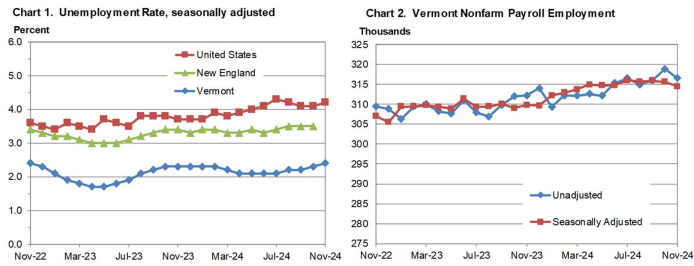
Weekly claims across the nation also were down, while overall hiring last month was brisk. For the month of December the US jobs report beat expectations, while the US unemployment rate fell one-tenth to 4.1% for December. The Vermont report will not be released until January 28.
Acting US Secretary of Labor Julie Su issued the following statement January 10, 2025, on the December 2024 Employment Situation report:
“Today, the Bureau of Labor Statistics reported that the American economy added 256,000 jobs in December, well above market expectations and reflecting a robust and resilient labor market. With unemployment ticking down to 4.1 percent and the three-month average of payroll employment gains at 170,000, this report underscores the strength of our economy as we close out 2024.
This positive economic news coupled with the expectation that the Fed would not soon reduce interest rates sent the stock market into negative numbers Friday. Since the presidential election when the markets surged, the DOW and S&P have fallen into pre-election territory and NASDAQ has seen modest gains.
As of mid-day January 10, the Dow was at 42,114.93, down about $500 (1.16%), the S&P 500 was at 5,855, down about $61 (1%) and the NASDAQ was 19,262, down about $215 (1.10%). The indices are about where they were in early October, with the exception of the NASDAQ which was lower at that time and has risen since.
Previous to today's strong jobs numbers the Fed indicated that the December rate cut could be the last for awhile, as inflation has not continued to subside and the strong economy could further raise inflation.
CNBC reported today that "Fed meeting minutes from December, released Wednesday, showed that officials were worried about inflation and the effect of President-elect Donald Trump’s policies, and indicated that they would be moving more slowly on interest rate cuts in 2025."
As a reminder, the Vermont Department of Labor has announced an increase to the State’s minimum wage, which began January 1, 2025. The State’s minimum wage will increase from $13.67 to $14.01 per hour - an increase of $0.34.
This annual adjustment also impacts the minimum wage for tipped employees. The “Basic Tipped Wage Rate” for service, or “tipped employees,” equals 50% of the full minimum wage. On January 1, 2025, the tipped minimum wage will increase from $6.84 to $7.01 per hour.
The State’s tipped minimum wage law allows employers to pay a lower hourly rate, as long as the employee receives tips equal to, or greater to than, the standard minimum wage during a given shift. In cases where the employee does not receive enough in tips during a workweek to equal the standard minimum wage per hour, the employer is required to pay the difference in order to ensure the tipped wage employee is compensated at the non-tipped minimum wage amount.
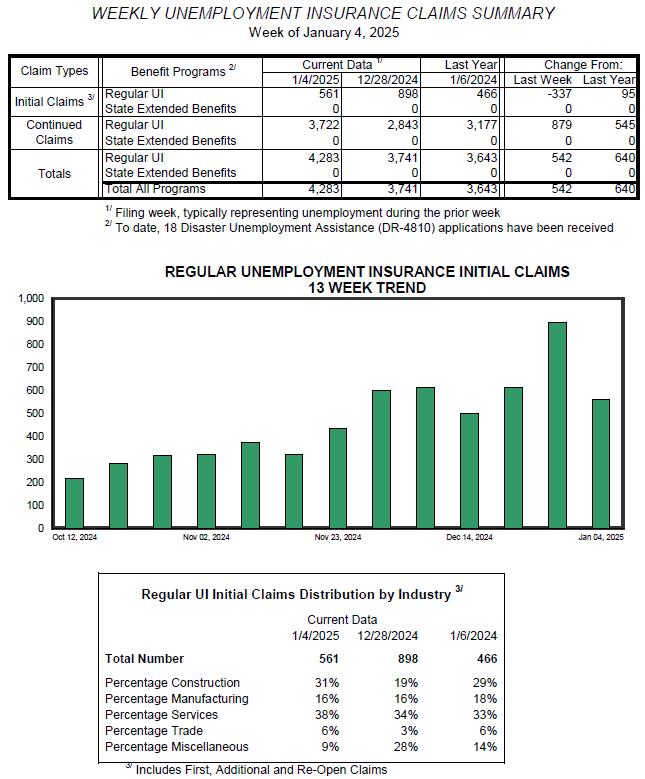
In Vermont for the weekly report, the Service industry accounted for the most claims last week with 38%, unchanged. Manufacturing accounted for 16% of claims, up from 14%. Construction claims fell 1 point to 31%.
See more tables below.
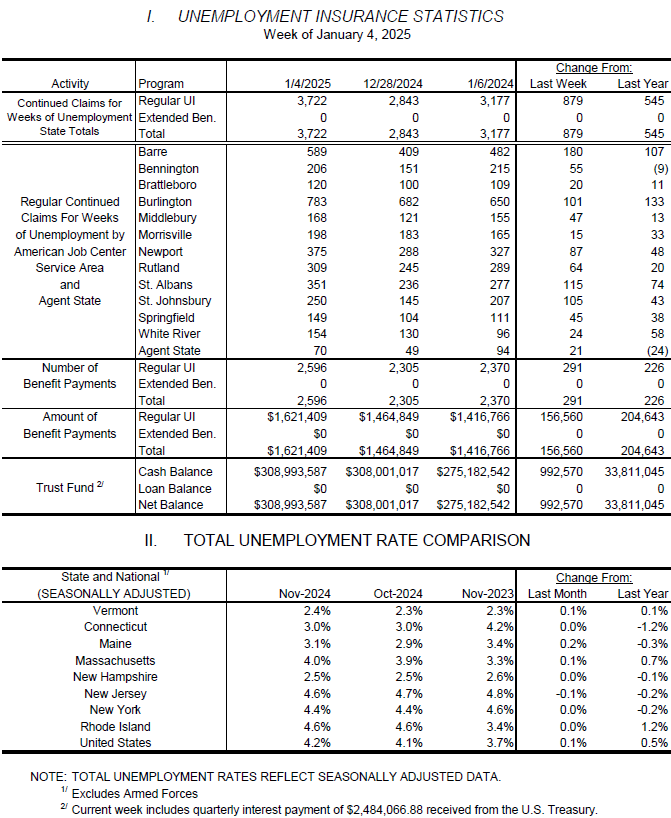
For the week, total unemployment insurance claims were 4,283 for the week (up 542 for the week and up 640 from this time last year). Meanwhile, the state unemployment rate remains tied for second lowest in the nation even as it rose one-tenth in November, as unemployment grew modestly (2.4 percent in November 2024).
Also today, the US DOL reported that for the week ending January 4, the advance figure for seasonally adjusted initial claims was 201,000, a decrease of 10,000 from the previous week's unrevised level of 211,000. The 4-week moving average was 213,000, a decrease of 10,250 from the previous week's unrevised average of 223,250.
Also in December, as Public Assets Insitute reported, Vermont's personal income was up 6 percent in 2023, which is the fastest median rate increase in the nation. PI grew by 3 percent in the US and only four states saw income drop: Alabama, Minnesota, North Dakoka and Iowa.
Meanwhile, PAI released its State of Working Vermont 2024 report, which concluded that: "More than half of single adults in Vermont, with kids or without, cannot afford to meet their basic needs. Even many two-earner households fall short. Meanwhile, the wealthiest Vermonters have over $1 million left annually after covering their needs.
"The state budget reflects our priorities. Healthcare and pre-K-through-12 public education each account for about a third of the total state budget. But the other policies and programs that help make Vermont affordable—like cash assistance, food programs, childcare subsidies, and housing support—together account for only 10 percent. That means reasonable, targeted investments in these areas can make a big, immediate difference to Vermonters struggling to afford their basic needs.
"Our laws enshrine the promises we’ve made to each other: that everyone has quality healthcare, housing, dignified work, education, food, social security, and a healthy environment. We have the resources to deliver on these promises and make Vermont a state that is both affordable and equitable for everyone who lives here."
"The November jobs report shows an expected rebound in hiring and no major surprises,” said Eric Merlis, managing director and co-head of global markets at Citizens. “The slight uptick in the unemployment rate and dip in the participation rate should convince the Fed to continue its gradual easing path at the December meeting.”
Meanwhile the Vermont Unemployment Trust Fund is well capitalized. As of the most recent data, there was $308 million in the Trust Fund, up about $1 million (as claims are paid out on one side, employers are contributing to the fund on the other). The pre-pandemic Trust Fund balance on March 1, 2020, was $506.2 million.
To support vital journalism, access our archives and get unique features like our award-winning profiles, Book of Lists & Business-to-Business Directory, subscribe HERE!