Undergraduate students present research among graduate students, faculty at D.C. event
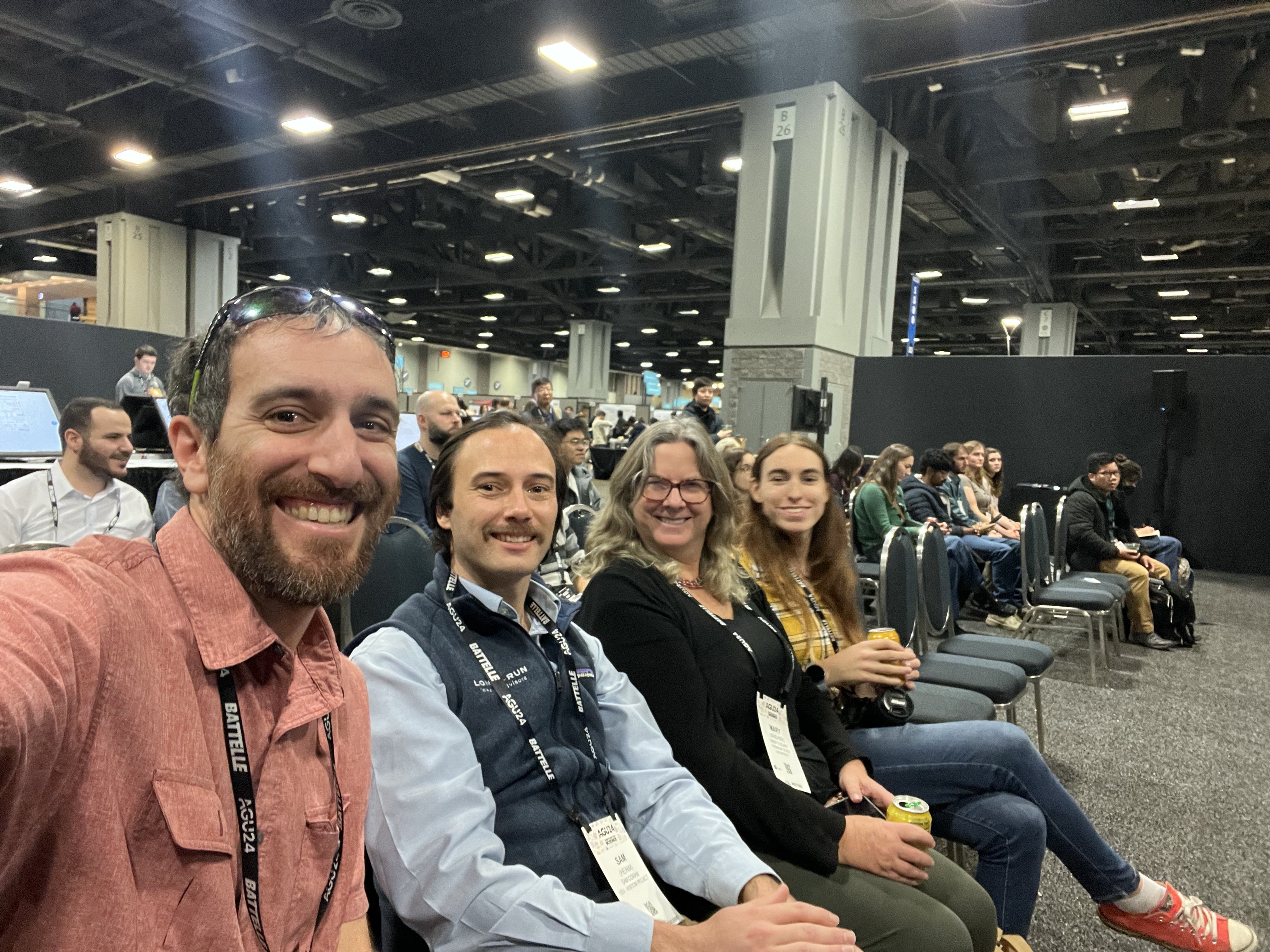
Vermont Business Magazine A group of undergraduate students and faculty from Vermont State University (VTSU) recently attended the American Geophysical Union (AGU) annual meeting in Washington, D.C. Students absorbed information on a wide range of topics in sessions with roughly 25,000 scientists from over 100 countries and had an opportunity to present their research on a national scale.
“Two students in particular, Sam Cowan, Amelia Vlahogiannis, and VTSU research scientist Eliza Goodell, did a fabulous job of sharing research work with the wider scientific community,” said Ross Lieblappen, associate professor in the natural sciences department at VTSU. Lieblappen, who teaches physics, chemistry, and environmental science, added, “Our students used a variety of formats to share their projects, so we got to experience AGU from all perspectives.”
The American Geophysical Union (AGU) is a 501(c)(3) nonprofit organization with approximately 130,000 members, including Earth, atmospheric, ocean, hydrologic, space, and planetary scientists and enthusiasts. AGU’s annual meeting is the largest gathering of Earth and space scientists, bringing together attendees to share research, foster connections, and advance understanding of our planet and environment.
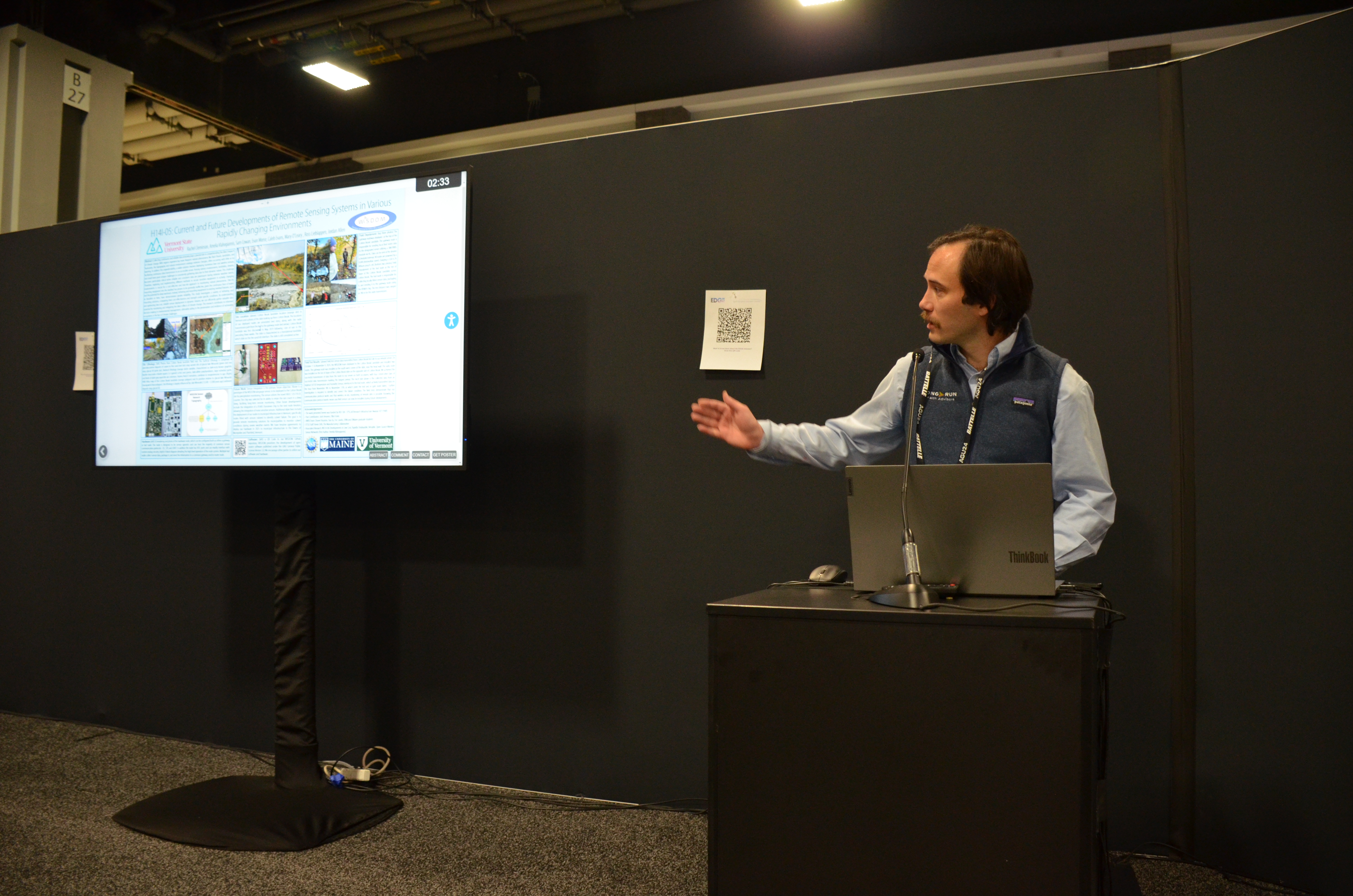
Sam Cowan led the e-lighting poster presentation on the WiSDOM (Wireless Sensing Divination using Onsite Monitoring) project, for which Professor Mary O'Leary served as principal investigator (PI) and Lieblappen served as co-PI. Cowan gave a three-minute talk to an audience of about 50 people, which was followed by an hour-long session featuring eight posters on the topic of "Advancements in Remote Sensing, Hydrologic Modeling, Data Assimilation, and Machine Learning for Terrestrial Water Cycle.
“It was nerve-wracking, but exciting,” Cowan reported. “I found a couple of folks who were very interested in our program. I was really excited to be able to show off our work.”
“Eliza Goodell led the DRACO* (Dynamic Research of Arctic Cryospheric Organisms) poster session, which was a four-hour long session,” Lieblappen noted. Throughout last summer, thanks to a $3.3 million federal contract, Lieblappen, who serves as PI for the project with Michelle Sama as co-PI, had the opportunity to lead a group of students on a research trip in the arctic, gathering data that was then shared with the broader scientific community through this poster session.
“My colleague Dr. Michelle Sama and I watched Eliza having great one-on-one conversations with a variety of researchers as folks walked through the 27-poster session focused on ‘Analyzing Subsurface Processes in Permafrost-Affected Regions and Their Impacts on Infrastructure and Climate,’” he remarked.
Amelia Vlahogiannis, an engineering student, gave a 10-minute oral session as part of the "Advances in Informatics, Radiative Transfer–Based Retrieval Algorithms and Instrumentation" with seven other presenters.
“After the session, quite a few folks came up to Amelia to ask her follow up questions,” Lieblappen said.
Vlahogiannis commented, “Since earth and space science is not my primary field of study, a lot of the presentations went way over my head,” but added, “when I found one or two I understood, I learned a lot.”
She noted that a lot of that information was about investigation into data and mathematical analysis of data, rather than scientific applications that would have been more foreign to an engineer.
“It’s really great to be given an opportunity that is usually given to someone above my educational level and in a higher position,” she shared.
VTSU President David Bergh commended both faculty and students for their participation in AGU annual’s meeting, sharing, “Having our students learn and even present in such an elite, dynamic setting not only benefits them in their educational journeys, but also helps elevate the critically important research VTSU is conducting to help address the global climate crisis.”
*The DRACO work was supported by the Broad Agency Announcement Program and the U.S. Army Engineer Research and Development Center (ERDC) under Contract No. W913E523C0008. Any opinions, findings and conclusions or recommendations expressed in this material are those of the author(s) and do not necessarily reflect the views of the Broad Agency Announcement Program and the U.S. Army Engineer Research and Development Center (ERDC).
VERMONT STATE UNIVERSITY
Vermont State University provides a high-quality, flexible, and affordable education for students seeking associate, bachelor’s, and master’s degrees, certificates, and in-demand professional credentials. The university builds upon a history of public higher education in Vermont dating back to 1787. More information about Vermont State University can be found here: https://vermontstate.edu/
Source: 1.6.2025. Randolph, VT – Vermont State University
To support vital journalism, access our archives and get unique features like our award-winning profiles, Book of Lists & Business-to-Business Directory, subscribe HERE!