

Reforms implemented in 2022 are now projected to save taxpayers $5.8 billion over time
Vermont Business Magazine Vermont’s public pensions have reached their highest funding ratios in nearly a decade, Treasurer Mike Pieciak announced today at a press conference with union leaders, the Vermont Pension Investment Commission (VPIC), and members of the Legislature.
Pieciak, who served on the Pension Task Force in 2021, credited the improved outlook to the 2022 reforms implemented under Act 114, robust FY24 investment returns, and tri-partisan Legislative support of the state’s retirement systems. A recent analysis by the Treasurer’s Office indicates the pension reforms and prefunding other post-employment benefits (OPEB) are projected to save taxpayers nearly $5.8 billion over time.
“Vermont’s public pensions ensure a secure and dignified retirement for the teachers, first responders, and essential public workers who keep our state running,” said Treasurer Pieciak. “Thanks to the collaboration of lawmakers and unions, the teacher pension is at its strongest funding level in 12 years and the state employee pension is at its strongest funding level in seven years. Not only are the public pension systems stronger today as a result of the 2022 reforms, but the State’s upfront investments will save taxpayers billions over the next two decades.”
Pieciak continued, “I want to specifically recognize my predecessor, Treasurer Beth Pearce, for her leadership and commitment to preserving and strengthening our public pension systems that helped get us here today. I also want to thank my fellow pension reform task force members and the legislature for working together to find solutions to these complex challenges. We should celebrate the significant progress made to date but also recommit to staying the course in the years ahead to strengthen and fully fund the public pension systems.”
The Treasurer’s Office manages the public pension systems for Vermont teachers, state employees, and municipal employees. Each system has its own funding, governance, and benefits structure.
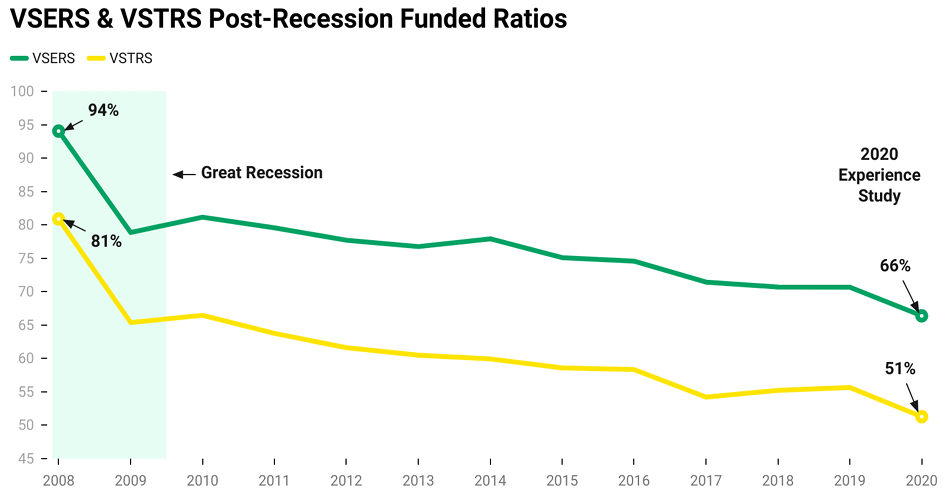
The Great Recession, historic underfunding, a lowered assumed rate of investment return, Vermont’s shifting demographics, and other factors led to a significant decline in the funding ratios of the state’s pensions from the late 2000s through 2020. During this period, the funding percentage of the Vermont State Employees’ Retirement System (VSERS) fell from 94% to 66%. The Vermont State Teachers’ Retirement System (VSTRS) declined from 81% to 51%.
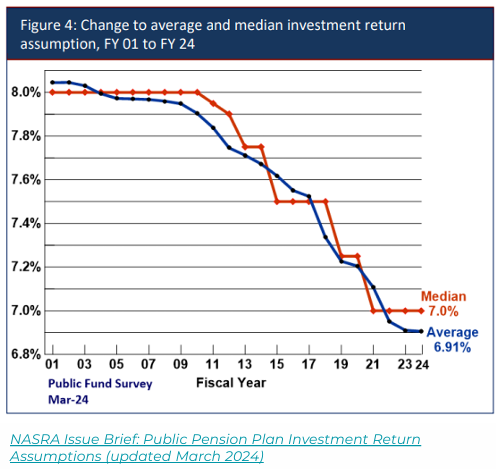
In 2022, the legislature unanimously approved Act 114, a landmark pension reform law for VSERS and VSTRS. Developed by a task force of lawmakers, union leaders, and administration officials, the law provided substantial one-time and ongoing funding to the pension systems. It also increased member contributions, adjusted the cost-of-living adjustments (COLA), and required the State to pre-fund OPEB.
The Vermont Municipal Employees’ Retirement System (VMERS) did not require immediate changes at the time, though the Legislature and the VMERS Board recently approved reforms to strengthen its funding, demonstrating the state’s ability to adapt as needed.
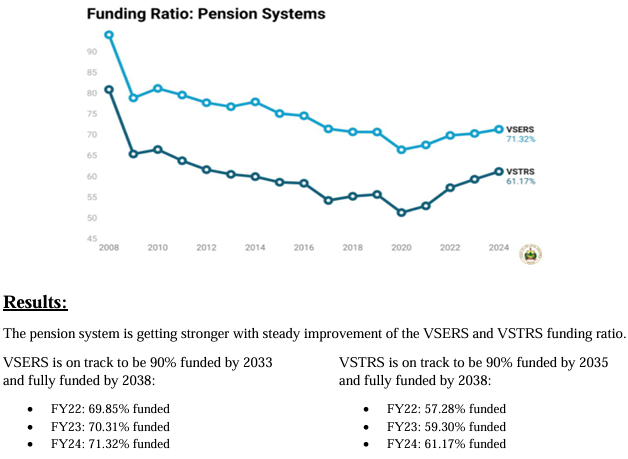
Since Act 114 became law, the pensions’ funding ratios have steadily improved. In FY24, the VSERS funding percentage grew by 1%, reaching 71.32% funding, while the VSTRS increased by 1.9%, achieving 61.17% funding. These are the highest funding ratios the systems have reached in nearly a decade, marking four consecutive years of growth.
Both systems are now cashflow positive net of investment returns, indicating that each plan’s incoming funds exceed the amount being paid out in benefits to retirees. Projections indicate that the VSERS and the VSTRS are on track to be fully funded by 2038.
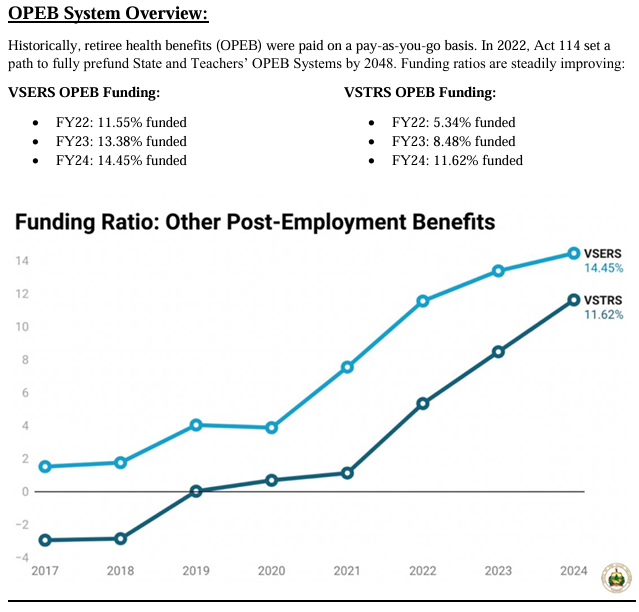
Funding ratios for the VSERS and VSTRS retiree healthcare plans (by far the largest component of OPEB) have also steadily increased. In FY24, the funding percentage of VSERS OPEB increased by more than 1%, reaching 14.45%, while VSTRS OPEB increased by more than 3%, to 11.62%. Both the VSERS and VSTRS OPEB plans are on track to be fully funded by 2048.
The State is contributing annually to the pension and retiree healthcare plans under Act 114, but those funds are helping the state earn an even greater return on investment that is used to pay off the State’s liability. In FY24, VPIC achieved very strong investment returns from the pension fund, earning nearly $600 million. The OPEB funds, managed by the Treasurer directly, produced gains over 13%, totaling $32 million.
A recent analysis by the Treasurer’s Office highlights the scope of anticipated savings under Act 114. Due to the reforms and the State’s upfront investments, taxpayers will avoid paying $5.8 billion over the next two decades.1
"The strong investment performance in FY24 for the pension and OPEB funds is helping us secure the retirement benefits that working Vermonters have earned,” said VPIC Chair Tom Golonka. “I’m proud of our team’s dedication and the effort they’ve put into delivering real results for the people who rely on these funds. The progress we’re making shows that Act 114 is working as intended—ensuring a stronger, more secure future for retirees who have given so much to our communities.”
Union leaders emphasized the vital role public pension systems play in the lives of their members and the broader Vermont community, while expressing gratitude to policymakers for their continued support.
“The continued strength and health of the teachers’ pension is a direct result of our work with members, lawmakers, officials, the treasurer, and governor in 2022. We are gratified that the pension remains on target to secure financial security in retirement for our state’s teachers,” said Don Tinney, a 31-year Vermont teacher and current president of Vermont-NEA.
Echoing this sentiment, Aimee Bertrand, President of the Vermont State Employees’ Association, highlighted the significance of collaborative efforts: “The favorable progress we see today in Vermont’s public pensions reflects the hard work and collaboration behind Act 114. These reforms have helped ensure that the public servants who dedicate their careers to Vermont can count on a secure and dignified retirement.”
Michael O’Neil, Executive Director of the Vermont Troopers’ Association, underscored the broader impact of these reforms. “On behalf of the members of the Vermont Troopers’ Association (VTA), I would like to thank the work of all the committee members concerning Act 114, which helped reform the State Employee pension system. The collaborative work of the Legislature, VTA, VSEA, and VT-NEA resulted in solutions which, since being implemented, have made significant progress towards the goal of having pensions fully funded by 2038. A fully funded pension system promotes financial health and growth not only for the participating employees but for the State of Vermont as a whole,” he said.
Attendees at the press conference also honored retiring State Senator and Senate Appropriations Chair Jane Kitchel. Senator Kitchel played a pivotal role in shaping Vermont’s pension reform efforts.
“As we reflect on the progress made in strengthening Vermont’s pension systems and funding retiree healthcare benefits, I am proud of the collaborative effort that led to the 2022 reforms,” said Senator Kitchel. “These changes were about keeping our promises to Vermont’s public servants while ensuring the long-term fiscal health of our state. Seeing this progress affirms that when we work together with focus and resolve, we can achieve meaningful results for Vermonters.”
Separate from this report, Equable Institute based in New York released the year-end update to its State of Pensions 2024 report. The analysis finds the aggregate funded ratio for U.S. state and local retirement systems are on track to increase from 75.5% in 2023 to 80.2% in 2024, based on available data through December 31st, 2024. Equable Institute estimates that unfunded liabilities will total $1.37 trillion for the 2024 fiscal year, compared to a high of $1.64 trillion in 2023.
Equable found, using different methodology, that Vermont also was making progress on its pension liabilities but still ranked low compared to other states. In 2024 the state ranked 45, about where it has been in recent years, but with the liability as a percentage falling.
|
STATES RANKED BY 2024 FUNDED RATIO |
||||||||
|
Rank |
State |
Funded |
Unfunded Liability |
Rank |
State |
Funded |
Unfunded Liability |
|
|
1 |
District of Columbia |
112.5 % |
-$1,403,077,888 |
42 |
South Carolina |
69.0 % |
$21,754,329,088 |
|
|
2 |
Nebraska |
108.5 % |
-$1,619,958,016 |
43 |
North Dakota |
68.9 % |
$3,408,814,592 |
|
|
3 |
Tennessee |
107.9 % |
-$5,273,603,584 |
44 |
New Mexico |
67.8 % |
$16,547,076,096 |
|
|
4 |
Utah |
104.2 % |
-$2,085,706,112 |
45 |
Vermont |
66.5 % |
$3,264,627,200 |
|
|
5 |
Washington |
102.5 % |
-$3,891,787,776 |
46 |
Connecticut |
63.5 % |
$33,233,213,440 |
|
|
6 |
Wisconsin |
102.1 % |
-$3,008,134,144 |
47 |
Hawaii |
63.2 % |
$13,875,644,416 |
|
|
7 |
West Virginia |
100.4 % |
-$81,263,616 |
48 |
Mississippi |
57.0 % |
$25,755,031,552 |
|
|
8 |
South Dakota |
100.0 % |
$0 |
49 |
New Jersey |
56.6 % |
$91,114,946,560 |
|
|
9 |
Minnesota |
93.2 % |
$7,086,123,008 |
50 |
Kentucky |
54.1 % |
$38,533,578,752 |
|
|
10 |
New York |
92.8 % |
$50,920,734,720 |
51 |
Illinois |
51.6 % |
$211,680,788,480 |
|
|
*Funded ratios are the aggregate of all statewide retirement systems and large municipally managed plans. Data is based on actual reported financial and |
||||||||
In 2024, Vermont now stands at covering 66.5% of its liability, whereas in 2019, before the COVID-19 pandemic it was 60.68%, bottomed out in 2020 at 58.4% (2021 was an outlier at 68.2% because of the COVID situation) and then has improved since to 61.9% in 2022 and 63.3% in 2023.
Equable describes itself as a bipartisan non-profit that works with public retirement system stakeholders to solve complex pension funding challenges with data-driven solutions.
The numbers are different between the Vermont Treasurer's Office and Equable because of different methodology. Both show the state's improvement.
Tim Duggan, Director of the Vermont Retirement Systems, responded to the Equable report by saying: "What I think Equable is doing, at a very high level, is aggregating our 3 public pension systems (State, Teachers, Municipal) and using market values (rather than actuarial values) for our unfunded liabilities and funded ratios. Using market values can result in big year-over-year swings in funded ratios.
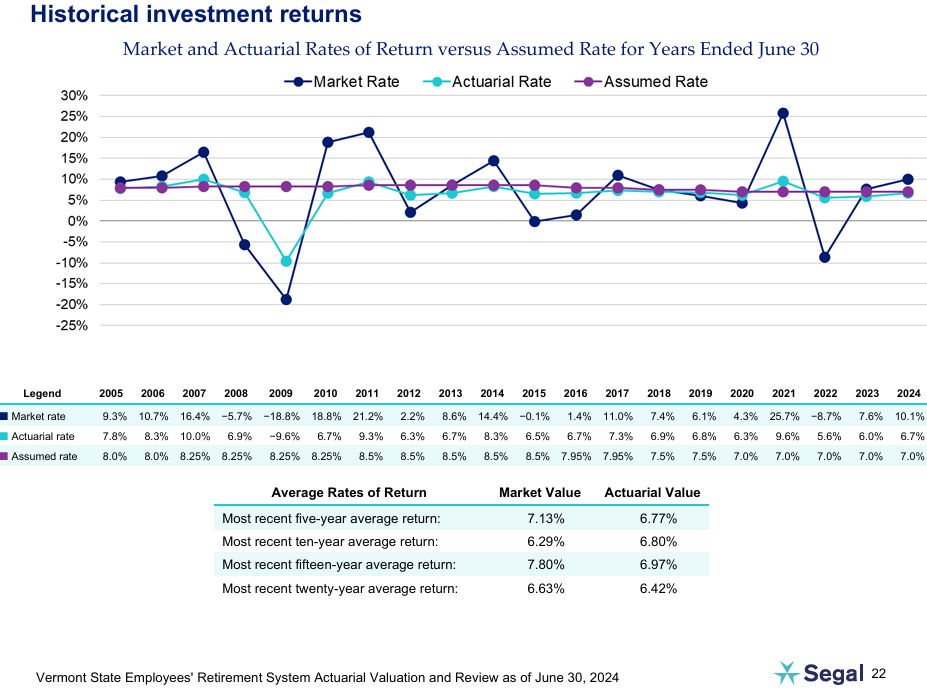
"If you recall, 2021 was an exceptionally good year in the markets, and our funds earned a return in the 25-26% range. In contrast, 2022 was a bad year, and our funds lost approx. 8-9%. With returns like these, you can see why the funded ratios (reflected on a market basis) would jump around from 2020 – 2022. If we calculated our annual contributions to the funds based on these fluctuating values, it would be tremendously more difficult to manage the state budget.
"This is why pension systems use an actuarial smoothing method to set the necessary annual contributions and track funded status on an actuarial basis. Vermont is no exception. We use a 5-year smoothing method that essentially recognizes gains and losses over a 5-year period. That way, the amount we need to fund each year is more predictable and less prone to significant swings up or down. The charts that Treasurer Pieciak displayed yesterday reflected the actuarial funded status, which smooths out the market returns, and they reflect a steady upward trend since 2020.
"In the event it is helpful to see this difference visually, we reflect both the market and actuarial returns in our annual valuations. Take a look at page 22 of this year’s State Valuation. You can see how the market returns fluctuate between 2020 and 2022, while the actuarial returns chart a much smoother course.
"Bottom line, Equable’s 2021 number looks reasonable to me, because it reflects the market valuation and not the actuarial."
Additional information on the FY24 reports for Vermont's pension and OPEB systems can be found here.
Source: 1.7.2025. Office of the Vermont State Treasurer
To support vital journalism, access our archives and get unique features like our award-winning profiles, Book of Lists & Business-to-Business Directory, subscribe HERE!
