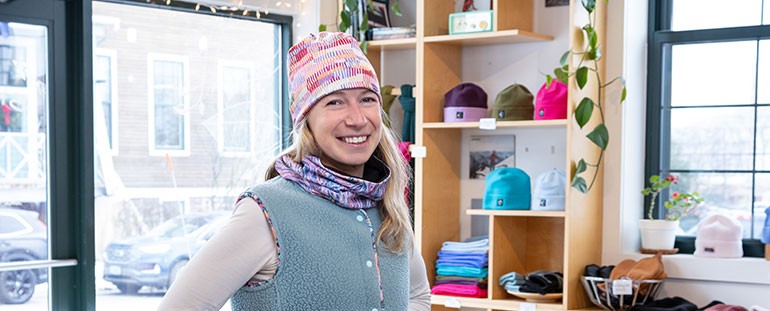
Corinne Prevot, Skida founder. Photo: Baldwin Photography.
by Joyce Marcel, Vermont Business Magazine
When people talk about Corinne Prevot, the young owner, founder and designer of the proudly made-in-Vermont outdoors accessories brand Skida, they often call her “a born entrepreneur.“
What exactly do they mean?
“She’s just an awesome go-getter,“ said Jason Levinthal, the founder of J Skis, which sells handcrafted, limited-edition skis and ski wear in Burlington as well as on the internet.
Levinthal collaborates on hat designs with Prevot and sells the Skida brand in his store.
“She’s a hard worker, passionate and very creative,“ he said. “And she’s created a great brand.“
Being an entrepreneur doesn’t speak to a person’s intelligence as much as it does their approach to business, Levinthal said.
“You take risks and try different things,“ Levinthal said. “You’re never going to figure anything out on your first try. You’ve got to be able to stand back up and get back on the horse, as they say. It’s just perseverance, being passionate, staying positive and finding a way to make it happen.“
Perseverance and passion are the attributes most frequently mentioned by those who know Prevot. After all, this is a woman who began making and selling ski hats while still in high school and has now, at age 34, created a business with yearly revenues exceeding $2 million.
Her business supports 21 full-time employees, as well as a network of seamstresses in the Northeast Kingdom who craft the products sold across the United States and abroad.

Photo: Prevot, left, meets with colleagues at Skida’s Burlington office. Photo: Baldwin Photography.
In person, Prevot exudes a charming innocence and likability. She is also undeniably an anomaly — young, female, creative, passionate, successful and phenomenally energetic.
(When I write profiles like this one, I typically ask the subject for five or six references who can speak to their character and business. Prevot sent me 19 names.)
Skida — the Swedish word for “ski“ — makes and sells ski hats in colorful fabric patterns ranging from polyester to cashmere. It also produces neck warmers, ball caps, bandanas, beanies, pants, balaclavas and headbands, to name just a few of its products.
A junior national champion in cross-country skiing, Prevot was already creating and selling hats to the skiing community while a high school student at Burke Mountain Academy.
“I was pretty crafty growing up,“ she said. “So I was knitting and making mostly fleece products. I had this fleece hat that I had made myself, which I wore to one of my early cross-country ski races. I was so warm during that race that I took my hat off and threw it to the side of the trail.“
Later, when she came back for the hat, it was gone.
“I realized I couldn’t race in a fleece hat because it was too warm,“ Prevot said. “I needed to find something — or make something — that was lighter weight and more breathable for cross-country ski racing.
At a nearby craft store, she found poly-Lycra fabric, often used in cycling caps, and repurposed it to produce her first batch of ski hats. The resulting hats were particularly bright and colorful, likely due to the fabric’s original use in swimwear.
“They had these really fun, tropical bright prints,“ Prevot said. “I made a batch for my teammates and me, and we wore them to this race in Maine. It was hilarious, because they were so much brighter and more colorful than anything you’d see in the Northeast cross country ski circuit in apparel for Nordic skiing. We had a good time that weekend.
“After the race,“ she added, “some gals from the Stratton Mountain School came up to me, and they were like, ’Hey, do you have any more of those hats? And can we buy some?’ I had a few extras and made my first sales. And that was the beginning.“
Prevot’s company fits into a growing cohort of clothing and accessory manufacturers in the state, said Kelly Ault, executive director of the Vermont Outdoor Business Alliance, a statewide nonprofit established in 2018 to support Vermont’s outdoor economy. Alliance members comprise businesses and organizations that represent the highly diversified outdoor sector of manufacturers, resorts, hospitality, retail, side services, educators and service providers that support the local and state economy.
Ault explained that the alliance is currently working with a network of 50 or so outdoor manufacturers in the state, ranging from startups to midsized companies like Skida to Vermont’s most beloved brands like Burton and Darn Tough.
“There are a wide range of companies,“ Ault said. “We’re hoping to continue to grow and expand and keep production in the state and support our employees being able to make things here that are durable, high-quality and beautiful.“
Vermont has become a hotbed for new companies working in textiles, apparel, accessories and footwear, Ault said. So Skida fits right in.
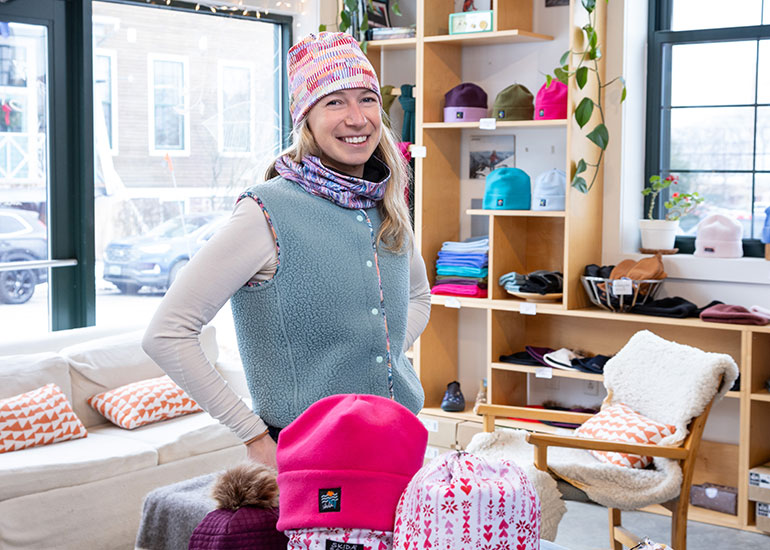
Corinne Prevot, at Skida’s flagship store in Burlington. Photo: Baldwin Photography.
“There has been a resurgence of companies who see a business opportunity, who are able to be close to the users that they’re serving, the customers that are indoors or out-of-doors, whether that’s a resident or someone visiting Vermont,“ Ault said. “And so we are seeing a number of companies like Skida being able to grow here and establish a market niche because of the world-class recreation assets that Vermont is able to offer in the outdoors.“
Adeline Druart, CEO of Lawson’s Finest Liquids, said she noticed something special about Prevot when they first met four years ago at a gathering of the Vermont Women’s CEO and Business Owner Peer Group.
“I think her entrepreneurial spirit is inspiring,“ Druart said. “And even more inspiring is knowing that she started so young, had that business spirit and was able to successfully scale it. For the business to be flourishing today and not have died in a basement somewhere — that’s what is remarkable.“
Prevot’s spirit and lifestyle drive the Skida brand, Druart said.
“Her brand really is an extension of who she is and what she believes in, which is the outdoors,“ Druart said. “Her products are unique and make people feel good. That is apparent in everything she creates.“
Most remarkable, Druart said, is Prevot’s commitment to Vermont and its people.
“It’s her community mindset,“ Druart said. “It started with her friends at Burke Mountain Academy and the ski community, who loved her products and wanted to buy them. But she built her business around the community of seamstresses who make her products in rural Vermont. It would have been easy for her to outsource manufacturing and be done with it. I don’t know many businesses that have done it the way she’s done it, which is relying on people at home to craft products for her.“
Early Days
Prevot draws much of her inspiration from her powerhouse parents, who operated a farm, competed successfully in Ironman competitions, ran marathons and held down demanding jobs — all while raising three kids.
Her father was a manufacturing operations executive at a packaging company in Pennsylvania, and her mother was a conservation easements and land surveyor.
“I was raised on a farm in southern Pennsylvania,“ Prevot said, “and my dad’s side of the family lived in the Lyndonville area of Vermont. We spent a lot of time going up there, making that nine-hour drive.“
Prevot said her parents’ devotion to endurance athletics had a great influence on her.
“They taught me from a young age about hard work, perseverance, discipline and routine,“ Prevot said. “They were at their peak before having children. They were both triathletes, and they would train for Ironman competitions while working full-time-jobs in Boston.“
The family farm, more of a hobby operation, was important to her mother, Prevot said, especially for growing their own food.
“We raised livestock, had a big vegetable garden and owned some additional fields that the neighboring commercial farms tended to,“ Prevot said. “We raised pigs, cows, chickens, but mostly sheep. Sometimes the flock got as big as 12 to 15, and that involved a lot of really fun tasks. As a kid, we would shear the sheep. Every spring they would lamb, and we’d have lambs to take care of. There was always some fun drama going on with the sheep.“
Her parents, now retired and living in East Hardwick, also modeled the importance of being involved in one’s community.
“I always have admired how they are so good at integrating into their communities,“ Prevot said. “When we lived on the farm in Pennsylvania, we knew all of our neighbors and kind of knew what everybody did. There were different farms around us. I remember going to the butcher shop, and the butcher also had his own farm. And we knew all the animals at his place. My parents were really good at staying connected with all of our neighbors, and I’ve always appreciated that.“
Prevot’s father, a Burke Mountain Academy graduate, served on the school’s board of trustees while she was growing up. During family visits to Burke for board meetings, Prevot fell in love with the place and learned to ski there.
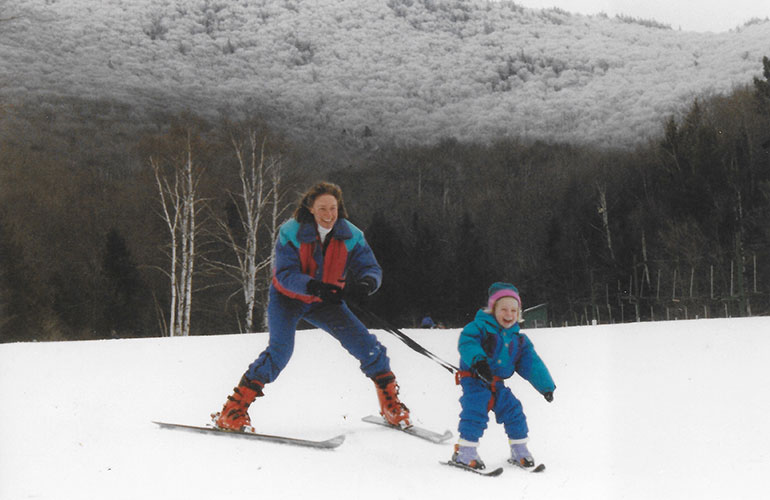
Photo: Prevot skiing at an early age. Photo courtesy of Skida.
“We would go and spend weekends up at the campus,“ Prevot said. “I remember playing in the soccer field with my brothers when I was 8 years old, and I asked, ’Can I go here?’ My mother had to explain to me, ’Well, if you are passionate about ski racing and you want to pursue that, you could go here.’ That planted the seed for me.“
She started school at Burke in the eighth grade, when she was 13. One of her first teachers at Burke, Viv Buckley, still remembers the Prevot family.
“I think her family is a special unit that helped shape her,“ Buckley said. “Her dad is this wildly successful businessperson. Her mom is one of the most understated people I know, who has her own talents and passions but consistently works in support of her family in the most chill, efficient and effective way.
“Her brothers are also unique, creative, driven. Each member of the family is beautifully balanced in a yin-yang kind of way: the love, the balance, the support, the drive, the humility, the sense of play, the concern for and appreciation of others.“
Buckley remembers Prevot’s independence and drive.
“While I would not have been able to predict that what I observed was entrepreneurial, her independence and drive were impressive as a high school freshman,“ Buckley said. “When I was approached about teaching a student who as a freshman was ready for precalculus, I was a little skeptical, not just about her ability but also the responsibility and drive that go with an independent study. My time with Corrine one-on-one was always delightful and inspiring. She was far from precocious, but simply curious and disciplined. I would not even describe her approach as overachievement. She was a genuine learner who also exhibited humility and creativity. It was a refreshing Socratic experience.“
Burke Academy attracts many students like Prevot, who go on to become entrepreneurial in fields such as farming, athletics and business, Buckley said.
“I think of Corinne as having curiosity, creativity, patience, optimism, a sense of play and appreciation for teamwork,“ Buckley said. “She has vision and drive without being demanding or controlling. She is inviting, inspiring and exudes wonder and joy.“
Prevot began her athletic career as a downhill skier at Burke, but soon discovered she loved Nordic more. She then began her cross-country skiing career — and her ski hat company.
“After the first weekend selling a few hats, I made a few more over the week and brought them to the next weekend ski races at the Trapp Family Lodge and at Stowe,“ Prevot said. “Then I sold a few out of the team van, went back and made a few more. At this point I was just selling them at ski races. They were so fun and got people excited. It was like, ’Which pattern are you going to choose?’ And it was an opportunity, early on, to have a form of self-expression and color at a time where that wasn’t necessarily as prevalent in our sport. Then I also developed some fleece styles for the Alpine skiers at Burke and started selling them at Alpine races. My classmates took them to the Alpine ski races and sold some of the hats for me. It was a fun thing for them to do.“
Skida grew in tiny steps, Prevot said.
“It’s really hard to pinpoint an exact moment when the business began, but there were all these little steps along the way,“ she said. “It kind of evolved from a kitchen-table project to what we kind of technically know as a business. I think it also reflects the journey that I had. I went on to learn about what I was doing, because I was so young when I started. I didn’t really know how a business operated to the degree that I know now. So I think my perception of what a business was and what Skida was evolved organically.“
One of Prevot’s earliest business mentors was Stephen Fuller, who was then the chief marketing officer at L.L. Bean.
“I was also a ski coach here in Maine,“ Fuller said. “Some kids who I had previously coached started going to school at Burke. When I brought some kids over to a race at the Trapp Family Lodge, I noticed some hats hanging from a rope at the Burke tent. One of my former skiers said to me, ’Those are Corinne’s hats. You really should talk to her, because she’s trying to start a hat business.’“
Soon thereafter, Fuller began working with Prevot.
“She had questions about inventory, and so I would introduce her to inventory personnel,“ Fuller said. “She’d have questions about wholesaling or selling direct to consumer, and I was essentially a source of information for her. One of the biggest things we used to talk about was forecasting. How do you forecast for a business? And one of the nicest things about Corinne — and I really do believe it’s one of the reasons why she’s been so successful — is that she’s incredibly good at asking questions.“
Many companies sell ski hats, and many young people start making clothing for their peers and dream of turning it into a business. Prevot’s venture was different.
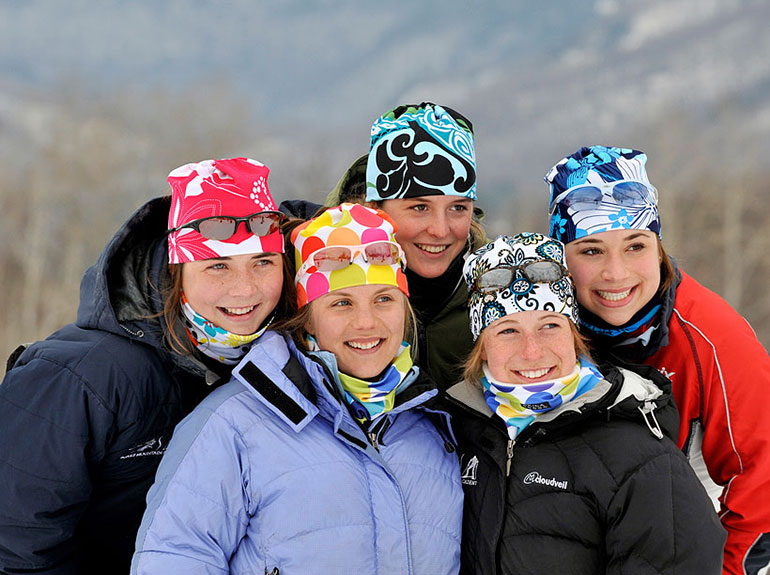
Photo: Prevot, second from right, models early Skida hats with classmates. Photos courtesy of Skida.
“In many cases, what stands out is her ability to be curious,“ Fuller said. “Also, she has an incredible aesthetic and understands what a brand is in its truest sense. The ability to ask questions and to look at things rationally and objectively — those two pieces don’t always go together. Someone who has an incredible design aesthetic and the makeup to be a good businessperson—those two skill sets don’t always go hand in hand. That’s one of the things that makes Corinne so unusual. She’s a truly amazing young person who has a unique set of skills and a lot of drive, and she has the ability to translate those into an incredibly successful business.“
Bringing freshness to a product line every year while remaining true to the brand’s aesthetic is difficult, Fuller said.
“One of the things you’ve got to know about Skida is that it’s a function brand and a fashion brand,“ Fuller said. “To be successful, it has to have a fresh look every year, and doing that repeatedly year after year after year is really hard.
“She now has the business very much in hand, but she still reaches out with questions,“ Fuller added. “I usually hear from her a few times a year. The questions are often about organizational structure or forecasting or, ’Hey, I think I’m at the point now where I have to bring in X position or Y position. What makes those positions successful in a bigger company?’ Those are the things that Corinne does really well.“
Eventually, Prevot needed help making the hats; that is when she connected with a cohort of independent seamstresses living in the Northeast Kingdom.
“While I was at Burke, my hat business was starting to get a little busier, and I was also starting to apply to colleges,“ Prevot said. “So I started looking around for help. The gentleman who managed the campus facilities, Rob, had a wife who was a seamstress and lived nearby. He offered to connect us, and his wife started making a few hats. Then, when demand increased, she referred us to a friend of hers who had worked at one of the garment factories in Newport. There’s so much garment manufacturing history in Newport.“
Prevot was able to assemble a network of contract sewers that she still uses today.
A Business in College
Prevot was still competing in Nordic skiing when she started at Middlebury College, pursuing a degree in sociology and geography while making and selling ski hats. She eventually completed her degree, but a study abroad program in her junior year took her to Nepal and changed her life.
“I decided I wanted to study abroad, and that meant not being able to give my fullest effort to the Nordic team,“ Prevot said. “So I retired from racing at that time. I studied development and social change and looked into international development and the effects that kind of work has had on Nepal on a cultural and sociological level.“
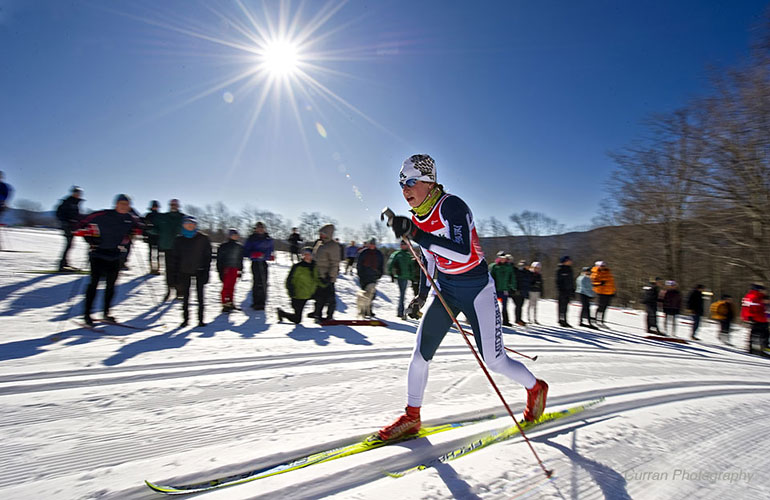
Photo: Prevot competes in a Nordic skiing competition for Middlebury College. Photo courtesy of Skida.
Prevot learned to speak Nepali, hiked in the mountains and even reached Mt. Everest’s base camp. But most importantly, she began learning about specialty textiles found in Nepal, such as cashmere, and she established a long-standing business connection with textile producers in the country.
By her junior year at Middlebury, Prevot had formally started her business. In 2011, she was chosen to attend an exclusive conference in tandem with a Forbes feature story on All-Star Student Entrepreneurs, a select group of college students who started significant businesses while attending school full time.
“In preparing for this event, I studied more about the business in a way that I could talk about it among other entrepreneurs,“ Prevot said. “This helped me understand Skida as a business and helped it evolve from a ’side project’ to a real business.“
Prevot went out and purchased a Singer sewing machine for under $100 at Walmart. Then she started buying fabric — often deadstock, or fabric ends — and seriously making hats.
“The startup costs were pretty minimal,“ Prevot said. “As I made my first sale, I was able to turn that money into more fabric. Originally, I was sourcing our fabrics from deadstock fabric outlets, and I would shop around for prints and colors that I liked. I had a couple of different sources, most of which were online. Sometimes I’d be shopping with these thumbnail images of what I think the pattern would look like, and then the fabric would show up and the print would be massive or, you know, very different from this tiny image. That was always part of the fun of it, too, that kind of surprise. But the beauty of deadstock fabric is that you only have a set amount of fabric available. So when I made hats and ran through that yardage, it would be done, I couldn’t get more.“
This process helped define the ethos of the brand. “It created the assortment and limited edition nature of what we’re known for,“ Prevot said.
But the variety of fabrics used in making the hats may be the quality that helped separate Skida from the competition.
“In the Nordic space, there really wasn’t a lot of color or pattern, especially the kind of feminine colors, flowers, polka dots and other similar types of patterns that we started with,“ Prevot said. “The hats we introduced were really new in the beginning. They were something that the Northeast ski community hadn’t seen before.“
Prevot gradually grew the business while in school, but it wasn’t until she graduated that sales began to take off in a big way.
“The growth was organic and passive as I was balancing a full course load and training and racing as a cross-country skier,“ she said. “When I moved to Burlington and set up shop in my first leased office space, that’s when it felt real. It wasn’t until I graduated from college that I started really paying myself a salary.“
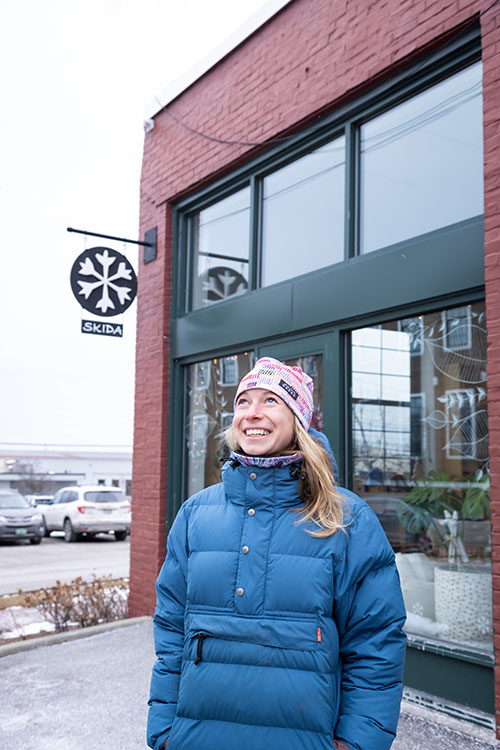
Photo: Corinne Prevot, at Skida’s flagship store in Burlington. Photo: Baldwin Photography.
The Future
Nepal looms large in Prevot’s future plans.
“Cashmere is my passion project,“ she said. “I’ve always loved cashmere, but I didn’t know much about it. When I went to Nepal, I kept seeing cashmere shops, and pashmina, and cashmere for really cheap. I thought cashmere was supposed to be really expensive, so I was confused.“
As part of her study-abroad program, Prevot needed to select a topic for an independent research project. She decided to dive into the cashmere industry.
Cashmere fiber comes from the underbelly of goats herded on the Himalayan plateau, from Mongolia to Nepal. The harsh, cold climate of the region produces exceptionally fine fur, as it keeps the goats warm.
“I kind of pulled back the layers and got to understand and meet a lot of different suppliers in the Kathmandu Valley — some that have been around and family-owned for many generations,“ Prevot said. “Traditionally, Nepal is one of the largest exporters of cashmere. But when India and China began creating tons of factories and knitting, and producing yarns at spinning mills, they could machine spin yarns at a much faster rate and higher volume. That really hurt a lot of the Nepal-based manufacturers, because it diverted the supply chain“.
When Prevot returned to Vermont and her business, she kept the fabric in mind.
“I knew that I loved cashmere, and I wanted to source some cashmere for Skida,“ Prevot said. “So in 2014, the year after I set up shop in Burlington, I went back to Nepal and did my first sourcing trip to four or five different factories. Now we work consistently with two.
“One of my favorite parts about that study-abroad program,“ she added, “was learning the Nepalese language and being able to go back and use that skill to communicate with people in the factory. Just being able to communicate in Nepali has made the experience so much richer.“
The Skida line now includes cashmere ponchos and shawls, and will soon include cashmere sweaters.
“I’ve gone back four times since that first sourcing trip, and I continue to meet with those same factories,“ Prevot said. “I have some really wonderful relationships with some of the families that run the businesses. It’s been so cool because they met me when I was a college student, interviewing them about cashmere production. Now I’m working with them to create products for Skida. I go over with designs of the types of knits and woven shawls that I want, and they handle the cutting and sewing.“
Skida is now a “proud partner“ of the U.S. Ski and Snowboard Team and also makes custom products.
“Skida is dedicated to collaborations and custom products for a variety of customers, like nonprofits, organizations and businesses — both local and nationwide,“ Prevot said. “This has been a way to expand our community and enable partners to create their own unique Skida products while promoting their own brands.“
The company recently collaborated with Vermont’s Rural Community Transportation to wrap a bus in one of its fabric designs.
“The wrapped bus, touting the 100th anniversary of the Vermont State Parks, featured our Elmore print,“ Prevot said. “This was a fun project and a rewarding end goal of amplifying the important work of Vermont-based community resources, like state parks and public transportation. The bus currently runs on Route 100 from Morrisville to Waterbury, giving free rides to Vermonters year-round.“
In addition to being Skida’s founder and owner, Prevot also serves as the company’s creative director.
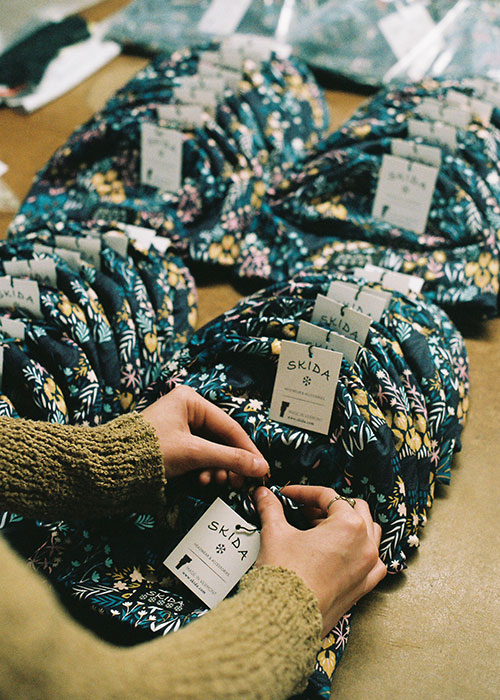
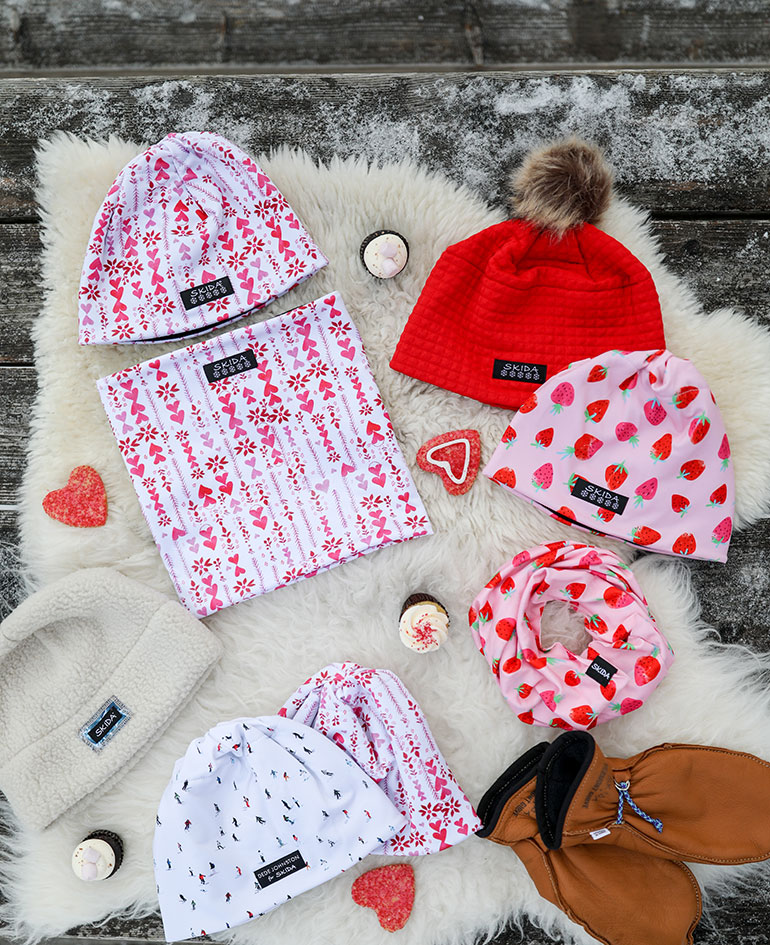
Photos: Skida products are proudly made in Vermont. Photos courtesy of Skida.
“I have a team,“ she said. “They do graphic design, they help with merchandising decisions and marketing, and deciding what prints we think we should do next, and what our customers are excited about. So it’s definitely a team effort to bring our prints to life. Now all of our patterns are exclusive to Skida unless they’re a collaboration, in which case they’re exclusive to two or multiple brands or organizations.“
Skida sells to over 300 retailers across the U.S. and all over the world on the internet. Developing international distribution is high on Prevot’s list of priorities. Canada is now one of her biggest markets, but Prevot would love to expand further and have a European distributor.
The need for deadstock is long gone. Skida now custom-designs its prints and cuts its hats to allow only 1% waste. Prevot takes pride in running a socially responsible company committed to preserving the environment.
Not surprisingly, Prevot has found a boyfriend, the athlete manager at Burton Snowboards, who similarly enjoys marrying his personal and professional pursuits.
“We’re both very passionate about winter sports and outdoor recreation, and we spend a lot of time doing those things together,“ she said. “We travel a lot together, and we have a lot of friends here that we love to stay connected with. We like music and food, and are both very career- minded.“
And the future for Skida?
“The future looks like keeping people covered in joy in inclement conditions,“ she said. “Having Skida around in the future is my goal.“
Joyce Marcel is a journalist in southern Vermont. In 2017, she was named the best business magazine profile writer in the country by the Alliance of Area Business Publishers. She is married to Randy Holhut, the news editor/acting operations manager of The Commons in Brattleboro.
To support vital journalism, access our archives and get unique features like our award-winning profiles, Book of Lists & Business-to-Business Directory, subscribe HERE!