Finds that a Sustainable Funding Source Required for Success
Vermont Business Magazine The Department of Housing and Community Development (DHCD) is announcing the results of a study required under Act 181 of 2024 that examines the feasibility and opportunities of creating a Land Bank in Vermont to revitalize underutilized properties. Land Banks are quasi-governmental entities empowered to make vacant, abandoned, deteriorated, and tax delinquent properties productive again.
A funding source would need to be established. In some other states, land banks are funded by collecting late fees/fines on delinquent property taxes, or are funded by a $3 per ton fee for the disposal of construction and demolition debris at state, county, and municipal landfills, or through a small transfer tax for real estate transactions, or with a "blight bond."
“We are dedicated to exploring options and trying to find innovative solutions to increase the amount and quality of housing in Vermont,” says Housing and Community Development Commissioner Alex Farrell. “This study is an example of our efforts to learn more about tools being used in other states to understand how they can apply to Vermont.”
In the latest Vermont Housing Needs Assessment, VHFA estimates there are 10,879 vacant and abandoned homes throughout the state, representing 3% of the housing stock. That assessment also determined that Vermont needs to add 24,000 to 36,000 homes by 2029 to meet demand.
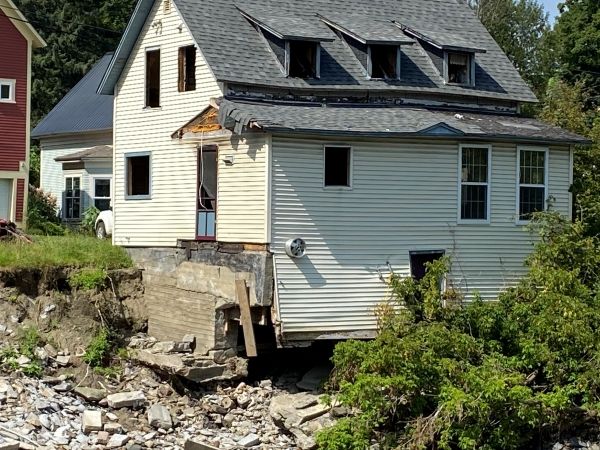
Depending on how they are structured, Land Banks can be used to redevelop vacant homes and commercial buildings, create new housing, obtain abandoned agricultural land, acquire and maintain land for conservation, and help stabilize communities after natural disasters like the flooding Vermont saw in 2023 and 2024.
Land Banks are not driven by getting the highest price for rehabilitated properties, rather they are focused on the best outcome for the community. Land Banks also have the potential to be a huge help to small, rural communities that lack the capacity to oversee these types of efforts.
“If Vermont adopted a Land Bank model, it could help smaller communities achieve their economic development goals,” says Economic Development Commissioner Joan Goldstein. “Removing blight and replacing it with homes and viable commercial and industrial space where employers can put people to work is an interesting approach to consider.”
In order to be effective, the study found Land Banks need a dedicated, sustainable funding source.
What is a Land Bank?
A land bank is a public entity with unique powers to put vacant, abandoned, deteriorated, and tax-delinquent properties back into productive use according to community goals. Land banks are accountable to the public given their status as quasigovernmental entities.
Problems land banks can help address:
• Vacant, abandoned, deteriorated properties.
• Properties with “cloudy” or unmarketable titles.
• Property with little market value.
• Restrictive public property disposition and/or funding requirements.
What land banks can do:
• Acquire tax foreclosed property cost effectively.
• Extinguish liens and clear title.
• Hold property tax exempt.
• Generate and collect revenue from delinquent tax fees, tax recapture, or other funding mechanisms.
• Make flexible disposition decisions, driven not by highest price but by best outcome.
What land banks are not:
• Simple community development corporations (CDCs).
• Financial institutions (no cashing checks).
• Get-rich-quick agencies.
You can read the full 2024 Land Bank Feasibility Report here.
2.3.2025. Montpelier, Vt. – Department of Housing and Community Development
To support vital journalism, access our archives and get unique features like our award-winning profiles, Book of Lists & Business-to-Business Directory, subscribe HERE!