

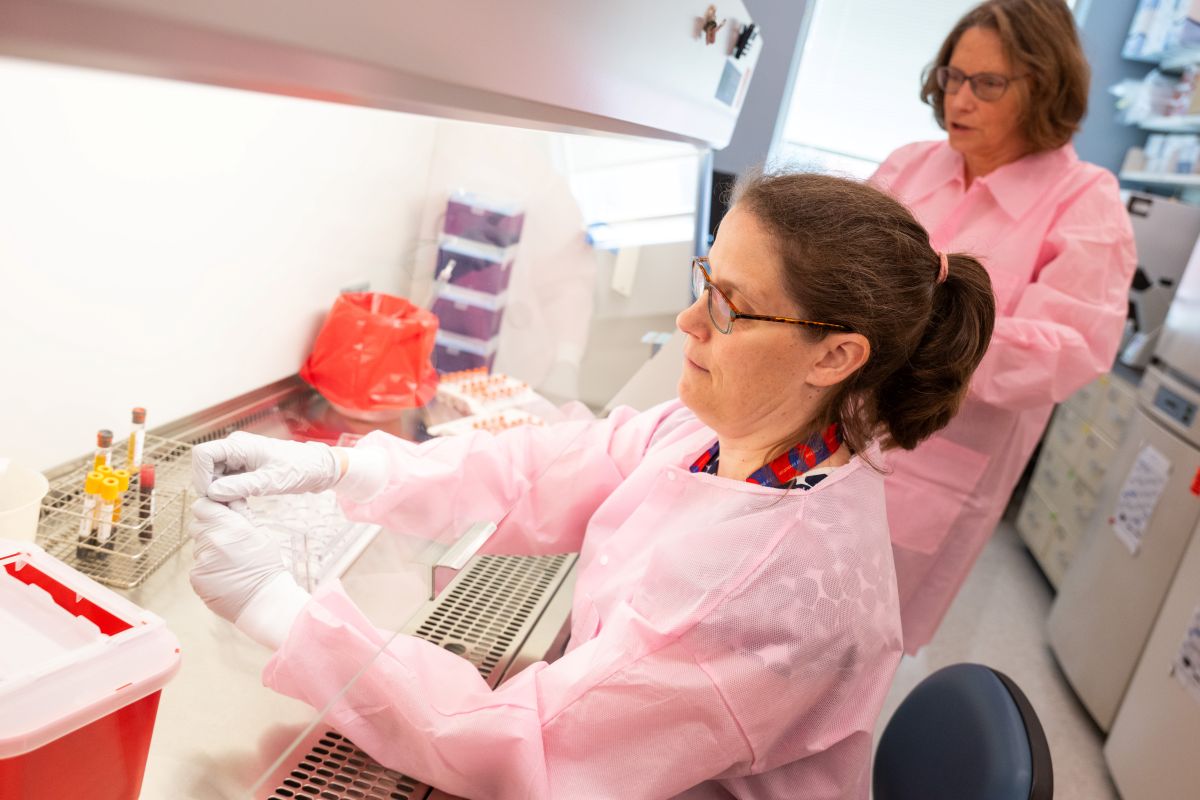
In the Vaccine Testing Center at the University of Vermont, lab manager Marya Carmolli (left) works with blood samples from dengue vaccine clinical trial volunteers, as Beth Kirkpatrick, M.D., looks on. (Photo by Andy Duback)
Vermont Business Magazine The world’s first single-dose vaccine to prevent dengue fever was approved for licensure following 16 years of research contributions by scientists at the University of Vermont Vaccine Testing Center, in partnership with the U.S. National Institutes of Health (NIH) and the Johns Hopkins Bloomberg School of Public Health (JHSPH). In addition, a promising new anti-viral medication designed to prevent infection and illness in individuals exposed to dengue virus will advance, thanks to clinical trials at the UVM Vaccine Testing Center and JHSPH. Both achievements were announced on November 26.
These accomplishments offer significant advancement in the global control of dengue, the leading cause of mosquito-borne viral disease worldwide. With over 100 million cases reported annually, dengue poses a growing risk throughout the globe, including in the United States. Along with high fever and severe muscle and bone pain, the virus can lead to shock, bleeding, and death.
“These milestones represent a turning point in global dengue prevention and treatment. We are proud of the role UVM has played in advancing science that will save lives worldwide,” said UVM Vaccine Testing Center founder Beth Kirkpatrick, M.D., professor and chair of the Department of Microbiology and Molecular Genetics at the Robert Larner, M.D. College of Medicine.
The new dengue vaccine is licensed for use in Brazil under the name Butantan-TV and the Instituto Butantan will incorporate it into Brazil’s national immunization program. Brazil recorded 5.9 million cases of dengue and over 6000 deaths in 2024. Additional global approvals are anticipated as the vaccine is developed through additional pharmaceutical partners including Merck and the Serum Institute of India.
Dr. Kirkpatrick served as principal investigator for the umbrella research funding award which supported early-stage clinical trials and immunology research on the vaccine at UVM. Kirkpatrick and colleagues began studying the candidate tetravalent (four-serotype) dengue vaccine in 2009 in collaboration with leaders in the dengue field: JHSPH professor Anna Durbin, M.D., and NIH virologist Steven Whitehead, Ph.D. Whitehead and colleagues at the NIH designed the candidate vaccine. Since 2009, more than 27 clinical trials have been conducted at UVM and JHSPH to develop this vaccine, yielding many major scientific and immunologic insights.
The new dengue antiviral treatment was investigated at the Larner College of Medicine led by Kristen Pierce, M.D., co-director of the Vaccine Testing Center and professor of medicine, and by Dr. Durbin’s team at JHSPH. About 80 volunteers participated in clinical trials at the two sites. The volunteers were randomly assigned to either receive the treatment or a placebo prior to receiving a dose of a mild strain of dengue virus. The study data, published in the New England Journal of Medicine on November 26, show that the treatment, an oral pan-dengue small molecular antiviral called Mosnodenivir, inhibits replication of dengue virus and prevents infection. An oral antiviral drug could be deployed in outbreaks and could be used in travelers and persons who cannot receive a vaccine.
Additional Larner College of Medicine investigators leading dengue vaccine and treatment studies include Mary Claire Walsh, PA-C, co-director of the Vaccine Testing Center, immunologist Sean Diehl, Ph.D., associate professor of microbiology and molecular genetics, and an experienced team of clinical research coordinators and laboratory staff.
- Read the announcement about approval of the vaccine in Brazil.
- Read the dengue antiviral treatment study, Daily Mosnodenvir as Dengue Prophylaxis in a Controlled Human Infection Model, in the New England Journal of Medicine.
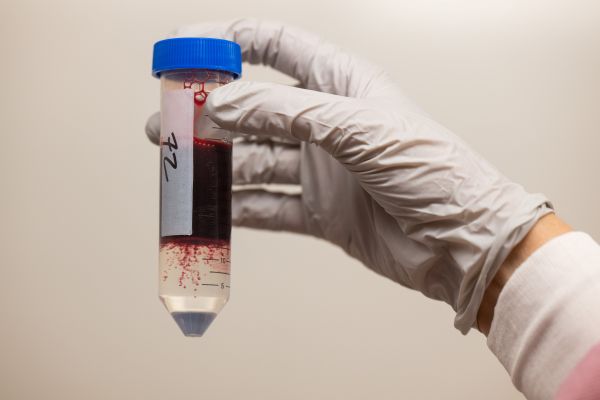
Red blood cells and serum separate after spinning in a centrifuge in the UVM Vaccine Testing Center. (Photo by Andy Duback)
Research like this has contributed to the University of Vermont’s designation by the Carnegie Classification of Institutions of Higher Education as an R1 institution, placing it in the top tier of research universities in the U.S.
About the Larner College of Medicine at the University of Vermont
Founded in 1822, the Robert Larner, M.D. College of Medicine at the University of Vermont is the seventh-oldest medical school in the nation. The college is dedicated to developing exceptional physicians and scientists by offering innovative curriculum design, state-of-the-art research facilities, and clinical partnerships with leading health care institutions. The college’s commitment to excellence has earned national recognition, attracting talented students, trainees, physicians, and researchers from across the country and around the world. With a focus on inclusive excellence, the Larner College of Medicine prides itself on cultivating an environment that uplifts and supports its faculty and student populations while advancing medical education, research, and patient care in Vermont and beyond.
12.3.2025. BURLINGTON—Larner College of Medicine at the University of Vermont uvm.edu/larnermed
To support vital journalism, access our archives and get unique features like our award-winning profiles, Book of Lists & Business-to-Business Directory, subscribe HERE!
