

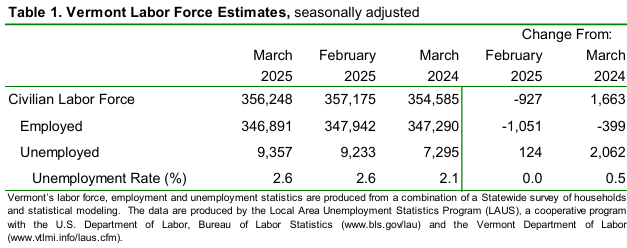
by Timothy McQuiston, Vermont Business Magazine Today, the Vermont Department of Labor reported that the seasonally adjusted statewide unemployment rate for March was 2.6 percent. This reflects no change from the prior month’s revised estimate. February’s revised estimate decreased by one-tenth of one percentage point from the preliminary estimate. The comparable United States rate in March was 4.2 percent, an increase of one-tenth of one percentage point from the revised February estimate.
Vermont continues to have the second lowest jobless rate in the nation, along with North Dakota and behind South Dakota (1.8%). Nevada has the highest rate at 5.7%.
The civilian labor force participation rate in Vermont was 65.3 percent in March, a decrease of one-tenth of one percentage point from the prior month’s revised estimate. The US average is 62.4%, according to the U.S. Bureau of Labor Statistics.
SEE TABLES BELOW
Michael Harrington, Vermont Labor Commissioner, said: “An estimated 900 jobs were added to the Vermont economy in March. Despite this growth, there are still an estimated 17,000 open jobs across the state. April 30th marks National Apprenticeship Day. Throughout the week, the Vermont Department of Labor will celebrate the importance of Registered Apprenticeships by highlighting a number of different efforts and activities that support Registered Apprenticeships. As one of the most effective pathways to a rewarding career, Registered Apprenticeships offer hands-on training and guaranteed employment upon completion. With the support of an employer sponsor, nearly any occupation can benefit from the apprenticeship model. To learn more about Registered Apprenticeships, employers and career seekers are encouraged to visit: https://labor.vermont.gov/
The seasonally adjusted Vermont data for March show the Vermont civilian labor force decreased by 927 from the prior month’s revised estimate (see Table 1). The number of employed persons decreased by 1,051 and the number of unemployed persons increased by 124. The change to the number of employed was statistically significant in the seasonally adjusted series.
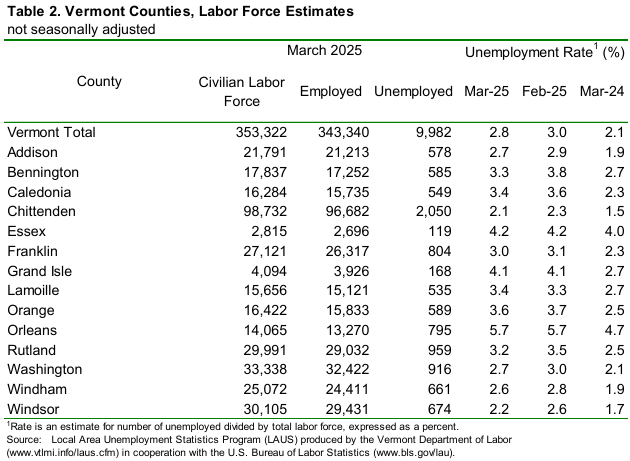
The March unemployment rates for Vermont’s 14 counties ranged from 2.1 percent in Chittenden County to 5.7 percent in Orleans County (note: county unemployment rates are not seasonally adjusted – see Table 2). For comparison, the March unadjusted unemployment rate for Vermont was 2.8 percent, a decrease of two-tenths of one percentage point from the revised unadjusted February level and an increase of seven-tenths of one percentage point from a year ago.
*** BLS note on LAUS geography and data changes in 2025: https://www.bls.gov/lau/geography-and-data-changes-in-2025.htm ***
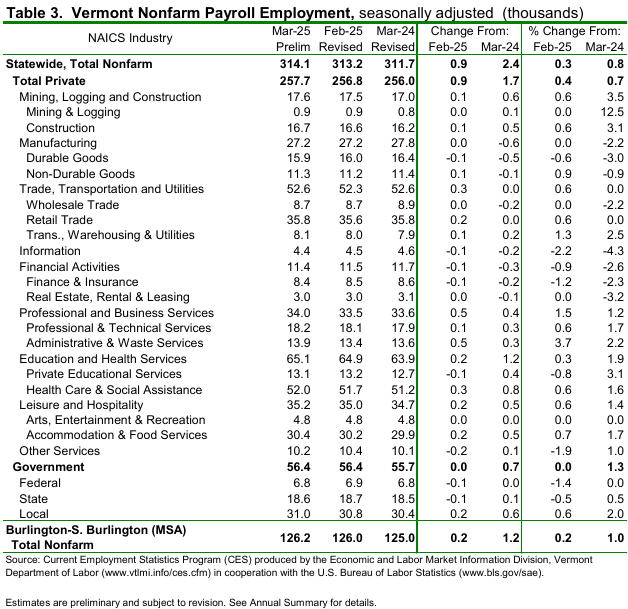
Seasonally Adjusted (Table 3)
The seasonally adjusted data for March reported an increase of 900 jobs from the revised February data. There was an increase of 100 jobs between the preliminary and the revised February estimates due to the inclusion of more data. The seasonally adjusted over-the-month changes in March varied at the industry level. The industry with a notable increase was Administrative & Waste Services (+500 jobs or +3.7%). The industry with a notable decrease was Other Services (-200 jobs or -1.9%).
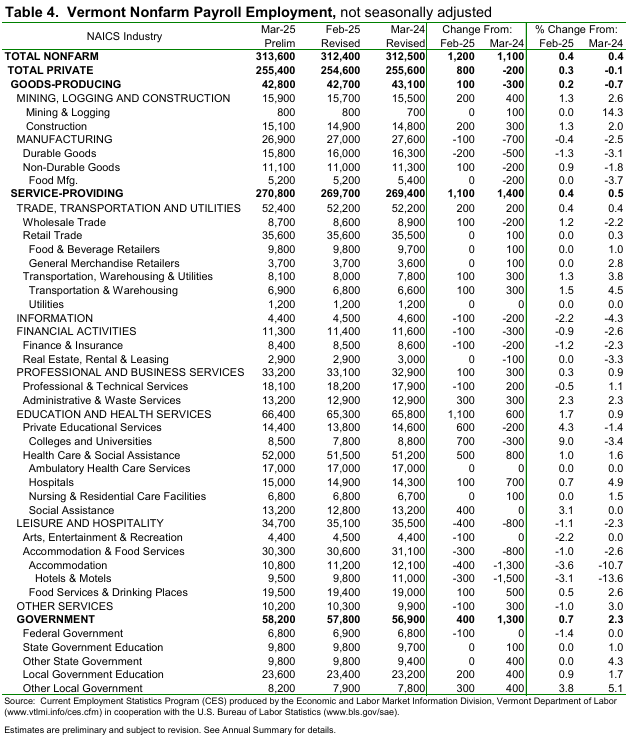
Not-Seasonally-Adjusted (Table 4)
The preliminary ‘not-seasonally-adjusted’ jobs estimates for March showed an increase of 1,200 jobs when compared to the revised February numbers. As with the seasonally adjusted data, this over-the-month change is from the revised February numbers which experienced a decrease of 300 jobs from the preliminary estimates. The broader economic picture can be seen by focusing on the over-the-year changes in this data series. As detailed in the preliminary not-seasonally adjusted March data, Total Private industries decreased by 200 jobs (-0.1%) over the year and Government (including public education) employment increased by 1,300 jobs (+2.3%) in the past year.
Weekly Unemployment Claims
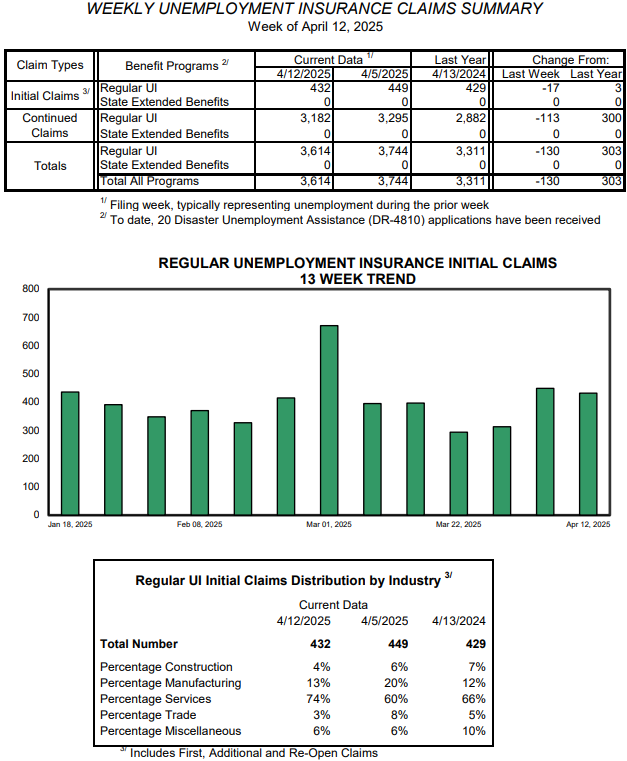
Vermont weekly unemployment claims for the week ending April 12, 2025, were largely unchanged but remain near their highest level since the end of February. A spike at the beginning of March carried them over 600. New claims this week were 432, down 17 claims from the week before and 3 more from last year. The end of the winter tourism season tends to increase claims. Claims, which are lowest in the summer, were 181 at the end of September 2024.
In Vermont for the weekly report, the Service industry accounted for the most claims last week with 74%, up 14 points. Construction was at 4%, down 2 points, as that industry ramps up. Manufacturing accounted for 13% of claims, down 7 points.
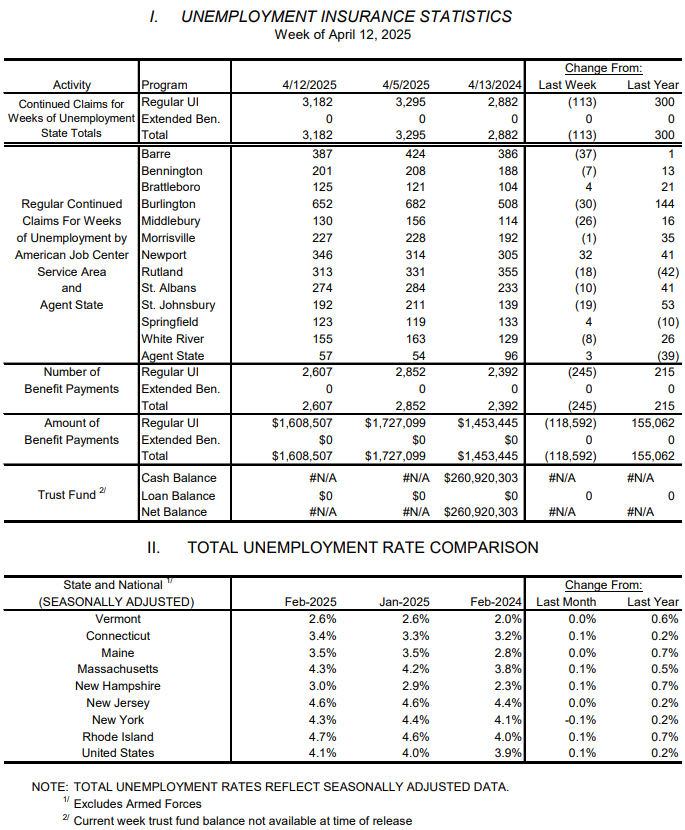
For the week, Vermont total unemployment insurance claims were 3,614 (down 130 for the week and up 303 from this time last year).
The Vermont Unemployment Trust Fund is well capitalized. As of the most recent data, there was $260.9 million in the Trust Fund, down about $1.8 million (as claims are paid out on one side, employers are contributing to the fund on the other). The pre-pandemic Trust Fund balance on March 1, 2020, was $506.2 million.
For the United States, in the week ending April 12, the advance figure for seasonally adjusted initial claims was 215,000, a decrease of 9,000 from the previous week's revised level. The previous week's level was revised up by 1,000 from 223,000 to 224,000. The 4-week moving average was 220,750, a decrease of 2,500 from the previous week's revised average. The previous week's average was revised up by 250 from 223,000 to 223,250.
Reuters has reported that the Trump Administration's tariffs campaign has severely eroded business and consumer sentiment, which could weigh on investment, spending and demand for labor. The US added 228,000 jobs in March while the unemployment rate rose to 4.2% in March from 4.1% in February.
The stock market has seen historic swings with chaotic messaging from the White House. The three major indices have lost ground this year despite a record surge in early April, before falling back. The S&P has been the steadiest this week, but the DOW, which peaked at over 45,000 in December is now back under 40,000 and the NASDAQ, which also peaked at over 20,000 in December, has likewise fallen to under 17,000.
| State | March 2025(p) rate |
Rank |
|---|---|---|
|
South Dakota |
1.8 | 1 |
|
North Dakota |
2.6 | 2 |
|
Vermont |
2.6 | 2 |
|
Montana |
2.7 | 4 |
|
Hawaii |
2.9 | 5 |
|
Nebraska |
2.9 | 5 |
|
Maryland |
3.0 | 7 |
|
Minnesota |
3.1 | 8 |
|
New Hampshire |
3.1 | 8 |
|
Utah |
3.1 | 8 |
|
Virginia |
3.2 | 11 |
|
Wisconsin |
3.2 | 11 |
|
Alabama |
3.3 | 13 |
|
Oklahoma |
3.3 | 13 |
|
Iowa |
3.4 | 15 |
|
Wyoming |
3.4 | 15 |
|
Maine |
3.5 | 17 |
|
Connecticut |
3.6 | 18 |
|
Florida |
3.6 | 18 |
|
Georgia |
3.6 | 18 |
|
Tennessee |
3.6 | 18 |
|
Arkansas |
3.7 | 22 |
|
Delaware |
3.7 | 22 |
|
Idaho |
3.7 | 22 |
|
North Carolina |
3.7 | 22 |
|
Kansas |
3.8 | 26 |
|
Missouri |
3.8 | 26 |
|
Pennsylvania |
3.8 | 26 |
|
West Virginia |
3.8 | 26 |
|
Mississippi |
3.9 | 30 |
|
Arizona |
4.1 | 31 |
|
Indiana |
4.1 | 31 |
|
South Carolina |
4.1 | 31 |
|
Texas |
4.1 | 31 |
|
New York |
4.2 | 35 |
|
New Mexico |
4.3 | 36 |
|
Louisiana |
4.4 | 37 |
|
Massachusetts |
4.4 | 37 |
|
Washington |
4.4 | 37 |
|
Oregon |
4.6 | 40 |
|
Alaska |
4.7 | 41 |
|
New Jersey |
4.7 | 41 |
|
Colorado |
4.8 | 43 |
|
Illinois |
4.8 | 43 |
|
Ohio |
4.8 | 43 |
|
Rhode Island |
4.8 | 43 |
|
Kentucky |
5.2 | 47 |
|
California |
5.3 | 48 |
|
Michigan |
5.5 | 49 |
|
District of Columbia |
5.6 | 50 |
|
Nevada |
5.7 | 51 |
|
Footnotes |
||
|
Note: Rates shown are a percentage of the labor force. Data refer to place of residence. Estimates for the current month are subject to revision the following month. |
||
Last Modified Date: April 18, 2025
The Unemployment and Jobs Report for April is scheduled to be released on Wednesday, May 21, 2025, at 10:00 a.m.