Exterior of Vermont Construction Academy’s new training center in Winooski. Courtesy photo.
Vermont Construction Academy, a new industry-created training center, opens in Winooski
by Olga Peters, Vermont Business Magazine
Construction jobs have expanded beyond wielding shovels and digging ditches. Today’s workers must also have the ability to follow digital plans, understand CAD design and be able to operate a machine connected to global positioning systems.
”Part of what we’re trying to do is overcome the perception that construction is low-tech, low-wage,” said Joshua Reap, president and CEO of the Associated Builders and Contractors of New Hampshire and Vermont. ”It’s the complete opposite of that. It’s high-tech, a great opportunity to make a good living and it involves a lot of technology.”

Photo: President and CEO Joshua Reap of the Associated Builders and Contractors of New Hampshire and Vermont. Courtesy photo.
ThinkVT, the state website aimed at attracting new residents, reports that Vermont’s construction industry comprises 40% of the state’s gross domestic product and generated $868.5 million in wages in 2024.
According to Reap, a seasoned carpenter, for example, can earn $110,000 to $140,000 a year. He added that most unskilled laborers start at $20 an hour, plus benefits.
”That’s pretty darn good tootin’ money in Vermont,” Reap said.
Unfortunately, like most industry sectors in Vermont, construction lacks the
workers to meet current demand or grow its future workforce, Reap said.
The industry, he added, has faced a workforce shortage at the national level for decades. The national chapter of ABC estimates there are currently 350,000 job openings in commercial construction across the county.
In Vermont, however, the shortage has reached a ”crisis situation.” Vermont’s construction industry loses approximately 2,000 workers to retirement or due to leaving the state each year, he said.
”When you think about how much not only our population but also our industry has been graying,” Reap said, ”we figure that, as an industry, if we don’t start growing now, we will not have a workforce in the next few years.”
Matt Musgrave, ABC’s Vermont regional director, points to the state’s cost of living and housing shortage as culprits behind the dwindling workforce. So, what does an industry whose members describe themselves as problem solvers do when faced with a workforce shortage? Launch a training center.

Photo: Vermont regional director Matt Musgrave of the Associated Builders and Contractors of New Hampshire and Vermont. Courtesy photo.
The Vermont Construction Academy is a 10,000-square-foot nonprofit center in Winooski that offers learn-as-you-earn trades apprenticeships. It is designed and supported by the industry and is overseen by ABC. Potential students can access course work throughout their careers, whether they are studying at a Career Technical Education center, adult learners shifting careers or professionals seeking to upskill.
More than a dozen Vermont construction companies donated their time and significant funding to launch the academy Musgrave said members handed the trade organization their skills wish list and then charged ABC with creating the facility.
”This is the first time, at least in Vermont, that I’ve seen such a big group of people with a common goal leverage all their resources to put something together we would never have been able to do on our own,” Musgrave said.
The VCA is committed to adding an additional 100 certified apprentices to the industry every year.
A Seven-Figure Investment
According to Reap and Musgrave, the construction academy represents a seven-figure investment from ABC members; many chose to keep their philanthropy for this project anonymous, including one stakeholder who provided ”a pretty generous gift” to help acquire the real estate.
Musgrave said the effort to build the academy should have taken seven years. However, thanks to members’ investments of time, expertise, philanthropy, and elbow grease, the academy was ready in seven months.
He also thanked the state and city of Winooski for supporting the project.
”As contractors, we all got together and said, ’We’re all struggling for workforce.’ Rather than compete against each other, we figured, ’Let’s do this ourselves. Let’s build people professionally,’” Reap said.
Establishing the VCA involved expanding ABC’s programming, hiring a full-time trainer and outfitting the facility. ABC collaborated with the Department of Labor and Agency of Education to broaden its commercial carpentry apprenticeship to include masonry, painting and finishing.
After receiving the keys on Jan. 1, Musgrave and Reap spent three months preparing the facility. Musgrave cited the location’s proximity to workers in Franklin County, the Islands and the Johnson and Cambridge areas as the reason for choosing the site.
”Winooski is one of the most underserved districts that we have in Chittenden County, and this is a way for us to bring something into that community,” he said.
The VCA’s supporters want the center to sustain itself through tuition or private donations.
”The industry knows what they need,” Musgrave said. ”They wanted us to be able to provide those services for them on their behalf and not be dependent upon state budgeting or federal budgeting.”
Building Healthy Professionals
The VCA strives to do more than teach basic construction skills. Its goal is to prepare individuals for thriving, well-compensated careers with robust benefits and career mobility.
VCA’s comprehensive training includes job-specific instruction alongside personal development. Apprentices follow the National Center for Construction Education and Research curriculum, receive hands-on training from VCA instructors and complete 2,000 hours with their employer-sponsor.
Upon completion, they earn an Occupational Safety and Health Administration 10-hour card and a nationally recognized industry credential from the U.S. Department of Labor.
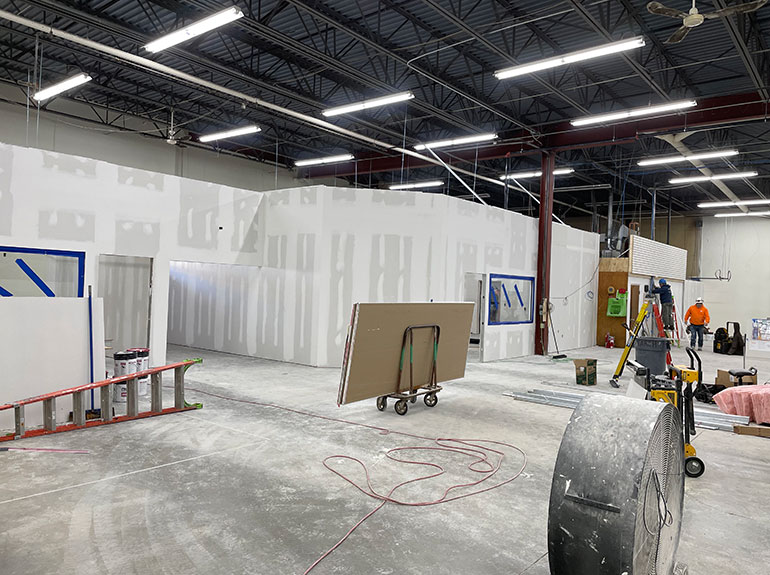
Photo: Work continues apace at Vermont Construction Academy’s new training center. Courtesy photo.
In addition to its core programs, the VCA will offer a pre-apprenticeship program, described by Musgrave as a ”boot camp.” This program includes instruction on commercial construction tools, financial literacy for new employees and interpersonal skills. Musgrave stated that the VCA aims to develop well-rounded individuals ”so that we can have healthy people go out in the workforce and build Vermont.”
ABC’s existing state-registered commercial carpentry apprenticeship program, which graduates registered journeymen, served as the inspiration for the VCA’s expanded training, due to the positive outcomes reported by participating employers.
The next cohort of apprenticeships starts in September.
The ABC is developing partnerships to help defray the cost of the program. Students are expected to pay something towards the course, but at this early stage, the organization is exploring grant funding for the first cohort.
Another possibility is developing a forgivable loan program. Students who complete the program and remain with their chosen employer for a certain length of time will have the loan forgiven.
Reap explained that the VCA and CTEs are two different experiences. CTEs are part of the state’s wider K-12 education system and do a good job, but they leave gaps.
”We’re finding, quite frankly, that the product coming out of CTE centers, a lot of kids are not prepared for the modern, professional construction operation,” Reap said. ”They need more time learning how to read blueprints, how to do construction math and how to do cost accounting.”
A Place Where People Fit In
Vermont needs to champion the trades and its people who are building the state’s schools, hospitals and homes, Musgrave said.
”Since I graduated high school in the mid-’90s, vocational-technical schools were always a penalty for people that didn’t fit in, as opposed to the right direction for someone that will fit in,” he said.
VCA will celebrate its official opening at the end of April. As the academy grows, it will offer more classes and advanced skill training for construction professionals at every stage of their careers.
”You’re always going to want to come back through our doors for advanced training because this industry continually evolves,” Musgrave said. ”You’re always going to be tied to the VCA as an opportunity or conduit to help you further your career.”
The VCA seeks students who are eager to learn and driven to achieve their goals, whether those include reaching a certain level of leadership, starting a family, buying a home or planning for an early retirement, he added.
”If they have the heart and they want to learn, we can give them everything else,” Musgrave said.
Olga Peters is a freelance writer from southern Vermont.
To support vital journalism, access our archives and get unique features like our award-winning profiles, Book of Lists & Business-to-Business Directory, subscribe HERE!