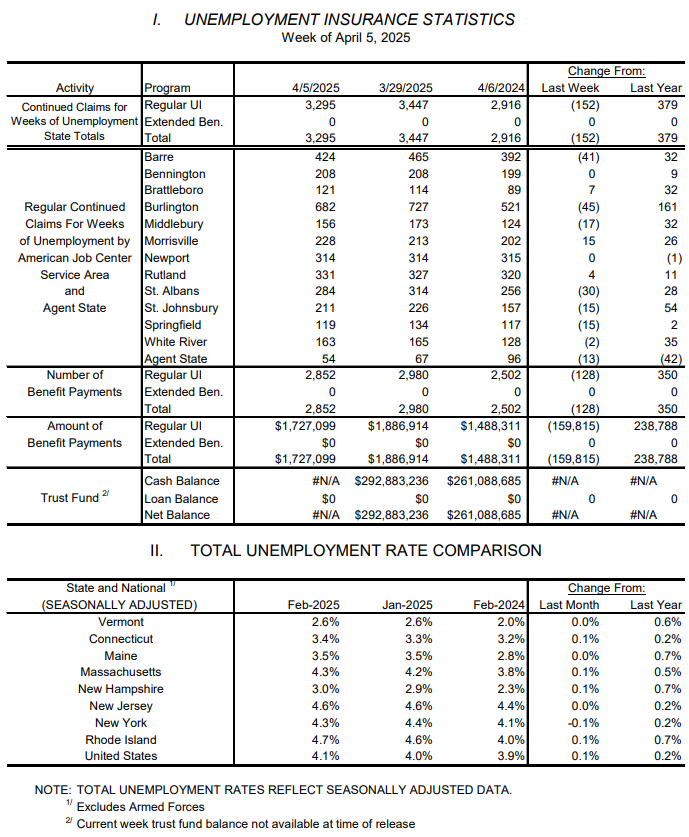
by Timothy McQuiston, Vermont Business Magazine Vermont weekly unemployment claims for the week ending April 5, 2025, increased to their highest level since the end of February. A spike at the beginning of March carried them over 600. New claims this week were 449, up 136 claims from the week before and 26 more from last year. The end of the winter tourism season tends increase claims. Claims, which tend to be lowest in the summer, were 181 at the end of September 2024.
In Vermont for the weekly report, the Service industry accounted for the most claims last week with 60%, up 2 points. Construction was at 6%, down 4 points, as that industry ramps up. Manufacturing accounted for 20% of claims, up 8 points.
For the week, Vermont total unemployment insurance claims were 3,744 (down 16 for the week and up 405 from this time last year).
The Vermont Unemployment Trust Fund is well capitalized. As of the most recent data, there was $292.9 million in the Trust Fund, down about $1.8 million (as claims are paid out on one side, employers are contributing to the fund on the other). The pre-pandemic Trust Fund balance on March 1, 2020, was $506.2 million.
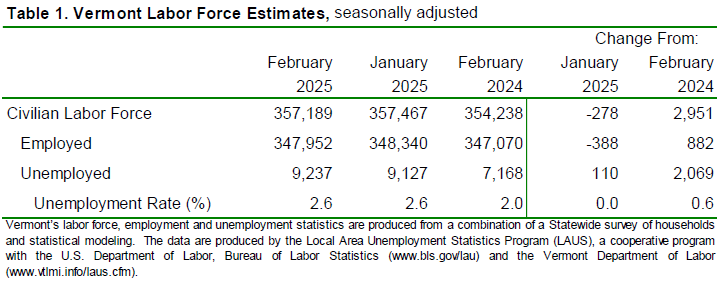
The Vermont Department of Labor reported last week that the seasonally adjusted statewide unemployment rate for February was 2.6 percent. This reflects no change from the prior month’s revised estimate. The three major indices were slightly worse from last month, as the Labor Force and Employed fell and Unemployed increased, but the changes were not statistically significant.
Vermont is still tied for the second lowest jobless rate in the nation with North Dakota. South Dakota is lowest at 1.9%. Nevada is highest at 5.8%. The Vermont civilian labor force participation rate was 65.5 percent in February, no change from the prior month’s revised estimate. The US average is 62.4%, according to the U.S. Bureau of Labor Statistics.
The comparable United States unemployment rate in February was 4.1 percent, an increase of one-tenth of one percentage point from the revised January estimate.
USDOL
In the week ending April 12, the advance figure for seasonally adjusted initial claims was 215,000, a decrease of 9,000 from the previous week's revised level. The previous week's level was revised up by 1,000 from 223,000 to 224,000. The 4-week moving average was 220,750, a decrease of 2,500 from the previous week's revised average. The previous week's average was revised up by 250 from 223,000 to 223,250.
Reuters reported Thursday that the Trump administration's tariffs campaign has severely eroded business and consumer sentiment, which could weigh on investment, spending and demand for labor. The US added 228,000 jobs in March while the unemployment rate rose to 4.2% from 4.1% in February. The president on Wednesday said he had paused targeted tariffs on trade partners for 90 days, less than 24 hours after steep new duties kicked in and plunged financial markets into turmoil.
But President Trump jacked up duties on Chinese merchandise to 125% from 104% after Beijing hit back with a 84% tariff on U.S. goods. The EU paused its first countermeasures against U.S. tariffs.
Wall Street responded to the topsy-turvy White House actions by responding likewise this week. The broad markets cratered early in the week and then had an historic surge on Wednesday followed by tanking again on Thursday, while finishing strong on Friday.
For the nation, nonfarm payrolls increased by a seasonally adjusted 151,000 for February, better than the downwardly revised 125,000 in January but less than the 170,000 consensus forecast.
US JOB OPENINGS AND LABOR TURNOVER – FEBRUARY 2025
The number of job openings was little changed at 7.6 million in February, the U.S. Bureau of Labor Statistics reported March 28. Over the month, hires and total separations held at 5.4 million and 5.3 million, respectively. Within separations, quits (3.2 million) and layoffs and discharges (1.8 million) changed little.
Job Openings
The number of job openings was little changed at 7.6 million in February but was down by 877,000 over the year. The job openings rate, at 4.5 percent, changed little over the month. The number of job openings decreased in finance and insurance (-80,000).
Hires
In February, the number and rate of hires were unchanged at 5.4 million and 3.4 percent, respectively. The number of hires was little changed in all industries in February.
Separations
The number and rate of total separations in February were unchanged at 5.3 million and 3.3 percent, respectively. Total separations increased in state and local government education (+32,000) and in federal government (+11,000).
In February, the number of quits was little changed at 3.2 million but was down by 273,000 over the year. Over the month, the quits rate was unchanged at 2.0 percent. Quits increased in state and local government education (+28,000).
In February, the number of layoffs and discharges changed little at 1.8 million. The layoffs and discharges rate was unchanged at 1.1 percent. Layoffs and discharges increased in retail trade (+67,000), real estate and rental and leasing (+24,000), and federal government (+18,000). Layoffs and discharges decreased in transportation, warehousing, and utilities (-42,000).
The number of other separations decreased 67,000 to 275,000 in February.
January 2025 Revisions
The number of job openings for January was revised up by 22,000 to 7.8 million, the number of hires was revised down by 22,000 to 5.4 million, and the number of total separations was revised up by 20,000 to 5.3 million. Within separations, the number of quits was revised down by 10,000 to 3.3 million, and the number of layoffs and discharges was revised up by 39,000 to 1.7 million.
Employees across the massive U.S. Department of Health and Human Services began receiving notices of dismissal on April 1 in a major overhaul expected to ultimately lay off up to 10,000 people. According to CNBC, the notices come just days after President Donald Trump moved to strip workers of their collective bargaining rights at HHS and other agencies throughout the government.
To support vital journalism, access our archives and get unique features like our award-winning profiles, Book of Lists & Business-to-Business Directory, subscribe HERE!