by Timothy McQuiston, Vermont Business Magazine Today, the Vermont House of Representatives passed H.454, the House’s comprehensive education reform bill. The legislation, which received tri-partisan support, marks a major step toward building a more equitable and student-centered public education system and a more stable, resilient financing system.
“I voted yes because the status quo is unacceptable for our kids, teachers, and communities,” said Speaker of the Vermont House, Rep. Jill Krowinski. “I know change is hard, but we must lead and create stability in our public education system. This is our moment. Let’s show every kid in our state, no matter where they live, they will have the best education at a price we can afford.”
“This bill stabilizes and lowers property taxes, bends the cost curve, and creates safe, consistent, quality education for all Vermont kids for a generation,” said Rep. Emilie Kornheiser, Chair of the House Committee on Ways and Means. “We can’t manage this in bits and pieces– we have tried to do that before. This bill rips off the bandages, duct tape, and bailing twine that have held our education and property tax system together over the last decade and builds a careful net to sustain our children and communities into the future. But we need that hope and careful vision for the future, change is inevitable, instability in the wider world is likely, and details matter – we don’t want to just fix problems, we want to set a direction forward for our kids and communities. This bill does just that.”
“H.454 addresses our challenges and builds for a more stable future by moving us toward scale, creating statewide cohesion and support for our system,” said Rep. Peter Conlon, Chair of the House Committee on Education. “And we do it with a stable and predictable funding system that allows our educational leaders to focus on education quality rather than on tax rates, budget cutting and common levels of appraisal. This is a positive step forward for our kids, educators, and taxpayers.”
Governor Phil Scott on Friday issued the following statement:
“This bill is nowhere near perfect due to the cost, timeline and more. However, we all agree that education transformation is needed this session. In order to accomplish that, the passage of this imperfect bill by the House so it can move to the Senate is an important procedural step toward achieving that goal. To be clear, there are many changes needed to earn final support of many legislators as well as my signature, and we will continue to make our case as this process moves through the legislative process.
“Having said that, I do appreciate the productive conversations we’ve had so far and I’m hopeful we can deliver education transformation to ensure all Vermont students have greater access to more opportunities and better outcomes, while Vermont taxpayers have a more predictable, stable, and affordable system.”
While acknowledging the urgent need for improvements in Vermont’s public education system, House Republicans expressed strong opposition to the legislation, citing concerns over a lack of transparency, fiscal responsibility, and a slow timeline.
“We remain hopeful that meaningful, bipartisan collaboration can still be achieved before the legislative session ends,” said Representative Pattie McCoy, House Republican Leader. “Vermont’s students, families, and educators need bipartisan action to improve our schools, while doing so at a price people can afford.”
“We’ve seen enough studies,” McCoy added. “Vermonters are tired of waiting for action. If we want to deliver meaningful property tax and education reforms that benefit both our students and hardworking Vermonters, we need our Democratic colleagues to come to the table.”
House Republicans stated that they remain committed to pushing for real solutions that prioritize the needs of Vermont families and ensure a sustainable, high-quality education system.
H.454 key components of the bill include:
- Moving to a foundation funding model which gives school districts funding based on the cost to educate a student
- Launching a statewide planning process to update and consolidate school district boundaries
- Establishing statewide class size minimums, shared calendars, data systems, and shared resources between schools
- Creating clearer rules for the use of public tuition dollars
- Planning for long-term school construction investments and projects
- Strengthening the State Board of Education to ensure transparent, accountable oversight with public input
See detail below.
The bill will now be considered by the Senate.
For more information on H.454, please visit the legislative website.
Joint Fiscal Office
April 7, 2025
Bill Summary
This bill would make numerous changes to Vermont’s statewide education system and education funding system. It would expand the Commission on the Future of Public Education, require a review of the State Board of Education’s rules, implement the State Aid for School Construction Program and Advisory Board, and require the Agency of Education (AOE) to draft a three-year Special Education Strategic Plan. It would also implement class size minimums, establish legislative intent for school size minimums for certain grades, implement a transition of tuition eligibility, and amend statute to recalculate the amount of tuition that can be paid to a receiving school.
The bill would repeal most of Vermont’s statewide education finance formula and establish a new funding formula and statewide property tax structure. This would include the creation of a foundation formula with supplemental district spending, four property classifications for statewide education property taxes, a repeal of the property tax credit, and the implementation of a homestead exemption. The bill would also establish Regional Assessment Districts.
As recommended by the Committee on Ways and Means, the bill also contains several administrative provisions related to minimum thresholds for tax sales (as recommended by the Act 106 (2024) Working Group on Vermont’s Abatement and Tax Sale Processes), property valuation hearing officer compensation, and a technical correction regarding property tax credit late fees.
Fiscal Impact
Since much of the bill is effective on July 1, 2029, and rests on future policy decisions, its overall fiscal impact is unclear. However, implementation of many provisions will likely have fiscal impacts in future years.
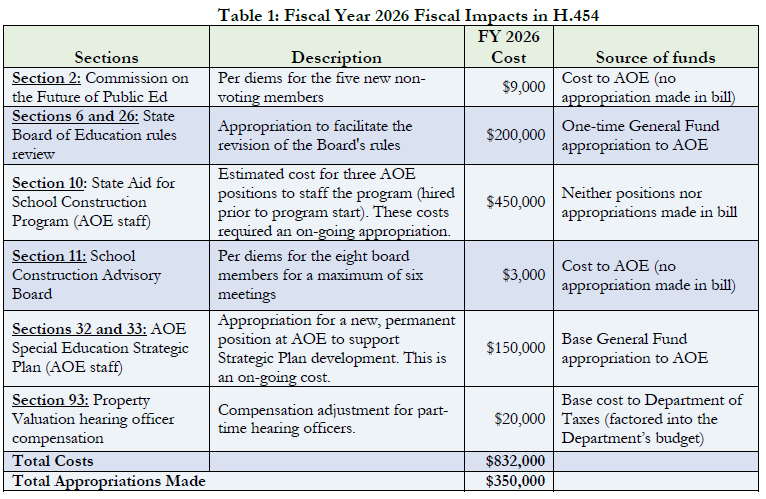
There are some known fiscal impacts of the bill. Table 1 shows the direct fiscal impacts of the bill in fiscal year 2026:
1 The Joint Fiscal Office (JFO) is a nonpartisan legislative office dedicated to producing unbiased fiscal analysis – this fiscal note is meant to provide information for legislative consideration, not to provide policy recommendations.
See full JFO report HERE.
To support vital journalism, access our archives and get unique features like our award-winning profiles, Book of Lists & Business-to-Business Directory, subscribe HERE!