Vermont Business Magazine Today, the Vermont House of Representatives gave preliminary approval to H.454, the House’s comprehensive education reform bill. The legislation marks a major step in building a more equitable and student-centered public education system and a more stable, cost-effective financing system.
“Today’s vote is an important step in seizing the best chance we’ve had in a generation to modernize a system that hasn’t kept up – not because our teachers or students are failing, but because the structure around them hasn’t changed,” said Speaker of the House Jill Krowinski. “This plan was built with input from Vermonters, including; educators, school leaders, finance experts, parents, and Vermonters. And it reflects what we’ve heard in every corner of the state: the system needs to be more predictable for taxpayers and better for our kids.”
Governor Phil Scott on Friday issued the following statement:
“This bill is nowhere near perfect due to the cost, timeline and more. However, we all agree that education transformation is needed this session. In order to accomplish that, the passage of this imperfect bill by the House so it can move to the Senate is an important procedural step toward achieving that goal. To be clear, there are many changes needed to earn final support of many legislators as well as my signature, and we will continue to make our case as this process moves through the legislative process.
“Having said that, I do appreciate the productive conversations we’ve had so far and I’m hopeful we can deliver education transformation to ensure all Vermont students have greater access to more opportunities and better outcomes, while Vermont taxpayers have a more predictable, stable, and affordable system.”
H.454 includes major policy reforms to education finance, governance, and infrastructure. Key components of the bill include:
- Moving to a foundation funding model which gives school districts funding based on the cost to educate a student
- A process to update school district boundaries
- Establishing statewide class size minimums, shared calendars, data systems, and shared resources between schools
- Creating clearer rules for the use of public tuition dollars
- Planning for long-term school construction investments and projects
- Strengthening the State Board of Education to ensure transparent, accountable oversight with public input
The bill is up for its third and final reading on the House floor on Friday, April 11th, and if passed, the bill will proceed to the Senate.
For more information on H.454, please visit the legislative website.
Joint Fiscal Office
April 7, 2025
Bill Summary
This bill would make numerous changes to Vermont’s statewide education system and education funding system. It would expand the Commission on the Future of Public Education, require a review of the State Board of Education’s rules, implement the State Aid for School Construction Program and Advisory Board, and require the Agency of Education (AOE) to draft a three-year Special Education Strategic Plan. It would also implement class size minimums, establish legislative intent for school size minimums for certain grades, implement a transition of tuition eligibility, and amend statute to recalculate the amount of tuition that can be paid to a receiving school.
The bill would repeal most of Vermont’s statewide education finance formula and establish a new funding formula and statewide property tax structure. This would include the creation of a foundation formula with supplemental district spending, four property classifications for statewide education property taxes, a repeal of the property tax credit, and the implementation of a homestead exemption. The bill would also establish Regional Assessment Districts.
As recommended by the Committee on Ways and Means, the bill also contains several administrative provisions related to minimum thresholds for tax sales (as recommended by the Act 106 (2024) Working Group on Vermont’s Abatement and Tax Sale Processes), property valuation hearing officer compensation, and a technical correction regarding property tax credit late fees.
Fiscal Impact
Since much of the bill is effective on July 1, 2029, and rests on future policy decisions, its overall fiscal impact is unclear. However, implementation of many provisions will likely have fiscal impacts in future years.
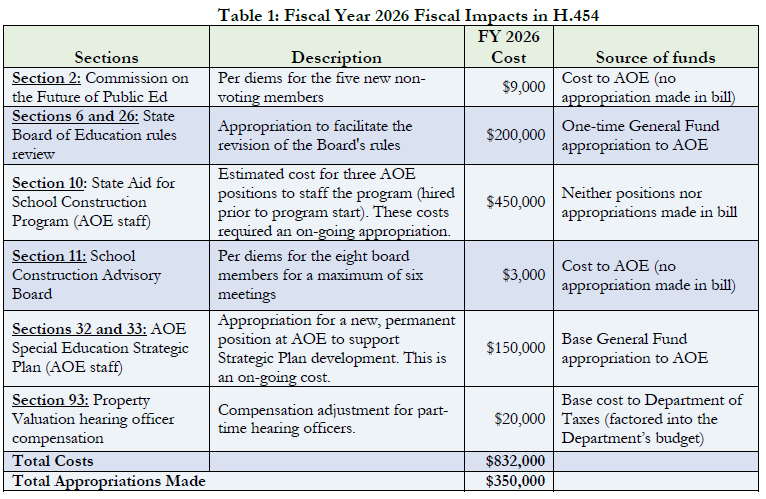
There are some known fiscal impacts of the bill. Table 1 shows the direct fiscal impacts of the bill in fiscal year 2026:
1 The Joint Fiscal Office (JFO) is a nonpartisan legislative office dedicated to producing unbiased fiscal analysis – this fiscal note is meant to provide information for legislative consideration, not to provide policy recommendations.
See full JFO report HERE.
To support vital journalism, access our archives and get unique features like our award-winning profiles, Book of Lists & Business-to-Business Directory, subscribe HERE!