

by Timothy McQuiston, Vermont Business Magazine Commercial real estate in Vermont is at an inflection point, as anyone can see driving around the state, especially in the more developed areas. There is a glut of office space. This will take many years to fill up. If it ever does. In the post COVID environment there are many more people, of course, working remotely. And no one believes that all of those people will come back into the office and certainly not into the office at the same levels as pre COVID.
So one of the questions is what are we going to do with all that office space? It is not easily converted into housing. Especially in the office buildings we're looking at now. The major problem is the plumbing. In a typical office building, the plumbing is centrally located, which is not conducive to apartment conversion.
For instance, you would have to do serious reconstruction of a building to put the plumbing farther out on the building in order to create apartments that have windows. Renters and condo buyers would demand windows in most rooms. If not, they probably wouldn’t live there long.
The other problem with the office buildings is they tend to be too square, said Matt Wheaton Executive VP at DEW Construction in Williston. This creates a problem for how the apartments would be built in any refurbished office building.
Apartment buildings tend to be built in a rectangular or tower fashion to take advantage of the plumbing and electrical requirements. Plumbing, which tends to be centrally located in a typical square office building.
“You're left with all these weird proportions depending on the building,” Wheaton said. “So it depends on the building, whether or not you can make it efficient enough to be profitable. Otherwise you're going to be left with a lot of amenity space.”
Tony Blake, a partner with V/T Commercial Real Estate in Burlington said in response to a question about the general state of the CommReal industry: “As you know, the commercial real estate and development markets are primarily made up of four basic segments: Office, Retail, Industrial, and Multi-family. A general response to your question is that, excluding multi-family, the commercial real estate market is flat. In particular, we have been experiencing a growing trend of "hitting the pause" button.
“This is being experienced nationwide, and is not necessarily unique to our market. It is our feeling that this pause is the result of a confluence of several influencing factors – high interest rates, inflation, costs of construction, lack of staffing, two international wars, and a very uncertain presidential election. Businesses seem to be pulling back and waiting to see how things sugar off after November. We are not anticipating much change until after the first of the year.”
“We have all learned that the office market has changed dramatically since the advent of COVID. While offices are starting to see, and perhaps demanding, an upsurge of staff returning, it is still very far from where it was prior to 2020.
“The Greater Burlington Area has an overall vacancy rate of 9.5%, which represents an oversupply of approximately 830,000 square feet. Absorption of vacant office space is low, indicating that demand is not increasing. Older office product, in particular, is suffering. Burlington's Central Business District is feeling the brunt of the downturn, which is also partly the result of the costs of parking downtown and the other challenges the city currently faces with a growing homeless population and drug issues.
“Interest rates are not helping, as they are only driving up the costs of remodeling and renovations, and adding to the already existing challenges of new construction. Federal funding pretty much evaporated once the COVID relief funds ended.”
There are still deals being made and some on the front or back burner, he said, though some still cannot yet be revealed publicly.
One, pertains to the State of Vermont office building at 108 Cherry Street in Burlington, AKA John J. Zampieri State Office Building.
“That property is under contract to be sold (the State vacated the building and relocated to the Innovation Center in the South End). The buyer has plans for a redevelopment – but there are many hurdles that must first be resolved before we can provide any further information.”
The Zampieri building is across from the massive CityPlace development. CityPlace will bring much needed housing (over 400 units), as well as a limited amount of retail and restaurants.

Photo: CityPlace in Burlington is rising fast as the state’s tallest building, which will bring more people and vibrancy into downtown. VermontBiz photo
To Tony Blake’s point, the original development concept included significant office space, which has long since been dropped from the plans.
“The development of the CityPlace project offers some optimism, as it is our collective hope that it will bring more residents to the downtown market, which in turn will stimulate commercial business growth in the Queen City. We've witnessed a healthy market in South Burlington's City Center – easy and safe access, affordable parking, etc. Naturally, we remain optimistic. The greater Burlington area remains a wonderful hub of opportunity, and we do believe in its ability to regain its commercial strength.”
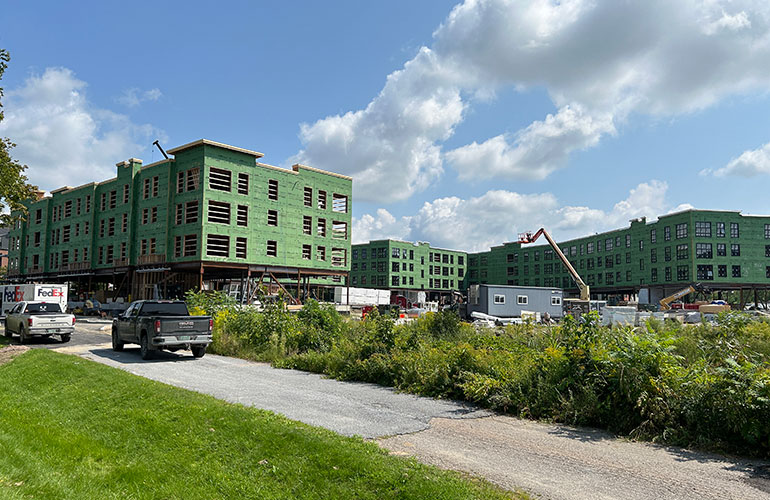
Photo: City Center in South Burlington. VermontBiz photo
“We are seeing some positive development in a few of the suburban communities – particularly in Williston. We've been working with the developers of Finney Crossing from the outset, and the retailers in that Williston Road development have been enjoying wonderful results.”
A recent, albeit more modest, deal that V/T Commercial recently brokered was for Seasonal Grams, Inc. (Pajama Gram, et al), which leased 4,944 square feet at the historic factory space at 128 Lakeside Avenue in Burlington. Pajama Gram was the largest division of Vermont Teddy Bear until the Teddy Bear division was sold off to Indiana-based USA Brands last spring. USA acquired Vermont Flannel in 2022.
Teddy Bear will remain at its famous plant and showroom in Shelburne. The design and management of Pajama Gram has been moved to Burlington while warehousing and fulfillment has moved out-of-state under a new owner from New York. The manufacturing was always done by outside contract.
Redstone, another major commercial real estate firm in Burlington offered their perspective.
Erik Hoekstra is their managing partner.
“Retail vacancy is extremely low right now with solid demand and very little new retail space being constructed,” Hoekstra said.
“Industrial vacancy is extremely low right now with solid demand and very little new industrial space being constructed.
“Apartment vacancy is very low right now, however, we are seeing an uptick in short-term vacancies in Burlington, South Burlington and Winooski right now. In the past, we typically had apartments released before they became vacant. We are now seeing some apartments sit vacant for 30-90 days before they are re-leased. We attribute this primarily to an extraordinarily large influx of new apartments in the market with new buildings in downtown Burlington, at Cambrian Rise, and at City Center in South Burlington. There are approximately 860 new apartments being delivered to the Chittenden county market in 2024 and most have already been completed.
“For context, over the last 24 years the historical average has been around 300 new apartments per year. This high level of deliveries in 2024 is on the heels of around 12 years of above average growth in inventory. We expect these apartments to be absorbed and also expect the volume of new apartments being built to decrease in coming years. The spike in short-term vacancies that we are seeing right now is likely a short-term phenomenon and something that we are watching very closely.
“Office vacancy is increasing and leasing activity is minimal. We are primarily seeing existing office tenants move from one space to another, more often than not downsizing in the process. For example, a tenant that had been leasing approximately 20,000 SF of office space for 30 years, moving to a different building where they are now occupying about 7,000 SF of office space. In the post pandemic remote and hybrid working world, this is the trend and we expect this trend to continue.
“Interest rates have made new construction challenging on top of a massive amount of inflation in construction costs over the past 5 years. Construction activity is slowing down and until something changes, we expect construction activity to be down for a while.
“Our big project right now is a 115-room TownePlace Suites by Marriott hotel in Finney Crossing in the Taft Corners area of Williston. This is a companion hotel to our existing Home2 Suites by Hilton property across the street. A former TownePlace Suites property off Zephyr Road in Williston was converted into apartments recently. When that Marriott franchise became available, we saw an opportunity and partnered with the developers of Finney Crossing to make the new TownePlace happen. Our grand opening is scheduled for late winter/early spring in time for graduation season for area colleges and UVM.

Photo: TownePlace Suites by Marriott hotel in Finney Crossing. Courtesy photo
“The crystal ball is cloudy right now. We are watching the market closely. Like everyone, we are keeping an eye on interest rate policy. Additionally, beyond the challenges associated with high interest rates, fundamental availability of debt has contracted.
“Many banks and credit unions have pulled back on lending due to a variety of factors including stress on their existing loan portfolios related to the challenges facing office properties and lower deposit balances as many consumers have spent through savings post pandemic. Inflation is a huge factor impacting us in a variety of ways as it is impacting everyone. Significant increases in property taxes and insurance premiums have been particularly challenging this year.
“We are cautiously optimistic that the Fed will achieve the soft landing that they have been shooting for and that the economy will be in a balanced state that allows economic expansion without the dramatic levels of inflation that we have seen in recent years. If this happens and we can avoid a recession, most sectors of real estate should fare reasonably well.”
Richard Wobby, the Executive Vice President of the Associated General Contractors of Vermont, said there might still be some opportunity for office space conversion, despite the issues described above.
He said he was recently in Louisville and they were taking two office towers and converting them into apartment buildings. Vermont doesn’t have the type of office towers that can be profitably converted into condos, but other spaces might eventually prove profitable if housing demand remains high and interest rates soften.