

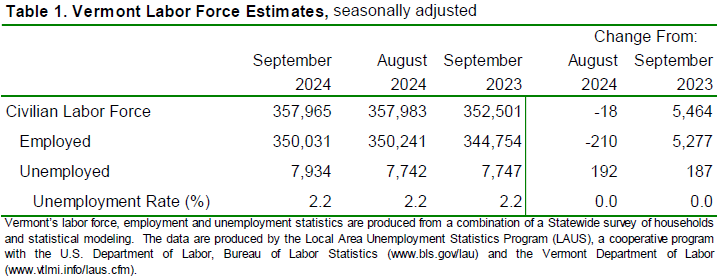
by Timothy McQuiston, Vermont Business Magazine Today, the Vermont Department of Labor released data on the Vermont economy for the time period covering September 2024. According to household data, the seasonally adjusted statewide unemployment rate for September was 2.2 percent. This reflects no change from the prior month’s revised estimate. The comparable United States rate in September was 4.1 percent, a decrease of one-tenth of one percentage point from the revised August estimate. Vermont continues to have the second lowest unemployment rate in the US, with South Dakota at 2.0 percent and Nevada highest at 5.6 percent.
There were small declines in the Labor Force and number of employed and an increase in the number of unemployed. Weekly unemployment claims remain low.
The civilian labor force participation rate was 65.7 percent in September, no change from the prior month’s revised estimate.
See tables below.
Michael Harrington, Vermont Labor Commissioner, said: “The topline data continues to reflect steady economic growth, with this release showing that job gains over the past year have been concentrated in three key sectors of Vermont's economy: Professional & Business Services, Health Care & Social Assistance, and Accommodation & Food Services. These industries are experiencing rising demand and require diverse skills to fill the growing workforce needs.
“Vermont's range of job opportunities remains broad, and the Department of Labor is dedicated to supporting employers and job seekers. This past month the Department celebrated Fall Job Fest season, welcoming more than nearly 1,000 job seekers, with over 100 employers across the state from Lyndonville to Bennington.
To learn more about our services, visit https://labor.vermont.gov/workforce-development.”
The seasonally adjusted Vermont data for September show the Vermont civilian labor force decreased by 18 from the prior month’s revised estimate (see Table 1). The number of employed persons decreased by 210 and the number of unemployed persons increased by 192. None of the changes were statistically significant in the seasonally adjusted series.
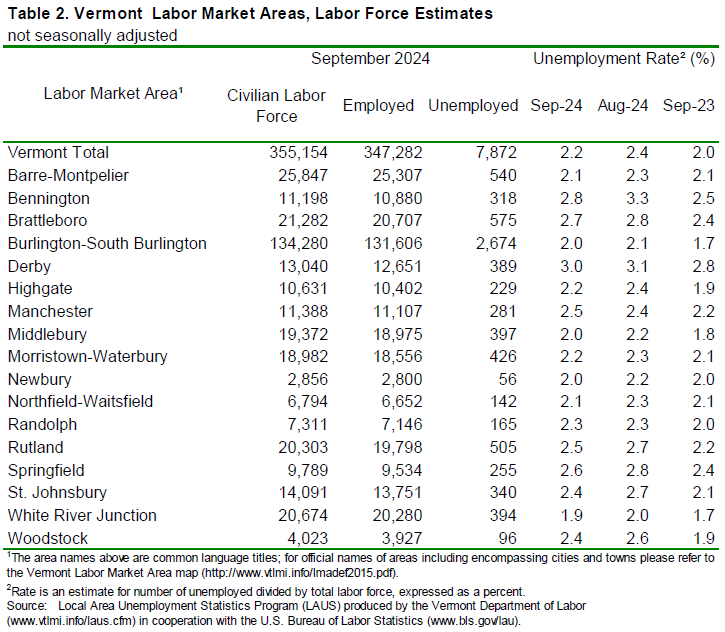
The September unemployment rates for Vermont’s 17 labor market areas ranged from 1.9 percent in White River Junction to 3.0 percent in Derby (note: local labor market area unemployment rates are not seasonally-adjusted – see Table 2). For comparison, the September unadjusted unemployment rate for Vermont was 2.2 percent, a decrease of two-tenths of one percentage point from the revised unadjusted August level and an increase of two-tenths of one percentage point from a year ago.
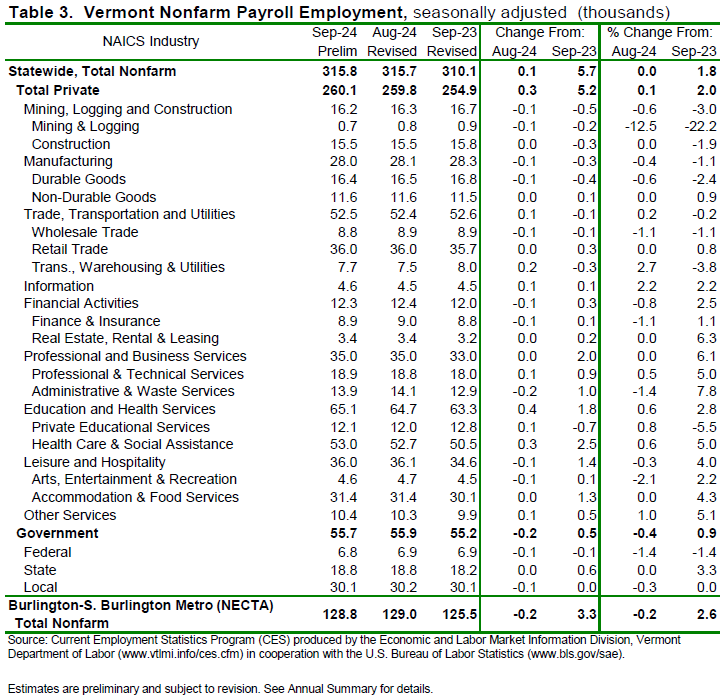
Seasonally Adjusted (Table 3)
The seasonally adjusted data for September reported an increase of 100 jobs from the revised August data. There was an increase of 100 jobs between the preliminary and the revised August estimates due to the inclusion of more data. The seasonally adjusted over-the-month changes in September varied at the industry level. The industry with a notable increase was Transportation, Warehousing & Utilities (+200 jobs or +2.7%). The industry with a notable decrease was Administrative & Waste Services (-200 jobs or -1.4%).
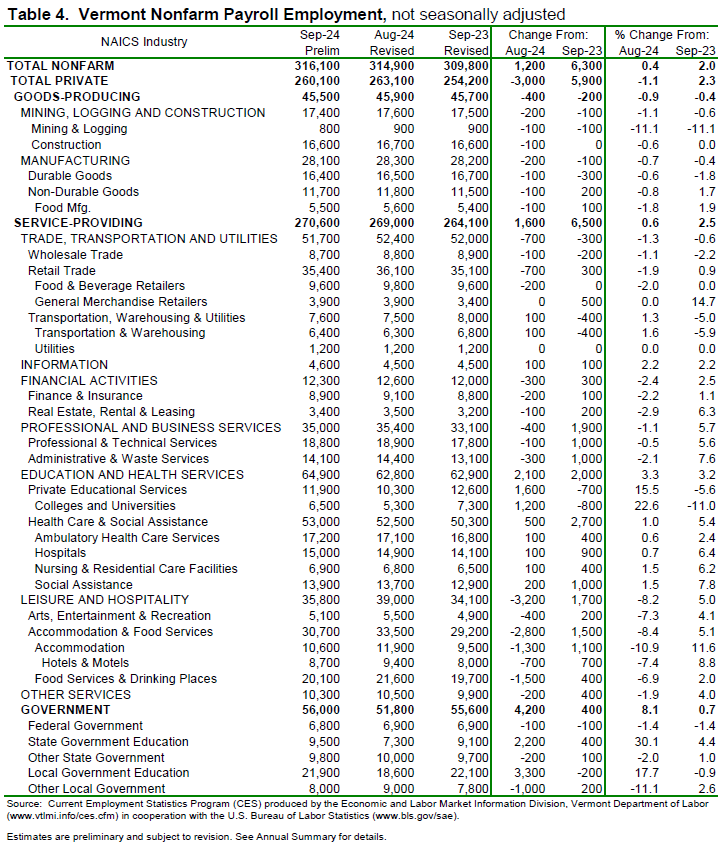
Not-Seasonally-Adjusted (Table 4)
The preliminary ‘not-seasonally-adjusted’ jobs estimates for September showed an increase of 1,200 jobs when compared to the revised August numbers. As with the seasonally adjusted data, this over-the-month change is from the revised August numbers which experienced an increase of 300 jobs from the preliminary estimates. The broader economic picture can be seen by focusing on the over-the-year changes in this data series.
As detailed in the preliminary not seasonally adjusted September data, Total Private industries increased by 5,900 jobs (+2.3%) over the year and Government (including public education) employment increased by 400 jobs (+0.7%) in the past year.
Weekly Unemployment Claims
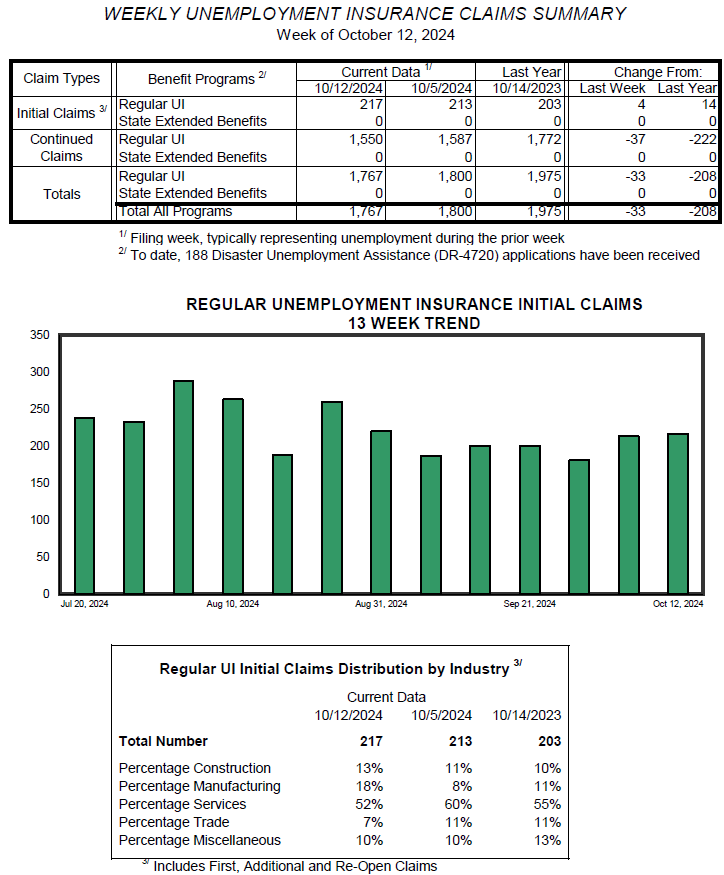
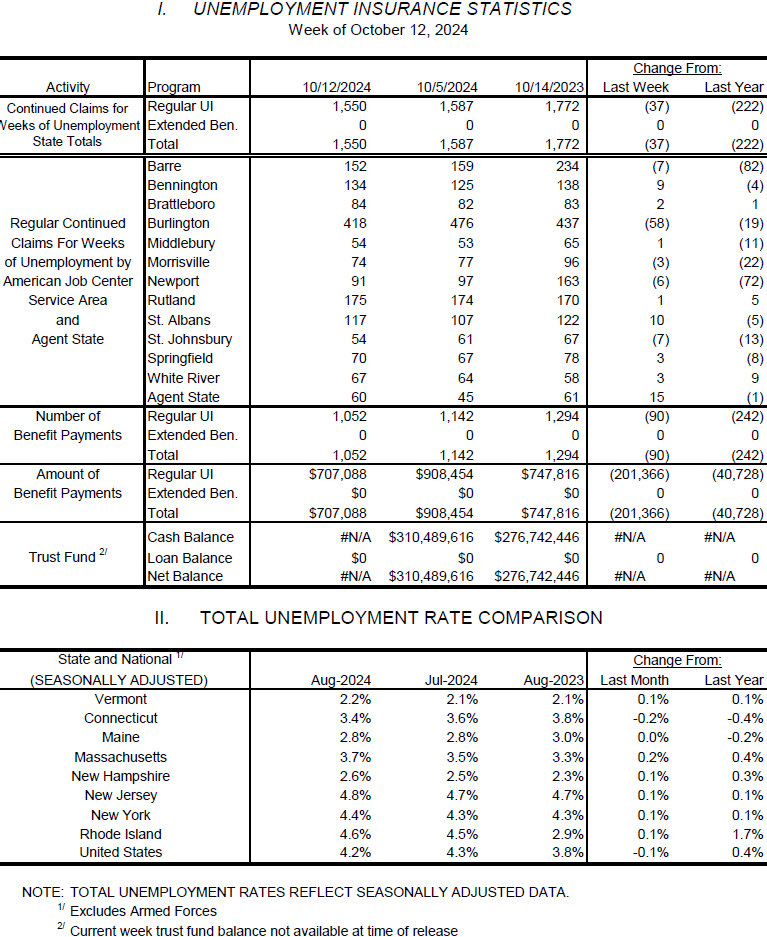
Weekly unemployment claims in Vermont increased slightly by 4 from last week and by 14 from last year to 217, which is a very low number. Ongoing claims were 1,767, down 33 from last week and 208 fewer than last year.
Meanwhile across the nation, in the week ending October 12, the advance figure for seasonally adjusted initial claims in the US was 241,000, a decrease of 19,000 from the previous week's revised level. The previous week's level was revised up by 2,000 from 258,000 to 260,000. The 4-week moving average was 236,250, an increase of 4,750 from the previous week's revised average. The previous week's average was revised up by 500 from 231,000 to 231,500.
According to Reuters, the Fed, which raised its policy rate by 525 basis points in 2022 and 2023 to tame inflation, is expected to lower rates by only 25 basis points next month. Nonfarm payrolls increased by the most in six months in September, with the unemployment rate falling to 4.1% from 4.2% in August. The U.S. central bank last month cut its benchmark interest rate by an unusually large 50 basis points to the 4.75%-5.00% range, the first reduction in borrowing costs since 2020, highlighting rising risks to the labor market.
The Vermont Unemployment Trust Fund is well capitalized. As of the previous week, there was $310.5 million in the Trust Fund. The pre-pandemic Trust Fund balance on March 1, 2020, was $506.2 million.
| State | September 2024(p) rate |
Rank |
|---|---|---|
|
South Dakota |
2.0 | 1 |
|
Vermont |
2.2 | 2 |
|
North Dakota |
2.3 | 3 |
|
New Hampshire |
2.5 | 4 |
|
Nebraska |
2.7 | 5 |
|
Maine |
2.8 | 6 |
|
Mississippi |
2.8 | 6 |
|
Alabama |
2.9 | 8 |
|
Hawaii |
2.9 | 8 |
|
Iowa |
2.9 | 8 |
|
Maryland |
2.9 | 8 |
|
Virginia |
2.9 | 8 |
|
Wisconsin |
2.9 | 8 |
|
Wyoming |
3.1 | 14 |
|
Connecticut |
3.2 | 15 |
|
Tennessee |
3.2 | 15 |
|
Arkansas |
3.3 | 17 |
|
Florida |
3.3 | 17 |
|
Kansas |
3.3 | 17 |
|
Montana |
3.3 | 17 |
|
Minnesota |
3.4 | 21 |
|
Oklahoma |
3.4 | 21 |
|
Pennsylvania |
3.4 | 21 |
|
Arizona |
3.5 | 24 |
|
Utah |
3.5 | 24 |
|
Georgia |
3.6 | 26 |
|
Idaho |
3.6 | 26 |
|
Massachusetts |
3.8 | 28 |
|
North Carolina |
3.8 | 28 |
|
Louisiana |
3.9 | 30 |
|
Missouri |
3.9 | 30 |
|
Colorado |
4.0 | 32 |
|
Oregon |
4.0 | 32 |
|
Texas |
4.1 | 34 |
|
Delaware |
4.2 | 35 |
|
New Mexico |
4.2 | 35 |
|
West Virginia |
4.2 | 35 |
|
Indiana |
4.3 | 38 |
|
New York |
4.4 | 39 |
|
Michigan |
4.5 | 40 |
|
Ohio |
4.5 | 40 |
|
South Carolina |
4.5 | 40 |
|
Alaska |
4.6 | 43 |
|
Rhode Island |
4.6 | 43 |
|
New Jersey |
4.7 | 45 |
|
Washington |
4.8 | 46 |
|
Kentucky |
4.9 | 47 |
|
California |
5.3 | 48 |
|
Illinois |
5.3 | 48 |
|
Nevada |
5.6 | 50 |
|
District of Columbia |
5.7 | 51 |
|
Footnotes |
||
|
Note: Rates shown are a percentage of the labor force. Data refer to place of residence. Estimates for the current month are subject to revision the following month. |
||
Last Modified Date: October 22, 2024
The Unemployment and Jobs Report for October is scheduled to be released on Tuesday, November 19, 2024 at 10:00 a.m.
Source: 10.22.2024. Vermont Department of Labor