Photo: HB Lozito, co-founder and executive director of the Brattleboro nonprofit Out in the Open. Photo: Baldwin Photography.
by Joyce Marcel, Vermont Business Magazine
Vermont’s rural life, with its rugged mountains, open farmland, maple stands and isolated homes, has always contained a wide variety of gender identities and sexual proclivities. In the past, they might have been whispered about, obscured, dismissed with a shrug or hidden. Now they are being celebrated.
One of leaders of this movement is innovator and community organizer HB Lozito (they, them), co-founder and executive director of the Brattleboro nonprofit Out in the Open, or OITO, whose mission is to connect rural LGBTQIA+ people to build community, visibility, knowledge and power.
For their work, Lozito last year received the penultimate Con Hogan Award for Creative, Entrepreneurial, Community Leadership from the Vermont Community Foundation. For Lozito, it was just a matter of turning an organizational eye onto a fresh new field of inquiry — one very close to their heart.
“There is so much to explore within ruralness and queer and trans experience,“ Lozito said. “Let’s just start organizing it and see what happens and what emerges and what we need.“
Cementing their move to statewide recognition, Lozito now sits on the board of Vermont Public.
“I joined in early 2023, and it’s been wonderful,“ Lozito said. “I had the honor of serving on the hiring committee for our next CEO this summer. It’s a fabulous organization, working at a very different scale than Out in the Open, that I’m thrilled to be a part of.“
OITO defines itself as “a multiracial, majority working class, grassroots, movement and capacity building organization based in Wabanaki territory throughout the states of Vermont and Maine.“
It defines LGBTQIA+ as comprising “those who are two-spirit, lesbian, gay, bisexual, transgender, queer, intersex, same-gender loving, asexual, pansexual, ceterosexual, genderqueer, nonbinary, agender, bigender and many more words to describe sexualities and identities we’ve yet to speak into being!“
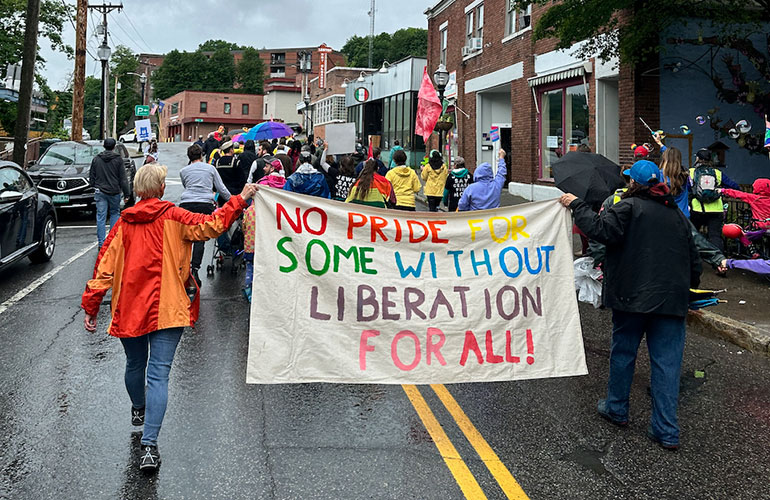
Photo: Rural LGBTQ+ Liberation March. Photo courtesy of Out in the Open.
OITO is formally anti-racist. “We believe that white people need to work alongside people of color toward ending white supremacy,“ it says.
Vermont is well-known for its progressive stance on LGBTQIA+ rights, having pioneered same-sex civil unions and marriage equality through judicial and legislative action, respectively. It has witnessed a trans person run for governor on a major party ticket, and both its state treasurer and its sole representative in Congress are openly gay.
Still, the state has tragically experienced trans murders and the presence of “Take Back Vermont“ signs — reminders that the fight for full acceptance and equality is ongoing. In spite of this lingering homophobia, OITO has become an economic driver in Brattleboro, Lozito said.
“Our organization has brought millions of dollars, mostly in out-of-state money, into Vermont in the last 10 years,“ they said. “We employ people who are working here full time, who are spending their money here. Even before COVID, we were hearing from people — mostly young people and those with young families: ’Oh, I wanted to move back to the Northeast. I want to move to a rural place, but we’re LGBTQ people. I wasn’t sure if I have any community. When I found out about Out in the Open, I knew I could move to this area and have a life here.’
“Economic development has never been a primary focus of our organization,“ Lozito added. “But it is a byproduct of the community that we create and the way that we do our work.“
While urban areas are often perceived as hubs for LGBTQIA+ communities, many individuals within this diverse group find fulfillment and acceptance in small towns and rural settings. Lozito, who identifies as trans, exemplifies this reality by thriving in such an environment.
“I know from my own experience that I feel best when I’m living in a rural place or small town,“ Lozito said. “But I need queer community around me. And there are probably other people that need this too. The through line is lots of exploration of lots of different things, and seeing where that takes us. My own personal story has been, ’I’m going to follow what I’m interested in. I’m not sure where it’s going to end up, but I know that I can trust myself to follow where I’m going.’ And that’s the story of Out in The Open as well.“
The Con Hogan Award, commemorates the late Con Hogan’s lifelong dedication to public service. Recognizing Lozito’s impactful work, the Vermont Community Foundation commended Out in the Open for its efforts “to build a multi-issue, multiracial social justice movement of rural LGBTQ+ people.“
“Through Lozito’s leadership, Out in the Open has expanded what it means to be queer in rural Vermont,“ the foundation said. “For over a decade, Lozito has been instrumental not only in creating safe and thriving places for rural LGBTQ+ people, but also in building community, visibility, knowledge and power, in part by searching out previously uncollected data to support the work.“
Lozito’s work began by shedding light on the lives of older gay, lesbian and trans individuals who have long been a part of rural Vermont communities. One of their initial projects, for instance, involved compiling an oral history of the Andrews Inn in Bellows Falls, a multifaceted establishment that served as a hotel, gay disco, bar and restaurant discretely nestled in the heart of a small working-class town. From 1973 to 1984, the inn functioned as a magnet and a sanctuary for gays and lesbians from across New England and New York.
The Andrews Inn Oral History Project grew out of a collaboration among Out in the Open, Vermont Performance Lab, Marlboro College and the Rockingham Arts & Museum Project.
“Myself, artist Ain Gordon and Professors Brenda Foley and Kate Ratcliff collaborated to co-design and co-teach a semester course at Marlboro called Politics of Change: Social Movements of the Late ’60s and ’70s,“ Lozito explained. “We were exploring oral-history techniques and rural social movements of this area in that time frame.“
They initiated the project by gathering oral histories from men and women who were part of the Andrews Inn scene and were still available to be interviewed. The project culminated in an event held at the Brattleboro Museum & Art Center. Photographer and artist Evie Lovett, who joined the project to capture portraits of some contributors, described the BMAC event as “deeply emotional.
“It brought out the elders of the Vermont queer community,“ Lovett said. “Some had not seen each other for decades. The emotion of that gathering was overwhelming. People on the panel openly wept as HB gave the introduction. Something really hard was now being celebrated.“
Lovett praised Lozito as “someone who made the project bloom and have a vibrancy and be heard by and seen by so many people. HB is someone who leads with joy. They are wise. They listen. They are welcoming. You want to be where HB is.“
So now, instead of the Andrews Inn being a “wink wink nudge nudge“ secret, it proudly holds the second-ever state of Vermont historic marker honoring LGBTQ+ history. The marker reads, in part, that the inn “became a destination for tourists and locals who were part of the emerging gay pride movement ... openly welcoming gays and lesbians at a time when there were few such places in Vermont.“
Lozito said they were weeping openly at the BMAC event.
“I was — and still am — deeply moved by the people I interviewed, our collaborators on this project and people whose lives I became a part of through this project,“ Lozito said. “It’s become about so much more than this project for me. We really are a part of each other’s lives. It’s an incredible thing as a younger person to connect with LGBTQ+ elders, to be trusted with some of their most intimate and personal stories, to be welcomed repeatedly into their homes.“
Other narratives are waiting to be told, Lozito said.
“For me to hear directly from people that we have always been here, to hear their stories of building a loving and powerful community here over many decades, gives me the strength to continue on my own work and to be able to stand in my own power as a rural queer and trans person,“ Lozito said.
Under Lozito, OITO has grown to a staff of five with a budget of approximately $500,000, and is now broadening its reach into rural Maine, Lozito’s childhood home.
HB Lozito is a chosen name. While Lozito is their family name, they chose HB as their first name many years ago.
“The name HB grew out of my college study-abroad program through the School for International Training in Brattleboro, given to me by classmates on that trip, some of whom remain close friends today,“ Lozito said. “It’s unrelated, linguistically, to my given name.“
Rural queer communities, like the ones Lozito is working to build, are important, said Katie Brydon, a nonprofit consultant who grew up in Maine with Lozito and now attends OITO events there.
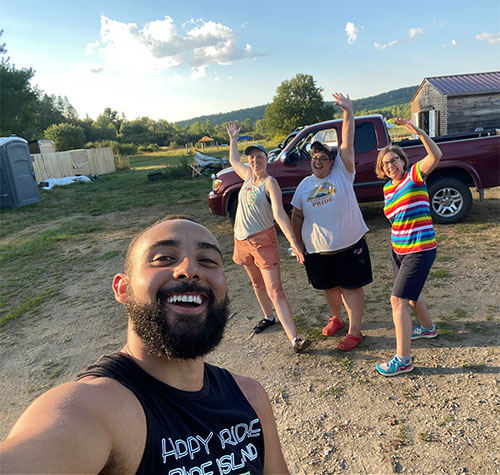
Photo: OITO staff. Photo courtesy of Out in the Open.
“Growing up in this area of the state and seeing queer community is not something that was an option for me growing up,“ Brydon said. “I was not aware of a lot of queer individuals, queer community or the importance and the value of shared space. It is very hard to see yourself living here as a queer person. And I think Out in the Open is not only creating space, but also identifying new spaces where people can come together, share community, make connections and actually serve others. It’s been so needed.“
One of Lozito’s first jobs when they came to Brattleboro was at BuildingGreen, the nationally recognized consulting firm specializing in sustainable building practices. Board chair Jerelyn Wilson calls Lozito a “can-do, organized and resourceful“ kind of person.
“HB has a way of making you feel comfortable,“ Wilson said. “They make you feel good about yourself. They have a very sunny personality. I don’t know as I ever heard them complain. When they took a job at BuildingGreen, one of their main responsibilities was doing these professional peer network summits. We did them in different cities around the country, with 50 architects or professionals who were focused on sustainability. And the idea was to create an intimate setting where people from different architectural firms could be open and honest and share with each other. HB was just stellar at helping to create an environment where people trusted each other, where there was a sense of confidentiality. I took over that role when they left, and there was nothing but positive responses about HB. People just loved HB.“
Alex Fischer, a bookkeeper at a Vermont worker-owned union cooperative who has known Lozito for 20 years, considers Lozito a part of their queer family.
“We met through mutual friends when we were part of Camp Trans in the early 2000s, which advocated for trans women’s inclusion at the famous Michigan Womyn’s Music Festival,“ Fischer said. “It started a kind of queer community-building and organizing through that space. And when we moved to Brattleboro, HB and I co-founded Homo Promo, a queer event collective for the southern Vermont region. Through that, HB and I shared a board seat on what was eventually to become Out in the Open.“
The need for queer community extends beyond just feeling safe; it also encompasses having a place to socialize and make friends, Fischer said.
“One part of it counters the narrative that rural communities are not accepting, because they are, and we are here,“ Fischer said. “I think there’s something about Out in the Open that helps give visibility to us. It creates options for us. The idea of rural queer community organizing and visibility creates a place to talk about and show that we are here, and also that our rural communities are incredibly loving and kind and accepting in a place that we can live and thrive.“
Adapting to rural life in Vermont requires a particular skill set, from learning to drive in winter to cutting and stacking wood. OITO aims to pass on these skills, offering classes in a wide range of subjects, including tofu making, nose-to-tail hog butchery, medicinal plant identification, auto repair, goat care, drag performance and cheesemaking.
“It’s helping us learn how to use a chainsaw and cut wood as well as how to organize our communities around trans-inclusive health care,“ Fischer said. “I personally appreciate and have benefited from the work of Out in the Open.“
Lozito integrates strategy with joy and fun, Fischer said.
“They do such an amazing job of being strategic and focused in the work they choose to take on and the work the organization takes on,“ Fischer said. “And they bring joy in as part of that decision-making. What is strategic and what is going to bring people in? What are other people going to get excited about?
“HB has great skills at relationship building across different types of relationships, both within our rural queer communities as well as with partner organizations, funders or other people in the organizing ecosystem.“
There’s a lightness in the way Lozito builds community, Fischer said.
“They are very open to learning, to adjusting, to being flexible,“ Fischer said. “They are very powerful and very influential and effective — not in a hammer kind of way, but in a thoughtful, listening and then adding to a conversation way. HB has done an incredible job of growing an organization. They are a great boss and manager, while working to create the world we’re trying to build, both within the organization and in the external world.“
Emily Marker, a kindergarten teacher, parent, member of the local LGBTQIA+ community and a former OITO board member, echoed Fischer’s thoughts.
“I first met HB when they moved here many years ago,“ Marker said. “We met through local queer friends. In 2014, HB asked me to join the board of directors of Out in the Open, which was named Green Mountain Crossroads at the time. I served on the board until 2021. I have always been impressed by HB’s deep commitment to their work and to the mission of Out in the Open. Even in the early days of the organization, when the board wasn’t sure we had enough money to pay HB beyond the next few weeks, they never lost sight of what was best for Out in the Open nor did they give anything less than their all to make that happen.“
Marker has had a firsthand look at how Lozito developed their vision for OITO.
“I watched them collaborate with community members, other leaders in the area and the greater LGBTQIA+ community,“ Marker said. “They are a creative thinker and a bridge-builder, working to fold in and create space for all types of movement work, artistic expression, storytelling, plus life-affirming and joy-filled wonder. HB has grown Out in the Open from an organization with one part-time staff person — HB — to an organization with five employees and a strong financial standing. This year Out in the Open even bought a piece of land on which to build a forever home.“
The 3.1-acre property of mostly undeveloped woodland in Brattleboro was purchased for approximately $150,000. It includes a drilled well, a partial timber frame building, a dug foundation, a completed road, a dedicated electric pole and a dug pond.
“We felt like it was the perfect amount of existing infrastructure for us to manifest our visions,“ Lozito said. “Significant work had already been done, allowing us to quickly make additions and get it ready for our community. This approach was far more cost-effective than dealing with a large existing structure on the property. And all just 10 minutes from downtown Brattleboro!“
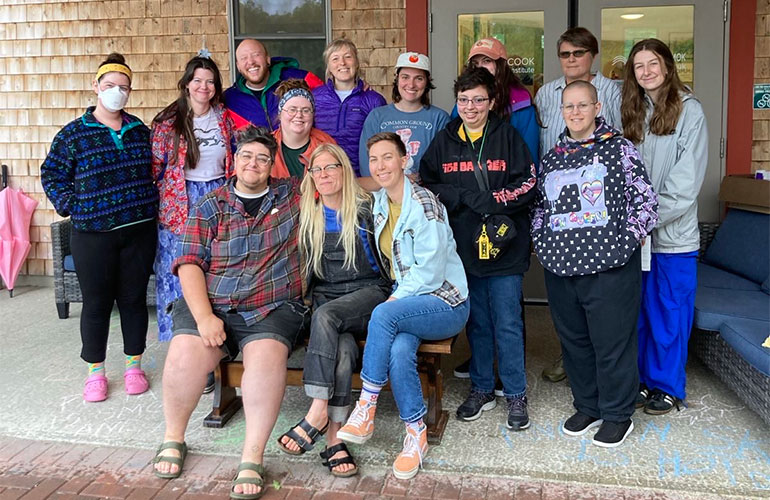
Photo: Rural LGBTQ+ Power and Belonging Fellowship cohort. Photo courtesy of Out in the Open.
Humble Yet Happy Beginnings
Lozito has deep roots in rural Maine. Raised in Hampden, south of Bangor, they have a strong family connection to nearby Mount Desert Island, where their mother’s family has lived for generations.
“We grew up sort of between Hampden and Mount Desert Island," Lozito explained. “I was down at my grandma’s house and my great-grandma’s house a lot of weekends and a lot of other times. I spent a lot of time on the shore and by the ocean. When I tell people I grew up in Hampden, folks who are casually familiar with Maine are often like, ’Oh, Camden. It’s really beautiful there.’ And Camden is very lovely. It’s right on the ocean. And there’s a lot of wealth. But at our exit, right off the highway, is a gigantic landfill. When I was a kid, it was smaller. But now it’s an 85-foot-tall mountain of trash."
Lozito has one sister, almost two years older, with whom they share a very close bond.
“She actually moved back to Maine with her family about seven or eight years ago,“ Lozito said. “They all live up there, which is very nice. My grandmother, who is turning 90 next year, is up there too. I see all of them when I go back.“
Lozito’s mother, a librarian who retired just last year, instilled a deep love for books in HB from an early age. Beyond that, she played a significant role in shaping Lozito’s life.
“Her story of work is kind of similar to mine,“ Lozito said. “She started at the library as a volunteer, when she was still working at department stores and at gas stations and a lot of other places. By the time she finished, she had performed every single job that was at the library. She was the janitor for a while, she was the children’s librarian, she was a volunteer, she worked at the front desk, and then she was the director. I started as Out in the Open’s only employee, working part-time while holding down two or three other jobs. And I’ve sort of done everything.“
The family may not have had much money, but never felt deprived.
“We had a house that was really great,“ Lozito said. “It was built in the 1700s and was constantly collapsing. It has a huge chimney in the center, and it’s all kind of crumbling towards the chimney. So a lot of what I learned from my mother was, ’Let’s figure it out.’
“The dirt basement had a seasonal river running right through it, which is astounding,“ Lozito continued. “Every spring the water would rise to almost the top of stairs. On top of the stairs was the sump pump, which was constantly not working, and we’d have to figure that out. There was a cow skeleton in the crawl space. The roof was leaking sometimes, and we’d have to figure that out. My mother would say, ’Let’s call someone when we need to, but a lot of these things we can do on our own.’“
Lozito learned valuable lessons in resourcefulness, managing personal finances and living within their means while still ensuring they had the essentials.
“A lot of that has carried over to how I run Out in the Open as well,“ they said.
Even amid the chaos, Lozito’s mother always found moments of joy and laughter.
“My mother is someone who laughs a lot,“ Lozito said. “We really enjoy being around each other. Our whole side of that family really likes being together and just laughing a lot, telling old stories and remembering things.“
Lozito’s relationship with her mother remains strong today.
“My relationship with my mom is wonderful, and sort of has always been really wonderful,“ they said. “We spent a lot of time together when I was a young person. And we still spend a lot of time together and text each other every day. I was one of those kids that had a lot of friends in high school. But I was very happy on a Friday or Saturday night to hang out at home and watch “Jeopardy!“ and play cards with my mom. That’s still the case today.“
Lozito’s father is a different story; he grew up in the Bronx, the child of Italian immigrants. He was a salesman by profession.
“He worked at American Tobacco when I was a young kid, then in firearms, and he’s worked in oil,“ Lozito said. “He works now in alcohol sales. So a pretty different track, and a different branch of our family.
Lozito’s parents divorced when HB was in middle school; for the most part, their father keeps his distance.
Lozito worked summers as a counsellor at an art camp; it was “foundational“ to the work they do today, Lozito said.
“The first time I was there was as a counselor in training, when I was 14,“ Lozito said. “I was mostly working in darkroom photography and teaching younger kids how to shoot photos and develop pictures. I kept doing that until I left for college. I also learned how to make beads out of glass. I still wear the beads pretty much every day. The camp owner’s parents were National Geographic photographers, and they would come in the summers and share their travels and show us some of their work. It was a really exciting place to be as a young person, learning a lot about creativity and trying things and making mistakes. I think that sparked a lot of how I’ve lived my life — and my career as well.“
Besides making glass beads, Lozito began carving wooden spoons out of freshly cut green wood; OITO recently received a grant from the Art Fund in Brattleboro to offer spoon-carving workshops. Lozito will be teaching the course.
“I have found it to be very meditative,“ Lozito said. “It’s very quiet. It’s very slow. You can do it with other people. And I really love and appreciate the communal nature of that. It’s been lovely to have something that is utilitarian and also beautiful that you’ve made. I end up doing a lot of gift giving through that.“
When Lozito began doing interviews with rural gay people, for example, they often brought an offering of a carved spoon.
“Usually folks also give me something too,“ Lozito said. “A lot of the work that we do now is around exploring rural traditions, and carving feels like one to me. Also, there’s something about a knife and an ax that can seem really intimidating, and I think it’s exciting to help people who maybe haven’t worked with those tools very much in their life, to make those kinds of tools more approachable.“
Lozito was turned on to community organizing in high school, where they wrote letters in support of political prisoners for Amnesty International, supported the Free Tibet movement, and worked for civil rights. Lozito’s mother even joined in, participating in an anti-sweatshop fashion show in downtown Bangor. But this was still the early 2000s, when gay students had to hide their true selves.
“Around that time, some of the teachers in our school started what they called the Civil Rights Team,“ Lozito said. “Pretty much every kid who is out now as an adult was part of the Civil Rights Team. We would do things like go to the Statehouse and meet with legislators. I wasn’t doing LGBTQ community activism in high school. But in the later part of high school, I came out, mostly to my close friends who were theater people, who are all queer as adults, which also feels really lucky.
“We were also part of Advocates for Student Awareness. We started doing a lot of things that were really fun. We called them random acts of kindness. For example, we decorated the statue of our mascot that was outside our high school for some holidays, just to bring fun and joy and a sense of wonder.“
Coming Out
Growing up, Lozito tried to understand gender expectations.
“In an unconscious way, I was exploring gender and sexuality quite early,“ Lozito said. “I can remember being 5 and 6 and thinking about a lot of that kind of stuff. For example, I loved playing baseball growing up. And then there was a time when everyone was like, ’You can’t play baseball. You have to play softball now.’ And thinking, ’This is so weird.’ But also, ’OK, I will also be good at softball.’ And then I came out. I had a girlfriend in college and came out to my parents my junior year of college.“
Lozito’s mother tried to process this “new information“ she had learned about her child.
“She was saying, ’I’m thinking back through my parenting with you. Was it this?’“ Lozito said. “Michael Wood was my best friend since we were 6 years old. And there’s a time around fourth grade when Michael’s mom and my mom were like, ’These kids have to stop having sleepovers.’ And when I came out to my mom, she was like, ’Is it because we made you and Michael stop having sleepovers?’ Nope, that’s not the reason. It was very sweet. She was just like, ’This is news to me, and I’m trying to figure it out.’ And since then it’s been great. She hired a number of trans employees at the library when she was still there, which was really cool and exciting.“
Lozito said their sister now takes her kids to the Bangor Pride parade and supports gay marriage.
“I had been out to friends, and certainly my high school friends, for much longer,“ Lozito said. “But I was nervous to tell my family, mostly because of what you hear about how it goes for other people. It was a different story with my dad, but that’s pretty typical of him in my life and my experience. He didn’t really get it.“
Lozito says childhood was enjoyable, but at times school was difficult. Their close childhood friend, Michael Wood, who is now an administrator in the Office of the Dean of Students at Bowdoin College, said that growing up queer in rural Maine back then had its challenges.
“HB and I grew up across the street and through the woods from each other,“ Wood said. “We met when I was 6 and HB was 5. We were probably the only two kids in our area — in our neighborhood, in our school — who had a different outlook on life. Kind of two queer kids who were both creative and curious and interested in the world around us, and what was outside of the world around us. HB grew up reading a lot because they had a librarian mother. I grew up performing and using my imagination a lot.“
As close as they were, neither came out to the other until they were in college.
“There’s probably a difficulty there when you and one of your best friends from your whole life have something that you’re both going through, and you both could probably be really good allies for each other to talk about it, and yet you don’t because of the constraints of the world you’re in and your surroundings,“ Wood said. “But I know we both grew up with really loving families and with really strong people around us — our parents, our siblings, our school, our teachers, our coaches. I would say whatever experiences we had as it related to maybe feeling left out or being different in the context of our childhoods, I think we also had a lot of experiences where we felt like we were valued. And that’s a tribute to a lot of the community members that took care of us growing up.“
Feeling safe and loved are crucial for all children, but these needs become even more complex when a child is grappling with their queer identity.
“Growing up queer in a small, rural Maine town, where it wasn’t as accepted, was difficult,“ Wood said. “So now, community for me means having a balance of art, meaningful work and family nearby. It also means having friends close, time to play, laugh and connect joyfully, as well as connecting with people in deep, meaningful ways.“
Lozito is a deeply loving person who cherishes the people in their life, Wood said.
“HB has done that for me over the years, over time, over distance and over space,“ Wood said. “I think they really model for a lot of queer people out there who do not know what it is to feel love through the work that they do. They model that you can be loved, that you should expect to be loved, that you’re worthy of that, and that it can be given freely and accepted freely. I think a lot of the work that they do really is bolstered by that energy that they bring.“
To this day, Wood and Lozito maintain a strong friendship.
“HB has always been one of the smartest people I’ve known,“ Wood said. “They’re someone I’ve always looked up to for their intellect and wisdom. HB is definitely a person I turn to when contemplating some of my biggest life challenges. Over the years, they’ve become someone who is incredibly supportive of the people they love and their community.“
Witnessing Lozito’s personal growth has been a joy, Wood said.
“Over the last decade-plus in Vermont, I’ve just seen them challenge themselves and try a lot of things,“ Wood said. “Things work out to varying extents, and then they try a different tactic. So I think this is a person who has long been homing in on the things that make them happy, the things that ground them, and not just a selfish way. I think they’re very grounded in community and community action. That’s something that they really value, and I think they have found a lot of that in their current work and current community in Brattleboro.“
A Grand Adventure
When it came time to go to college, Lozito decided to get as far away from Maine as they could get. They chose Whitman College in Walla Walla, Washington.
“Until then, I had never been further west than Pennsylvania,“ Lozito said. “I love where I grew up, and I love New England and the Northeast, but I wanted to try something different. I’d never been to the West Coast before, and I didn’t even visit before I went there. I had bought a car for $300 my senior year of high school, and my mom and my sister and I packed it up, and we drove out together. It was really exciting to be with them, sort of like discovering all of this new stuff together at the same time. We would drive until we got tired and then try to find a hotel. And so that was wonderful.“
One reason Lozito delayed coming out to their family was that they had established a completely new life on the West Coast.
“My life felt very separate,“ Lozito said. “After my sister and my mom dropped me off at college, I don’t think they came back to visit until graduation. And none of my friends from college came to Maine.“
Lozito earned a degree in environmental studies and politics. After graduation, a period of wandering ensued.
“My girlfriend at the time and I drove around,“ Lozito said. “We started in Texas and drove up to Maine, and then we spent some time in the Boundary Waters (in Minnesota). I didn’t have a job for a while. Then we moved to Portland, Oregon, where a bunch of my friends from college were also living, which was great. I got a job working in a before-school program and an after-school program. I was working 6 to 9 a.m. and then 3 to 7 p.m. The following summer, I got an internship working on building a graduate school database, which was really exciting.“
Afterward, Lozito dedicated two years to the Northwest Service Academy, an AmeriCorps program focused on environmental service.
“The first year, I worked for an environmental nonprofit called Ecotrust in Portland, running a program called Salmon Nation, which focused on bioregionalism and community building. The next year, I was a team leader in that same AmeriCorps program, managing a group of 15 AmeriCorps members based in various nonprofits around Portland. That was a lot of fun.“
After a brief stint working at a one-acre urban farm in Oakland, California, Lozito apprenticed with their sister on a Maine farm. The two continued farming together intermittently in various locations. Then, in January 2011, with the farming season over and no job lined up, Lozito accepted an invitation from friends to share a house in Brattleboro. Shortly after arriving, they found employment at Building Green.
Building Queer Community
Cobbling together a life in Vermont isn’t easy; there’s a reason Vermonters laugh when they hear the song title “Moonlight in Vermont“ and add “or starve.“
At Building Green, Lozito successfully fostered community among architects for three years. They then transitioned to Groundworks, initially known as the Morningside Shelter, while also working part-time for a filmmaker. It was during this period that Lozito became involved in queer organizing, which would eventually lead to the establishment of Out in the Open.
OITO, originally known as Green Mountain Crossroads, was founded in 2012 by Alex Potter and Debbie Potter when the Centers for Disease Control and Prevention began restricting funding for rural AIDS and HIV programs.
“At the time, Alex Potter and Howie Peterson, experienced LGBTQ+ community organizers, were working full-time at The Men’s Program at the AIDS Project of Southern Vermont,“ Lozito said. “Both had been involved in community work for many decades. Alex, aware of the impending defunding for about a year, decided to establish Green Mountain Crossroads in the wake of The Men’s Program’s closure, serving as board president from 2012 to 2014.“
Debbie Potter served as part-time executive director until late 2013 or early 2014. Lozito was hired as executive director in April 2014.
In Lozito’s first year, they overhauled nearly every aspect of the organization, retaining only the EIN (employer identification number) and the name.
“We eventually changed the name as well, in 2019,“ Lozito said. “The board composition changed completely about four times, and we updated the mission, vision and values to what they are today, with the important addition of a specific focus on rural social justice, movement building and organizing. We had a single $3,500 grant from the Vermont Community Foundation’s Special and Urgent Needs program, which covered the purchase of a computer and my first few months of salary. We had no other funds in the bank and, at the time, no additional funding on the way.“
In 2015, OITO launched several events that have since become long-standing traditions, including the Pride Family Potluck, Earth Gay Vermont (now known as Farm Work Days) and the Out in the Open Summit for Rural & Smalltown LGBTQ+ Folks (initially called the Rural LGBTQ+ Futures Summit).
With the exception of a two-year hiatus due to COVID, these events have become annual traditions.
Other memorable moments include President Barack Obama’s invitation to OITO in December 2016 to participate in a White House program on Advancing LGBT Progress in Rural America. In 2017, OITO launched the physical exhibit of the Andrews Inn Oral History Project, culminating in a vibrant community dance party at the former inn, attended by many who had frequented it during its heyday.
Things gradually progressed. In mid-2018, OITO received a $50,000 capacity building grant from CenterLink, enabling the organization to hire a second full-time staff member as development director. This positive momentum continued in August 2019, when it received the same grant again and established the position of programs and volunteer coordinator.
In May 2020, OITO launched the Rural Trans and Queer Health Justice Work Group, leading to the formation of a Community Advisory Group supporting the creation of an LGBTQ-dedicated clinic within Brattleboro Memorial Hospital.
In spring 2022, OITO initiated a peer-support program for community members in health care settings. August 2022 marked OITO’s first official program in Maine — an Out in the Open Summit in Monroe.
By December 2022, OITO was selected as one of 32 national grantees for the New Pluralists Healing Starts Here program, focusing on advancing pluralism across the U.S. This grant has fully funded OITO’s work in Maine throughout 2023 and 2024.
In March 2023, OITO facilitated its inaugural five-day Vermont Trans Audio Retreat, supported by the Vermont Arts Council of Vermont and in collaboration with West Virginia-based Country Queers. This successful event will be repeated in Maine in November.
Additionally, last fall, OITO launched the first cohort of its Power and Belonging Fellowship in Maine, a six-month program designed for rural LGBTQ+ individuals to connect, develop community-organizing and facilitation skills, and host supported public events within their local communities.
On March 7, OITO closed on the new property in West Brattleboro.
“We’ve done a lot over the last 10 years in a lot a lot of different ways,“ Lozito said. “We’ve tried a bunch of times to have really defined programs, but that never worked very well for us. What we’re good at is bringing people together and then doing some sort of shepherding to get people to where they want to go together next.“
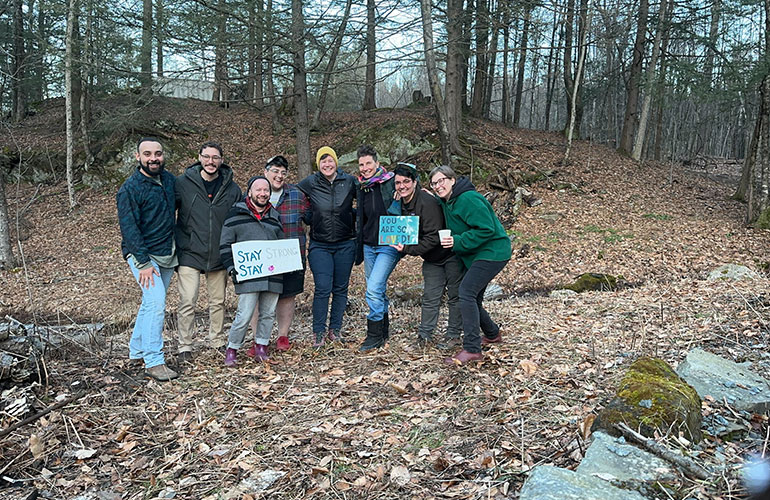
Photo: Group at Our Place Drop-in Center! Photos courtesy of Out in the Open.
The Con Hogan Award
Last year, the Vermont Community Foundation honored Lozito with its penultimate Con Hogan Community Leadership Award. This $15,000 prize recognizes individuals who, like Hogan — the late president of the American Public Human Services Association — dedicate their lives to public service, envisioning a Vermont that champions the public good. The award celebrates those who actively strive to realize this vision, inspire future leaders and utilize the prize money to further cultivate their leadership abilities.
According to Diana Wahle, a Windham County resident and member of the Con Hogan Award Committee, Lozito was chosen from a pool of 40 nominees.
“HB stood out,“ Wahle said. “I was so proud that they were from our region, as well. They were dealing with a population that we were concerned about, but we had never had an awardee that exemplified leadership in that arena before.
“Their nomination was outstanding,“ she added. “It was beautifully written, comprehensive and showcased their advocacy work, the growth and success of their organization and its expansion into Maine. It was a clear and unanimous choice.“
Lozito deposited the $15,000 prize into the bank.
“Honestly, I saved it,“ Lozito said. “I am not someone who grew up with money. In fact, money has been a huge source of stress almost my entire life. Just the relief of anxiety, of knowing I had that little bit of a cushion, has been really amazing.“
The Con Hogan award also significantly elevated Lozito’s statewide profile.
“It’s been really wonderful to get to know the committee as people,“ Lozito said. “And it gives me more confidence in doing things like going through with a land purchase. Some of the folks who are on the Con Hogan committee also work for the Vermont Community Loan Fund, and that gave me a lot of confidence to be able to call them for advice. We didn’t end up getting financing from them, but it was really helpful to just have had that initial connection. There are incredible leaders within our state who are working in a lot of different areas that are very deserving of all kinds of recognition.“
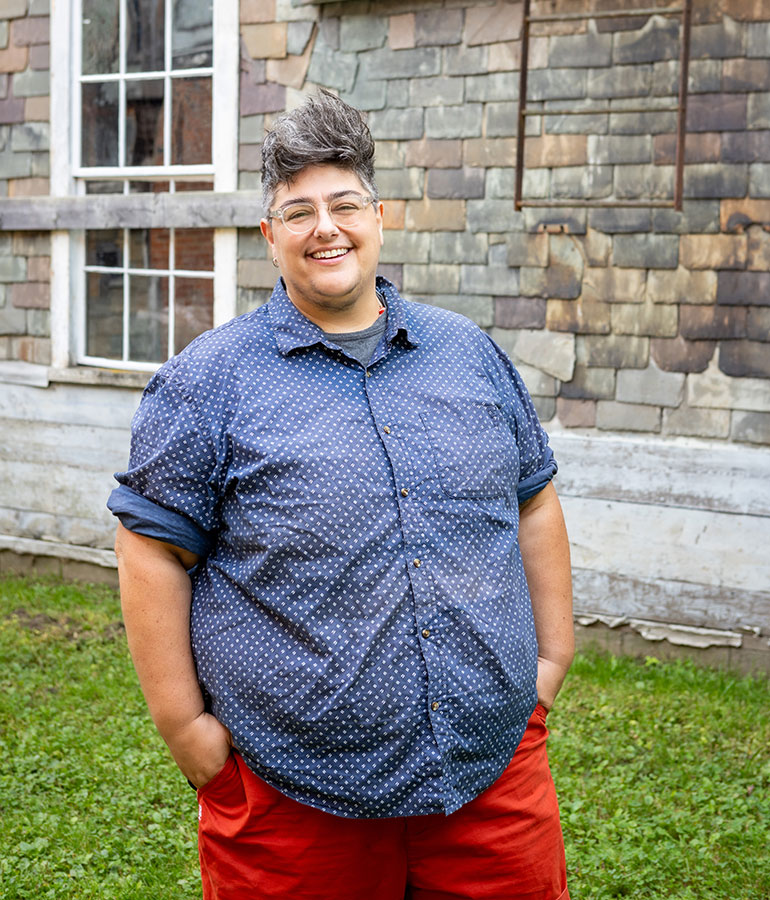
Photo: HB Lozito, co-founder and executive director of the Brattleboro nonprofit Out in the Open. Photo: Baldwin Photography.
The Future
Each fall, OITO hosts a Futures Summit, drawing inspiration from Lozito’s work at Building Green.
“At Building Green, the people had similar shared job experiences,“ Lozito said. “They were all sustainability directors. But just putting people together, giving them the structure and the container, and seeing what happens from that, is the basic idea.“
The summits maintain a flexible structure, adapting to the needs and interests of the participants. For instance, after the hog butchering class at the first summit sparked a protest from the vegan community, Lozito invited them to the next summit for a constructive dialogue.
While the initial summit attracted 35 people, attendance has since grown to around 100. However, Lozito prefers to cap attendance at 50, ensuring that everyone has the opportunity to connect and engage meaningfully.
“We’re creating an agenda, offering themes, getting meals for people, offering accessibility, so that folks who have kids can come, and people that have mobility needs can come,“ Lozito said. “Then we use our facilitation skills to open the floor for people and say, ’What are the conversations that you want to be having with your neighbors? What are the conversations you think we as an LGBTQ community in a rural place need to be having together? Tell us what that is, and then we’ll help you make it into a conversation.’“
The 10th summit, held in early September, embraced a theme of “Expect the Unexpected,“ promising an engaging and surprising experience for attendees.
“Something that we started doing, which has served us really well, is saying up front, ’This is not going to be perfect,’“ Lozito said. “There are going to be things that people don’t like. There are going to be things that go completely off the rails and are totally wild. There’s thousands of things in this extremely complex thing we’re trying to do in a weekend, and some of them will go wrong. I think that helped deflate the critiquing and complaining, just acknowledging that we’re not perfect and sometimes things are going to get messed up.“
This summer OITO will offer its Pride Family Potluck, a popular event that typically attracts about 300 people of all ages. “Last summer the youngest person was 2 months old and the oldest person was in their 80s,“ Lozito said.
In addition to oral history projects and audio skill-building classes in both Brattleboro and Maine, OITO will focus on developing its newly acquired land in Brattleboro. The organization envisions future summits with camping facilities and, eventually, cabins for participants. Fundraising efforts are ongoing to support these ambitious plans. The majority of OITO’s funding comes from individual donors and small foundations.
For Lozito personally, the most important thing is to maintain their sense of wonder.
“It’s been a thread throughout my life,“ they said. “I can remember as a young person, being in the woods and looking at a tree for many hours. I think that has helped me maintain a sense of self, curiosity and exploration.“
Lozito’s roots now intertwine Maine and Brattleboro, but Brattleboro will always be home.
“We’re all here together,“ Lozito said. “We know that folks are coming back to our programs many times. We know people are telling other people in their life about the experiences they’re having with Out in the Open. We need to help each other. And that creates a lot of common ground for understanding and relationship building.“
Joyce Marcel is a journalist in southern Vermont. In 2017, she was named the best business magazine profile writer in the country by the Alliance of Area Business Publishers. She is married to Randy Holhut, the news editor/acting operations manager of The Commons, a weekly newspaper in Brattleboro.
To support vital journalism, access our archives and get unique features like our award-winning profiles, Book of Lists & Business-to-Business Directory, subscribe HERE!