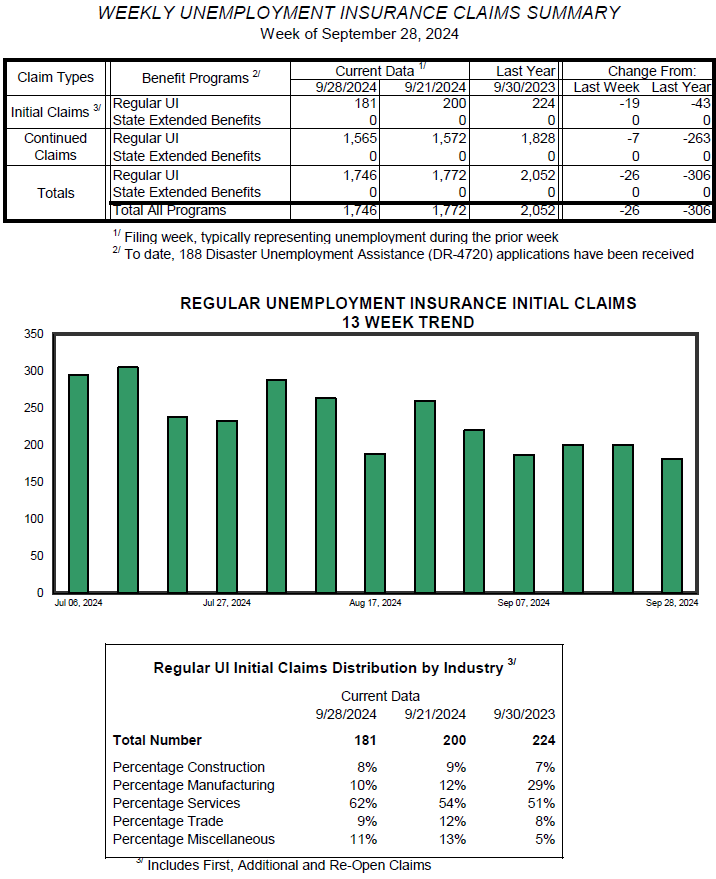
by Timothy McQuiston, Vermont Business Magazine Weekly unemployment claims fell slightly last week to a very low level and their lowest levels since September 2023. For the week ending September 28, 2024, new claims were 181, which is down 19 claims from the week before and 43 fewer from last year.
Meanwhile, unemployment claims and hiring have rebounded strongly across the US, as the Federal Reserve Bank cut interest rates by a robust 0.5% (50 basis points). Economists suggest the positive numbers suggest that the economy will indeed negotiate a "soft landing" and avoid a recession. Recent national and international events, however, could alter that outcome.
In Vermont, the Service industry accounts for the most claims this week with 62%, up from 52%. Manufacturing accounted for 10% of claims, down from 12%.
See tables below.
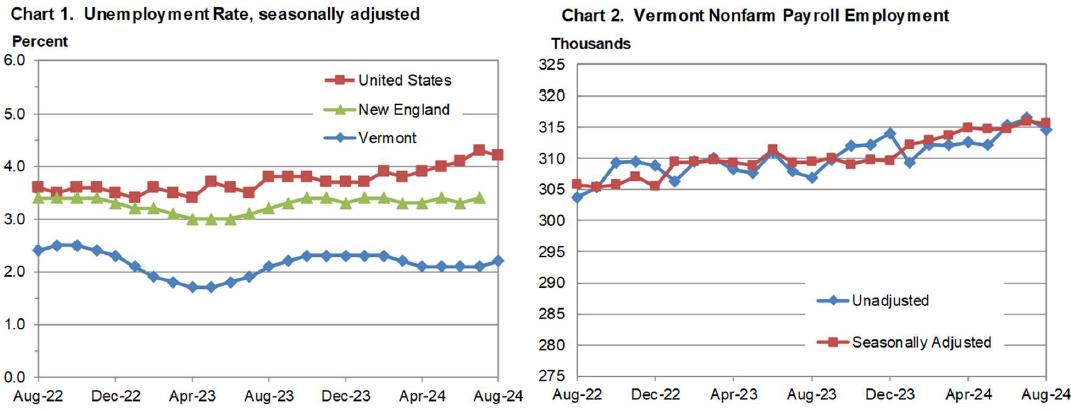
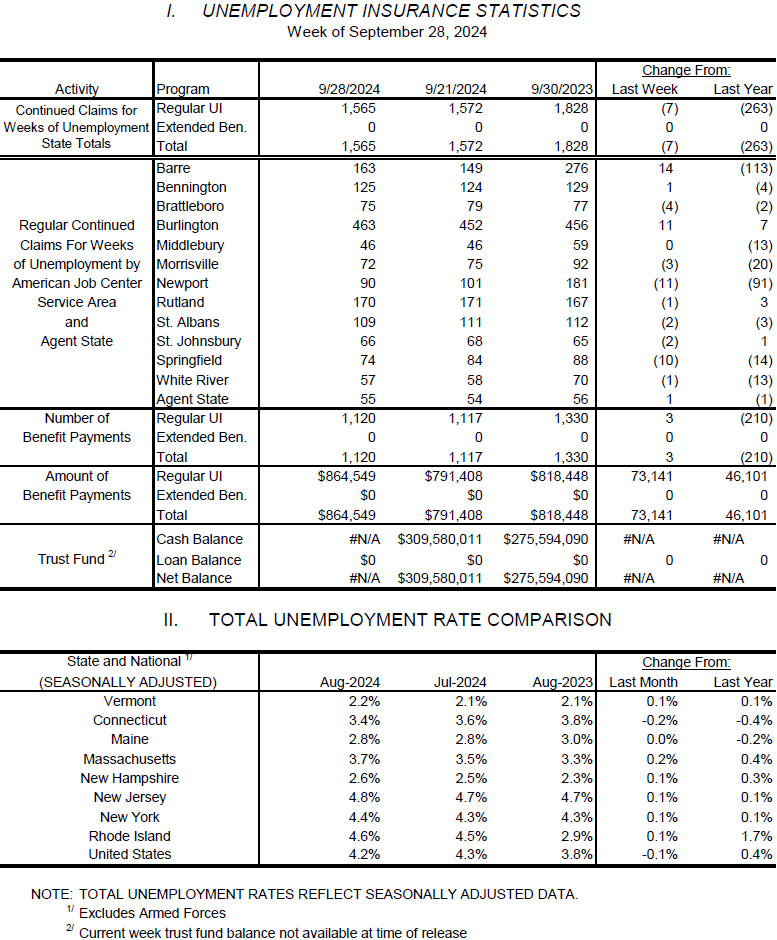
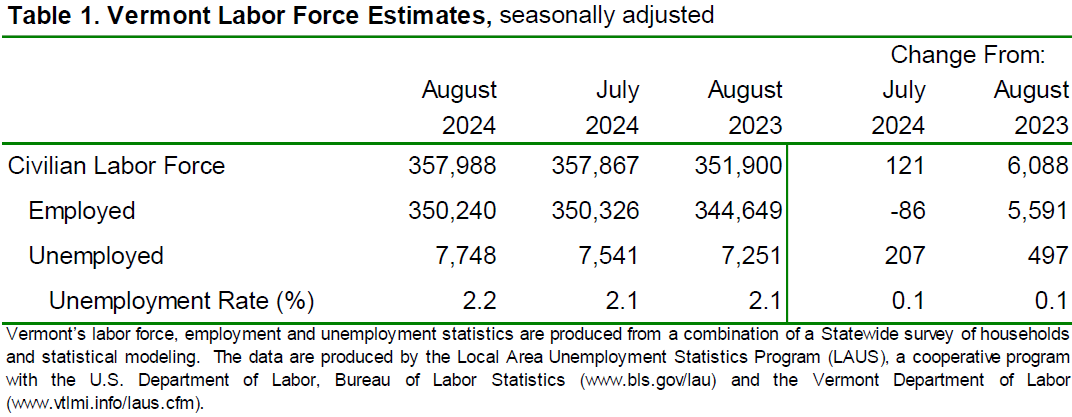
For the week, total unemployment insurance claims were 1,746 for the week (down 26 for the week and down 306 from this time last year). Meanwhile, the state unemployment rate remains second lowest in the nation even as it rose one-tenth in August, as unemployment grew modestly (2.2 percent in August 2024).
The comparable United States rate in August was 4.2%, a decrease of one-tenth of one percentage point from the revised June estimate.
The civilian labor force participation rate in Vermont was 65.7 percent in August, no change from July’s revised estimate.
U.S. DOL approves additional Disaster Unemployment Assistance benefits
In the week ending September 28 according to the US Department of Labor, the advance figure for seasonally adjusted initial claims in the US was 225,000, an increase of 6,000 from the previous week's revised level. The previous week's level was revised up by 1,000 from 218,000 to 219,000. The 4-week moving average was 224,250, a decrease of 750 from the previous week's revised average. The previous week's average was revised up by 250 from 224,750 to 225,000.
Job growth has expanded but recent layoffs, Hurricane Helene and labor actions have created uncertainty. However, inflation has fallen to its lowest level in three years (2.5%), US employment grew as the unemployment rate fell (4.1% September), the economy expanded by "a vigorous 3%," and corporate profits and the stock markets have rebounded. The Dow Industrial Average is near its all-time high, as is the S&P 500 (both records set at the end of September), while the NASDAQ peaked in July and has not fully rebounded.
Economists offered caution to the jobs picture because of recent events. According to Reuters: "The number of Americans filing new applications for unemployment benefits increased marginally last week, but the devastation unleashed by Hurricane Helene in the U.S. Southeast and strikes at Boeing (BA.N)
, opens new tab and ports could distort the labor market picture in the near-term."
Still, the overall economic news at this moment is positive.
"It looks like we may be coming in for a soft landing after all,” Eric Merlis, managing director and co-head of global markets at Citizens, told VermontBiz. “While geopolitical events could still throw a monkey wrench into things, today’s jobs numbers should ease concerns about the labor market. Today’s report should give the Fed more flexibility as it looks to continue lowering rates and it should help counter arguments that the Fed acted too late."
The Vermont Unemployment Trust Fund is well capitalized. As of the previous week (no report this week), there was $309.6 million in the Trust Fund (as claims are paid out on one side, employers are contributing to the fund on the other). The pre-pandemic Trust Fund balance on March 1, 2020, was $506.2 million.
To support vital journalism, access our archives and get unique features like our award-winning profiles, Book of Lists & Business-to-Business Directory, subscribe HERE!