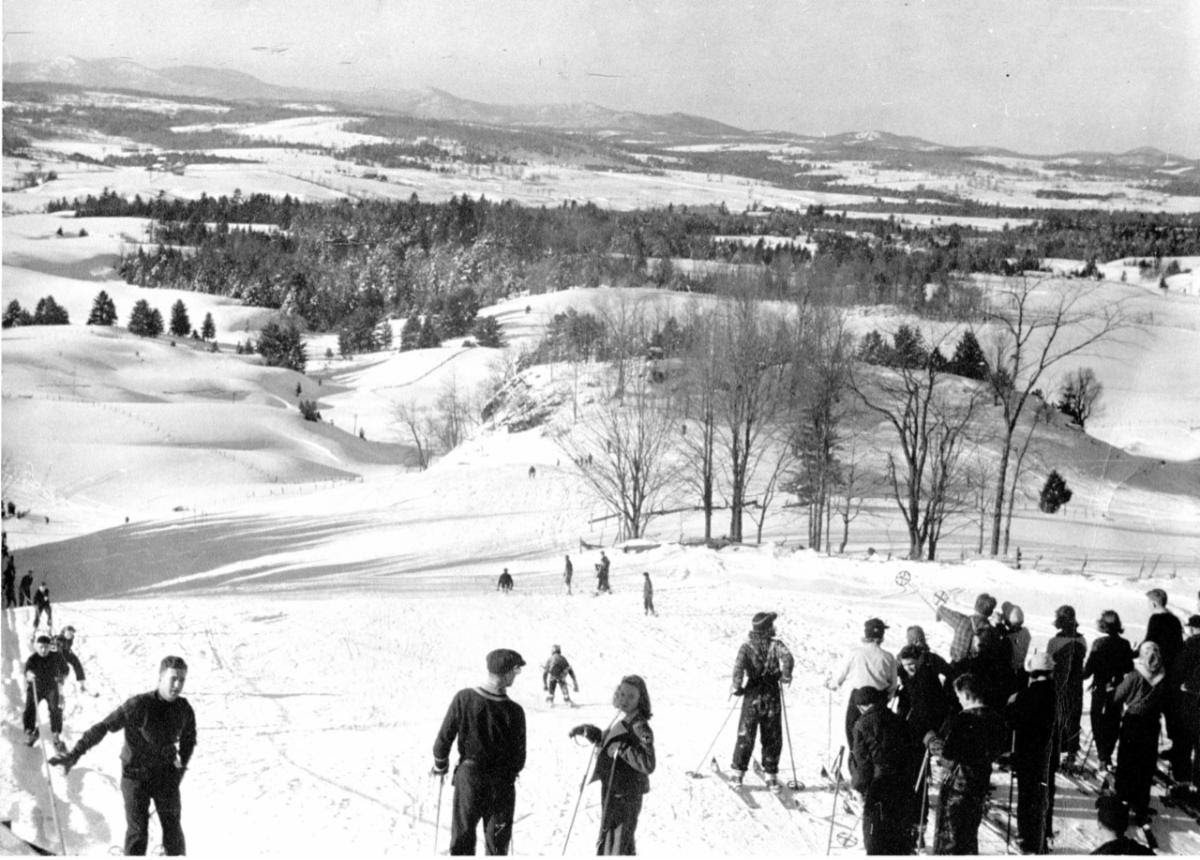
Barre Ski Club 1940. Courtesy VTSSM
Searching for Vermont’s Lost Ski Areas – Part 2
Vermont Business Magazine Vermont’s lift-service skiing history began in 1934 with the installation of the first ski lift in the country: a rope tow powered by a Ford Model T engine on Gilbert’s Hill in Woodstock. A year later, the second rope tow in Vermont was built by Wesley Pope on Glenn Skiff’s farm in Jeffersonville. After that, small ski areas began popping up all around the state.
The Vermont Ski and Snowboard Museum has been documenting Vermont’s “lost” and “lost and found” ski areas for twenty-five years. To date, 184 have been identified, including four that were in the planning stages but never opened. The upcoming exhibit, “Searching for Vermont’s Lost Ski Areas – Part 2,” is a schuss down memory lane for those who learned to ski or ride at one of these slopes. In Part 2 of the exhibit, an additional 113 documented areas, not featured in Part 1, are introduced through photographs, interviews, newspaper clippings, and memorabilia from the Museum’s collection.
For those who missed last season’s popular Part 1, it is incorporated within the new exhibit. All areas are identified on an eight-foot-tall map, including 20 ski areas that are currently operating.
A few of the lost areas highlighted in the exhibit include four in Waterbury, five in Stowe, and one right off Interstate 89’s eastbound Route 2 exit in South Burlington (Exit 14E). Towns like Newport, Middlebury, and Lyndonville had a strong ski-jumping tradition, which evolved into adding lifts for alpine skiing.
Lifts and ski programs appeared at Norwich University, Johnson State College, Vermont Junior College in Montpelier, Sterling School, and at Goddard College. Farmers in central Vermont and the Champlain Valley, seeking extra income during the winter, installed rope tows and strung lights for night skiing.
Town recreation programs added lifts and offered lessons right in the middle of towns and villages. Inns and hotels rigged up lifts for their guests to enjoy. Many were community-based and locally run, while others were built with a vision similar to what ski areas look like today.
Some areas lasted a season or two, while others lasted decades. Many closed due to rising insurance costs and stringent state lift safety protocols.
The Vermont Ski and Snowboard Museum, located at 1 South Main Street in Stowe, invites you to attend the “Searching for Vermont’s Lost Ski Areas – Part 2” exhibit opening on Friday, December 6th between 5PM-8PM. Admission to the exhibit opening is free and all are welcome. Thereafter, the Museum is open Thursday through Sunday 12PM to 5PM through the winter.
Searching for Vermont’s Lost Ski Areas is made possible by the work of many volunteers, Union Bank, Darn Tough, Winthrop H. Smith Jr. Charitable Foundation and Jeremy Davis of New England Lost Ski Areas Project.
Link to images relating to this exhibit.
About VTSSM - Since 1988, the Vermont Ski and Snowboard Museum has been dedicated to collecting, preserving, and celebrating the rich history of skiing and riding in Vermont. The museum is a 501c3 non-profit that survives on the support of members and donors.
The Vermont Ski and Snowboard Museum thrives by collecting, preserving, and celebrating Vermont's skiing and snowboarding history. The Vermont Ski and Snowboard Museum is a 501c3 non-profit organization that welcomes visitors from around the world to share, reminisce, and enjoy the collections and their stories. The museum creates visually stimulating and historically in-depth exhibits, along with year-round educational programming and statewide community events.
Vermont Ski and Snowboard Museum
1 South Main St.
Post Office Box 1511
Stowe, VT 05672
802-253-9911
To support vital journalism, access our archives and get unique features like our award-winning profiles, Book of Lists & Business-to-Business Directory, subscribe HERE!