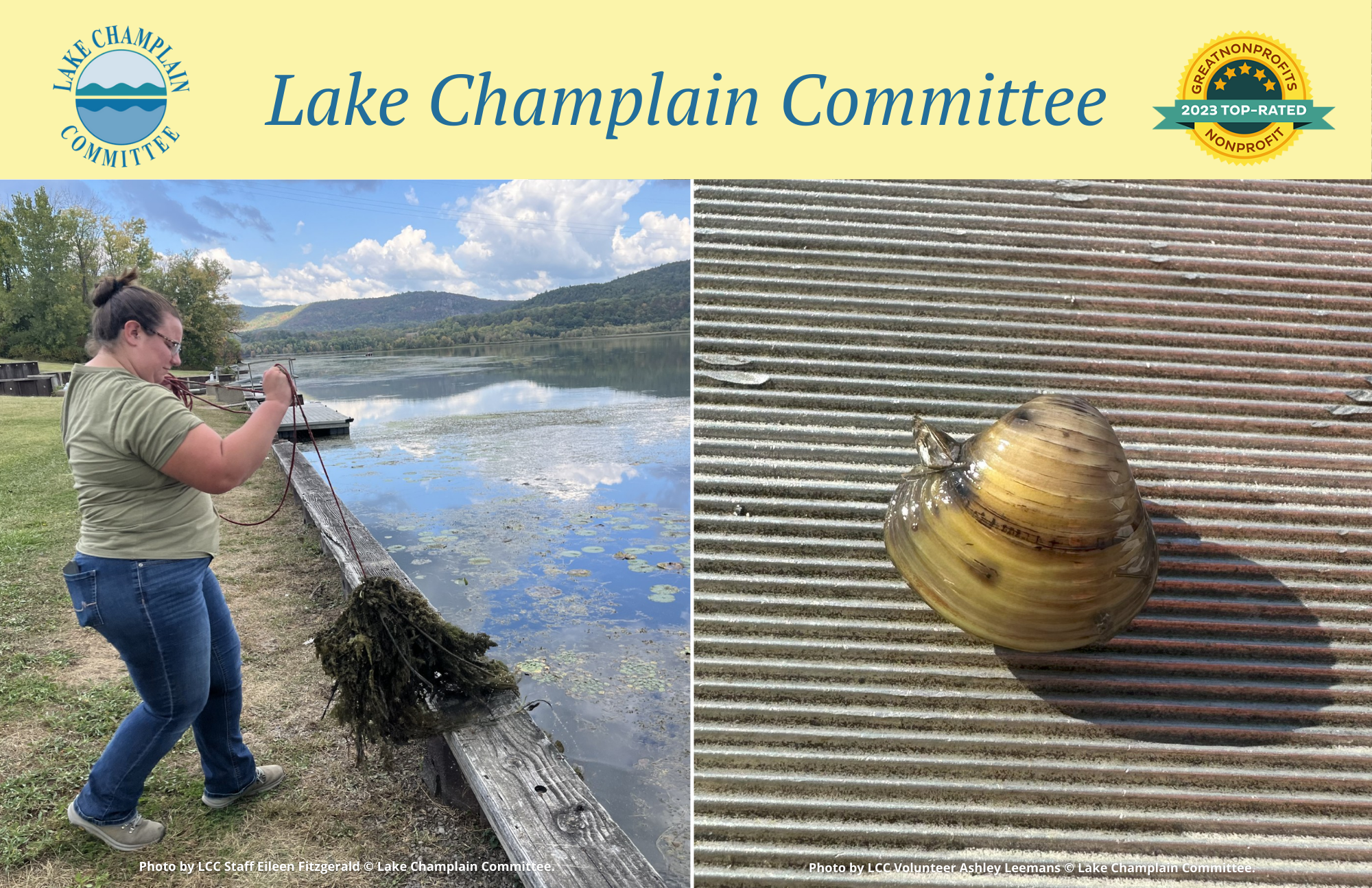
LCC community science volunteer Ashley Leemans found an invasive golden clam when checking her Whitehall NY site for aquatic invasive species on 10/22/24.
by Lori Fisher, LCC Executive Director In late October Lake Champlain Committee (LCC) community science volunteer Ashley Leemans tossed an aquatic rake into Lake Champlain and pulled in a clam while doing a routine monitoring check for aquatic invasive species (AIS) at the South Bay Boat Launch in Whitehall, New York. Ashley immediately reported her finding complete with photos to LCC and we followed up with state agencies who conducted further analysis and confirmed our suspicions that the mollusk was golden clam (Corbicula fluminea).
The aggressive AIS has been documented in the region since 2008, but the October 2024 sighting is the first known confirmation in Lake Champlain. Native to the eastern Mediterranean, Asia, Africa, and Australia golden clam is hermaphroditic, meaning a single individual can reproduce and start a new population. The species is known to reproduce quickly in other waterbodies in northeastern North America.
What’s next?
The Lake Champlain Rapid Response Task Force—a collaborative of New York, Vermont, Quebec and federal agencies that LCC helped establish—met to review next steps to respond to the discovery. The Lake Champlain Basin Program (LCBP) and New York State Department of Environmental Conservation (NYSDEC) are assessing the significance of this introduction and conducting further surveys to determine the extent and additional actions necessary. If they find established populations of golden clam that would bring the number of known nonnative and aquatic invasive species in Lake Champlain to 52. This finding underscores the importance of ongoing efforts to protect the lake’s ecosystem and native species through early detection of invasive species and the value of LCC’s AIS community science volunteer program - CHAMP.

Golden clam – Corbicula fluminea
The invasive golden clam is distinguished by concentric ridges on its outer shell.
What do Corbicula fluminea look like?
Golden clams have a triangular hinged shell and are usually smaller than a penny but can reach sizes of up to 5 centimeters in diameter. The exterior of their shells range in color from greenish yellow to dark brown and are marked with concentric growth bands that form distinct ridges you can feel. The interior is white, bluish, or light purple and smooth. The exterior ridges are a distinguishing feature which makes golden clam easy to recognize and differentiate from native mollusks like fingernail clams.
What’s the big deal with golden clam?
Golden clam—Corbicula fluminea—is an aquatic mollusk first discovered in North America in 1938 in the Columbia River in Washington state. It has since spread across the contiguous United States and is now found in nearly all 50 states and the District of Columbia. Golden clam is an aquatic invasive species in North America, which means that not only are they not native to our region, but they also actively harm the environment, the economy, and/or human health. A single adult can produce approximately 35,000 larvae per year, making eradication difficult once they become established. Large infestations can have numerous negative effects on ecosystems including out-competing rare native mussels, altering the nutrient cycle, disrupting habitat, and limiting planktonic food availability. Golden clams are filter feeders and excrete elevated levels of nitrogen and phosphorus in the lake-sediment interface, depleting oxygen, and triggering cyanobacteria blooms. Additionally, they can “biofoul” human-made structures such as water systems, costing an estimated $1 billion per year in the United States.
Where are golden clam in the Lake Champlain Watershed?
Unlike zebra mussels, which attach to hard surfaces, golden clams prefer open, sandy bottom areas with limited plant growth, where they can form dense, thick mats. In 2007, Golden clam was documented in Lock 8 of the Champlain Canal, only two locks away from the Lake Champlain side of the canal system. In 2009, they were confirmed downstream of Lake Champlain in Becancour, Quebec in the St. Lawrence River. In 2010, they were detected in Lake George, New York. (A significant effort was made to control the infestation but the invasive expanded its range and as of September 2024 occupies 85% of sandy areas in the lake.) In 2016, the invasive clams were found in Lake Bomoseen, Vermont, and now inhabit a portion of the lower lake. Lake George drains into Lake Champlain along the La Chute River in New York. Lake Bomoseen drains into Lake Champlain via the Castleton and Poultney Rivers in Vermont. Lake Champlain is surrounded and that’s why state and provincial surveillance and the surveys conducted by LCC CHAMP community science volunteers are important.

Be a CHAMP in 2025!
LCC is looking for additional community science volunteers to join our 2025 CHAMP crew. You’ll get training, a cool aquatic rake, support throughout the season, and a good feeling from stewarding the lake.
How you can help?
Follow clean, drain, dry practices whenever you recreate on and around waterways. If you have access to a public or private Lake Champlain shoreline location and a few hours to spare each month from June through late October, consider becoming one of LCC’s community science volunteers for our Champlain Aquatic invasive Monitoring Program – CHAMP. We’ll train you on how to identify AIS including critical “watch list” species, supply you with any equipment you need for successful surveying, teach you how to throw an aquatic rake (it’s fun!), and support you throughout the season. For folks interested in getting actively involved with spread prevention but who can’t make the time commitment of a CHAMP volunteer, we host annual beach combing events and AIS harvesting programs. Fill out our volunteer response form and check the box for AIS monitoring and harvesting and we’ll be in touch when we schedule 2025 outings and events. LCC’s Champlain Aquatic invasive Monitoring Program is funded by LCC donors and the Lake Champlain Basin Program/NEIWPCC. Click here if you’d like to make a special gift to support the program financially.
Shout out to Ashley and LCC CHAMP volunteers!
We’re grateful to LCC CHAMP volunteer Ashley Leemans of Washington County Soil & Water Conservation District for acting swiftly and reporting right away when she found what she thought was golden clam while surveying in Lake Champlain’s South Lake. Big thanks to all our 2024 CHAMP volunteers—you’ll find them listed below along with the territories they cover. With 587 miles of shoreline there’s still plenty of need for more Lake Champlain CHAMP monitors. We prioritize the South Lake and northern reaches because of their proximity to other waterways with more populations of AIS and public access locations as they’re the most likely sites for new infestations given boating traffic but we welcome any new sites for 2025 monitoring.
NY CHAMPS - Corinna Aldrich (South Bay Boat Launch in Whitehall), Amy Calkins (Westport Boat Launch in Westport), Joanne Cwikla (Ausable Point Public Beach in Peru and Port Douglass Beach & Boat Launch in Port Douglass), Kevin Farrar (Bulwagga Bay sites and Gilligan’s Bay in Crown Point), Ashley Leemans (South Bay Boat Launch in Whitehall), Amy McNamara (Westport), Jenny Patterson (Point Au Roche State Park in Beekmantown), Michael and Veronica Stahl (Port Henry Town Beach in Port Henry), and Noah Weber (Stevenson Bay in Westport).
VT CHAMPS - Brittany Carter (Georgia Shore Municipal Beach in Georgia VT), Carol Crosby (Alburgh Public Beach in Alburgh), Eileen Fitzgerald (Oakledge Park in Burlington and Keeler Bay Access Area in South Hero), Dalanna Newton (Malletts Bay in Colchester), Desiree Otero (St. Albans Bay Fishing Access in St. Albans), Sue Poirier (Wagner Point in Alburgh), Paul Smith and Elisa Nelson (Boat Ramp at the Champlain Bridge in Addison), and Jeff van den Noort (Graveyard Point in North Hero).
QC CHAMP - Sandy Montgomery (Missisquoi Bay in Philipsburg).
To support vital journalism, access our archives and get unique features like our award-winning profiles, Book of Lists & Business-to-Business Directory, subscribe HERE!