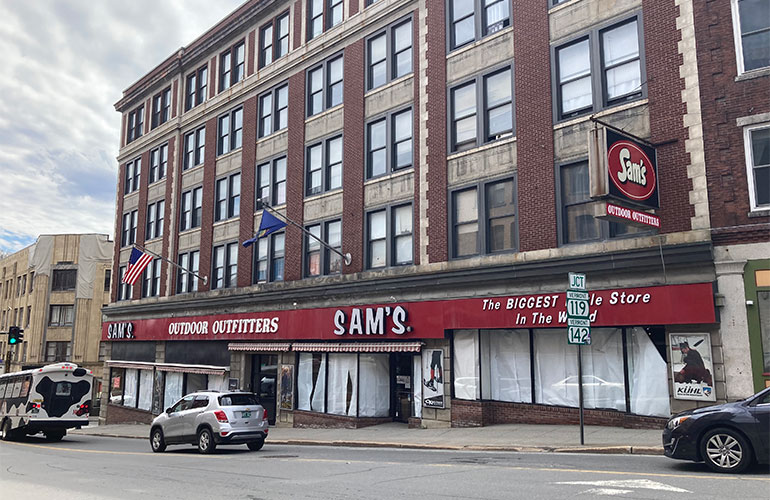
Photo: Sam's in Brattleboro all closed up. Photo: Olga Peters
Areas of the Windham County economy have improved, and there is change in the business landscape
VermontBiz Windam County’s shifting, transitioning and eclectic economy has claimed another victim: Sam’s Outdoor Outfitters, a multigenerational business in downtown Brattleboro, closed its flagship store at Flat and Main streets in April, just seven months after M&T Bank shuttered its nearby branch at the corner of Elliot and Main
But the news isn’t all bad. Several other long-running businesses, including Burrows Specialized Sports, Everyone’s Books and Mocha Joe’s Coffee House, have found new ownership and will live to see another day.
At a fundamental level, said Adam Grinold, executive director of Brattleboro Development Credit Corp, the local economy remains strong. Employers large and small across the county are seeking to add more employees and continue to grow.
“As we sit here today, I would characterize (the economy) as in transition,“ Grinold said. “All in all, the opportunity for sales remains strong; the challenges are managing the expenses.“

Photo: Adam Grinold, executive director of BDCC. Courtesy photo.
Travel north to Rockingham, and infrastructure projects like the Vilas Bridge, which have languished for decades, are making swift progress, with more projects poised to take off. The county’s Communications Union District, DVFiber, is rolling out high-speed internet to previously underserved areas like Readsboro, Whitingham and Marlboro, opening up new opportunities for remote work and new businesses.
“Eclectic is the word that I would go with,“ said Eric Durocher, economic development director for the town of Dover. “I think each town has its own kind of special offerings all throughout the county that make this a unique county economically.“
Dover is trying to balance its economic development opportunities, funded by its 1% local option tax, against its Grand List, in which 90% of the town’s taxable personal property is composed of second homes.
“We want to make sure that we’re doing everything we can to keep that sense of community as much as possible,“ Durocher said.
Durocher stresses that Dover’s second-home owners contribute to the town in their own way, for which Dover is grateful. Still, the high percentage of seasonal homes means Dover’s pool of potential school board members, selectboard officials, volunteer firefighters, library volunteers and local business workers is shrinking.
In other words, where you stand on the economy might depend on where you sit.
“I think it’s working well for some and not well for others,“ said Chris Campany, executive director of the Windham County Regional Commission.
Reasons to Feel Encouraged
In Campany’s opinion, stagnant wages pose the biggest challenge for the county, which borders Cheshire County in New Hampshire and Franklin County in Massachusetts. Vermont salaries lag behind those in similar communities in New England and many parts of the country. Add to that a severe shortage of affordable housing, and Campany doubts many residents’ economic situations are improving.
According to the latest data from the National Low Income Housing Coalition, a nonprofit organization dedicated to ending America’s affordable housing crisis, a person earning Vermont’s minimum wage of $13.18 per hour would need to work 61 hours a week to afford the rent of a typical one-bedroom home in the area.
“I imagine some people who are already on the margins are feeling like things are kind of slipping backward,“ Campany said.
For people new to the state and those who can work remotely, the quality of life may feel high, Campany said, especially if this person has retained their salary from a community with a higher cost of living.
In March, the Vermont Department of Labor reported Windham County’s workforce at 22,678, with an unemployment rate of 2.0%
Campany wonders whether all community members are at the table when municipal and state lawmakers create policy.
“My concern that I’ve always had is the extent to which those who are most engaged in the local economy — meaning they are working here, they’re earning wages here, they’re spending money here, they’re hiring people here — are directly involved in policy discussions,“ Campany said.
Other municipal and state leaders echo Campany’s concerns.
The common wisdom is that democracy and policymaking benefit from having people with multiple perspectives and experiences at the table. Only some, however, have the time or resources to volunteer or serve in public office. In general, those who can serve are retired or more financially secure.
“I don’t think this is unique, certainly not unique to our region or Vermont,“ Campany said. “It’s just the nature of the challenges of serving the public, whether as a volunteer or a public official: How much time and what amount of capacity do you have to actually be able to do that work?“
Three years ago, the goal of expanding the pool of citizens able to serve on the selectboard prompted Brattleboro’s Town Meeting representatives to approve increasing the stipend for selectboard members.
Grinold, meanwhile, said as the cost of materials and other goods increases, businesses must balance raising their own prices while remaining competitive within the market.
“Wages, of course, are increasing, which is a good contributor to a growing economy,“ he said. “More money in more pockets allows those local dollars to move about our economy.“
Better wages and reversing the county’s population decline have been at the top of the BDCC’s agenda since the time that Entergy, former owners of the Vermont Yankee nuclear power plant, said it would close the facility by 2014. Vermont Yankee was one of the area’s highest-paying employers at that time. The BDCC and its partners, who later established the Southeastern Vermont Economic Development Strategy, known as SeVEDS, worried that losing the large economic driver would adversely impact the region.
“For us, it’s about ensuring that we have high-skill, high-wage and high-growth jobs, and those employers who can afford through the sale of their product or service to pay those high wages,“ Grinold said.
He noted that the region’s wages have increased sharply over the past five years, though perhaps not as much or as fast as people would have liked.
According to the US Census Bureau, Windham County’s median household income was $51,985 in 2019. By 2022, it had risen to $65,473, an increase of almost 26% in just three years.
Increasing the state’s minimum wage helped elevate the lowest salaries, he added. However, middle-income workers didn’t see as big a bump.
Despite the myriad challenges, county residents have reason to feel encouraged, Grinold said.
A decade ago, Windham County had the second-oldest population in the state, people were leaving the area in high numbers and wages were below those of our neighbors, Grinold said. In the intervening time, the county has turned a corner and experienced an uptick in population and employee wages.
Grinold credits this change to the strategy set out by the SeVEDS strategic plan, “which is to invest in your assets and try to make those assets grow. It’s not about wishing you had something you didn’t and trying to make it happen.“
He said the county leaned into strengthening what it already had. For example, the most significant growth in wages and GDP in southeastern Vermont has come through value-added food production. Companies like Against the Grain and Commonwealth Dairy are a part of cultivating existing assets.
Meanwhile, Grinold continues to take calls from employers and individuals outside the state who are seeking to relocate to Vermont.
“These kinds of things can take years to pull together,“ he said. “So it’s not like we have a caravan of businesses driving up to put their stakes in the ground. But it is reassuring to have that continued interest.“
Housing and Real Estate
“The housing situation, I mean, it seems to be both the chicken and the egg, you know?” Campany said.
In Campany’s opinion, the dream of purchasing a single-family home on a large plot of land is beyond the financial grasp of most residents.
Campany said municipalities are limited in their ability to make meaningful progress in building new affordable homes. Infrastructure, specifically water and sewer, is one of the biggest challenges to constructing large amounts of new housing, in his opinion.
“The only places where you're going to be able to get meaningful numbers of homes built is where you actually have the wastewater and the public wastewater and water systems support that,” he said.
The Windham Regional Commission has submitted a proposal to the UVM Leahy Institute for Rural Partnerships. As of April, Campany said the proposal made it through the first round of UVM’s vetting process.
The proposal would create a statewide map of wastewater infrastructure and capacity if selected. Campany said Vermont needs a cohesive map of where water and wastewater systems exist and their future capacity. With it, it is easier to see if the policies for building more housing align with the infrastructure to support it.
“We seem to be talking so much about regulatory policy, but we don't seem to be talking so much about the underlying infrastructure issues that determine what can be developed where,” he said.
As someone whose previous work experience included states with regional or county-level government with financing and taxing capacity, Campany said planning wide scale in Vermont can be a challenge. It’s like reinventing the wheel 250 times.
“You have nothing between a municipality and the state that actually raises public funds to make those investments happen. And that's not just the Vermont challenge. That's a New England challenge. We have a governance structure that goes back to pre-colonial times that probably made a lot of sense, starting in the 1600s, but now creates some real challenges for us here in the 2020s.”
With a Grand List of 90 percent second homes, Dover has studied the STR market.
Durocher explained that many second homes double as short-term rentals (STRs) when the owners aren’t in residence.
He said these STRs are sometimes necessary. During peak ski weekends, sometimes visitors outnumber hotel beds.
The Wilmington Dover Bi-Town Committee spent months studying the local STR market.
Like most Vermont towns, Dover and Wilmington have a housing shortage. Specifically, housing that is affordable to local workers, he said.
But a vacation home that doubles as an STR wouldn’t necessarily be used for a long-term rental by second-home owners, so the towns are looking to other solutions to their housing shortage, he said.
One effort includes an incentive program to build Auxiliary Dwelling Units (AUDs). The town has also pre-paid for educational programs on shared housing so residents can take them for free. The Bi-Town Committee has set the goal of adding five units of new housing to each town yearly.
It’s a slow process, said Durocher. Over time, those combined 10 units add up.
Durocher said STRs still require management. It’s hard to enforce rules when one’s neighbors change every weekend.
Dover has put some guardrails in place for STRs. It’s contacted a third-party registration company and instituted a few rules. First, properties must meet the state’s fire safety regulations. Also, the property owner must designate an emergency contact who will respond to calls within an hour. This person doesn’t need to live in Dover, but they must have the authority to make decisions. For example, possess the code to disarm a security alarm, authorize contacting a plumber in the case of burst pipes, or deal with unruly guests.
Windham County’s real estate market is stuck, said Realtor John Hatton.
Hatton is an associate broker at Berkley & Veller Greenwood Country Realtors in Brattleboro. He has 20 years of experience in the market and helps train agents. He is also a teacher for Windham and Windsor Housing Trust’s home buyer course.
According to Hatton, demand for houses is very high, while inventory is extremely low. It’s a seller’s market, yet many people can’t afford to sell.
Projects Moving Forward In Rockingham And Dover
Gary Fox, development director for the Town of Rockingham, feels enthusiastic about the town’s economy. Despite a drop in population, the area has experienced a wage bump. Several big infrastructure projects have gained momentum after decades of sitting idyl.
Local wages have significantly increased since 2019. Fox credits growth at the three local manufacturing companies—Sonnax, Chroma, and Whitney Blake—for helping increase wages.
According to the town’s economic report, the median family income in 2019 was $43,668. In 2022, that number increased to $70,165, higher than the Windham County average of $65,473.
Fox said many of Rockingham’s larger infrastructure projects are funded by various federal, state, and local sources.
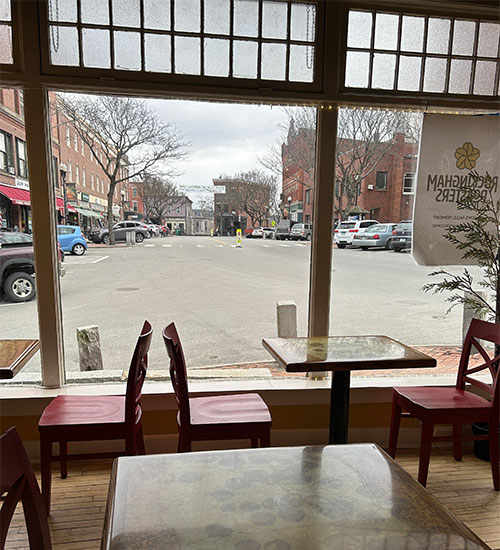
Photo: A view of downtown Bellows Falls from Rockingham Roasters. Photo by Olga Peters.
The Vilas Bridge has been closed to traffic since 2009 and is scheduled for renovations. The bridge is one of the connections between the Village of Bellows Falls and Walpole, NH, and is overseen by the NH DOT. Fox said the bridge is on New Hampshire’s construction schedule for 2029.
Redeveloping The Island has made progress, including clearing a Brownfield left behind by a former paper mill. Fox said an area-wide plan for The Island includes adding mixed-use development with commercial spaces on the ground floors and housing above.
In a US Environmental Protection Agency Brownfields announcement, the EPA wrote, “The redevelopment of this former paper company in Bellows Falls is a model for how construction and demolition can be done to save money and the environment.”
The Bellows Falls Area Development Corporation took over The Island project in 2013 to clean up and redevelop the 30-acre parcel bordered by the Bellows Falls Canal and Connecticut River.
As the site of the former Robertson Paper Company mill, some of the chemicals found in the soil and building materials included lead, arsenic, asbestos, petroleum, and polycyclic aromatic hydrocarbons, according to the EPA. The redevelopment is being funded with federal, state, and local support, including grants from the Environmental Protection Agency's Brownfields Assessment and Cleanup Program, wrote the EPA.
Fox said renovating and expanding the transit opportunities on The Island is a top priority for the town. The area around the train station is undergoing renovations, and the town is also working to renovate the old and undersized bridges that access the area.
Fox said work to replace the Depot Street Bridge has begun. The designs are complete, and the project has received federal funding. Work like moving utilities has started. Fox anticipates construction beginning in 2026 or 2027.
The former Bellows Falls Garage, built in the 1920s, was demolished and replaced by a new 31,879-square-foot building. Still called The Bellows Falls Garage, the multifamily housing project hosts 27 affordable housing units. The Windham and Windsor Housing Trust led the project in collaboration with DEW Construction and Gossens Bachman Architects.
Fox said many of these projects wallowed because they needed more leadership and political will.
“This time around, the town of Rockingham has that leadership, the willingness to take ownership of it, too,” he said. “So we secured the new version of earmarks, so we're repeating what was done 20 years ago, but with a different leadership, and a development-oriented climate at not only at the leadership level but all the way through” to the voters who approved the town budget and bonds.
He suspects some of the community’s support for development comes from witnessing the loss of several local landmarks. According to Fox, after years of neglect and lack of community support to redevelop properties like the Robertson Paper Mill and the Methodist Meeting House, which had served for 30 - 40 years as the YMCA building, these—in many cases beloved—structures had crumbled beyond repair. Watching them go made several community members embrace development, he said.
Fox said a weakness in the Rockingham economy is its declining population. According to him, when he moved to the area 30 years ago, Rockingham’s population averaged 5,500 people. Pre-COVID, the town’s population was 5,031. Two years later, the population had dropped to 4,867.
“When you lose 17 percent of the population, it hurts, and then there's fewer kids in the school, and you have a whole spiral that happens with the loss of population, so that's the weakness,” Fox said.
He still sees opportunity. The area can attract new residents by developing more housing and rehabilitating buildings.
Part of Rockingham’s area-wide plan includes renovating the living spaces on the upper floors in existing downtown buildings and attracting more commercial activity on the ground level.
According to Fox, the Village of Bellows Falls is vibrant. Over two weekends in April, the Bellows Falls Opera House hosted sold-out performances with 3,000 people in attendance.
During COVID, the Opera House received grant funding through the Shuttered Venue Operating Grant, to which the town added additional funding. The combination of funds allowed upgrades to the building’s roof to hold the weight of a new lighting system. The soundboard received upgrades. The venue hosts films and live performances, such as the Wild Goose Players performance of “Fidler on the Roof.”
“I heard from out-of-town visitors dropping off guests at the train station that they loved the uniqueness of the various small shops – the café, vintage shops – clothing, LP record albums, used books, independent bookstore, jewelers, hardware, sporting goods, art galleries,” Fox said.
As the home of Mount Snow Ski Resort, Dover’s economy has relied on winter tourism dollars for decades. Expanding the economy to include all four seasons is an active marketing effort by Dover’s economic development department in conjunction with the Bi-Town committee.
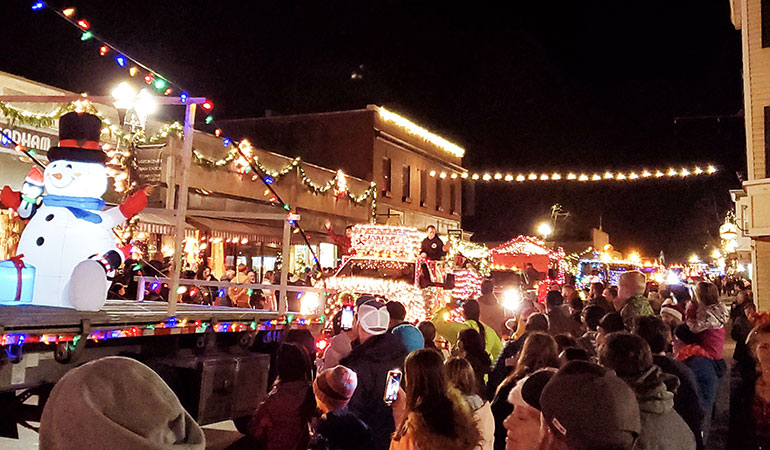
Photo: Bellows Falls in 2023, the 2nd annual festival of lights parade. Courtesy photo.
“It's always been like feast or famine. You feast during the winter, and then you limp along through the summer until it snows again,” Durocher said. “We’re really trying to make it not be that way.”
The town constantly looks to expand its offerings beyond skiing.
Dover converted 53 acres of town-owned land into a recreational area called Horace Hill. The property includes high-end hiking and mountain biking trails and an 18-hole disc golf course. Durocher anticipates the new course will be a part of the Disc Golf Vermont Tour next spring.
According to Durocher, one benefit of living in Dover is that its community of approximately 185 businesses often takes initiatives to improve the town. For example, local business owners have built pickleball courts, installed skateboard parks, and funded winter ice skating rinks.
Dover funds its economic development efforts using revenue generated through the one percent local options sales tax. Durocher said the revenue amounts fluctuate but tend to average approximately $670,000 annually.
BDCC Turns 70 And An Economy’s Natural Cycle
Grinold is giving the Windham County economy a lot of thought these days.
The BDCC is celebrating its 70th anniversary. It’s prompted him to flip through the organization’s archives. The exercise has highlighted the large generational cycles that the economy moves through.
He said the businesses founded after World War II replaced industries that existed during the First World War. Fast-forward to the 1960s, and Vermont experienced people moving here as part of the “back to the land movement,” and the economy changed again. Now, workers can choose remote jobs. He said that today’s kindergarteners will have careers that people living in 2024 can’t imagine.
So, while Grinold doesn’t feel that Windham County’s economic sky is falling, he knows it is doing more with less: workers, students, volunteers, and funding.
Part of the county's current problem is that previous generations' business models were based on something other than less. They were built on growth.
“They were built on a stable or growing population,” he said. “We’re in the middle of trying to reinvent this, so we're fighting the fire in front of us. And really, we should be figuring out how to make the earth a little less dry, right?”
Grinold said the region needs to remain focused on workforce development, skill building, and “ensuring that our employers have access to employees who can make their highest and best contribution to the community for their employment.”
He said Southeastern Vermont will remain competitive in the wider regional economy by maintaining strong support systems to help people thrive in their chosen careers from high school through early careers.
Taking the long view of the economy does not erase the fact that many of the local changes, like the closure of Sam’s and the M&T Bank in Brattleboro, are making people nervous.
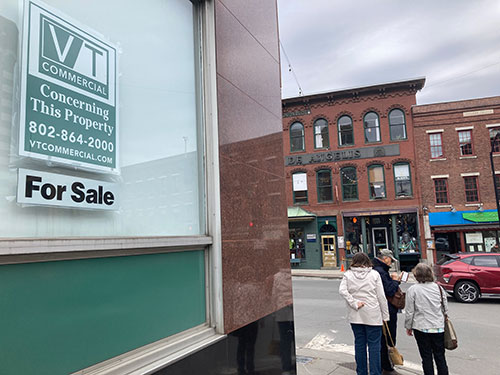
Photo: Downtown Brattleboro. now former M&T Bank building at the corner of Elliot and Main streets. Photo by Olga Peters.
Grinold said Main Street is constantly evolving.
“If you take a step back and look at that historical framework with which businesses come and go and natural life cycles, it's not as scary from a historical perspective than when you're living in the moment,” he said.
Before Sam’s, in the 1940s and 1950s, the Book Press occupied what is now the Harmony Parking Lot. When they outgrew the space, the company told the town to find the Book Press a new space, or the owners would move it down south, he said.
According to Grinold, the community found a solution by selling bonds to help buy land and build the Book Press, a new space on Putney Road.
“That was the community coming together to say no, this is important. We're going to find a solution. And I'm 100 percent certain that Brattleboro, Southern Vermont, and Vermont will continue to find ways to transform itself,” he said.
Olga Peters is a freelance writer from Windham County.
To support great journalism, access our archives and get unique features like our award-winning profiles, subscribe HERE!