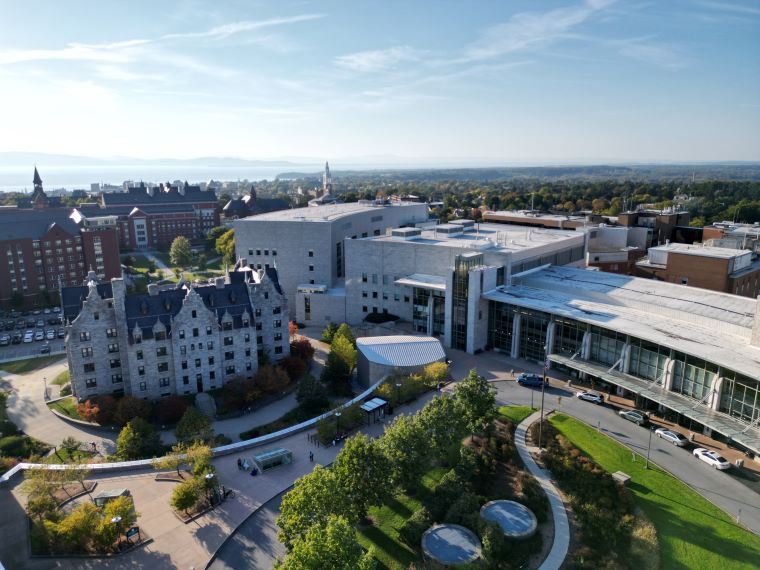
UVM Medical Center entrance. Courtesy photo.
Goal Is to Educate Public on Benefits of Clinical Trials, Counter Misinformation like “Placebo Myth,” Encourage Participation
Vermont Business Magazine Surgery to remove malignant melanoma, the deadliest form of skin cancer, is often lifesaving. But cutting away both the melanoma and up to four centimeters of the skin around it, which could harbor cancer cells, may cause long-term pain and scarring in patients.
A clinical trial at the UVM Cancer Center, currently enrolling volunteers, asks the question: Would reducing the amount of skin removed around the melanoma improve patients’ post-surgery quality of life without increasing the risk of melanoma returning?
100+ Clinical Trials at UVM
The trial, led by Jessica A. Cintolo-Gonzalez, MD, is one of more than 100 the UVM Cancer Center is currently conducting and is especially relevant in Vermont, which has the second highest incident rate of melanoma in the United States.
The Association of Clinical Trial Research Professionals has designated May 20 Clinical Trials Awareness Day, designed to raise public awareness of the benefits of clinical trials like the melanoma study, counter misinformation, and encourage more eligible patients to enroll.
Dr. Randall Holcombe, MD, MBA, director of the UVM Cancer Center, is bullish on the benefits clinical trials can bring to cancer patients.
A well-designed clinical trial, like those offered by UVM, is almost universally the best option for treating cancer, he says, potentially more effective and less toxic than the current standard of care.
“I tell my patients that the treatment they're getting today was a clinical trial 10 years ago, and the clinical trial that they participate in today has the potential of setting a new standard of care 10 years from now,” he said.
The placebo myth
Holcombe says patients who decide not to enroll in a clinical trial are often swayed by a common misconception. Many believe they’ll either be given an experimental new treatment or, via a placebo, no treatment at all.
But giving a sick patient a placebo — essentially letting their disease progress — is unethical, Holcombe said, and doesn’t happen in tests of new treatments.
Instead, the new treatment is often compared with the standard of care, what patients would normally be receiving if not participating in a trial. “You really can’t lose,” Holcombe said.
Clinical trials are plagued by several other myths that depress patient participation, including the belief that patients are treated like guinea pigs and receive little care.
“Less than 5% of adult patients diagnosed with cancer participate in clinical trials. However, in most instances, patients are monitored more closely than when receiving standard-of-care treatment. Many patients who have participated in a clinical trial have positive things to say," said Christa Varnadoe-Rothman, DNP, AGNP-C, OCN, CCRP.
Further, the Coalition of Cancer Cooperative Groups (2009) found that of those who participated in clinical trials: 91% would recommend a trial to others, 92% had a positive experience, and 96% felt that they were treated with dignity and respect. (See below for five common myths about clinical trials).
As well as helping themselves, patients in clinical trials are helping researchers develop the therapies of the future that could help many others.
“If you look at the history of clinical research over the last 30 years, you'll find that about a third to half the time, clinical trials have moved the bar and established a new standard of care,” Holcombe said. “This is how we make continual progress against difficult diseases like cancer.”
First Clinical Trial — in 1774
Clinical Trials Day is celebrated globally each May 20 to recognize the day in 1774 that James Lind, a ship’s surgeon in the British Royal Navy, started what is often considered to be the first randomized clinical trial. In this case, it was to study the effects of different treatments on scurvy, a disease caused by a deficiency of vitamin C, and a major scourge for sailors on long voyages.
Five Myths About Clinical Trials and Cancer
Myth #1
Patients frequently get placebos.
Fact
Placebos are very rarely used on clinical trials for cancer patients and every patient gets at least the standard of care.
Myth #2
Patients who enroll in a clinical trial for cancer are locked in and won’t be able to change treatments.
Fact
Clinical trial participants can choose to stop participating at any time and return to their standard quality of care.
Myth #3
Clinical trials are just for patients with advanced stages of cancer when no other option is possible.
Fact
Clinical trials provide the very highest level of care for patients at all stages of cancer.
Myth #4
Patients in clinical trials are often treated like guinea pigs.
Fact
There are strict rules about how patients are consented and monitored. Patients’ safety and providing the highest quality of care are always top priorities.
Myth #5
Clinical trials for cancer are dangerous because they use new medicines.
Fact
While there is some level of risk, clinical trial drugs go through rigorous testing for safety in humans, and patients are monitored closely for adverse effects.
About the UVM Cancer Center
The University of Vermont Cancer Center is Vermont’s only not-for-profit comprehensive clinical and research cancer center. Founded in 1974, the organization is located within the University of Vermont Larner College of Medicine and enjoys a clinical partnership with the University of Vermont Medical Center. Drawing on the expertise of more than 165 research and clinical members, the center works to reduce the burden of cancer in Vermont, northeastern New York and across northern New England, through research, outstanding clinical care, community outreach and education.
Source: University of Vermont
To support great journalism, access our archives and get unique features like our award-winning profiles, subscribe HERE!