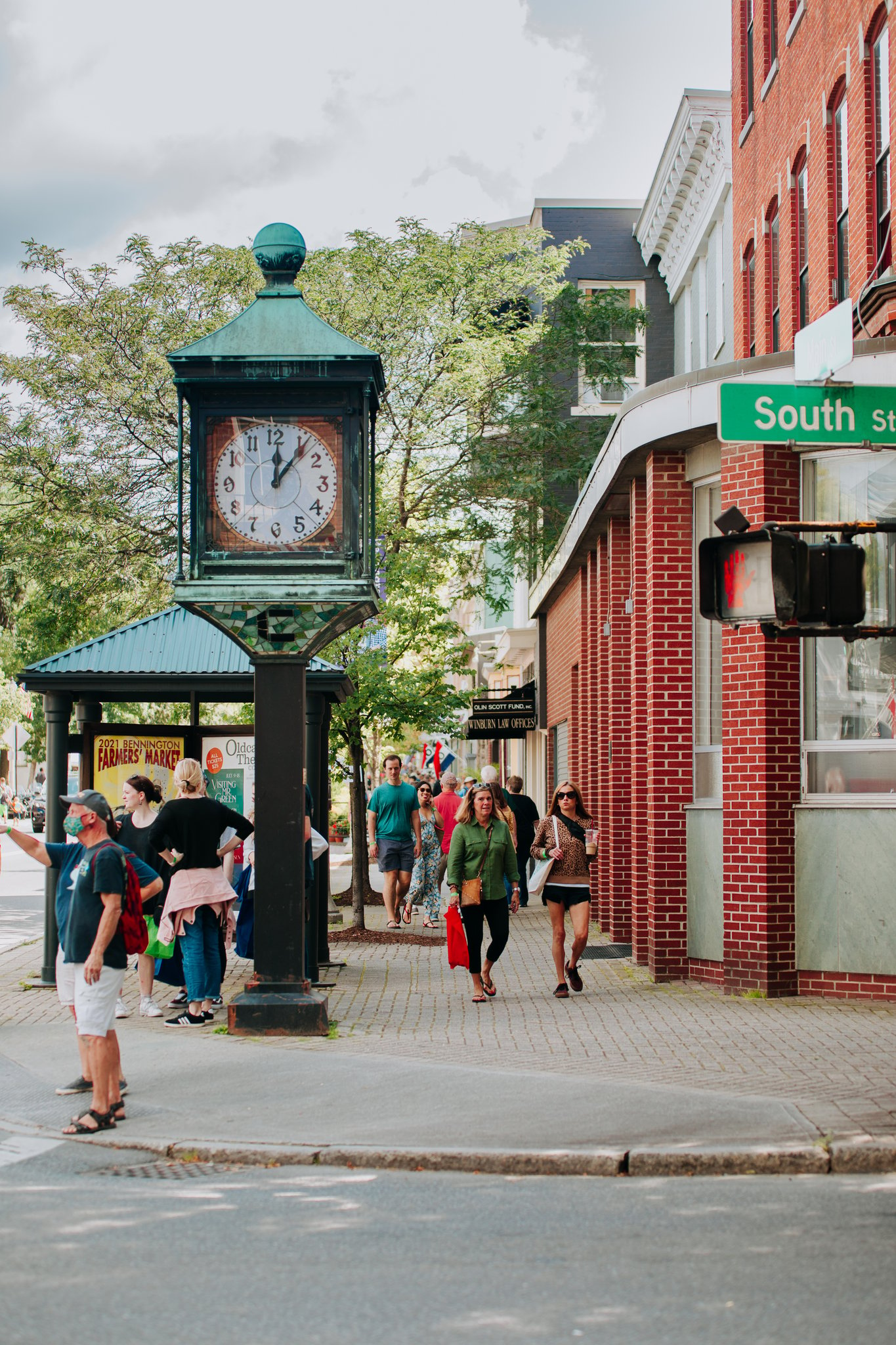
Photo courtesy of the Southwestern Vermont Chamber and Lorianna Weathers Photography.
Vermont Business Magazine The Southwestern Vermont Chamber of Commerce recently conducted its annual State of the Commerce survey, providing valuable insights into the prevailing economic trends and sentiments about the regional economy. The survey, which saw participation from businesses and organizations across various sectors and towns in the region, highlighted both the challenges faced by businesses and their hopes for the future.
Town/Community Distribution
The survey respondents represented a diverse mix of communities within Southwestern Vermont, with Bennington leading as the predominant town, comprising 61% of the respondents. Manchester followed with 27% of respondents, while Arlington, Dorset, Londonderry, and North Bennington made up 7% each. The survey showcased the collective voice of businesses and organizations from across the region, reflecting the Chamber's commitment to inclusivity and regional representation.
Industry Types
The survey also shed light on the diverse range of industries present in the region. The nonprofit sector and shopping emerged as the leading industries taking the survey with 15% and 12% respectively. Other prominent sectors included health care, housing/real estate, lodging, education, and professional services.
Business Ownership Diversity
The survey revealed a positive trend in business ownership diversity, with 33% of respondents identifying as woman-owned and 5% as young professional-owned (40 and under). Additionally, respondents also identified as BIPOC-owned, LGBTQI+ owned, disabled-person-owned, and immigrant-owned. This demonstrates the region's growing diversity in the economic landscape. "We are proud to see a growing diverse range of business ownership in our region," said Matt Harrington, Executive Director of the Southwestern Vermont Chamber. "It reflects our community's work on inclusivity and the strength that comes from a variety of perspectives."
Top Business Challenges
When asked what respondents saw as their number one challenge impacting their business or organization, 42% said workforce, 25% indicated rising costs, 9% said employee costs like health care, benefits, and insurance, while 7% indicated marketing and gaining customers. Comments in this section stated a lack of available contractors and people in the trades as a challenge, as well as the cost of retail space to rent in the downtowns. Last year’s survey only showed 30% of respondents concerned about workforce needs, which indicates there is an ever-growing challenge for the workforce in the region.
When asked what respondents anticipated would be their greatest challenge within the next 12-18 months, 29% indicated staffing, 21% indicated financial stability, 13% indicated growing customers/clients/donors/volunteers, and 11% indicated fatigue and burnout.
When asked how their employee count had changed since 2023, encouragingly 40% indicated some type of growth (from 1% to 100% in employees). Eighteen percent indicated a loss of employees, while 42% indicated that they have not changed their employee number.
Current & Future Outlook
When asked for a letter grade to indicate how healthy they felt their organization or business was doing, ranging from A (excellent) to F (closure imminent), 70% ranged from B (successful) to A (excellent) with 47% feeling “successful,” 16% feeling “really good,” and 7% feeling “excellent.” The other portion, B- (temporarily successful) to D (not doing well) made up 30%. Luckily, no respondent indicated “fear of closure” or “closure imminent” in this survey.
When asked about their business's financial performance compared to five years ago (2019), a significant portion of respondents, 49%, reported that their businesses were doing better. This optimistic response indicates that despite the challenges faced during the intervening years, many businesses in Southwestern Vermont have managed to recover and even improve their financial health. On the other hand, 15% of respondents mentioned that their business's financial performance was worse compared to 2020. Twenty-two percent of the respondents stated that their financial performance remained the same as it was in 2019, while 15% indicated that their organization or business wasn’t around in 2019.
An overwhelming majority of respondents, 87%, expressed that Southwestern Vermont is a good place to have a business or organization. However, this was down from 2023’s survey where 94% of respondents indicated that the region was a good place to do business. "Despite the slight dip, it's clear that our region continues to be a strong and supportive environment for businesses," commented Harrington. "We remain committed to enhancing this environment and addressing the challenges identified by our members."
New this year, the survey asked how they felt about doing business in Vermont as a whole. Not as encouraging, respondents indicated 70% in terms of Vermont as a good place to do business.
When asked if in the next three years respondents felt that Southwestern Vermont would be a better or worse place to run their businesses and organizations, 77% indicated better, while 23% indicated worse. This was slightly down from the 80% that said in 2023 that the next three years would be better in the region. When asked a similar question at a state level, 66% of respondents said better, while 34% of respondents said worse.
Respondents were also asked if they plan to retire or close their business or organization in the next one to three years. Seven percent said yes they were planning to close or retire; this was down from the 14% in 2023 that indicated they would be closing.
The last question on the State of the Commerce survey asked what additional services would help support their growth. At 29%, respondents said property rental options. Improved cell service, improved connections to other business owners, and workforce development programs all came in at 25%. Transportation/infrastructure improvements and better destination marketing of the region came in at 24%, while health and wellness programs, access to professional consulting services, and streamlined regulatory and permitting processes came in at 18%, 16%, 16% respectively. Other services worth mentioning from respondents include better health insurance options, housing, and predictable, fair, and affordable property taxes.
"We view feedback as a gift and a critical tool for making data-driven decisions," said Harrington. "These insights from our businesses and organizations allow us to focus our efforts and energy on propelling the Southwestern Vermont economy forward. By understanding the challenges and opportunities businesses face, we can work collaboratively to create a thriving economic environment for all."
The Southwestern Vermont Chamber’s mission is to promote, lead and advocate a unified effort, on behalf of our business and nonprofit members, to maintain and improve a healthy business climate and rewarding quality of life for the entire Shires of Southwestern Vermont region. The 2027 vision for the organization is to cultivate a vibrant regional economy driven by innovation and collaboration where commerce thrives in harmony with the stunning natural landscapes and welcoming and diverse communities.
Source: Bennington, Monday, August 5, 2024 -- The Southwestern Vermont Chamber of Commerce SWVTChamber.com I ExploreTheShires.com
To support great journalism, access our archives and get unique features like our award-winning profiles, Book of Lists & Business-to-Business Directory, subscribe HERE!