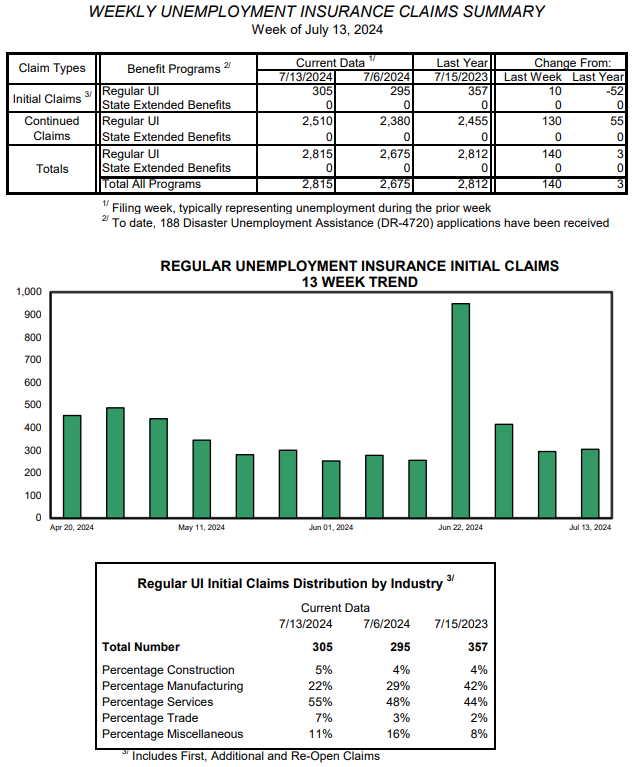
by Timothy McQuiston, Vermont Business Magazine Weekly unemployment claims rose slightly last week. For the week ending July 13, 2024, new claims were 305, mostly back to their usual summer lows. Service claims remain somewhat elevated, but Manufacturing claims are at their typically low level after a spike in June. The Vermont Department of Labor said because of the timing of the report, these claims are not affected by the July 10 floods that hit central and northeast Vermont.
The Vermont Department of Labor confirmed to VermontBiz that several manufacturers experienced temporary layoffs and reduced hours in June; they could not say who those employers were. Labor acknowledged it was "a trend" but did not further specify.
The Service industry accounts for the most claims this week with 55 % up from 48%. For the week of June 22, Manufacturing accounted for an unusual 37% of claims. It is now back to 22%, which is also much lower than they were a year ago.
See tables below.
For the week, claims were up 10 for the week but there were 52 fewer than this time last year. Meanwhile, the state unemployment rate remains near historic low levels as employment and the labor force have increased (2.1 percent in June 2024).
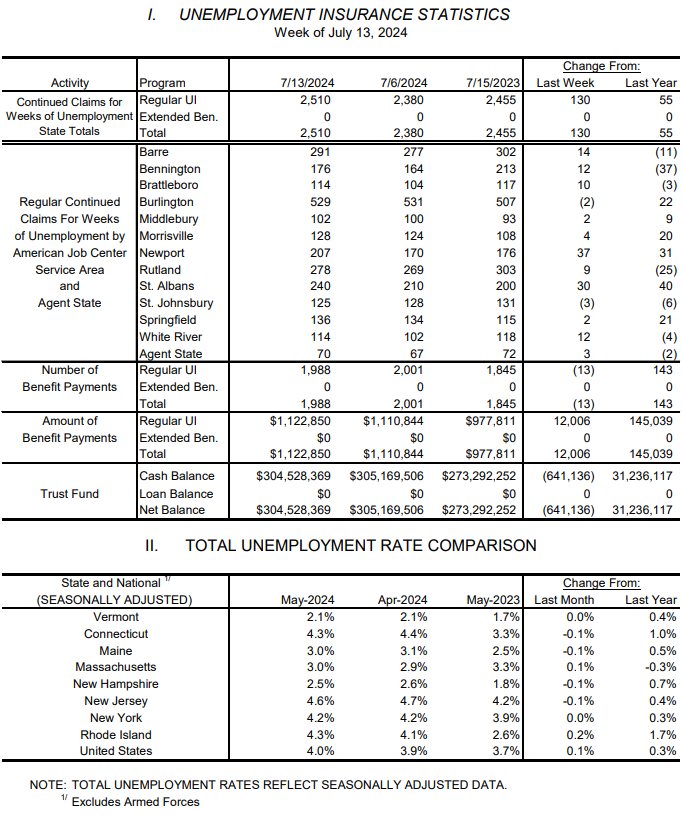
Vermont has the second lowest rate in the nation, behind South Dakota (2.0%). Nevada and California (5.2%) have the highest rates.
The comparable United States rate in June was 4.1 percent, an increase of one-tenth of one percentage point from the revised May estimate.
The Vermont civilian labor force participation rate was 65.7 percent in May, an increase of one-tenth of one percentage point from the prior month’s revised estimate.
For new and continuing UI claims, there were a total of 2,815 claims, up 140 from the week before and 3 more than last year.
Workers affected by July 2024 flood should apply for unemployment benefits
Nationally for the week ending July 13, the advance figure for seasonally adjusted initial claims was 243,000, an increase of 20,000 from the previous week's revised level. The previous week's level was revised up by 1,000 from 222,000 to 223,000. The 4-week moving average was 234,750, an increase of 1,000 from the previous week's revised average. The previous week's average was revised up by 250 from 233,500 to 233,750.
Reuters reports that the increase is more than expected and blames the usual, temporary auto plant closures and the result of Hurricane Beryle (whose remnants also led to the Vermont flooding).
However, Reuters notes that claims are still higher than this time last year, it's taking longer for the average unemployed person to find a job, jobless levels and the unemployment rate are also higher that last year, though they don't expect it to go higher.
For all that, and with inflation "ebbing," the Federal Reserve is expected to cut interest rates in September.
The Vermont Unemployment Trust Fund is well capitalized. As of last week, there was $304.5 million in the Trust Fund, down $641,136 for the week (as claims are paid out on one side, employers are contributing to the fund on the other). The pre-pandemic Trust Fund balance on March 1, 2020, was $506.2 million.