Vermont Business Magazine Public Assets Institute in Montpelier this week released its State of Working Vermont 2023. PAI said in the report that Vermont is facing challenges old and new—from housing shortages and a child mental health crisis to more frequent floods and pandemics. The new problems are far more costly to fix than anything we’ve seen before.
The good news, PAI said, is that the state has the resources to address its problems and invest in its future. Policymakers need to tap that capacity by changing the way Vermont raises and spends money.
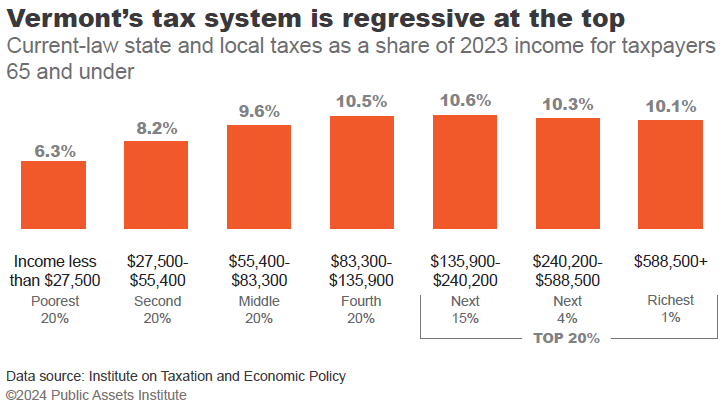
Some of that capacity is related to income inequality and the regressive nature of the personal income at the top of the scale.
While still not totally progressive, Vermont’s tax system is less regressive than it was five years ago and less regressive than most other states’ systems. Vermont was one of six states, including Minnesota, New York, New Jersey, Maine, and California, plus the District of Columbia, whose tax systems lessen income inequality. In most states, low- and moderate-income people pay a larger share of their income in taxes than do the top 1 percent of taxpayers.
In recent years Vermont has increased progressivity by curbing some tax breaks that favor people with higher incomes and instituting tax credits for lower-income residents.
PAI's annual report analyzes Census and other data, including wages, jobs, and employment, poverty, household income, and wealth inequality to provide a clear picture of how Vermonters are doing and where the state needs to go.
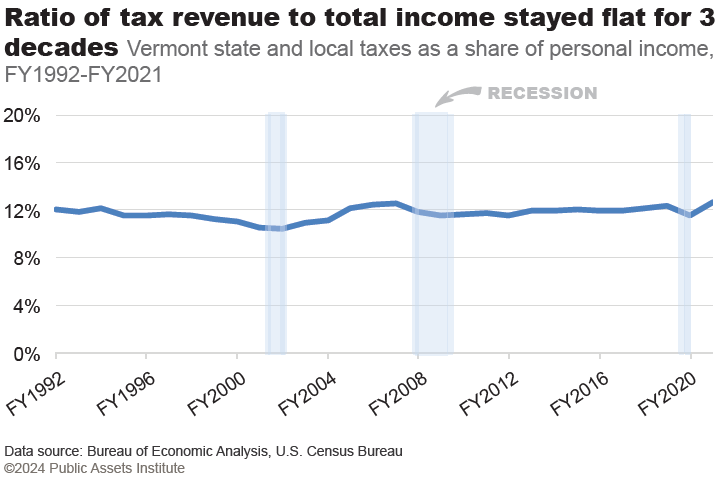
PAI points out that Vermont has a "passive" method of balancing its budget by using basically the same tax structure it has used for decades, despite both the changing nature of the need and the regressive nature of the personal income tax, just as there is growing income inequality.
PAI shows that Vermont has the capacity to change the tax structure while meeting the new challenges. PAI lays out the data to show the existing economic, tax and revenue conditions.
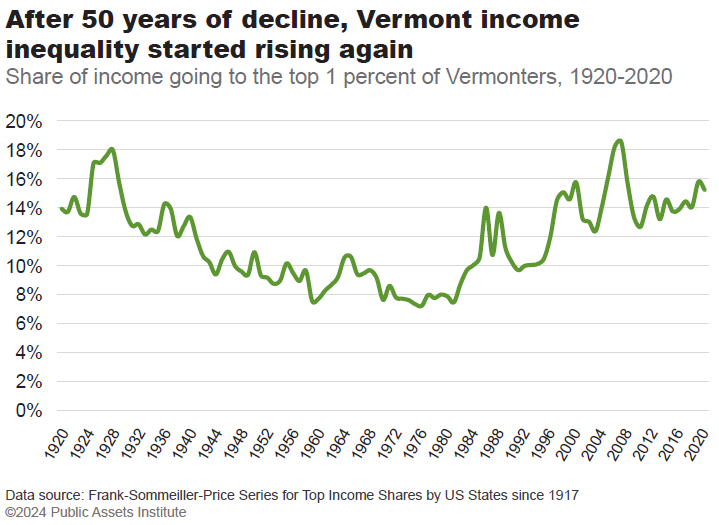
The state’s increasing income inequality shows that some Vermonters have a greater ability to contribute additional taxes than others. Any tax increase should take fairness among taxpayers into consideration.
While PAI does not directly advocate for a single tax change, PAI Board Member Jared Duval recently wrote in an op-ed that he supports legislation that would reduce the tax obligation of lower-income Vermonters while raising it for higher-income Vermonters.
Duval wrote in part: "H.701 would lower taxes on lower-income Vermonters by expanding this pair of proven anti-poverty tax credits (the child tax credit and the earned income tax credit). These credits help the lowest-income Vermont families fill the gap between income and expenses by providing cash when they file their taxes.
"During the pandemic, temporary expansion of these tax credits at the federal level helped bring 10,000 Vermonters out of poverty. When the expansion ended, Vermonters were worse off.
"Expanding the state child and earned income tax credits — and improving access to the credits — will increase financial stability so more Vermont families can meet their basic needs and live with dignity. Doing so as proposed in H.701 would require about $14.5 million.
"H.828 would create an income tax surcharge on personal annual income over a half million dollars. This would be a marginal tax, affecting fewer than 2% of Vermont residents. This proposal is projected to raise an additional $70 million to $100 million per year.
"Together, these bills would go a long way to making Vermont’s tax system more progressive. Together they would do so while generating additional revenue to invest in making Vermont more affordable, especially for Vermont families with lower incomes."
The data
As in previous years, this report uses data from the U.S. Census—primarily one-year estimates from the American Community Survey—as indicators of Vermonters’ well-being. It also relies on data from the Vermont Department of Labor, the U.S. Bureau of Labor Statistics, the U.S. Bureau of Economic Analysis, and other sources. With Census indicators, we compare data from 2019, the most recent year unaffected by the Covid pandemic, with 2022 data, the most recent available. Where 2023 data are available from other sources, we have included them.
State of Working Vermont 2023 was created in conjunction with the Economic Policy Institute in Washington D.C. and was funded in part by the Annie E. Casey Foundation and the J. Warren and Lois McClure Foundation, a supporting organization of the Vermont Community Foundation. We thank them for their support but acknowledge that the findings presented in this report are those of the Public Assets Institute and do not necessarily reflect the opinions of our partners.
Source: 2.27.2024. Public Assets Institute. Montpelier. publicassets.org