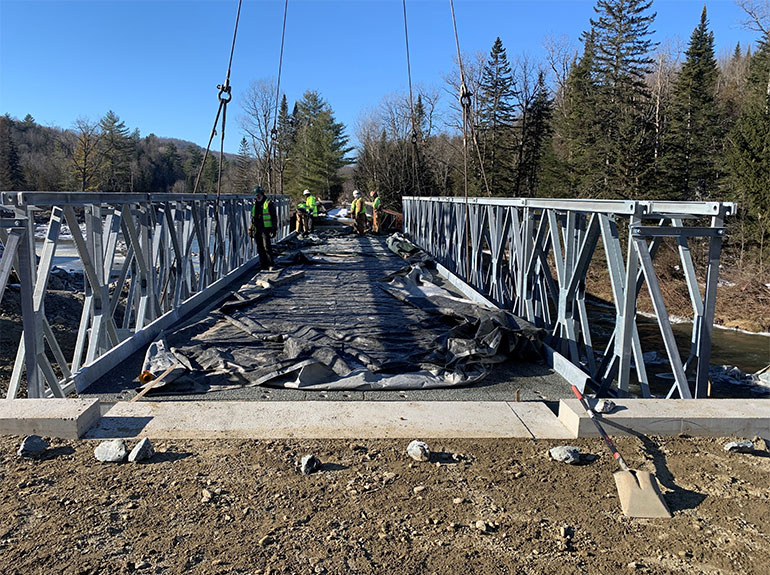
Lamoille Valley Rail Trail repairs on a bridge in Hardwick. Photos courtesy of Vermont Agency of Transportation.
But living in Lamoille County is beyond the means of many
by Olga Peters, Vermont Business Magazine Lamoille County’s economy is cooking. Its bread and butter is tourism, with two four-season resorts and associated businesses. Manufacturing also fuels the economy. It is a sector of economic development that specialists like Patrick Ripley want to grow.
The Stowe area is second to Burlington for the number of room and meal taxes it sends to the state.
“Lamoille County is a great place — you should come visit,” said Stowe Town Manager Charles Safford.
But there’s a catch: The cost of living in Lamoille County is beyond the means of many who would like to live there.
“Gone are the old days of ski bums hanging out at the resort, skiing and doing odd jobs,” said Steve Clokey, chief marketing officer for Smugglers’ Notch Resort.
According to real estate broker McKee Macdonald, housing in Lamoille is expensive, and for people living outside the main population centers public transportation is inadequate. Those factors, said Patrick Ripley, executive director at the Lamoille Economic Development Corp. and Lamoille Chamber of Commerce, make it difficult to find workers.
According to the latest available data from the U.S. Census Bureau, Lamoille County’s population was 26,090 in 2022 and had a median income of $69,886. Approximately 9.2% of residents live in poverty.
The LECD, through its workforce training programs, and area businesses, which have raised wages for many workers, have taken affirmative steps to attack the problem. But the high cost of housing and child care are difficult to overcome.
“I generally classify it as an affordability of living issue,” Ripley said. “It’s hard for entry-level workers to live and thrive in Vermont.”
Stowe Town Manager Charles Safford agreed, saying the town struggles to find service employees, primarily because most workers can’t afford to live in Stowe.
The big question for the Stowe area is, “Where do we grow from here?” Macdonald asked.
Realtor Macdonald, who serves as president of the Stowe Area Association, a nonprofit organization that markets and promotes Stowe as a premier place to live, work and visit, said there is no easy answer.
“It’s not a one-bullet solution,” he said. “Where will this town grow in the next 10, 15, 20 years? How do we do that in a smart way?”
Last year’s summer and winter floods left their mark. Ripley said. The communities of Johnson, Cambridge and Wolcott absorbed the brunt of the damage.
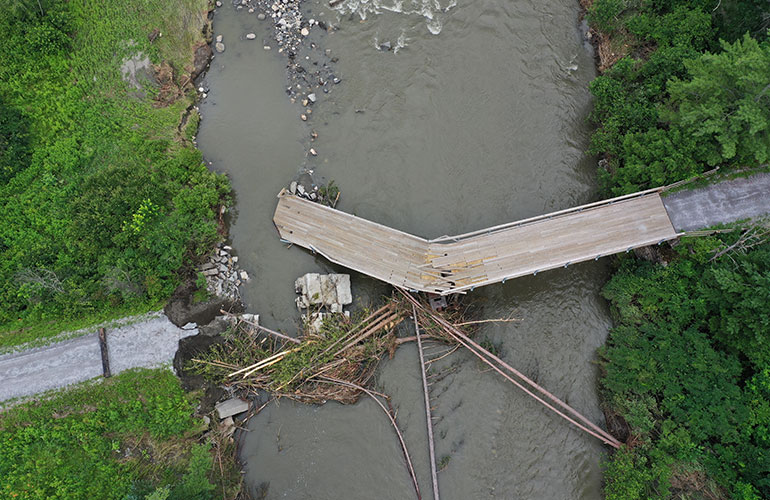
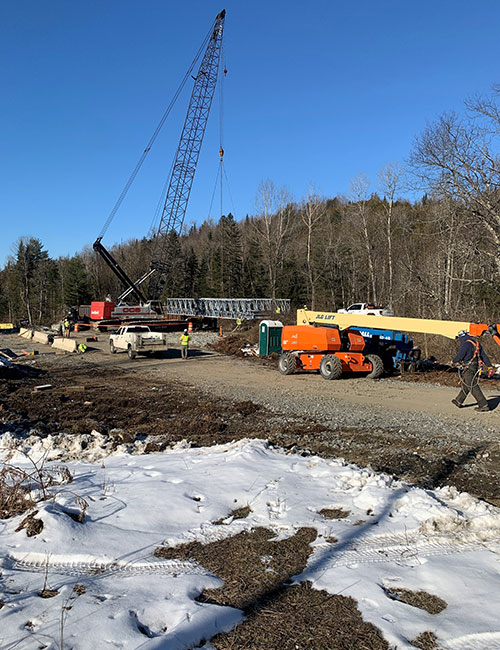
Photo: Lamoille Valley Rail Trail repairs on a bridge in Hardwick. Photos courtesy of Vermont Agency of Transportation.
Some businesses were still mid-cleanup from the summer rains when the December waters washed through, he added.
Flood waters inundated Johnson’s wastewater plant, according to Tasha Wallis, executive director of the Lamoille County Planning Commission. The town resorted to using a temporary trailer with a system of hoses immediately after the summer floods. Meanwhile, officials are considering rebuilding the plant on higher ground.
Flooding exacerbated the county’s housing crunch, as displaced residents searched for new places to live, Wallis said. The floods also disrupted Copley Hospital’s water system in Morrisville.
N.A. Manosh Corp., which specializes in water, wastewater and septic systems, transported potable water to the hospital. This support helped the hospital operate at close to normal.
The hospital also received bottled water deliveries from The Alchemist, the local Hannaford Supermarket, community members and the state.
Walcott Selectboard chair Linda Martin said the summer floods “wreaked havoc” on properties along the Lamoille River. The municipal fire station, town garage and town hall basement took on water as well.
Martin is assisting seven property owners through a Federal Emergency Management Agency buyout program. Three residential buyouts have received approval so far.
Lamoille County projects in progress
While it’s good that people in flood-prone homes can receive a buyout, losing those properties reduces Wolcott’s grand list, the value used to raise municipal taxes. This is problematic for a town of approximately 1,600 people with a primarily residential tax base, she said.
Eight feet of water filled Johnson’s only grocery store. Ripley said that the Sterling Market will not reopen because of concerns about future flooding.
Ernie Pomerleau, president and CEO of Pomerleau Real Estate, has told news organizations that he is working with another grocery store to take over the space. At publication time, the conversations were still ongoing.
Swaths of the Lamoille Valley Rail Trail were damaged days before its summer grand opening, Ripley said.
On Jan. 6, the Agency of Transportation finished temporary repairs, reopening the 93-mile trail for winter use. VTrans plans to resume repairs this spring and summer.
Rail Trails Program Manager Jackie Cassino said in an email that the July floods damaged 131 sites along the trail. In December, the rains damaged another 26 sites. Members of the public can track the progress of trail repairs via a newly created online dashboard. (https://vtrans.maps.arcgis.com/apps/dashboards/f1620020118c4ee6aae50522…).
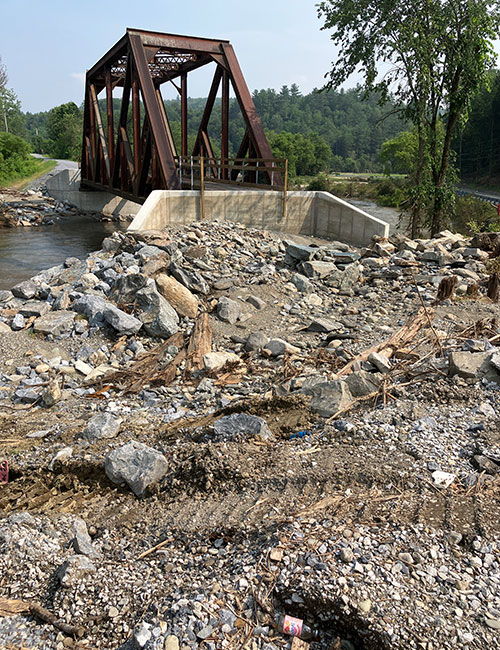
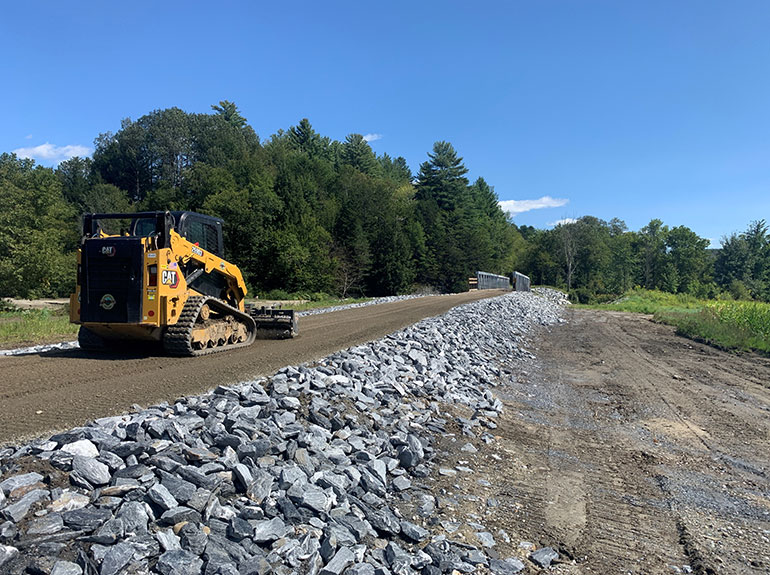
Photo: Lamoille Valley Rail Trail repairs on a bridge in Wolcott. Photos courtesy of Vermont Agency of Transportation.
In Wallis’ experience, community conversations about flood recovery have changed since Tropical Storm Irene in 2011. After Irene, communities focused on improving existing infrastructure. When these entities were damaged anew during last year’s flooding, talk shifted to asking which community assets should be moved out of the river’s way.
Looking for Support in Stowe
The town of Stowe installed its first traffic light last year, a sign of its popularity as a tourist destination and desirability as a place to live. Indeed, the town’s population has grown over the past few years. But that growth has resulted in some unintended consequences, such as occasional traffic jams.
In response, Town Manager Charles Safford said, resorts in the area have begun offering free parking to visitors who carpool and issuing blackout dates for ski pass purchases to help manage the number of people coming through town.
The Selectboard appropriated $80,000 to hire an international consultation firm, Stantec, to conduct a highway capacity study. A final report and recommendations is due in February.
Safford said the board is also investigating where it has permitting and utility capacity to add more infill development, as outlined in Act 47, which provides loan and grant funds to financially distressed local governments as well as technical assistance to formulate financial recovery plans.
“I think, to some degree, the state has made those decisions for us,” Safford said. “They said you’re going to have to introduce increased density throughout your sewer core, which is pretty expansive.”
Underlying these efforts is a bigger question facing Stowe: How does the town preserve its charming New England character? Or as Safford puts it, “How do we grow Vermont while maintaining its character and sense of place, be welcoming and plan it well, so that we still feel like we’re in Vermont at the end of the day?”

Stowe ski patrol is celebrating 90 years in 2024. Photo courtesy of Stowe Mountain Resort.
People come to Stowe to enjoy its restaurants, shopping, outdoor recreation areas and ski resorts. They also are drawn by its mountains, forests and cows, Safford said. In Safford’s opinion, if the town isn’t careful, it could lose the beauty and community that makes Stowe, Stowe.
“People come to Stowe, and they want that quintessential Vermont experience they’ve imagined, right? They don’t want to go from one urban hell to another.”
He said that the town needs more support from the state.
According to Safford, Stowe contributes half of the county’s grand list and ranks second behind Burlington for the amount of alcohol, room and meal taxes sent to the state.
In 2022, Stowe collected more than $179 million in rooms, meals, and alcohol and $1,792,440 in local 1% option tax. Of that total amount, the municipality kept $1,508,410 in its coffers. The rest flowed into the statewide budget.
Some residents are frustrated by what they see as an imbalance, he said.
For example, voters struck down a $39 million bond to make repairs at the local high school. The state education fund does not pay for capital projects.
Safford said the town wants the state to return some of its tax money to help alleviate the strains on the municipality.
A Housing Market in Transition
Macdonald describes Lamoille County’s real estate market as transitioning. He said the market remains active and has settled since the hyper days of the COVID pandemic. After a few years of sight-unseen sales, buyers and sellers are requesting requirements like contingencies and inspections again.
That said, the county lacks the inventory to meet demand, which has kept prices high. Sales in Stowe have remained cash-heavy, he said. The impact of increased interest rates is smaller in Stowe than in other areas of the county.
According to numbers from Macdonald, sales of single-family homes in Stowe in December have increased almost 17 percent compared to 2022. Median sale prices have decreased by nearly 21%.
He said sales have slowed in the ultra-luxury market of homes selling for $3.5 million or more. At the $1 million price point, what Macdonald called the “entry market” is still active.
Few proprieties are listed under $1 million in Stowe, Macdonald said. In December 2023, the median home price was $975,000 with the average closer to $1.2 million. When the buyers have the funds to purchase a home in the $1 million to $1.5 million range, they tend to “be isolated from larger economic stressors.” The Stowe housing market is an outlier compared to the rest of the county.
The median sale price in Morristown for December was $230,000, and the number of sold listings is down 40%.
Countywide, the lack of inventory continues to be an issue. Lamoille has approximately seven months of inventory.
Short-Term Rentals
Stowe is home to a vibrant subeconomy centered around more than 1,000 short-term rentals. The STR community includes:
Vacation homeowners who rent out their property when they are away.
Local landlords who operate one or more STRs.
Several management businesses.
The Selectboard is considering an ordinance to regulate the STRs and has established a working group to investigate the issue.
The board received an estimate for an STR host compliance software package from Granicus as part of its deliberation process. The software would help the town track property owner’s compliance with any new regulations for the purposes of enforcement. The company provides governments with digital tools to provide online services, update websites and support public meetings and records management.
Grancius staff identified 1,250 STRs in Stowe. Of the property types, 97% were whole unit rentals (rather than a single room in a person’s home).
Single-family homes were the most common rental building types. The median nightly rental price was $321.
To set up the rental registry would cost the town $82,000. If the Selectboard decided to manage the registry in-house, Grancius staff estimated the municipality would need to hire one full-time staff member per 100 STR units.
Several members of the Stowe Area Association earn their livelihoods from. As a result, the association has adopted the Vermont Short-Term Rental Association, or VTSTRA, guidelines.
Macdonald hopes the Selectboard will find a balanced approach to regulating STRs. It’s necessary to have safe rental properties that comply with fire safety codes and are insured. It’s also important to note that STRs generate a lot of revenue for the municipality, he said.
Rents are high in Stowe. But as someone who grew up in Stowe, he said rents have always been high. STRs haven’t caused that affordability issue.
Unfortunately, limiting STRs in a heavy vacation home market like Stowe won’t create new affordable long-term rental housing, he said. Instead, the town will be filled with empty vacation homes.
Safford said the Selectboard is in the process of drafting an ordinance around registering short-term rental properties.
One piece of the ordinance he expects will require STRs without an owner/occupier to have a designated person for when emergency services are called to a property. This person needs to be able to reset an alarm and be a designated person to whom emergency services can turn the property back over.
Stowe has a year-round population of approximately 5,000 people. Safford said that two-thirds of its housing stock is private vacation homes (excluding hotels).
Housing Staff at Smugglers’ Notch Resort
Smugglers’ Notch Resort caters to families. Since the COVID lockdown of 2020, Communications Director Steve Clokey has seen the resort increase in popularity with families.
In his experience, COVID-19 sparked a trend of families traveling together seeking outdoor recreation. Demand for tickets has increased.
In that way, the pandemic was good for Smugglers’ Notch.
Unfortunately, the pandemic accelerated expenses like overall inflation, payroll increases, and insurance.
Finding workers — especially seasonal workers — is hard.
The resort hires approximately 850 seasonal workers.
The resort hires approximately 75 international workers every winter through the J-1 Visa Exchange Program. The workers arrive in early December and leave in late March. Because of the tightness in the local housing market, the resort has removed a few of its guest lodgings from rental to house J-1 Visa holders.
Clokey said the downside to this solution is less rental income from paying guests.
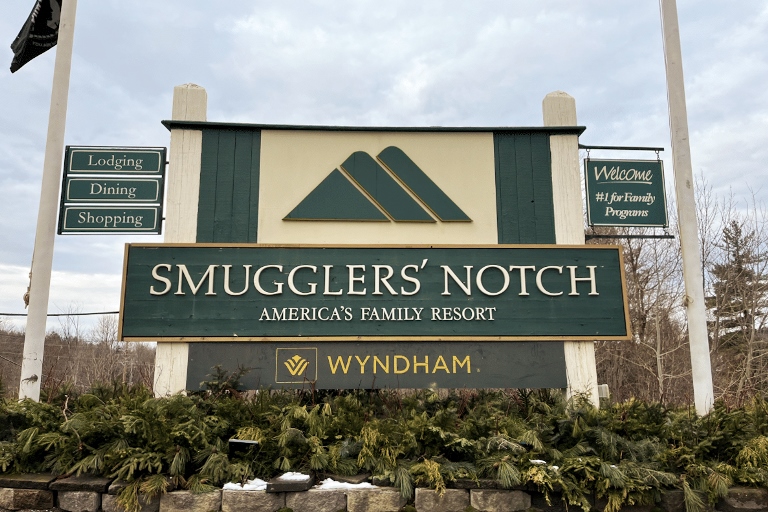
On the west side of Mt Mansfield is Smugglers' Notch, famous as a family resort. File photo.
Despite a starting wage of $20 an hour, in Clokey’s experience most workers can’t afford to live locally. By the time they pay rent, food and other expenses, “they’re just working to stay alive,” he said. “That’s not sustainable.” According to the US Census, the gross median rent for the county is $1,066.
Workers with financial struggles are as much a sustainability issue as environmental concerns such as climate change.
Clokey said the recent winters have been good at Smugglers’ Notch, thanks to the mountain’s snowmaking program. He added that temperatures over the past three winters have fluctuated a lot, which is a challenge to the snowmaking.
Clokey said the resort has invested in high-efficiency snowmaking guns and electric motors to pump the water to be environmentally sensitive. The resort has also invested in two solar arrays and is looking to increase its number of EV charging stations. Clokey said the resort itself recycles and composts, but he’d like to encourage more quests to compost.
A Strategy to Build a More Inclusive Organization and Community
Last summer, the Stowe Area Association announced its new three-year strategic plan. The three-legged stool focused on:
- Destination Stewardship: Striving to balance the needs of visitors, the environment, and the local community.
- Sustainability: Ensuring the long-term success of SAA and its staff through sustainable practices.
- Membership Growth: Attracting new members and enhancing existing members’ engagement by providing valuable programs, services, and benefits.
Simmons added, “A central focus of this vision is our dedication to inclusivity, demonstrated by our participation in the Vermont Declaration of Inclusion Initiative and the announcement of our own Declaration of Inclusion.”
“At the heart of our efforts is the aspiration to create a welcoming destination for everyone, irrespective of race, ethnicity, gender identity, sexual orientation, religion or ability,” she added.
So far, the strategic plan has received positive responses from new members and visitors who have expressed their appreciation for the organization’s efforts to be inclusive and welcoming, said board president Macdonald.
“Recognizing the dynamic balance between the needs of visitors, the environment, and the local community, we established a Destination Leadership Task Force to develop a comprehensive Destination Leadership Marketing Plan,” Simmons wrote.
“This plan includes the redesign and launch of a new destination website, prioritizing accessibility from both an ADA functionality standpoint and user-friendly navigation to ensure easily accessible information,” she said.
“Concurrently, we are collaborating with an external agency to explore the brand identity of our destination, involving discussions and surveys with a diverse range of business and community stakeholders. Our aim is to ensure that everyone has a voice in shaping the future direction of our destination.”
According to Simmons, the Stowe economy is robust. Revenues reported from Stowe’s Local Option Tax (LOT) for July through September 2023 showed a 10% increase from the previous year.
“Although winter’s occupancy lags slightly behind last year, optimistic projections for March and April, fueled by the Total Solar Eclipse on April 8, indicate promising prospects,” she wrote. “Area businesses anticipate welcoming guests during what is traditionally a slower tourism period, with many lodging properties already at full occupancy for that weekend.” The summer floods and rain are blamed for a 10% decline in occupancy.
Yet, fall occupancy reached record levels with an 85% average occupancy during the three-week fall foliage period in 2023.
Businesses have expressed an interest in fostering more midweek stays outside of the ski season and hosting more summer events in Stowe, Simmons said.
Building Broadband in 2024
Members of the Lamoille Communications Union District, Lamoille FiberNet, look forward to hosting online meetings where members have adequate internet instead of calling in from their landlines.
“Everybody needs better broadband,” said Executive Director Lisa Birmingham.
Approximately 90% of addresses lack broadband in the county’s smaller towns like Belvidere, Elmore and Wolcott.
“That’s just not fair anymore,” Birmingham said.
The Communications Union District represents 10 towns in Lamoille County.
The CUD completed the first phase of installing 2 GB broadband. The three-year process included:
- Acquiring funding.
- Developing a service model.
- Signing a partner contract with Fidium Fiber, part of Consolidated Communications.
Birmingham said 2024 will be the big construction year. The board anticipates having more than 80% of the addresses in the CUD’s universal service plan connected to the 2 GB symmetrical fiber network constructed by Fidium Fiber by the end of this year. The system has a future capacity of 10 GBs, according to Birmingham.
The CUD hopes to connect the remaining addresses by 2025.
Birmingham said the 2024 construction cycle is fully funded at $25 million.
Approximately $15.6 million came from ARPA funding and matching funds from the Vermont Community Broadband Board. Seven communities also pledged a portion of their local ARPA monies to ensure residents more than 500 feet from the main line can afford to connect. Birmingham explained that some homes more than 500 feet from the main pole couldn’t pay the extra connection fees.
Building the network isn’t enough. She said that people need to be able to afford to connect to it.
“So just because we build it doesn’t mean people will actually be able to connect. So there’s an affordability issue,” she said.
She said that ensuring adoption and digital equity felt critical throughout the board’s planning process. The board chose Fidium partly because of its lower prices for end users. The board and Fidium signed a 20-year agreement, which includes product improvements. If the company upgrades its system — such as offering 10 GB service — in one of its service regions, it must make the same upgrades in Lamoille County.
“Part of the problem with these older networks is that there was no incentive to invest in product improvements, so people were left behind,” she said. “My board wanted to ensure this was not just a short-term investment.” Birmingham hopes the county’s communication infrastructure will become more resilient once Fidium finishes the new network.
According to staff at Fidium, fiber networks tend to weather storms better than older copper lines that still stretch across Vermont.
According to Jeff Austin, senior director of Fiber Build Strategy for Consolidated, “Generally, fiber is more resilient because it transmits data using light pulses that can travel long distances without degrading, instead of electrical signals over copper.
“The light signals are generated at our Central Offices or Hub locations, which have redundant power sources and require no additional electronics between these locations and a customer’s house to provide service to our customers,” Austin added. “ Essentially, as long as the fiber remains intact, we can maintain customer service. So long as the central office and the customer’s equipment maintains power, they will still be online.”
Managing Expenses and Improving Efficiency at Copley
Copley, Lamoille County’s nonprofit community hospital, had a busy year. It maintained operations after the summer floods, provided in-house training and mentorship to nurses and clinical staff, and broke ground on a new medical office in Waterbury.
The new clinic for Mansfield Orthopedics, a hospital department, is scheduled to open this summer. It is intended to improve patient access to orthopedic and podiatry services. The 10,000-square-foot facility will include 14 exam rooms and two diagnostic imaging rooms.
Funding for the project includes $1 million in community support and $6.6 million of a $10.9 million loan and grant from USDA Rural Development. The remaining $4.3 million in funding from USDA Rural Development will be used to refinance existing construction debt.
Copley installed a new 160-slice CT scanner, and thanks to donors, the cardiology department upgraded its stress-testing equipment.

Copley Hospital in Morrisville and North Country Hospital in Newport now have telemedicine equipment that allows both audio and visual communication between each of these two rural critical access hospitals and the University of Vermont Medical Center in Burlington during the transport process for newborns with life-threatening conditions. Above, Copley Hospital’s birthing center team. Courtesy photo.
The Woodlands at Stowe, the former Copley Woodlands, the hospital’s 40-unit independent living community for people aged 55 and up, changed its name to The Woodlands at Stowe. It celebrated 25 years in operation with a new logo and branding.
Still, going into 2024, the hospital will keep a sharp eye on expenses.
“In October 2023, despite praise from the Green Mountain Care Board about Copley’s efficiency and ability to provide high-quality care, the GMCB approved an FY2024 budget that forced Copley to operate at a $3 million loss,” said Emily M. McKenna, executive director of development, marketing and community relations.
“After nine years of consistent cuts in GMCB-approved pricing, Copley faces a challenging financial situation,” she added.
According to McKenna’s numbers, in fiscal year 2023, the hospital’s total operating revenue ($98,069,617) and expenses ($99,796,157) had increased compared to the previous fiscal year. Once operating income loss and nonoperating revenue were factored in, the hospital had a net income of $1.4 million, which increased over FY22.
In fiscal year 2023, the hospital provided:
- 3,690 surgical visits.
- 1,467 patient admissions.
- 13,901 emergency room visits.
- 5,822 patient days of care.
- 155 births.
- 13,765 hours of rehab therapy.
- 34,348 radiology services.
- 148,651 lab procedures.
- 267,134 pounds of laundry done.
“I think Stowe and Lamoille County are really fantastic areas to live in,” Macdonald said. “We’re very well positioned for the future growth.”
“I think that our communities will keep giving back to the state of Vermont, and I hope that that’s reciprocated from the state level in terms of things like assisting with school infrastructure and transportation and housing,” he added.
Olga Peters is a freelance writer from Windham County.