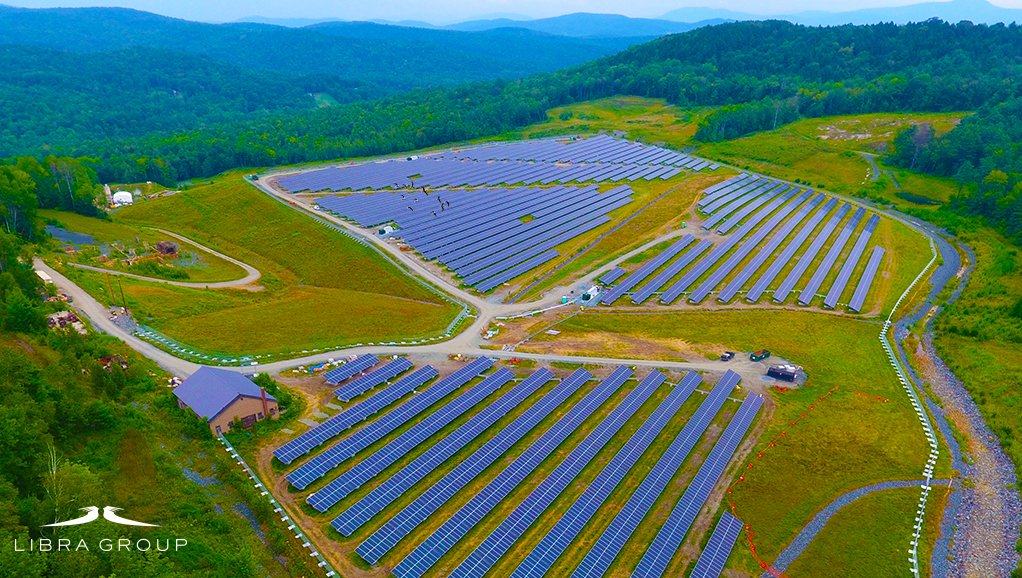
For a century the boom-and-bust Elizabeth copper mines were part of Vermont's vital mining industry. The Elizabeth mines in South Strafford thrived during and shortly after World War 2. It subsequently required a massive cleanup effort and eventually part of the site was developed into Greenwood Energy’s 7 MW Elizabeth Mine Solar Project in 2017. Historic image courtesy EPA. Solar array image courtesy Libra Group.
Vermont Business Magazine The US Environmental Protection Agency (EPA) will conduct comprehensive reviews of completed cleanup work at six National Priorities List (NPL) Superfund sites in Vermont this year.
Each individual site will undergo a legally required Five-Year Review to ensure that previous remediation efforts at the sites continue to protect public health and the environment. Once the Five-Year Review is complete, its findings will be posted to EPA’s website in a final report.
“Every step of the process at a Superfund site is critical and reflects a commitment we make with local communities to be as thorough as possible. Cleaning up hazardous waste sites takes extensive time and effort, and these Five-Year Reviews allow EPA to ensure our cleanup efforts continue to protect public health and the environment, while keeping everyone informed and accountable, especially in those communities that have been overburdened by industrial pollution.” said EPA New England Regional Administrator David W. Cash. “EPA continues to evaluate these cleanups, with the overarching mission to protect public health and the environment and ensuring that Vermont communities will continue to be protected.”
In 2024 EPA will conduct Five-Year Reviews at the below listed sites. The included web links provide detailed information on site status as well as past assessment and cleanup activity.
Five-Year Reviews of Superfund sites in Vermont to be completed in 2024:
Parker Sanitary Landfill, Lyndonville
The Parker Sanitary Landfill site is located in Lyndonville, Vermont. A solid waste landfill operated on site from 1972 until 1992. Before 1983, a large amount of hazardous waste (liquids and sludge) was disposed of at this location and were poured/placed directly onto the ground. These activities led to groundwater contamination and affected private wells in the area. Following construction of the site’s remedy, operation and maintenance activities and groundwater treatment and monitoring are ongoing.
A solid waste landfill operated on site from 1972 until 1992. Before 1983, about a million gallons of liquid wastes and 760 tons of solid or semi-solid wastes including metal plating wash waters, waste oils, electroplating sludge, paint sludge, chlorinated solvent sludge, caustic cleaners and metallic salts were disposed of in at least three areas of the landfill. Liquid and sludge wastes were poured directly onto the ground or into unlined pits and lagoons. During a site inspection in 1984, the state detected contaminants in a stream bordering the landfill, in groundwater at the landfill and in four private wells near the landfill.
The site is located in a residential area, and an estimated 3,200 people get drinking water from a municipal well field located within approximately two miles from the landfill. In addition, 124 private wells are located within three miles of the Site.
Bennington Municipal Sanitary Landfill, Bennington
The Bennington Landfill Superfund Site (Site), located off Houghton Lane in Bennington, VT is a 15-acre municipal sanitary landfill. The Site was placed on EPA's National Priority List (NPL) on March 31,1989. The areas to the north and east of the Site are former borrow pits. The area directly east of the Site is wetland/woodland. The other areas surrounding the Site are residential. The Site is bordered by wetlands serving as headwaters for Hewitt Brook to the east, a residential area to the south, and U.S. Route 7 to the west. The Town of Bennington (Town) purchased the Site in 1985. Several Bennington industries dumped liquid wastes into an unlined lagoon on the Site from 1969 to 1975. Town records indicate that polychlorinated biphenyls (PCBs), volatile organic compounds (VOCs) (i.e. solvents), and lead were disposed of at the Site. The lagoon was closed in 1975 after attempts by workers failed to dry it up by landfilling it. An underground drainage system built in 1976 was designed to lower the groundwater level below the landfill waste. The system discharged through a culvert into an unlined, ponded area. In 1986, the Vermont Department of Environmental Conservation (VT DEC) detected contaminants in the groundwater discharging from the culvert into the ponded area. Approximately 2,200 residents located within 3 miles of the Site use private wells. The area surrounding the Site is mainly rural residential. Morgan Spring, a bedrock water source located 3 miles south of the landfill, is used regularly to supplement the Bennington water system.
Tansitor Electronics, Inc., Bennington
The site is being addressed through federal and potentially responsible party (PRP) actions.
A long-term remedy focused on the entire site. A 1990 investigation into the nature and extent of contamination determined that ingestion of groundwater from the shallow soils would pose an unacceptable risk. In 1994, the state reclassified the groundwater beneath the site as requested by Tansitor. In 1995, EPA designed a cleanup plan that included a waiver for groundwater cleanup within a 10-acre portion of the site due to the impracticality of achieving drinking water standards. It also included land use restrictions to prevent use of or contact with the groundwater, and groundwater monitoring to observe any changes in contaminant location or concentrations. Groundwater monitoring is ongoing.
The first five-year review in 2004 concluded that human health and the environment were being protected. Groundwater monitoring showed gradual reductions of VOCs and confirmed VOCs were not migrating. Similarly, no contaminants were detected in groundwater monitoring of the bedrock beneath the site.
The 2004 review said vapor intrusion into indoor air from the groundwater plume was possible. It also said chemical 1,4-dioxane, because of its association with the manufacturing of trichloroethane, the primary contaminant detected in the groundwater, could be present. Both the 2014 and the 2009 five-year reviews have agreed with 2004 conclusions.
After the 2004 review, EPA reviewed soil vapor data from the initial investigations to assess the potential indoor air pathway. The soil vapor data were found to be below OSHA values. VT DEC, after reviewing relevant data and assessing continued use of solvents in the facility, indicated that based on the department’s experience at similar manufacturing facilities, vapor intrusion did not represent a significant issue.
In addition, following the 2004 review, analysis for 1,4-dioxane was added to the groundwater monitoring program. The results showed that it was present in the same locations as the trichloroethane within the ten-acre portion of the site but was not detected beyond that area.
Elizabeth Mine, Strafford
The Elizabeth Mine is an abandoned copper mine located on Mine Road in the village of South Strafford, which is part of the town of Strafford in Orange County, Vermont. The area consists of two mine tailings piles, one area of waste rock and heap leach piles, two open-cut mines, several adits (horizontal mine entrances), underground shafts and tunnels, ventilation shafts, and several former ore processing buildings as well as other on-site structures. Following site investigations, cleanup and environmental monitoring are ongoing. Deposits at the Elizabeth Mine were discovered in 1793. The mine operated from the early 1800s until its closure in 1958. The ore was initially valued for its iron content, and then its pyrrhotite content from which copperas (iron sulfate) was produced. Circa 1830, the deposit was primarily exploited for its copper content based upon the recognition that a significant amount of chalcopyrite (copper iron sulfide) was disseminated in the pyrrhotite. For nearly a century, intermittent production came from the open-cut mine as underground work did not begin until 1886. During early mining operations, several copper smelters were built on the site. Between 1830 and 1930, about 250,000 tons of ore were mined, from which about 10.5 million pounds of copper were produced. From 1943 to 1958, three million tons of ore were mined, producing more than 90 million pounds of copper. All mining operations ceased in February 1958.
Video Riches & Remains: The Legacy of Vermont Copper Mining (youtube.com)
BFI Sanitary Landfill (Rockingham), Rockingham
In the early 1960s, the 17-acre BFI Sanitary Landfill (Rockingham) site served as a borrow area for the construction of Interstate 91. In 1973, Browning-Ferris Industries, Inc. (BFI) bought the landfill from an individual who had started operations in 1968. State files indicate that industrial wastes, including heavy metals, bases, pesticides, and volatile organic compounds (VOCs) were deposited in the unlined disposal area from 1968 to 1979. In 1983, Vermont licensed the site as a municipal landfill certified to accept hazardous waste from small quantity generators. The BFI Rockingham Landfill Superfund Site was placed on the National Priorities List (NPL) in 1989. In 1993, the U.S. Environmental Protection Agency (EPA) signed an Action Memorandum to initiate a Non-Time Critical Removal Action (NTCRA). The NTCRA include the placement of a multi-layer cap over the landfill; expansion of the existing landfill gas management system; operation and maintenance of the Route 5 Stabilization and Seepage Control System shallow groundwater collection trench; and institutional controls (ICs). In 1994, EPA signed a Record of Decision (ROD) selecting monitored natural attenuation and ICs as the long-term cleanup approach for the restoration of contaminated groundwater. Construction of the NTCRA action was completed in July 1995 and EPA certified the Completion of Work Report in September 1996.
Pownal Tannery, Pownal
The Pownal Tannery site is located between Route 346 and the Hoosic River in Pownal, Vermont. A former hide tanning and finishing facility owned by the Pownal Tanning Co., Inc. was located at the 28-acre area.
From about 1937 until 1962, untreated wastewater from the tanning process was directly discharged into the Hoosic River. A lagoon system of six lagoons was constructed in several stages between 1962 and 1971 to receive tannery wastewater. In 1982, a state-permitted lined landfill was constructed to receive sludge dredged from a portion of the lagoons. The tannery landfill sits on land across from the Hoosic River and southwest of the tannery building complex. In 1987, two-thirds of the landfill was covered and closed. It has been inactive since 1988 when the company declared bankruptcy. The remaining area remained uncovered until 2001. Contamination came from the tannery building complex, a lagoon system and the tannery's sludge landfill.
EPA placed the site on the Superfund program’s National Priorities List (NPL) in January 1999.
More information:
The Superfund program, a federal program established by Congress in 1980, investigates and cleans up the most complex, uncontrolled, or abandoned hazardous waste sites in the country and EPA endeavors to facilitate activities to return them to productive use. In total, there are 123 Superfund sites across New England.
Superfund and other cleanup sites in New England
Source: 2.1.2024. EPA. Learn more about EPA Region 1: https://www.epa.gov/aboutepa/epa-region-1-new-england