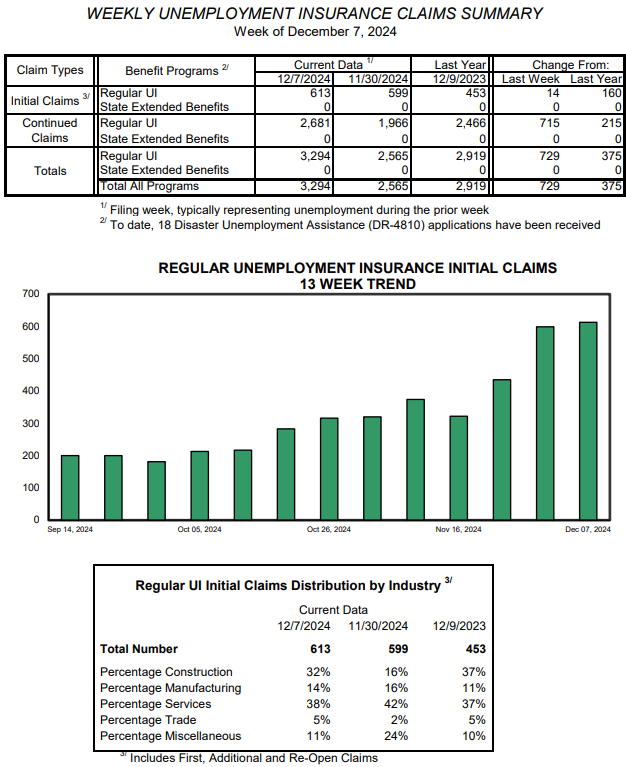
by Timothy McQuiston, Vermont Business Magazine Weekly unemployment claims remained relatively high last week as they have since the end of summer. For the week ending December 7, 2024, new claims were 613, which is up 14 claims from the week before and 180 more from last year. Claims were 181 at the end of September.
Meanwhile, unemployment claims and hiring have rebounded strongly across the US, as the Federal Reserve Bank cut interest rates by a robust 0.5% (50 basis points) in September and 25 basis points in early November. Economists said the positive numbers suggest that the economy will indeed negotiate a "soft landing" and avoid a recession. Recent national and international events, however, could alter that outcome.
Overall, the month of November US jobs report beat expectations.
The U.S. economy added 227,000 jobs in November, marking a sharp rebound from the previous month. Economists polled by Dow Jones expected an increase of 214,000 jobs for the month. Jobs growth for October was revised to 36,000 from 12,000. The unemployment rate came in at 4.2% for November, as was expected. The Vermont jobless report will not be available until December 20.
"The November jobs report shows an expected rebound in hiring and no major surprises,” said Eric Merlis, managing director and co-head of global markets at Citizens. “The slight uptick in the unemployment rate and dip in the participation rate should convince the Fed to continue its gradual easing path at the December meeting.”
The three major indices have all broken historic records over the last two weeks, but the movement has been choppy. The Fed has indicated recently it may be reluctant to cut interest further as inflation and mortgage rates have not declined as much as hoped, but the expectation is that the Fed will make another rate cut of 25 basis points next week (December 17-18).
The DJIA, the S&P 500 and NASDAQ were mostly unchanged in trading Friday morning after a mixed week and a down one for the S&P.
In Vermont for the weekly report, the Service industry accounted for the most claims last week with 38%, down from 42%. Manufacturing accounted for 14% of claims, down from 16%. Construction claims increased to 32% (from 16%), which accounted for the outdoor building season winding down.
Seasonal hiring and firing during the holiday season can result in wild swings in the UI numbers.
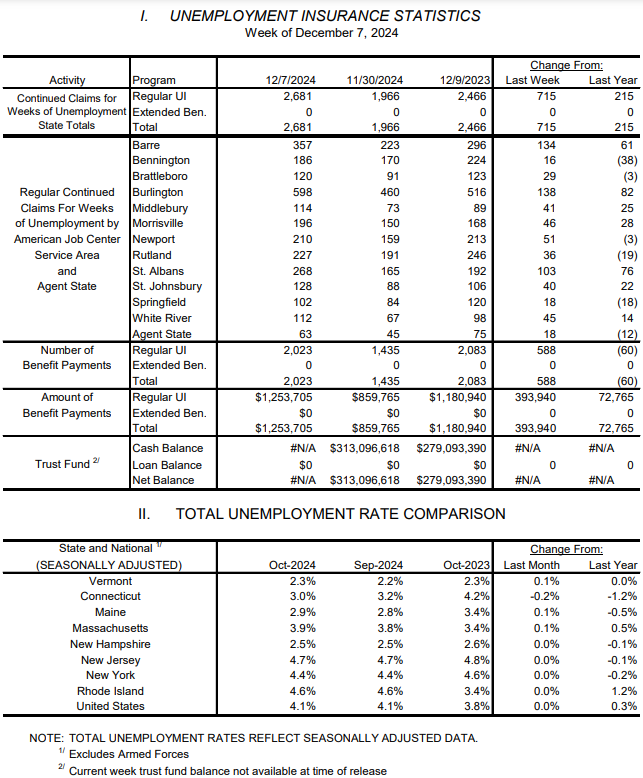
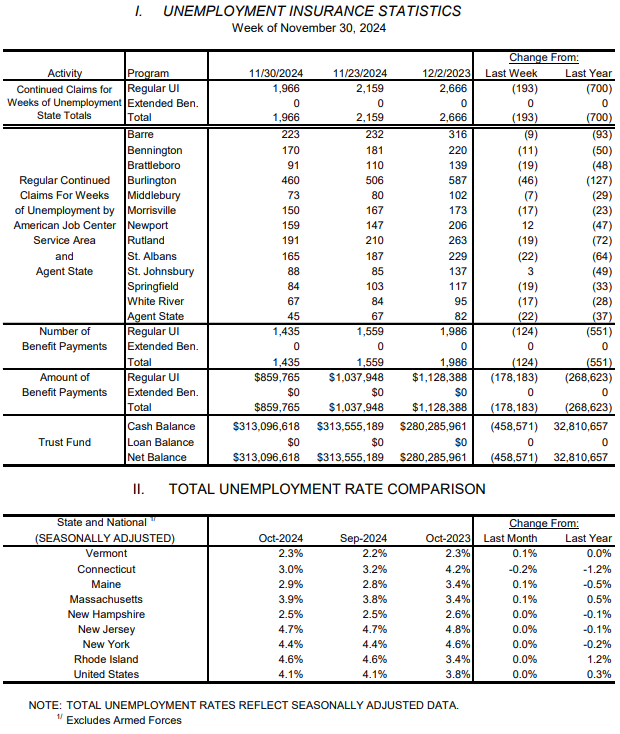
See tables below.
For the week, total unemployment insurance claims were 3,294 for the week (up 729 for the week and up 375 from this time last year). Meanwhile, the state unemployment rate remains second lowest in the nation even as it rose one-tenth in October, as unemployment grew modestly (2.3 percent in October 2024).
The comparable United States rate in August was 4.1%, a decrease of one-tenth of one percentage point from the revised September estimate.
The civilian labor force participation rate in Vermont was 65.6 percent in October, a decrease of one-tenth of one percentage point from the revised September estimate.
In the week ending December 7, the advance figure for seasonally adjusted initial claims was 242,000, an increase of 17,000 from the previous week's revised level. The previous week's level was revised up by 1,000 from 224,000 to 225,000. The 4-week moving average was 224,250, an increase of 5,750 from the previous week's revised average. The previous week's average was revised up by 250 from 218,250 to 218,500.
For the month of October 2024, the Vermont seasonally adjusted statewide unemployment rate was 2.3 percent. This reflects an increase of one-tenth of one percentage point from the prior month’s revised estimate. The civilian labor force participation rate was 65.6 percent in October, a decrease of one-tenth of one percentage point from the prior month’s revised estimate.
All three major indicators were negative for the month, with the Labor Force and Employment down, while the number of Unemployed rose. However, none of the changes were statistically significant in the seasonally adjusted series.
The comparable United States rate in October was 4.1 percent, no change from the revised September estimate (the November US rate is 4.2%, which is reported ahead of the rates for the states). Vermont continues to have the second lowest rate in the US. South Dakota is lowest at 1.9 percent and Nevada is highest at 5.7 percent.
Meanwhile the Vermont Unemployment Trust Fund is well capitalized. As of the most recent data, there was $313.1 million in the Trust Fund, down about half-a-million (as claims are paid out on one side, employers are contributing to the fund on the other). The pre-pandemic Trust Fund balance on March 1, 2020, was $506.2 million.
To support vital journalism, access our archives and get unique features like our award-winning profiles, Book of Lists & Business-to-Business Directory, subscribe HERE!