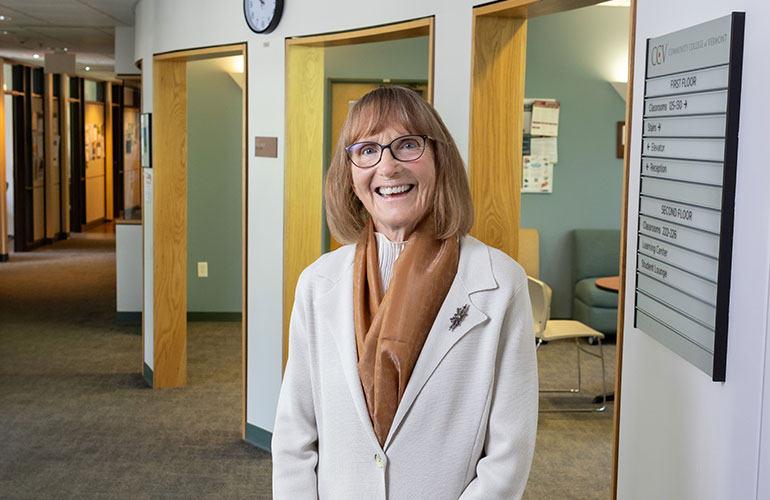
Joyce Judy, president of CCV. Photo: Baldwin Photography
by Joyce Marcel, Vermont Business Magazine Community College of Vermont and its long-time president, Joyce Judy, are inextricably linked, their histories intertwined in a seamless partnership.
Founded in 1970, CCV has been led by Judy for the past 15 years. Judy, now 68, began her 41-year tenure at the college in 1983, becoming interim president in 2009 and assuming the presidency fully in 2010.
“I’ve grown up and changed, and CCV has grown up and changed,“ Judy said. “In some ways, I feel like we have grown up together.“
Raised on a dairy farm, Judy learned the value of hard work early in life, crediting her upbringing for instilling the skills necessary to lead CCV. Her connection to the family farm remains strong, as she returns to help with chores as often as possible, embodying the practical, hands-on approach that defines both her personal and professional life.
Judy tells the story of a regional director, who has since passed away, to illustrate the essence of CCV.
“I love this story, because it resonates deeply with me and reflects CCV’s values,“ she said. “One day, he was outside our Burlington center, sweeping up cigarette butts. A visitor asked, ’Why are you picking up cigarette butts?’ His simple reply was, ’Whatever it takes.’“
That spirit of dedication and going above and beyond permeates the culture at CCV, Judy added, “and it’s very much how I operate as well.“
During her tenure at CCV, Judy has transformed the college into a leader in innovation and creativity — qualities not typically associated with community colleges.
Despite its reputation for upscale sophistication, Vermont is fundamentally a rural state. This created a dilemma in the late 1960s when a nationwide movement emerged to build more community colleges, aimed at providing education for those who couldn’t afford traditional universities.
Vermont’s population was dispersed across farms, dirt roads and small communities, many struggling financially. This led to the innovative concept of a community college without a central campus.
“There was a state commission that came up with this idea of, ’Well, what if it was a different kind of college — one that drew on the existing resources of a community, held night classes in high school classrooms and church basements, and engaged people who would teach what they know,’“ said Doug Wilhelm, author of the 2024 book “Kind of a Miracle: The Unlikely Story of the Community College of Vermont.“
“I might teach writing, you might teach journalism,“ Wilhelm said. “At first this idea was just dismissed, because it was very radical and different. But when Gov. Deane Davis took office, the idea took hold. He gave authority to set up what was originally called a Community College Commission, and that’s what started this.“
At its inception, CCV was entirely free, with volunteer instructors teaching courses in diverse locations across the state — high school classrooms, the backs of hardware stores, anywhere available.
“But tuition didn’t stay free for long,“ Wilhelm said. “Today instructors and teachers are certainly paid. But the model is still that you draw on people in the community who can teach what they know. There’s no full time faculty — never has been, and there are no plans to have full-time faculty. So it’s a very different kind of college.“
“When you think about the future of higher education,“ Judy told Wilhelm, “it isn’t sitting and waiting for people to come to you, it’s reaching out and providing pathways.“
The Community College of Vermont, the second-largest college in the state, serves over 10,000 students annually across 12 locations and online. Offering 11 associate degrees and 26 certificate programs, CCV caters primarily to Vermonters, who make up at least 94% of its student body. Due to the fact that over 80% of students are enrolled part-time, most require more than three years to complete their chosen program.
CCV is part of the Vermont State College system and shares a board of trustees with Vermont State University. However, CCV operates as an independent entity with its own budget, projected to be $32 million for the 2025 fiscal year. Approximately 75% of this funding comes from student tuition, with the remainder derived from state appropriations, philanthropy and grants.
Tuition has remained flat for the past four years.
Today, CCV operates 12 academic centers throughout Vermont, in Newport, St. Johnsbury, Upper Valley (White River Junction), Springfield, Brattleboro, Bennington, Rutland, Middlebury, Chittenden County (Winooski), St. Albans, Morrisville and Montpelier. It continues its unique model with no central campus and no plans to establish one. CCV maintains its reliance on part-time instructors, boasting a faculty of 501 individuals.
“Officials like to say the college is within 25 miles of 90% of the population of Vermont,“ Wilhelm said. “The only way to do that was to reinvent what a college could be. So that’s what they did. And in a lot of ways, they’ve continued to do that, because they’ve had to be creative. Take, for example, library services: You can’t build one library that would serve this whole statewide spread-out college. They had to invent a different way to do it. So they were one of the first colleges in the country to create a virtual library, where students could log in and gather information over the internet.“
CCV was also one of the first colleges in the country to offer online classes, in 1996, long before COVID forced the world indoors.
“They’ve been creative and different the whole way through — more than 50 years now,“ Wilhelm said. “And they are still reinventing what a college can be.“
In researching his book, Wilhelm interviewed numerous individuals connected to CCV. He noted that the words most frequently used to describe Judy were “real,“ “hard-working“ and “earthy.“
“She’s not a person who seems to have a facade,“ Wilhelm said. “She’s just who she is. And everybody I’ve talked to about her is really impressed with her. I’ve interviewed other college presidents in my career, and often they seem to be putting on an act. They’re often performers. They have to be, to raise money. But Joyce doesn’t seem like that. She seems like a down-to-earth person you might meet in your ordinary life.“
CCV’s diverse student body comprises working adults, parents, high school students, veterans and military-connected students, first-generation college students, new Americans and multilingual learners. Notably, around 54% of students are the first in their families to pursue higher education.
The average age of a CCV student is 26, and approximately one-quarter of the student population takes college courses while still in high school. Vermonters make up a significant majority, with roughly 94% of students hailing from the state. Additionally, over 80% of degree-seeking students juggle their studies with full- or part-time employment.
“Here’s an example of our diversity,“ Judy said. “We just had our graduation. One graduate was 17, and our oldest was 69.“
In an era marked by crippling student debt, it’s noteworthy that over 60% to 65% of CCV students graduate debt-free.
“Our students are eligible for financial aid,“ Judy said. “They also are eligible for funds from the Vermont Student Assistance Corporation. We have a number of tuition-support programs. And the Legislature, along with the administration, has created a program called the 802 Opportunity Program, which allows any Vermonter or Vermont family that makes $75,000 a year or less to come to CCV at no cost to them. That is huge. And it represents half of all Vermont families. That’s a pretty amazing amount.“
CCV both survives and thrives on innovation. For one example, the school partners with Brattleboro Memorial Hospital to offer an accelerated pathway to careers as medical assistants. The College to Career program is a one-semester apprenticeship limited to 20 participants. BMH provides full scholarships to eight successful applicants, and scholarship recipients have their CCV tuition covered and are hired as medical assistants at BMH upon successful completion of the program.
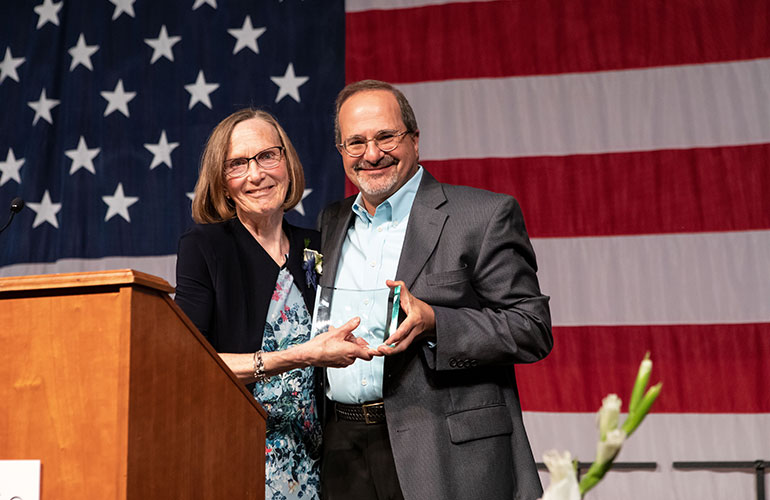
Photo: Judy presents Steven Gordon, president and CEO of Brattleboro Memorial Hospital, with the 2019 Community Service Award at Community College of Vermont’s 52nd commencement ceremony. Photo: Mitch Moraski Photography
Or another example: The Central Vermont Medical Center has partnered with CCV and Vermont State University in a different way. It has created a unique “earn-and-learn“ opportunity to increase the nursing pipeline. Incumbent LNAs at CVMC complete prerequisite course work at CCV before entering the nursing program at VSU. CVMC provides flexible scheduling so that students can continue working while they pursue LPN licensure.
And CCV is growing. In the spring of 2024, CCV saw a 6 percent increase in enrollment compared to the fall of 2023. In the summer of 2024, enrollment went up 10 percent compared to summer 2023.
Given the estimate that the U.S. loses one college a month, or the fact that Vermont has lost at least five small four-year colleges in the last three years, any kind of growth is remarkable.
“My heart goes out to those traditional schools because it’s tough,“ Judy said. “And it’s tough for the communities they are in, because those are oftentimes economic engines in those local areas. The reality is around the demographics. New England, in particular, is shrinking. I saw recently that there’s been a 21 percent decline in K-12 education since 2000. So for the last 10 years, that pipeline has been shrinking. And that compounds over time.“
Interestingly, CCV has not seen a large return to in-person classrooms since COVID.
“I think people have learned about the convenience of online learning,“ Judy said. “It’s timesaving as well as money-saving. They don’t have to travel somewhere. They can make education work with their own life. Even the traditional 18-year-olds are rethinking how they’re going to access learning.
“There will always be a swath of students who go to Middlebury, who go to UVM, who go to Dartmouth,“ she added. “They’re going to start in September, and four years later they’re going to graduate. But a growing swath are going to be more in and out. They’ll get a certificate, they’ll leave, they’ll start working, they’ll come back. They’ll access education for whatever they need.“
In her role as president, Judy has garnered the respect of a wide range of individuals, including Gov. Phil Scott. The governor sees CCV as a key player in removing the stigma associated with career and technical education, or CTE, and changing the narrative surrounding postsecondary options.
He believes that trades, certificate programs and other training opportunities — like many offered by CCV — should be viewed as equally valuable and potentially lucrative as four-year degree programs.
“I’ve always appreciated Joyce’s passion for helping Vermonters get ahead in life through CCV programs,“ Scott said. “Throughout my time as governor, my team and I have made it a priority to end the stigma around CTEs, which is something Joyce feels strongly about as well. She grew up on a dairy farm, and I think that upbringing grounds her and brings an important perspective to CCV.“
Judy prioritizes her students and their needs in her work, according to Scott. He particularly enjoys attending CCV graduations, where he can witness the positive impact of Judy’s leadership firsthand.
“I see the result of Joyce’s empathy every year at CCV’s graduation ceremony,“ Scott said. “There are graduates who are just out of high school, veterans, parents with children, and even grandparents, all making a point to advance their education that will lead to good-paying jobs here in Vermont.“
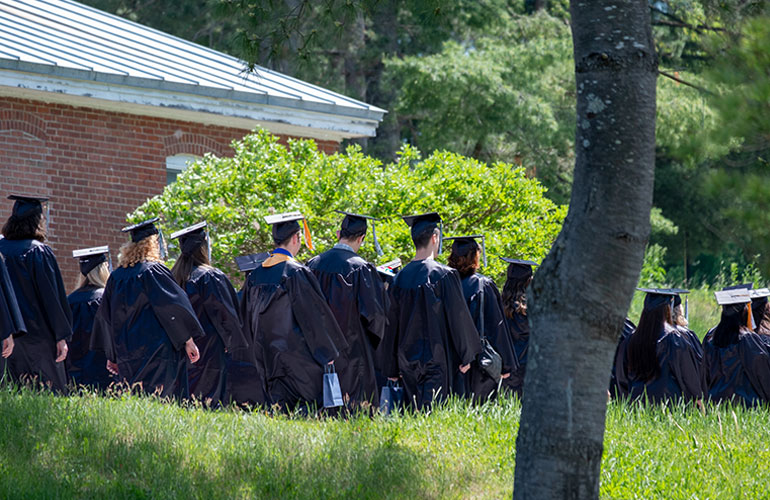
Photo: Top: 2024 CCV graduates proceess to Shapiro Field House. Photo credit Jade Premont, CCV

Student Caitlin McGinley addresses her classmates as Gov. Scott looks on. Photo credit Jade Premont, CCV
State Treasurer Michael Pieciak also admires Judy’s leadership. He first met her when he joined the Vermont State College board in 2015.
“I think of her as being a great leader who assembles really high-quality and competent team members,“ Pieciak said. “She is fiercely loyal to CCV’s mission, the organization itself and the students it serves.“
Pieciak further emphasized that Judy consistently remains at the forefront of educational innovation.
“She is committed to providing diverse pathways to an associate degree for individuals of all ages, both traditional and nontraditional students,“ Pieciak said. “These are programs that make it much more affordable for people to attend CCV. You would be very hard-pressed to find somebody who has done as much for young people and nontraditional students in Vermont. She is a real leader and a real champion in that space.“
Pieciak added that Judy is also a wonderful friend.
“But she doesn’t suffer fools, I’ll say that,“ he said. “I haven’t had that experience yet, but I’m sure it will happen. Also, she’s a very caring person. She really cares about the students and the mission that they’re serving. The other thing I’ll mention about Joyce is her work ethic. She is really dedicated. There’s nobody that I’ve come across who is harder to schedule lunch with than Joyce. Her schedule is always full.“
Dan Smith, president of the Vermont Community Foundation, has known Judy for more than 15 years. The foundation’s mission focuses on community impact and closing the opportunity gap, which VCF defines as “the systems and structures that hold people in Vermont communities back because of race or family economic background.“
The foundation administers the J. Warren and Lois McClure Fund, a program that provides a pathway to an affordable associate degree for all Vermont students. This mission naturally aligns with CCV’s goals, making them a natural partner in advancing educational opportunities for Vermonters.
“The innovative work that is being done at the Community College of Vermont is one of the brightest spots in terms of addressing economic inequality in the state of Vermont,“ Smith said. “That is not just true because community colleges generally are the most effective tool for college continuation among low-income students and first-generation students. It’s also because of Joyce’s leadership and the commitment to supporting rural students, systemically marginalized students and Vermonters of all ages, in every corner of the state, with their hopes and dreams.“
Smith described Judy as incredibly humble and noted her willingness to work tirelessly for an extended period.
“She’s served in so many different roles at the community college,“ he said. “She has spent the bulk of her career at the Community College of Vermont and has cultivated an incredible amount of loyalty and commitment.“
Beyond her leadership at CCV, Judy currently chairs the board of the Central Vermont Medical Center. Her collaboration with Anna Noonan, the medical center’s president and COO, on workforce development programs led to the creation of CCV’s innovative nursing program.
“For nurses, it's an entry level to nursing practice,“ Noonan said. “And we were looking for a partner to establish a connection for prerequisites for that nursing program. Joyce and her team were very willing to partner with us to offer prerequisites.“
The prerequisite courses cover subjects such as basic science.
“Doing that at a college level can be very costly,“ Noonan said. “Doing it through CCV is much more affordable.“
Noonan calls Judy “an incredible innovator“ in the academic arena.
“I think she understands the importance of making postsecondary education accessible to Vermonters,“ Noonan said. “And she does that with her team by developing programs and program tracks that allow individuals to continue to work, continue to meet other commitments they may have as adult learners, and still have an academic focus.“
Noonan adds that Judy has played a large role in making a college education more accessible.
“I think that’s probably the most incredible thing that CCV has done under Joyce’s leadership,“ Noonan said. “She’s an incredible leader who is leaving a lasting imprint in Vermont through her role as the president of CCV.“
Diane Dalmasse, director of HireAbility Vermont, an organization that helps Vermonters with disabilities and chronic health conditions obtain employment, has developed a professional relationship and friendship with Judy through their collaborative work at CCV on a program focused on creating career pathways for high-risk youth and youth with disabilities.
“I really believe that Joyce runs a very high-performing organization at CCV,“ Dalmasse said. “One of the hallmarks of that is that they are very thoughtful and intentional about making commitments and taking on new initiatives and new programs. But once they make that decision, they’re all in. They follow through on commitments and deliver, which is very refreshing and something I really respect.“
CCV has been an exceptional partner, Dalmasse stated. Her organization currently contracts a full-time CCV staff member dedicated to working exclusively with HireAbility participants. The program’s primary goal is to ensure participant success at the postsecondary level, mainly at CCV. Dalmasse regards this program as a “game changer.
“We have shifted our focus from helping people to get a job to helping people have a career pathway, including credential attainment leading to higher-wage jobs and moving people with disabilities out of poverty,“ Dalmasse said. “CCV has been just an outstanding partner with us in that journey. They help people who may not have been taught to think that they can have a career, or who do not believe they have a whole lot of competence or a sense of self-worth, to succeed. We develop ways to provide them with on-ramps to higher education.“
Dalmasse shared that she attended a CCV graduation several years ago and was deeply moved, like the governor, by witnessing students receive their degrees.
“These students are, by and large, Vermonters,“ Dalmasse said. “And by and large, they are students who are the first in their family to obtain postsecondary education and a degree. To see the pride on the faces of the graduates, and the pride of the families and parents that were there, made me realize that CCV is very unique.“
Life on the Farm
Judy comes from an extraordinary family. Her mother, a nurse, was raised on a farm. Her father, a World War II veteran, aspired to be a farmer. However, tragedy struck just six weeks after their wedding when her father sustained a devastating injury, resulting in him becoming a paraplegic for the remainder of his life.
“After a long hospitalization, he was essentially paralyzed from the neck down,“ Judy said. “Yet he and my mom were still determined they were going to farm. They bought this kind of rundown farm in Plainfield, New Hampshire. It was on a dirt road with no running water and little electricity. Today the farm is a thriving enterprise. It’s McNamara Dairy. My two brothers continue to farm there, as do four of my nephews and one of my nieces. And they’ve all been to college. If my parents were still alive, they would be so incredibly proud. Now it’s four generations!“
While her father’s accident left him with limited mobility in his hands, he was still able to drive.
“He drove everywhere,“ Judy recalled. “By today’s standards, he probably wouldn’t be able to get a license, but back then, we’d help him into his pickup truck, and that’s how he managed the farm. He couldn’t do the physical labor, but then along came his five kids — I have four siblings — and we pitched in to help, along with hired hands. We didn’t have a lot of money growing up, but we had everything we needed, and we never felt poor.“
Her father managed the farm from the cab of his pickup truck.
“He was the brains behind the farm,“ Judy said. “He had a fascinating mind. If something broke down, he could tell you how to fix it just by looking at it.“
Judy is the middle child in her family. Her two older sisters pursued distinct careers, one becoming a veterinarian and the other a fruit and vegetable farmer. Her two younger brothers, along with their families, continue the tradition of working the family farm.
“Another value I learned from growing up is that my mom had to do a lot of physical labor because my dad couldn’t,“ Judy shared. “There was never a division of chores like ’girls do this, boys do that.’ No, everybody needs to do this. And as we got older, anyone who wanted to farm could farm. It just so happened that my two brothers stayed on the farm, but my sisters and I are still very involved as well.“
Judy recalled that her mother was exceptionally frugal, never purchasing anything unless she knew she could afford it. This resourcefulness, Judy explained, instilled in her a creative approach to managing resources.
“That’s a lesson I carried forward from my parents. It’s not about operating from a place of scarcity, but recognizing the incredible resources around you and figuring out how to utilize them. Instead of thinking, ’I don’t have money for this,’ it’s more about asking, ’How can I make this happen?’“
Another notable trait inherited from her parents was a strong work ethic.
“They instilled in us a work ethic that you just do whatever it takes to get the job done,“ she said. “That’s what farmers do. And I feel it’s something that we do at CCV. We don’t have a lot of staff, and we don’t have a lot of money. But we do incredibly innovative and creative things, because it’s ’whatever it takes.’“
Her parents made an incredible team, Judy reminisced.
“My mom was essentially a physical extension of my dad’s body,“ Judy recalled. “She could do everything for him. Growing up, it simply became normal; you don’t even think about it. But as you get older, and after they passed away, you reflect on some of those things.
“For instance, my dad was on the school board, but they had to move the meetings because he couldn’t get into the school. It was just a different life. We rarely went out to eat as kids, because few restaurants were accessible to my dad.“
Despite these challenges, Judy said her parents were very social people, so people would often visit the farm. The things she experienced growing up might seem unusual or interesting to others today, but as a child, it was simply her everyday life. Judy said she wouldn’t trade her upbringing for anything.
“It really helped me to do the work that I do today,“ she said. “Community colleges don’t have a lot of resources; we have to be very creative with the limited resources we have. I also feel like I have a real connection to people who never imagined that college was in their future.“
Judy and her husband, Ben, still return to the farm to work.
“It keeps me grounded,“ she said. “Whenever I can, I try to go and do some chores. I can feed calves, shovel, whatever needs to be done. Real work — hard physical work — grounds me and gives me perspective. The work people do is truly important to me. My day job is engaging, interesting and creates opportunities for many, but I still try to get back to the farm.“
The Judys have been married for nearly 47 years. Ben, who retired in 2022 from the Vermont Department of Labor, currently serves as chair of the Laraway Youth and Family Services Board of Directors.
“He continues to stay very active and spends a couple of days each week helping at my family’s farm,“ Judy said. “He is my anchor and very much a support to me. He is known to many CCVers because he has joined me for many events during my 40 years. We do not have children, but we have many nieces and nephews who are like children to us.“
Away From the Farm
A lifelong advocate for education, Judy earned a degree in animal science from the University of New Hampshire. With foraging being an integral part of her life on the farm, she also worked as a 4-H Extension Agent.
“I often use that animal science degree when I talk with students,“ Judy said. “That’s because I’m such a believer that for many jobs, you need to demonstrate a level of perseverance. There are certain jobs where you need very specific training and a credential — a nurse, for example. But with education, you’ve demonstrated that you’ve set out a goal and you’ve achieved a degree. And every job requires reading, writing and math — those are basic skills.“
During our interview, Judy thoughtfully posed the question, “When do you stop wondering what you want to be when you grow up?“
She continued, reflecting on her own experience, “I’m such a believer that so many of us have no idea what we want to do when we grow up. I’m still wondering that myself. But I have an education which opens so many doors to opportunity. I truly believe in the power of education; it doesn’t guarantee you anything, but it certainly opens up doors and possibilities. In some ways, for so many of us, it doesn’t matter what degree you get; it’s that you get a certain level of education.“
Coming to the College
Judy recounted several other “miscellaneous jobs“ before serendipitously landing her career at CCV. She briefly worked at Castleton State College before she and her husband relocated to Brandon, where she met Nancy Chard. Chard held various roles at CCV, including counselor, teacher, regional director and academic dean, and became a close friend to Judy. Judy recalled Chard saying, “If you ever leave Castleton, give me a call.“ When Judy and her husband started working with her brothers on the farm, she felt adrift and reached out to Chard, asking if she wanted to talk.
Chard, who died in 2010, initially hired Judy part-time until a full-time position became available. Judy then transitioned into an adviser role for both the Springfield and White River Junction CCV centers, working as an adviser specifically for the Springfield branch from 1983 to 1994. During this time, she pursued further education and obtained a master’s degree in organization and management from Antioch New England.
In all those years, Judy left CCV only once, a decision she later referred to as one of the biggest mistakes of her career.
“I left CCV in the middle of the 1980s,“ she said. “I was recruited to come back to a job I had left, and I let people convince me that I wanted to go back. After a week into it, I thought, ’I have made the worst mistake of my life. I left that job for very intentional reasons and now I’m back!’ So I went home and said to my husband, ’I can’t do that job.’ And he said, ’Well, do whatever you need to do.’ So, the next day, I resigned.“
She called Chard to see if she could get her old job back. As luck would have it, CCV hadn’t yet filled the position.
“I mean, the stars were aligned,“ Judy said. “But I have to say, it was an embarrassing moment for me. It was humbling, but it’s the best professional decision I ever made. Because I came back to something I was really passionate about. And I have grown from there.“
In 1994, Judy was promoted to dean of students. She recounted deciding that to do her job most effectively, she should move to central Vermont.
“My husband was thinking he was going to do something different, even though we were both still very much connected to the farm. So we moved to Waterbury in 1994, and I still feel like we’re new residents. But we’ve been here for 30 years!“
In 2001, Judy ascended to the position of provost. Subsequently, in 2009, when President Tim Donovan transitioned to chancellor, the board requested her to assume the role of interim president.
“I was not really aspiring to be the president, and they conducted a national search,“ Judy said. “I was like, ’OK, I don’t aspire to be a president of a college, but I aspire to be the president of CCV.’ So I decided to apply with no expectation of where it would end. But it ended in a good place. And I’ve been here ever since.“

Photo: Judy with CCV students. Photo credit Jade Premont, CCV
The Uniqueness Factor
Judy emphasized the distinctiveness of CCV among community colleges nationwide, attributing it to former Gov. Deane Davis’ vision of bringing education directly to local communities. She noted that Vermont is the only state with a single community college operating across 12 locations, whereas most states have multiple community colleges, each serving a specific population center.
There’s a productive tension within CCV between the needs of the entire organization and the specific needs of each individual location, Judy said.
“It’s not the same thing,“ she said. “But we are one college. I believe that tension is a good thing.“
One of CCV’s most valuable assets is its ability to offer courses that seamlessly transfer to other institutions of higher education. For example, CCV maintains a robust relationship with the University of Vermont.
“Because so many of our students transfer there, we have very distinct transfer agreements with the colleges within the University of Vermont,“ Judy said. “UVM publishes the UVM courses and the CCV equivalents on its website to make it easy for students to go back and forth. A lot of UVM students take CCV courses, and vice versa.“
Another unique aspect of CCV is its 100% part-time faculty. Judy emphasized Davis’ belief, which she still holds, that with a population of 620,000 dispersed across small communities, effectively bringing education to Vermonters requires a part-time faculty model. She clarified that the faculty are not adjunct to anything, underscoring their integral role within CCV’s educational approach.
“They are our faculty, and they are involved in governance of the college,“ Judy said. “We also provide a lot of professional development, because we hire people who are skilled in their profession but may need assistance to become good teachers.“
Judy explained that classes at CCV are highly interactive, contrasting them with the traditional large-lecture format many students experienced growing up. She emphasized the importance of student participation and responsibility, even in online courses, which are capped at 20 students.
Judy added that while CCV’s innovative approach was unique when it began, it now serves as a role model for other institutions.
“What’s interesting today is that I receive calls from administrators from other states asking me to talk to them or their board about how to structure one community college in a state,“ Judy said. “They want to know how to bring all those small community colleges that are separate, freestanding institutions into one institution, as opposed to having 15 or 17 different community colleges. It’s been interesting to see the evolution. For a long time, we were sort of the odd person out.“
As the nation’s demographics shift, the youth population declines and four-year colleges become increasingly expensive, CCV’s model seems to offer a promising solution.
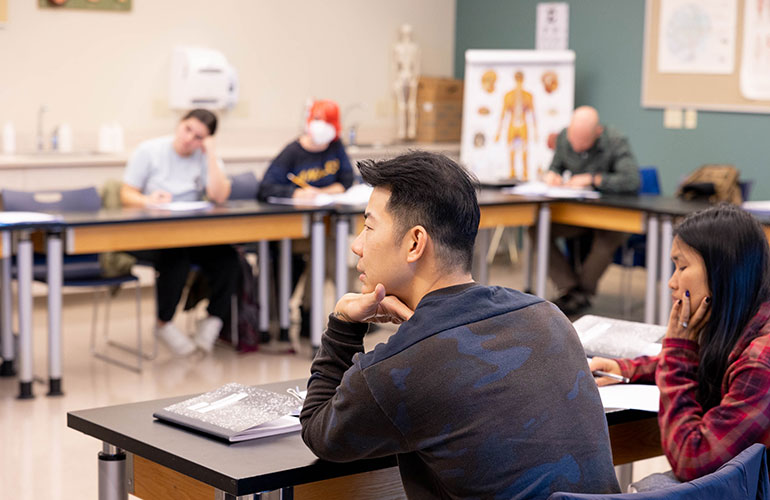
Photo: CCV students. Photo credit Jade Premont, CCV
Creative Accessibility
A core aspect of CCV’s mission is accessibility, with the institution constantly seeking ways to improve in this area. One approach, Judy explained, has been to attract and support unconventional students, whoever they may be at any given time. For instance, in the 1970s and 1980s, CCV primarily worked with low-income women, and later expanded its focus to include refugee populations.
“We are currently working closely with the Afghan population being resettled in southern Vermont,“ Judy said. “When they’re ready to take college courses or advance their skills, we’ll be there to support them.“
She added that CCV has a history of collaborating with new communities in Vermont, including the Southeast Asian population in the 1990s and Bosnian refugees who settled after the Yugoslavian civil war.
“As new populations arrive in Vermont,“ Judy said, “we have consistently stepped up to meet their educational needs.“
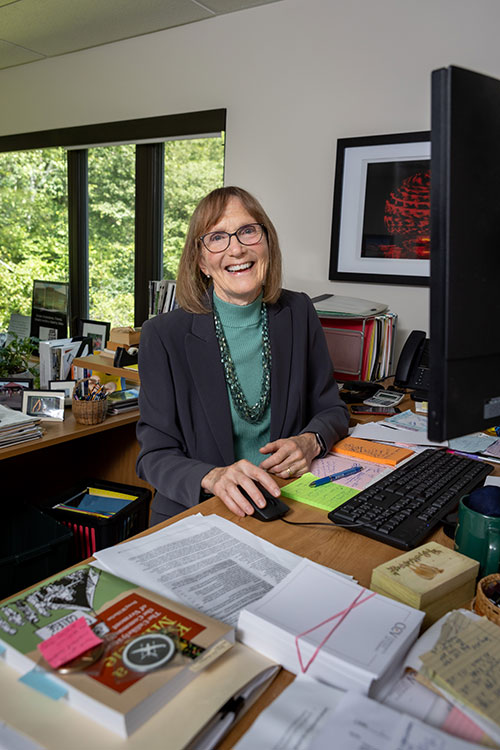
Photo: Judy at CCV headquarters in Montpelier Photo: Baldwin Photography.
Financial Aid
The national narrative is that higher education is too expensive and leaves students struggling for years with crippling debt. Judy knows a way around that conundrum, and yes, it involves CCV.
“What troubles me is the narrative about how much debt college students face,“ she said. “What is happening is that many first-generation families, many people from low- and even middle-income families, are taking themselves out of the education game because they believe they can’t afford it. They leave before they explore. My plea is, ’Let’s sit down together and figure this out. Because maybe there is a path forward.“
CCV provides dedicated financial aid counselors to serve students across all 12 locations. “We invest heavily in financial aid advising because money is a sensitive topic,“ Judy said. “It’s often a significant barrier for students.“
To address financial challenges, Judy mentioned Act 77, a 2013 initiative aimed at ensuring all Vermont students have access to high-quality educational experiences that prepare them for post-graduation success. This initiative has proven beneficial for high school students aspiring to attend college.
Since 2001, CCV has offered programs like Dual Enrollment and Early College, providing high school students a head start on their college education.
Data reveals that while an average of 60% of Vermont high school graduates enroll in college directly after graduation, 80% of students participating in CCV’s Dual Enrollment or Early College programs enroll in college within 16 months of graduating high school.
In the past five years, CCV has served over 13,300 students through its secondary education programs.
“For Dual Enrollment, any student who’s enrolled in a Vermont high school can take two college courses while they’re still in high school,“ Judy said. “That is huge, because then they can leave and transfer those credits. One course can cost about $1,000, so they’re saving real money.“
The Early College Program is designed for students who want to complete their entire senior year of high school at CCV, earning college credits while simultaneously fulfilling their high school graduation requirements.
“They can still play sports, they can still be in the drama club, but they take their academic courses at CCV,“ Judy said. “So they leave high school with a high school diploma and one year of college at no cost to their family.“
Additionally, the McClure Foundation’s Free Degree Promise offers all students in the Vermont high school classes of 2023 to 2026 the opportunity to earn a free associate degree through CCV’s Early College program.
“If a student starts at CCV in the Early College program that is funded through the state,“ Judy explained, “the McClure Foundation will pay for that second year. The student can leave with an associate degree, or the equivalent of their first two years of college. There has been such an interest in this from Vermont families.“
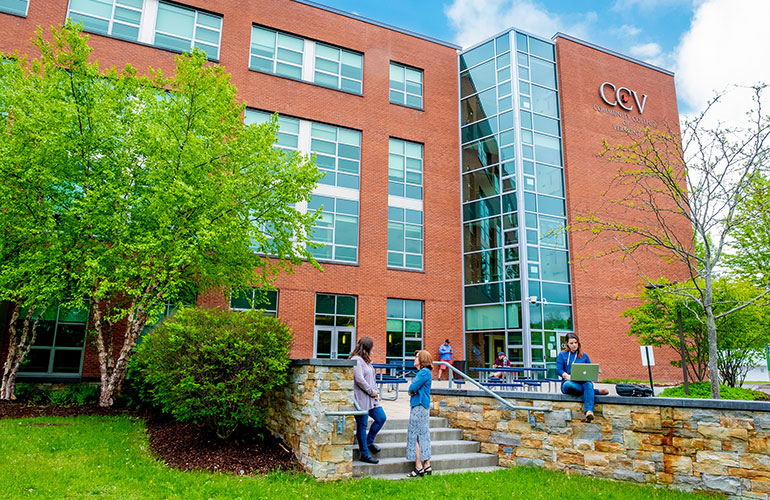
Photo: CCV Winooski campus. Photo credit Jade Premont, CCV
Unconventional Students
CCV continually seeks to serve underserved populations, demonstrating this commitment by offering online courses since 1996.
“You can learn without traveling,“ Judy said. “You can learn without child care. We serve a lot of veterans. We had seven or eight veteran- and military-connected students in our graduating class this year. I just had a student a year or so ago who graduated from one of our centers. He’s a Vermonter, but he did almost his whole program while he was deployed.“
While CCV does enroll out-of-state students, its primary focus remains steadfastly on serving Vermonters.
“We have some out-of-state people who access our programs because we’re offering what they want,“ Judy said. “We also see a lot of students who move to Vermont and start to take courses.“
The business community is another crucial population served by CCV.
“CCV is only as strong as our relationships in the community are deep,“ Judy said. “And so we make sure that we are attentive to what businesses are facing, and what they are looking for. They need employees urgently, and so we have recently created a lot of shorter-term certificates. Certificates work well for businesses, because they want students to enter the workforce faster. We help them get the essential components of education, and then once they land that job, they can come back and round out and get their degree.“
An associate degree typically consists of 60 college credits, spanning 20 courses. In contrast, a certificate generally ranges from 24 to 30 credits, encompassing eight or nine courses within a smaller, more focused area of study.
Illustrating CCV’s ongoing commitment to serving new populations, Judy explained that a few years ago, the Funeral Directors Association approached the college with a unique challenge. They were facing a shortage of new funeral directors as many in the state were retiring. CCV collaborated with the association and the Office of Professional Regulations to identify the requirements for becoming a licensed funeral director, ultimately creating a program and now offering a certificate for aspiring funeral directors.
“It’s not hundreds, but it’s a number of people who aspired to move into that role,“ Judy said. “We do that with manufacturing. We’ve done it with early child care and learning. We are a big player in the early-childhood education area. This past spring, we had over 400 students enrolled in early-childhood education statewide.“
Judy maintains that unconventional students have transformed CCV’s reputation.
“Over time, we saw that our students aspired to degrees and opportunities way beyond what we could provide,“ she recalled. “Doors are opening so much for them, and they are so skilled, so we had to up our game in terms of quality and in terms of creating pathways for them.“
CCV began focusing on establishing transfer pathways to institutions like the University of Vermont, Champlain College and Norwich University, as many students sought to continue their education beyond CCV.
Ironically, this success came despite initial skepticism from some institutions of higher learning. Judy noted that in the early days, “they just wished community colleges would go away. I think people thought of us as fly-by-night institution. But I would say the way CCV has gained its reputation is because of our students.“
CCV students have proven themselves by excelling in their academic pursuits beyond community college.
“It’s really the students’ stories that have helped change the perception of what we do and what we offer,“ Judy emphasized. This led CCV to focus heavily on academic quality and standards in the 1990s, navigating the balance between adhering to higher education expectations while maintaining its innovative and responsive approach to serving a diverse student population.
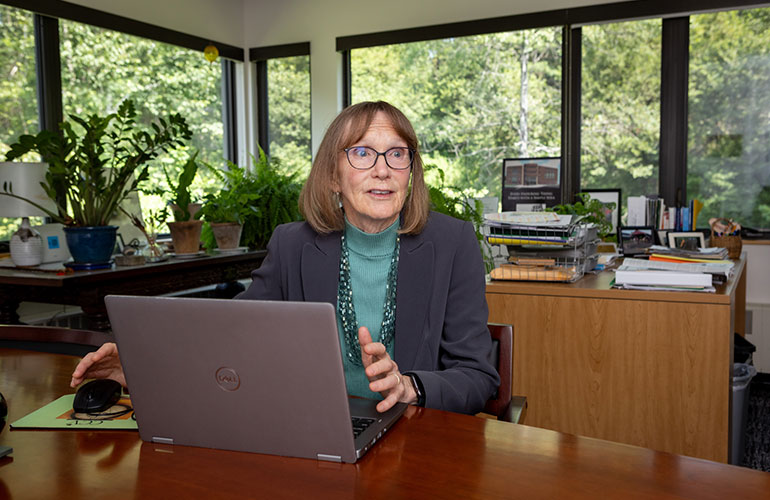
Photo: Judy at CCV headquarters in Montpelier Photo: Baldwin Photography.
The Future
In its ongoing commitment to reaching new and unconventional learners, CCV has recently launched an education program within the Vermont correctional system.
“We did this all with philanthropic money,“ Judy said. “We didn’t want to use any public money. We wanted to prove the concept that, if we could provide some education and support to people who were residents of these facilities, then when they got out, maybe we could help change their trajectory and their family’s trajectory.“
Judy expressed her ongoing concern about Vermont’s high recidivism rate, which exceeds 50%.
“It’s not good for the family, it’s not good for the (formerly incarcerated individual) and it’s not good for the state of Vermont,“ Judy said. “It costs us a lot of money.“
After successfully pitching the program to the McClure Foundation and securing seed money, CCV began offering courses at the Northern State Correctional Facility in Newport, which proved highly successful.
“We actually had a superintendent at the time come to us and say, ’This is changing the culture of the institution, because people are investing in themselves. They’re feeling better about themselves.’“
The program experienced a prolonged pause due to the COVID-19 pandemic, but was revitalized with the support of U.S. Sen. Bernie Sanders (I-VT), who secured government funding for its continuation. Judy shared that by the fall, the program would be operating in St. Albans and Chittenden, with plans to expand into Springfield. She also revealed that courses would be offered in all correctional facilities by the following fall, and hinted at an interesting aspect of the program yet to be unveiled.
“It’s the correctional employees who make it pretty difficult for these folks to take courses, because they’ll ask, ’Why should they have that opportunity when I don’t get that opportunity?’ Judy said. “So we also created a parallel program offering courses to people who are employed by corrections. They’re using it as a recruitment and a retention tool.“
Attending prison classes is a humbling experience, Judy said.
“I try to visit a class every now and then, and it’s probably the most powerful and humbling educational experience I get to witness,“ Judy said. “They’re all grateful for the opportunity.“
CCV remains committed to serving additional populations as they emerge or are identified within Vermont.
“We’re doing a lot of work with multilingual learners,“ Judy said. “We’ve always served a lot of new Americans, but how do we step up our game and do even more? We recently received an anonymous gift from a philanthropist to hire someone that’s fully dedicated for a couple of years to help us dig deeper and develop stronger programs.“
Additionally, there’s a growing movement to facilitate the recognition and re-credentialing of new Americans who hold professional qualifications earned in their native countries. This initiative is particularly focused on addressing Vermont’s shortage of physicians, nurses and pharmacists.
“They’re really skilled in their home country,“ Judy said. “And they come here and they have to work in food service in the hospital, a very entry-level job, because their credentials don’t match. Well, what can we do about that? I think the Legislature recently passed a bill to offer in-state tuition to anybody who relocated here. They won’t have to wait a year.“
Judy expressed that she has no immediate plans to retire.
“Personally, I have to keep running to keep up,“ she said. “And if you asked me that question tomorrow, I might have a different answer.
“I think the challenge for me,“ she continued, “is to make sure I leave before people want me to leave. And then I would like to leave CCV on a really high note.“
Joyce Marcel is a journalist from southern Vermont. In 2017, she was named the best business magazine profile writer in the country by the Alliance of Area Business Publishers.
To support great journalism, access our archives and get unique features like our award-winning profiles, Book of Lists & Business-to-Business Directory, subscribe HERE!