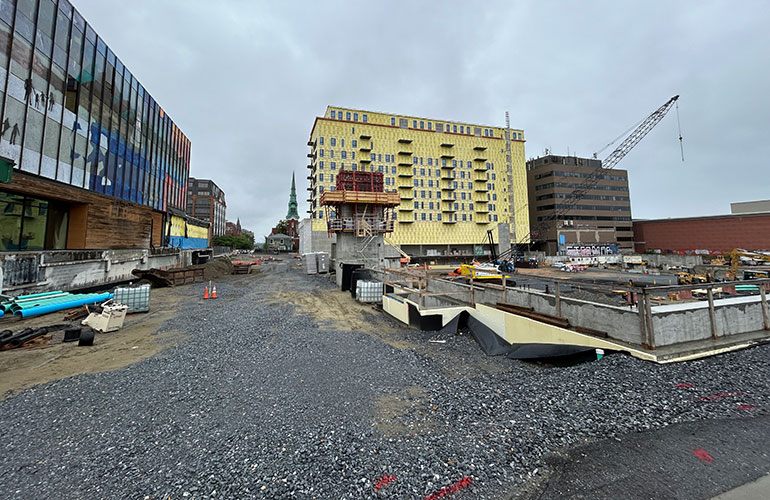
Photo: CityPlace in Burlington is quickly rising as the state’s tallest building, promising to bring more residents and increased activity to the downtown area. VermontBiz photo.
by Timothy McQuiston, Vermont Business Magazine
Housing and workforce availability are the primary factors currently affecting the Chittenden County economy. This situation mirrors trends seen in many regions across the state and nation. Limited housing and a tight labor market contribute to rising costs and hinder economic growth potential.
Still, there is no question that the region is experiencing what otherwise would be considered, especially in historical terms, a thriving economy.
What concerns those we spoke to is the future. While there is plenty of capital infused by the federal government in response to the pandemic, and while incomes are relatively high and unemployment is absolutely low, future growth could be limited.
Following an extended period of low interest rates and inflation, a significant shift has occurred with both now on the rise. Property taxes are also increasing, further compounding economic pressures.
While the persistent challenges of limited housing and workforce availability aren’t expected to resolve quickly, the influx of federal funds that has helped to mitigate some of these issues will eventually dwindle.
Despite recent economic fluctuations, personal income continues to rise, and individuals maintain a significant level of wealth. This is partly due to the sustained growth in home equity and the long-term appreciation of investment portfolios.
While middle- and low-income households face increasing financial pressure, with rising rents squeezing their budgets, they are not benefiting from the growth in real estate wealth that homeowners enjoy. This disparity is exacerbated by the simultaneous rise in home values and rental costs.
With the juxtaposition of these different sides of the economy, and the uncertainty they bring, business and economic leaders offered their perspectives and data.
Housing
Despite the recent surge in housing construction, particularly in apartment buildings within Burlington, South Burlington, and Williston, the impact on affordability and inventory remains unclear. The ongoing and vigorous development efforts have yet to translate into noticeable relief for those struggling with high housing costs or limited options.
Charlie Baker, executive director of the Chittenden County Regional Planning Commission, was blunt about what the regional economy needed:
“Housing, housing, housing,“ Baker said. “Specifically, reviewing the Act 250 bill (H.687) and beginning work on implementing it. We have started work on a methodology for distributing regional housing targets across our municipalities. We are working with the NRB (Natural Resources Board) on making sure we and, more importantly, they, have a common understanding of the geographies (maps) for the interim exemptions from Act 250.“
The Act 250 changes are expected to help downtowns across the state, while potentially limiting growth in rural areas. Gov. Phil Scott vetoed the Act 250 bill, despite some encouraging housing provisions, due to concerns that the new law could further restrict rural development.
Despite what appears to be that vigorous housing development in Burlington and its suburbs, Baker said: “From my perspective, there is not close to enough housing being built. There have been about 2,000 housing units getting built statewide for the last 20 to 30 years. I think we need to be building at least 4,000 a year to address the housing needs and achieve a healthier housing market.
“That is not a one-year number; it’s what we need to do year after year to have a healthier housing market. If Chittenden County were to shoulder 25% of the housing production, we would be building about 1,000 units a year. We have been building around 700 a year for the last 30 years on average.
“Approximately 60% to 70% of homes are for ownership, with 30% to 40% for renters. Other parts of the state are probably closer to the 30% rental number, and we should be closer to 40%, given our significant student population.“
Frank Cioffi, president of the Greater Burlington Industrial Corp., echoed Baker’s assessment. He emphasized the need for greater creativity in building neighborhoods, redeveloping and repurposing office buildings and other existing structures, while fostering denser redevelopment in areas with municipal water and wastewater services. He also suggested providing incentives to municipalities to encourage more innovative housing development.
“New housing in Chittenden County should be constructed for workforce and Vermonters and Vermont families, Cioffi said.
He emphasized that in Burlington, South Burlington, and Winooski, housing for UVM and other college students must be built on university property. He argued against institutions buying and renting newly constructed, off-campus housing, citing the Market Street area in South Burlington as an example of a development that should not be replicated.
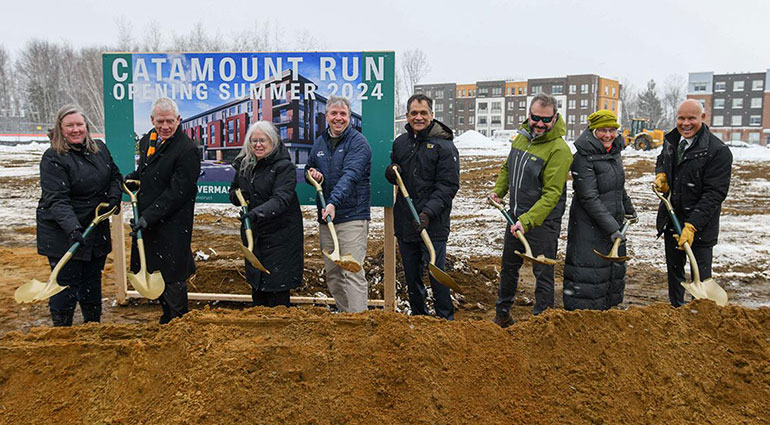
Photo: Ground is broken in March 2023 for a UVM housing project in South Burlington’s City Center. An adjacent complex is being completed for the UVM Medical Center. These projects are intended to provide housing, thereby aiding in the recruitment and retention of workers. UVM photo.
This viewpoint might not be universally popular, particularly in the Market Street area of South Burlington, where both the University of Vermont and the UVM Medical Center are constructing apartment complexes for their students and staff. The hospital, like other employers, faces challenges in recruiting and retaining staff due to high housing costs.
Meanwhile, UVM recently canceled a large student housing development due to escalating costs. Concurrently, Burlington officials have been urging colleges to build more housing to alleviate pressure on the city’s limited housing supply.
There is also a larger discussion to be had about short-term rental properties and their impact on housing inventory and valuations. Burlington and state officials are navigating this issue, as these properties generate tax revenue but also reduce the supply of housing available for long-term residents.
Data from the Vermont Housing Finance Agency, which compiles information from online marketplaces like Airbnb and Vrbo, revealed that the monthly availability of entire units as short-term rentals fluctuated between 9,378 and 10,358 during the 2023 fiscal year.
Average monthly revenue was approximately $4,000. In the same period, 1,400 individual rooms were available and had an average monthly revenue of approximately 25% of that for entire units.
The Legislature’s Joint Fiscal Office projects that a 3% tax on overall revenue from short-term rentals will generate $11.8 million for the Education Fund in fiscal year 2025, increasing to an annualized $14.7 million from fiscal year 2026 onwards.
“We have to make Vermont a place where people want to start and grow businesses,“ said Victoria Bronner, president and CEO of the Bank of Burlington. “We continue to pass legislation that only makes this state a less friendly place to have a business. The housing can be simple to correct, but both state and local government need to remove the barriers that impede housing creation.“
Jobs and Workforce
In April, Vermont’s seasonally adjusted unemployment rate was 2.1%, ranking third lowest in the nation. The unadjusted rate was slightly higher at 2.3%. County-level data, which is not seasonally adjusted, shows Chittenden County with the state’s lowest jobless rate at 1.6%, though up from 1.3% in April 2023. Orleans County had the highest rate at 4.2%. Nationally, the unadjusted unemployment rate was 3.5%, with a seasonally adjusted rate of 3.9%.
“As always,“ GBIC’s Cioffi said, “our primary focus is the retention and growth of jobs for Vermonters in our region and in the state. “First, it’s about retention of those key employers and the jobs they provide to Vermonters. The activities and investments of these employers form the foundation of our region’s and state’s economy. Then, it’s about the expansion of jobs, workforce, of capital investments in, and the growth and competitiveness of, those key employers, like GlobalFoundries, Dealer.com, Rhino, Beta Technologies, OnLogic, Blodgett, Data Innovations and many others.“
Beta and OnLogic have built gleaming new facilities in South Burlington, and. Beta recently opened a new campus at Leahy Burlington International Airport.
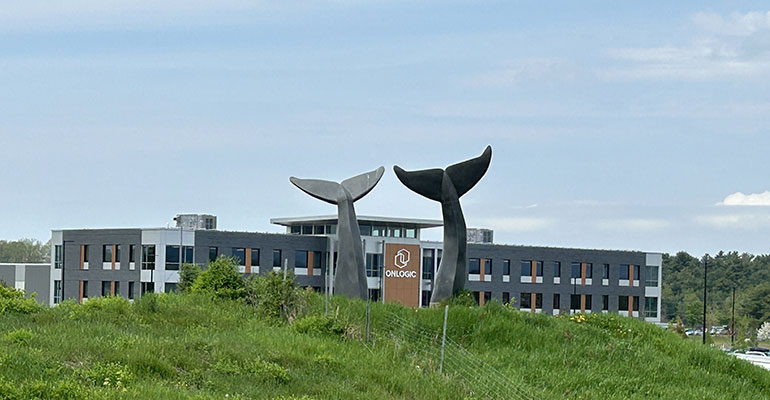
Photo: OnLogic’s new global headquarters at Technology Park in South Burlington. VermontBiz photo.
Cioffi also stressed the importance of workforce development and training. His agency collaborates with the Vermont Training Program of the Department of Economic Development to provide funding through training contracts to key employers. This initiative aims to support employers while enhancing worker skills and wages.
Working with the Vermont Department of Labor to facilitate state and federal training and grant assistance to working Vermonters through various measures and initiatives.
The Vermont State Workforce Development Board issued its strategic plan last year, aiming to add 10,000 new workers annually by 2040. Half of this growth would come from in-state initiatives, including upskilling 900 Vermonters, retaining 3,000 students and re-engaging 2,000 workers each year.
Since the end of the pandemic, the labor force participation rate (the percentage of working-age adults in the workforce) has gradually risen to 65.5% as of April 2024. North Dakota boasts the highest participation rate at 69.7%, alongside South Dakota, which shares the lowest unemployment rate at 2.0%. Conversely, Mississippi has the lowest participation rate at 54.5%, yet maintains a relatively low unemployment rate of 2.8%.
The participation rate would seem to be the lowest hanging fruit for job creation, as a 1% increase in Vermont’s workforce would translate into over 3,500 jobs.
The remaining half of the job growth target involves attracting 5,000 new residents to Vermont annually. However, recruitment and retention have been long-standing challenges. While jobs are available, the SWDB’s report acknowledges that housing and child care have been persistent barriers to attracting and retaining workers.
“From my perspective,“ Baker said, “the workforce shortage is now a symptom of our housing shortage. We won’t be able to have enough workers until we have enough housing.“
While “affordable housing“ is subjective and varies based on income level, the affordability crisis disproportionately impacts lower- and middle-income earners. This issue has been intensified by rising interest rates, labor shortages and supply-chain disruptions, which have collectively inflated the costs of construction, ownership and rental of housing.
A recent example highlighting this affordability crisis is the University of Vermont’s decision to cancel plans for a large student complex near the DoubleTree by Hilton Burlington. UVM cited the escalating costs of construction, driven by rising interest rates, labor shortages and supply chain-disruptions as the primary reasons. These factors made the project financially unviable and would have resulted in rental rates beyond the reach of the intended student residents.
The canceled $100 million project, announced in August 2023 with city support, would have accommodated 540 undergraduates. Its aim was to alleviate pressure on the existing housing stock in the area. Despite this setback, UVM is nearing completion on a separate project in South Burlington that will provide 550 beds for graduate students, staff and faculty.
While the University of Vermont’s canceled project highlights the challenges facing affordable housing development, organizations like the Champlain Housing Trust are actively working to address the issue. Chris Donnelly, CHT’s director of community relations, detailed their extensive list of ongoing and upcoming projects:
-
Fort Ethan Allen: CHT is working with Evernorth and Engelberth Construction to transform three former dorms into 65 affordable apartments, with the first building ready for occupancy in November. “These are beautiful, old buildings and once housed the 10th Cavalry, a Black Army regiment otherwise known as the Buffalo Soldiers,“ Donnelly said.
-
Bay Ridge (Shelburne): Breaking ground this month on a new neighborhood with 68 apartments and 26 permanently affordable, shared-equity condominiums, with the first homes available in spring 2025 at prices between $170,000 and $190,000.
-
VFW Post (Burlington): Demolishing the existing VFW Post to construct a new building with a community center and 38 new apartments, including five for unhoused veterans.
-
Former Champlain Inn (Burlington): Converting the property into a year-round shelter for 35 to 40 people and a winter shelter for an additional 30 individuals.
-
Other Projects: Developing 80 to 100 homes and apartments in Hinesburg; potentially expanding and modernizing the O’Brien Community Center in Winooski; building 70 to 80 homes and apartments at Cambrian Rise in Burlington; and several smaller projects, including a pilot developmental disabilities housing Initiative and expanding the Feeding Champlain Valley headquarters.
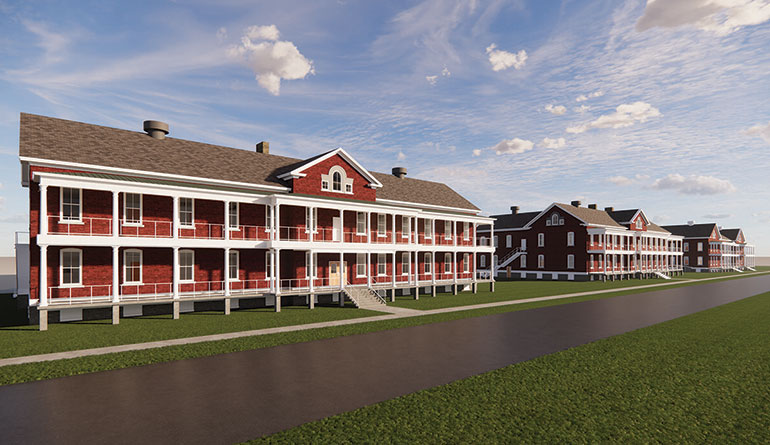
Photo: At Fort Ethan Allen in Colchester, CHT is working with Evernorth to transform three former dorms into 65 affordable apartments. CHT image.
These diverse initiatives, Donnelly said, demonstrate CHT’s commitment to providing affordable housing options and supporting community needs across the region.
Donnelly and other housing advocates emphasize that the growing number of unhoused Vermonters is partially attributable to the scarcity and high cost of housing, a pre-existing issue that was exacerbated by the COVID-19 pandemic. Donnelly acknowledges that the overall housing problem is not a recent phenomenon but has been further intensified by recent events.
“We are pretty far behind,“ he said, “and it’s due to a lack of building over decades. One positive development I’ve noticed in the past few years is the generally accepted understanding that we need to build more housing. That’s shifted from, say, 10 years ago.
While other regions offer potential models for addressing the housing crisis, the unique circumstances in Vermont and Chittenden County present distinct challenges, Donnelly said. Unlike Minneapolis, which implemented regulatory and zoning reforms with a 4% rental vacancy rate and subsequently saw rents stabilize or decrease, Vermont has faced a persistent 0-3% vacancy rate for over 15 years. This limited availability has hindered the impact of new construction on rental costs, making it more difficult to achieve similar results.
Despite these challenges, he added, exploring successful approaches in other areas can provide valuable insights for developing effective solutions tailored to Vermont’s specific context.
“It’ll take several years to get to that point in Chittenden County, but I believe that the reforms are pointing us in the right direction,“ he said. “We’ll need more resources, however, to make some of the housing affordable to lower-wage workers and middle-income households.“
Regarding the need for additional housing, Donnelly stated, “The Vermont Housing Finance Agency will soon release a needs assessment to determine precise targets, but recent estimates suggest a statewide need for 30,000 to 40,000 new homes and apartments. A significant portion, potentially a third or more, should likely be concentrated in the northwest region where job opportunities are concentrated.“
He emphasized the market’s current inability to provide affordable housing for many workers, necessitating subsidies for purchase prices or rent to ensure opportunity and mobility.
Donnelly also advocated for the state’s policy of investing in permanently affordable housing, arguing that taxpayer-funded subsidies should yield long-term benefits for the community.
“There may be some immediate savings from the regulatory and zoning reforms enacted in the last couple of years, but the higher interest rates means that private-market developers will still have a difficult time bringing any new housing to market for less than $500,000. The median price for a newly built Chittenden County home in 2023 was $700,000.“
Economic Expansion
Industrial development seems to be in a curious position. Office space is staying empty, much commercial has headed to the suburbs, there are some big industrial spaces available at Teddy Bear in Shelburne and in Williston where Keurig is moving all their operations to Essex.
Meanwhile, CityPlace Burlington will bring new residents and new energy to the downtown that seems to need it.
The estimated $200 million project, which will occupy what was the center section of the former Burlington Square Mall, will comprise a minimum 350 residential apartments, including 70 permanently affordable units; two hotels, providing a maximum total of 350 guest rooms; 40,000 square feet of retail space; and 172,000 square feet of parking.
Cioffi sees some positive news in industrial development.
“Manufacturing and how we make products and perform valued added services have totally changed, he said.
He also expressed optimism about the “reshoring“ of some businesses, a trend partially accelerated by the pandemic. He believes that the CHIPS Act, advancements in renewable energy, alternative energy technologies and artificial intelligence will further foster and encourage American innovation.
Regarding value-added services, Cioffi suggested that the future of the workplace — its location, structure and function —could undergo significant transformations in the coming years, unlike anything we’ve seen before. However, he expressed confidence that existing built environments will adapt and evolve to meet the changing needs of the marketplace.
However, Cioffi expressed concern about a “crisis“ in the supply of permitted, infrastructured industrial park lots for manufacturing, stating, “As of June, there are fewer than 25 industrial lots with the necessary permits and infrastructure, each with a buildable area exceeding 5 acres.“
Cioffi said Gov. Scott wisely created the Rural Industrial Development Program to stimulate economic growth. This program facilitates the expansion of existing industrial parks and proactively identifies suitable locations for new ones. By pre-permitting these industrial sites, the program significantly reduces the cost and complexity for businesses, especially manufacturers, to establish or expand their operations.
Economic Future
Bank of Burlington’s Bronner said she anticipates an economic slowdown both locally and nationally, which may lead other banks to tighten credit. However, she asserts that Bank of Burlington, with its strong capital and liquidity, is well-positioned to continue lending to robust local businesses and even grow during this period of economic contraction.
Bronner’s confidence is bolstered by the bank’s exceptional growth in the past 20 months, exceeding expectations and demonstrating a strong market demand for a local, business-focused bank.
Meanwhile, Baker highlights the positive aspects of the diverse and growing employment landscape but also acknowledges the challenge of insufficient housing construction to meet the needs of current and future employees and their families.“
Economic Report
In March, Arthur Woolf, a former UVM professor who now runs a consultancy under his name in Westford, prepared a report for the GBIC titled “The Role of Northwest Vermont in the State Economy.“ In the executive summary, Woolf writes:
“In 2023 the three northwestern Vermont counties — Chittenden, Franklin and Grand Isle — had a combined population of 227,942, 35% of the total Vermont population of 647,464. But they have a higher share of the state’s jobs, wages and income; a higher average wage; and provide a disproportionate share of state personal income taxes and sales taxes.
“The region is growing faster than the statewide average, and has been for several decades. Vermont’s economic and demographic growth are concentrated in those three counties. Although the northwestern region has experienced faster job growth than the state as a whole, the overall pace of job growth statewide has been sluggish. For example, between 2000 and 2019, Vermont’s economy added 14,000 jobs. By way of comparison, between 1997 and 1999, Vermont employers also added 14,000 jobs. It took 19 years to add the same number of jobs that it took two years to do in the 1990s.
“While the three northwestern counties added jobs at a faster rate than the state as a whole since the turn of the century, the other 11 counties combined had fewer jobs in 2022 than at the turn of the century.
“Compared to their share of the state’s population, the northwestern counties account for a slightly smaller share of meals and rooms and education property tax revenues. This is most likely due to the large amount of economic activity and resulting tax revenues that come from the state’s ski resorts and vacation industry, almost all of which are located outside of the three northwestern counties. (The only ski resort in northwest Vermont is Bolton Valley. Cochran’s Ski Area in Richmond has no guest accommodations.)
“The three northwestern counties also act as economic drivers for the state, on net, as they attract workers who live in other parts of the state and from other states. Economic activity in the northwestern part of Vermont therefore contributes to the economic vitality of communities in other Vermont counties.
“From 2000 to 2010, Vermont’s population grew by about 17,300. Between the Census count in 2010 and the 2023 Census estimate, the state added 21,700 residents. Growth in both periods was a relatively slow 0.3% per year, for a total population growth of 6.4% since the turn of the 21st century. But over that same period northwest Vermont’s population has grown by 14.6%, while the rest of the state added only 2.4% to its population.
“Although northwest Vermont grew more than twice as fast as the state as a whole, the state’s population growth in both decades of the 21st century has been the slowest of any decade since the 1930s, when the nation was mired in the Great Depression. During that decade, Vermont lost population, as it also had during the 1910s. During the first half of the 20th century, Vermont’s population growth was anemic, even during the Roaring ’20s, an economic boom period when Vermonter Calvin Coolidge served as president for nearly six years. In that decade, Vermont’s population grew by only 0.2% per year. The state’s average annual growth rate during the current century has been only slightly faster, at 0.3% annually, while northwest Vermont’s growth was twice as fast, at 0.6% per year.
“Vermont’s historical and recent experience is very different from the national pattern. The U.S. population has grown more than twice as fast as Vermont’s since 2000. During the first decade of the 2000s, only three states grew more slowly than Vermont. During the 2010s, Vermont’s population growth ranked it 40th in the nation. By any measure, Vermont’s population growth over the past two decades has been very slow and well below the U.S. average.“
Just as population growth has been greater in the northwestern counties, wages also are higher. Woolf writes:
“People working in the three northwestern counties earned a total of $7.9 billion in wages in 2022, 44% of the statewide total of $17.6 billion. With 44% of the state’s total payroll and only 40% of jobs, average wages in northwest Vermont are 11% higher than the statewide average and 20% higher than the average of the other eleven counties.
“The state’s GDP and wages are also higher in the northwest: Gross domestic product (GDP) is the most comprehensive measure of economic activity in a region. At the state or regional level, GDP measures the value of all goods and services produced in the area, less the cost of the inputs — raw materials, intermediate inputs and labor — required to produce them. In 2022 Vermont’s GDP was $40.8 billion. (That is less than 0.2% of the national GDP of $25.7 trillion, or $25,700 billion.) NWVT had a GDP of $17.5 billion, 42.8% of the state total. That share was relatively constant from 2001 to 2007 but has been steadily increasing since 2007.4
“In 2022 northwest Vermont’s total personal income was 37.6% of the state total. That share has been relatively stable for the past eight years after a slow increase since 1969, the first year for which we have data, when NWVT accounted for 30% of state personal income. But the trend is that of a slow, steady increase in NWVT’s share of state personal income.“ (See Table 1)
Regarding revenues, Woolf writes:
“The two largest sources of total tax revenue to Vermont state and local governments are the income tax, discussed above, and the property tax. In fiscal year 2021, Vermont’s state and local governments raised a total of $4.9 billion in taxes. The personal income tax accounted for 25.3% of that and the property tax was 39.7% of the total.
“The personal income tax is the largest single source of revenue for Vermont’s General Fund, accounting for 71% of all general fund tax revenues in fiscal year 2022. In calendar year 2022, northwest Vermont residents paid $415.8 million in personal income taxes, 41% of the $995.4 million in net income tax revenues paid by Vermont residents.
“Education property taxes levied on residential and nonresidential property raised $1,460.9 million in 2023, with $494 million coming from property in northwest Vermont. .Slightly over one-third of all education property taxes raised in Vermont come from NWVT. That percentage masks a significant difference in the types of properties those taxes come from.
“Nearly 40% of all residential property taxes (taxes collected on houses owned and lived in year-round by Vermont residents) statewide come from NWVT, while just under 30% of state nonresidential property taxes (taxes collected from owners of commercial, industrial, rental property and vacation homes) come from NWVT.
“This big difference stems from the large number and value of vacation properties located in or near Vermont’s ski resort towns (the only ski resort in northwest Vermont is Bolton Valley). And although NWVT has a large share of commercial property — office buildings, factories and the like — that is still not large enough to compensate for the high value of ski resort properties located outside of the region“
In summary, Woolf writes:
“With 35% of the state’s population, the three northwestern counties of Vermont — Chittenden, Franklin and Grand Isle — are more important to the state than their population share indicates. They account for a larger share of jobs, income and wages than their population share. They are growing in population and in their share of Vermont’s total economic activity while the rest of the state’s population is virtually stagnant.“
To support great journalism, access our archives and get unique features like our award-winning profiles, Book of Lists & Business-to-Business Directory, subscribe HERE!