


Jordan Newquist interns with Kingsbury Companies. Courtesy photo.
But the summer flooding, staffing issues and inflation may slow down future projects
by Olga Peters, Vermont Business Magazine Vermont was a very different place before the midsummer rain came — and with it, unrelenting floodwaters, the likes of which have not been seen in the area for several decades.
Suddenly and without warning, a go-go period for the construction industry was stopped in its tracks as the state began the task of cleaning up and dealing with the devestation.
“It’s kind of funny," Richard Wobby Jr said in mid-August. Wobby is executive vice president and director of safety training and member services at the Associated General Contractors of Vermont. “Two months ago, everything was planned. We knew everything that was coming down the pike, and we knew what we had to do.
“Now, two months later, you have seen a major catastrophe affect roughly 50% of the state.”
In 2020, the construction industry contributed 3.4% to the state’s gross domestic product and paid $803.6 million in wages, according to ThinkVermont, a Department of Economic Development initiative that promotes the benefits of living and working in the Green Mountain State. In 2016, construction workers earned 8% more than private-sector employees in the state.
The J. Warren and Lois McClure Foundation, in partnership with the Vermont Department of Labor, identified jobs within the trades as some of the state’s most promising employment opportunities. To win the designation, a job needed to pay above the state’s median wage of $22.55 an hour and anticipate at least 500 openings over the next 10 years.
According to Wobby, many of Vermont’s contractors and tradespeople were having a busy year. Companies had adapted to hiccups in the supply chain and lead times spurred by the COVID-19 pandemic. Many companies were addressing inflation and a lack of staff. The workforce is still down 15% to 20%. On the bright side, federal funding from the American Rescue Plan Act and Infrastructure Investment and Jobs Act was fueling projects across the state.
And then a slow-moving weather system moved into the area July 11, dumping records amount of water that flooded streets, washed away bridges and and wreaked havoc on the area’s transportation infrastructure.
In one 48-hour period, the town of Calais recorded 9.2 inches of rainfall. At the Montpelier airport, more rain fell in those two days than during Tropical Storm Irene, setting a record that had stood since 1948.
According to Wobby, as of August, the summer floods had left:
Approximately 1,000 houses uninhabitable or needing to be rebuilt.
A number of commercial entities damaged.
Seventeen communities that needed bridges and another 50 that need culvert or roadwork
Meanwhile, he said, companies are tackling the planned and unplanned work with a somewhat depleted workforce.
Going forward, Wobby estimates most planned projects will experience a six- to nine-month lag time. Flood recovery could take 18 months, he added.
So while this year’s construction season has been good, time will reveal if the summer floods, combined with the ongoing stresses of staffing and inflation, might slow or derail projects this autumn or spring 2024.
Maintaining the Transportation System
“I think we saw that some of the resiliency and engineering that went into the recovery of Hurricane Irene worked,” said Jeremy Reed, construction engineer at the Vermont Agency of Transportation. “And we’re trying to apply those lessons post-2023 flooding.”
Reed described every project the VTrans undertakes as an investment in the Vermont community.
Prior to the summer flooding, the agency anticipated paving approximately 250 miles of roadway this year and tackling between 95 and 100 projects. This work should result in payments to contractors in the range of $280 million, Reed said.
He acknowledged that some of the repairs — or ongoing projects — might not move as quickly as people would like. (See “What does true recovery look like?” on Page 28.)
“We are trying to be intentional and thoughtful about how we invest, and how we dedicate resources with all these competing interests, like the tight labor market with the cost of materials, with the immediate needs of flood recovery and our long-term approach to investing in communities in the state network,” he said.
The Asset Management Bureau within VTrans identifies which areas of the state’s transportation infrastructure will receive repairs, and in which year.
According to Reed, the asset bureau uses a series of factors, from road conditions and traffic volume to community needs and available funding, to prioritize the agency’s work. “You can’t always do the worst roads first,” Reed said. “You oftentimes can get significant benefits from doing preventative maintenance work. It’s like painting your house instead of waiting for the clapboards to rot.”
Reed highlighted the agency’s bigger projects happening this year.
Southern Region
- Route 9: Repave nearly 13 miles of road from Wilmington to Brattleboro. Work includes milling the existing surface, improving the sub-base, and replacing guardrails and some culverts. Contractor: Pike Industries. Target completion: fall 2023. Estimated cost: $27.6 million.
- Route 30: Resurface almost 10 miles of roadway in the towns of Brattleboro, Dummerston and Newfane. Work includes milling the existing surface, improving the sub-base, and replacing guardrails and some culverts. Contractor: Eurovia Atlantic Coast. Target completion: fall 2023. Estimated cost: $27.5 million.
- Interstate-91: Finish the southbound bridges in the Westminster area that have been closed for over a year. Those bridges should reopen this fall. Reconstruction on the northbound bridges will begin next summer.
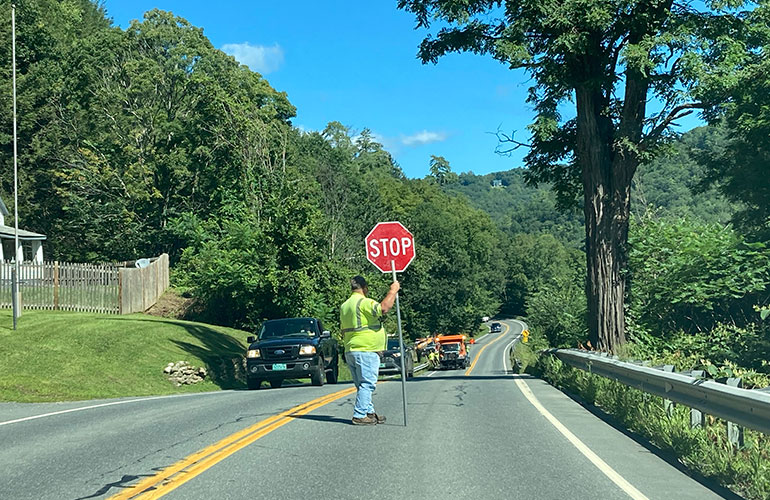
Photo: VTrans work on Route 30. Photo: Olga Peters
Central Vermont
- Repaving the Class 1 town highways in Montpelier. Contractor: Pike Industries. Target completion: fall 2023. Estimated cost: $5 million.
“With some of the damage that the city of Montpelier received with the flooding, you know the repaving of the streets is certainly welcome at this point,” Reed said.
Northwest
- Highway paving in Burlington.
- Reopen the state’s lone drawbridge that connects Grand Isle and North Hero. (Work is complete.)
- Replace the superstructure deck of Mother’s Bridge and reopen traffic to two lanes. Contractor: Kubricky Construction Corp. Target completion: fall 2023. Estimated cost: $15.6 million.
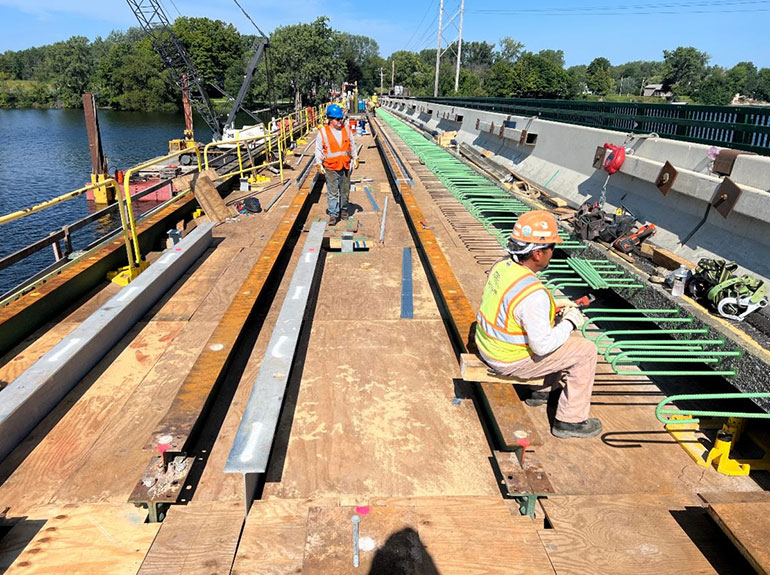
Photo: Alburgh passage bridge project. Courtesy photo.
Northeast
- Complete the paving of more than 40 miles of Interstate 91 from Lyndon to Barton. Contractor: Pike Industries. Target completion: fall 2023. Estimated cost: $18.5 million.
- Pave 7.5 miles of VT- Route 105, starting in Island Pond. Contractor: J. Hutchins. Target completion: fall 2023. Estimated cost: $2.3 million.
The agency is also conducting railroad work in the western corridor in partnership with Amtrak. Reed said that the agency undertakes multiple rail projects in a given year, such as rehabilitating bridges to achieve weight capacity, culvert replacements, platform projects or general upgrades to the rail line.
A little trivia: Operating rail lines falls under the jurisdiction of the Federal Rail Administration. The actual ownership of various lines can vary between public and private, including some owned by the state of Vermont.
Reed said the agency has experienced few supply-chain issues.
“I think what we’re seeing now is less supply chain interruption and more price escalation associated with normal inflationary pressures,” he said.
Inflation can pose issues for agencies like VTrans, whose projects go through a competitive bidding process. Reed said contractors are expected to hold to their agreed prices for a contract’s duration. The agency does include price escalation clauses in its contracts for things like fuel and asphalt, which are indexed to the commodity market.
“That’s really a risk-sharing effort,” Reed said. “If we didn’t have that, contractors would have to assume all that risk, and we would probably see higher bid prices. That being said, if the price goes down, we see that benefit as well.”
The agency also has stockpile provisions to help mitigate price fluctuations. For example, if a contractor has a two-year project and wants to purchase all the structural steel for the project at once, the agency will pay for the steel in year one.
One of the bright spots this year is the influx of federal funding through the Infrastructure Investment and Jobs Act. Reed said the agency saw a 28% increase in funding, thanks to the federal monies.
It’s funding the agency is grateful to have. However, communities will probably not see a 28% increase in the number of projects.
“Unfortunately, some of that (funding) has been offset just through pressures in the labor market and some of the inflation with materials,” Reed said.
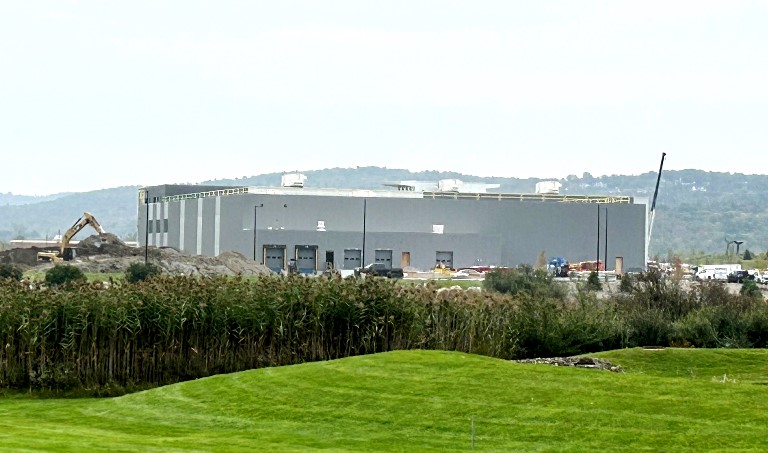
The massive OnLogic headquarters at Technology Park in South Burlington is nearing completion along I-89 near the Whale Tails. VermontBiz photo.
Major building projects include the impressive OnLogic headquarters in South Burlington, near the whale tails and across I-89 from their current offices.
ReArch Company, Wiemann Lamphere Architects, and VHB are leading the $60 million, 140,000-square-foot project, which broke ground in 2022 and is expected to be occupied by the end of this year.
Construction is also progressing on City Place Burlington after the center section of the down mall was demolished and left vacant from 2018 to when ground was broken on the first phase of the new centerpiece, also in 2022. The initial housing piece is expected to be completed next year. Over 400 units are planned, as well as parking and ground-level retail.
Farrington Construction, Omega Electric Construction and S.D. Ireland are all invested in the CityPlace development.
Meanwhile DEW Construction has major projects in Vermont, New Hampshire and Maine.
In Vermont they include: Cambrian Rise – Building M, in Burlington. This is a new, 252,000 GSF multifamily housing development. The project includes two levels of underground parking, and six levels of housing above, totaling 117 units. Levels 1-4 consist of apartments for rent, while levels 5-6 are for sale condo-style units.
Riverwalk Apartments, White River Junction, with new construction of 42 units of affordable residential housing, 50,890 GSF. Four stories of wood-framed affordable housing above a sub-grade parking garage—apartments range from studios to two-bedroom units.
Retreat Farm – North Barn Project in Brattleboro, which is a 7,541 GSF historic renovation to an existing barn to transform it from an agricultural barn to an event space for 250+ occupants.
Williston Public Safety Facility in Williston. This is the new, 34,000 GSF field station for the Vermont State Police that is scene from I-89. The project includes an 11,022 SF climate-controlled garage.
Inflation, Supply Chain, Workforce
Supply-chain and workforce issues continue to ripple through construction projects across the state. Over the last eight months, for example, Kingsbury Companies submitted the lowest bid on five competitive-bid projects. However, the company wasn’t awarded any of the projects because even its lowest bids came in 30% to 50% above budget, explained the company's president, TJ Kingsbury.
Based in Middlesex, Kingsbury Companies provides heavy civil contractor services throughout New England and New York, including site development, septic systems and large-scale commercial dam reconstruction.
Despite the large amounts of federal COVID recovery and infrastructure monies coming into communities, they’re not necessarily turning into projects at the rate people has expected.
“We’re thinking we’re going to get a wastewater treatment plant for a million dollars, that in today’s dollars is $1.5 million,” Kingsbury said. “Right now, it’s been overly burdensome with the unrealistic budgeting from engineers and owners.”
The company has suffered supply-chain issues for the last 18 months, he added.
“We’ve got projects that were supposed to be completed over a year ago that are still waiting on primarily electronic parts,” he said.
Acquiring some materials such as windows and doors has become easier. Others, such as dump trucks, are still a challenge. But inflation, Kingsbury said, remains his biggest obstacle.
“We go to the grocery store, and we’re like, ‘Oh, well, groceries are more expensive,’” Kingsbury said. “But you get into construction projects, and you’re talking 30% to 50% increases in some areas.”
Kingsbury believes labor, more than supply-chain issues, has contributed to the rising cost of doing business.
“The double whammy is we’ve seen an 8% to 12% increase in rate of pay, but then you’ve got a decrease in productivity,” Kingsbury said.
Many of the workers entering the trades are new to the industry. While they might be hard workers, they lack the long-term experience of a 20-year industry veteran.
In an effort to attract new workers and ensure they have the right skills, Kingsbury Companies is investing in an internal training program. (See “Building the Next Generation of Trades Professionals” on Page 26.)
Gregory Tatro, human resources manager at G.W. Tatro Construction, which provides specializes in road construction, wastewater facilities, snowmaking systems and penstock for hydroelectric dams, said he feels his company has had more luck than most hiring new workers. Even so, he said the company has to deal with a lack of experience many of these employees bring to the job.
According to the National Association of Home Builders, the average age of a construction worker in Vermont is 47, which is considered high for the industry. The organization also found that construction workers in the state tend to be older than workers in comparable professions, by about four years.
“You have all this bunching happening at (the upper) end of the life span and a giant expanse of people 18 to 55, where there’s just not that many,” Tatro said.
G.W. Tatro has tried to recruit high school graduates into the construction trades, but has found these students are overhwelmingly being funneled into higher education or other trades, such as plumbing.
To make headway, Tatro said, construction companies, with their reputation as hard places to work and desire for highly skilled workers, need to become better at supporting new employees.
“This isn’t a TV dinner, where you unwrap it, put it into microwave and it’s good to go,” he said. “You’ve got to add some ingredients and take some time and really make sure this all comes together so that you can have something later.”with materials,” Reed said.
W.W. Building Supply caters to DIYers and professionals from its stores on Route 100 in Wilmington and on Route 30 in Newfane. Along with hardware supplies, the company operates a lumber yard, a bathroom and kitchen design center, and a window and door installation business. The company delivers to nearby towns Whitingham, Londonderry, Townshend and Jamaica and to ski areas such as Mount Snow and Stratton.
Owner Ed Druke, who purchased the business 30 years ago, said the cost of materials and meeting energy codes make life difficult for homeowners and professionals trying to build affordable and medium-priced houses.
“It’s a huge challenge working with customers to try to help them out as much as you can, but you need to steer them in the right direction for making sure their homes are being built correctly,” Druke said.
In light of this, Druke was surprised to discover the large number of building projects underway in Windham County. The strong real estate market is good business for Druke as year-round residents and vacation homeowners alike invest in making home improvements.
“With the 30-some-odd years that I’ve been here in Newfane, I’ve never seen so many permits go out for that many projects,” he said.
Druke, like many of his fellow business owners, has struggled at time to find qualified workers. When he took over the business, employees often remained in their job for decades. Now, younger members of the workforce seem to jump from one job to the next.
Working in the building-supply industry requires a vast database of knowledge, Druke said. Knowing when to use a silicone caulk over butyl rubber, for example, takes expertise and experience, he said.
“You’re asking our employees to answer questions about how to build things,” he said. “It takes years to learn that stuff — and it changes so fast.”
Druke is a member of the Vermont Retail Lumber Association, an organization that encourages Vermont career centers to get people interested in the construction industry. This year, the organization sponsored a career day for high school students to visit Vermont Technical College.
Building supply companies these days are also dealing with a new issue: finding truck drivers in an age of marijuna legalization. It turns out a significant portion of the population that may want to drive a truck isn't all that thrilled by the random drug testing required to obtain and maintain a license.
“As a young person being brought up in this day and time, you have legalized marijuana and you have a job that you can’t use that with,” Druke said. “Then why would you want to go into that job?”
This summer, Druke braced for flooding in the Wilmington and Newfane stores. Luckily, in Wilmington, the North branch of the Deerfield River stopped short of flooding Route 100.
Flood waters ran through the Newfane location’s lumber yard. Thanks to the company’s flood mitigation measures, the flood waters passed without damaging the building or supplies, said Druke.
Since Tropical Storm Irene in 2011, the Newfane location has been flooded three or four times. A July storm two years ago was worse than Irene, he said.
Druke said the state has worked with the company to obtain permits that allowe it to remove sediment from the nearby West River and install other flood-mitigation measures.
WW Building must foot the flood-mitigation bill, but it is money well spent, according to Druke.
“When you see units of plywood floating out in the middle of the yard, it’s not a good feeling,” he said.
Loving the Work
“What I love about this work is meeting so many talented people with a range of different talents,” said Jeanne Morrissey, owner of the Williston-based general contractor firm J.A. Morrissey. “When you see the work of a craftsperson, it’s like art. And they have to do that inside of legal, contractual, high-stakes relationships.”
Businesses has been brisk for Morrissey the last two years, she said.
“Everybody here worked very, very, hard last year, and they’re working very, very hard this year,” said Morrissey, who founded the company in 1993.
Morrissey said construction is a “high-requirement industry.” Along with knowing their job, employees must understand building regulations, choose appropriate materials, follow legal contracts and meet client needs.
“It’s not easy to be out in the field,” she said. “It’s not an easy job in the office managing all the challenges, either. So I give everybody a lot of credit for how hard-working they are.”
Morrissey said her company’s workforce is small but stable. She explained that some construction companies staff up or downsize to match projects. She tries to keep staffing numbers stable by choosing projects approrpriately sized to the company’s capacity.
Still, Morrissey noted that Vermont’s trades workers are retiring at a faster rate than new workers are entering the field.
In her experience, engaging and educating young workers is an industry-wide challenge.
“Like everybody else, we’re making the best of the moment we’re in and trying to find the best way to engage the younger people for a longer term.”
Learning a trade takes time, she said. It’s one thing to build math skills or learn how to read a blueprint. It’s much more difficult to accure industry-specific knowledge or understand building regulations.
This has led to some staff turnover, but Morrissey tries to make the best of it.
“I’m enjoying the young people that are here,” she said. “I’m hoping that they can continue to grow and have a relationship with the company that is its own reward in whatever way that can be created.”
Rising prices and material shortages must also be regularly addressed. Morrissey said it’s important to engage clients in conversation about how inflation and material availability will affect their budget and completion date.
Most clients embrace this concept, she said, “but you really don’t know until something arrives or until something is done, because everything is somewhat fragile inside the system that way.”
Pierre LeBlanc, chief executive officer of Engelberth Construction, said 2023 has been a very positive year.
“We’re pretty excited about the year that we’ve got coming together, We’ve had some good projects, so things are shaping up pretty well,” he said.
Last year, Engelberth celebrated its 50th anniversary. LeBlanc said the company is selective of its clients and is fortunate to work with many great customers. The company serves a number of colleges and hospitals in Vermont and New Hampshire.
With locations in Colchester and Concord, New Hampshire, Engelberth Construction employs approximately 150 people. And like J.A. Morrissey, Engelberth has a stable workforce. Many of the subcontractors the company works with, however, have experienced staffing shortages.
The impacts of inflation vary by project, he said. Pricing is one of the reasons it took two years for an affordable housing project Engelberth is working on to receive a green light.
“Some of the budgets that were done a few years ago are pretty aggressive,” LeBlanc said. “It’s a little bit harder to hit those budgets nowadays.”
Pricing challenges aside, he feels construction is a good business.
“I think in a lot of senses, people look at construction as a lower-tier type job, and it’s really not,” he said.
Happy 50th Anniversary
A round of applause for Fred’s Energy! The heating and plumbing company is celebrating its 50th anniversary. Founded in 1973 by Fred Oeschger as a plumbing business with two trucks in the town of Derby., Fred’s has expanded into a full-service company with a fleet of vehicles and over 80 experienced staff members with additional locations in Richard, Morrisville and Lyndonville.
“Our employees go above and beyond for our customers, which has contributed to our long-time success,” General Manager Dennis Percy said. “Simple things such as covering our shoes to protect homes, to educating customers on what was done — and even getting permits for customers when needed — show how much we appreciate and respect our customers. We also share information with homeowners as to how they can save time and money, which everyone appreciates.”
During COVID, work temporarily stopped for a time. With the flood of 2023, the work never fully stopped. On top of planned work, communities need to rebuild so businesses can reopen, people have healthy places to live and roads are safe for travel.
Wobby himself is still looking for trades professionals to repair the damage done in Montpelier.
“I’m looking for some sheet rockers and some painters, because my office was 2 feet underwater,” Wobby said.
“When the head of the biggest construction association in Vermont says they’re looking for somebody to help them, you know we have a problem,” he said.
Olga Peters is a freelance writer from Southern Vermont.