

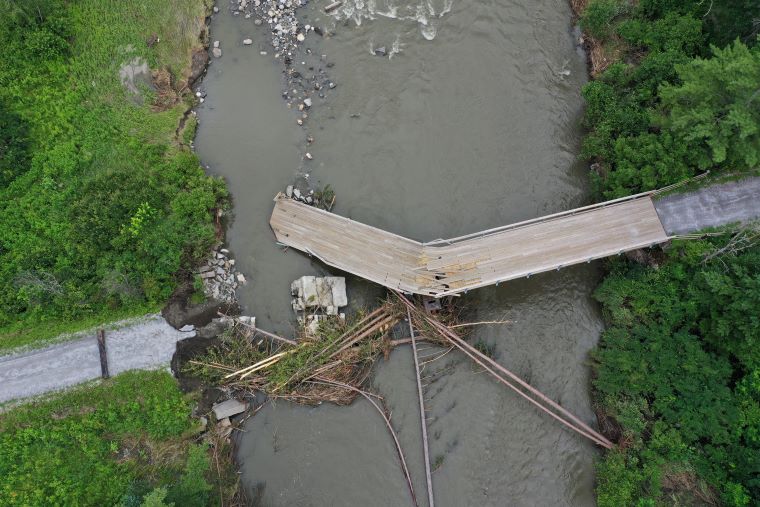
A large washout at the just-completed Lamoille Valley Rail Trail in Hardwick from the #Flood23. Vtrans photo.
Rebuilding from the flooding of 2023 may be a longer road than most communities anticipate
by Olga Peters, Vermont Business Magazine More than six weeks after historic rainstorms pelted Vermont and other areas of the Northeast, state officials were still dealing with the damage to state roadways and transportation infrastructure.
Michael Booth, district transportation administrator at the Agency of Transportation, said calculating the miles of damaged roads is difficult to determine.
“We had a total of 1,130 damage sites, including our railroad infrastructure,” Booth said in an email. “We have repaired 784 of those sites and are continuing to make significant gains each day. We have replaced 51 culverts and cleaned debris/silt from another 350.”
Booth said the recovery effort is moving as quickly as possible. VTrans employees and industry partners have worked “tirelessly” since the flooding to repair the state’s infrastructure.
“We are performing a lot of bank stabilization work and scour repair around bridges and culverts,” he said.
“Since Irene, we factor resiliency into our infrastructure projects," Booth added. “We typically upsize our infrastructure to accommodate larger events. We have learned from this summer’s flooding that factoring resiliency into projects helps reduce the severity of the storms’ impact.”
VTrans hydraulics engineer Patrick Ross described each flood as having a unique “fingerprint.” Each flood teaches the state something new. That said, Ross noted that the resiliency work VTrans invested in since Tropical Storm Irene has paid off.
“We are working with our partners across the state and specifically with the ANR (Agency of Natural Resources) Rivers Program,” Ross said in an email. “VTrans is coordinating efforts and informing ANR about immediate issues and working through problems in real time.
“When VTrans is making emergency decisions to work in extreme conditions to protect infrastructure and safeguard the traveling public,” he added, “we are following up and assessing emergency construction actions.”
This means the agency investigates the river and stream work performed at each flood site to determine if it was adequate or whether the agency should return to make additional repairs once the water recedes.
“Our education, coordination and teamwork is paying dividends everywhere,” Ross said. “We do not see the same level of roadway infrastructure damage to bridges, culverts and roadway embankments, in part because we went back and addressed substandard flood recovery sites after Irene and in part due to our continued efforts to build more resilient infrastructure.”
Creating more resilient infrastructure includes making adjustments to a waterway so it has more room to move, said Ross.
Providing brooks and rivers with room to spread has made a big difference in how a waterway floods in the future. When a river is able to spread out into a floodplain, it reduces the water’s energy, speed and force. This in turn can reduce flood damage.
“We replaced many structures with wider bankfull width culverts and bridges,” Ross said. “We repaired embankments with more appropriate material, and we tried where possible to give the water more room to spread out, thereby reducing the energy to damage Vermont’s infrastructure.”
Ross continued, “Additionally, VTrans has done a tremendous amount of work educating our staff across the agency about the importance of building back better, respecting the power of water and working more in balance with the rivers and streams.”
Richard Wobby Jr., executive vice president and director of safety training and member services for the Associated General Contractors of Vermont, said that most of the flood repairs completed by the state and municipalities are only temporary. The permanent bridges, roads, houses are still to come.
AGC/VT’s members had enough supplies to make post-flood emergency repairs, Wobby said. He anticipates building supplies such as furnaces, heating systems and ventilator systems will be in short supply once people begin rebuilding their flood-damaged homes.
The residential side of flood recovery is “a little behind the 8-ball,” he said.
Why?
In Wobby’s opinion, part of the reason is because the state requires contractors to be licensed or registered with the Secretary of State’s office. Residential contractors must also follow a series of rules and declare any work over $10,000. These regulations, instituted approximately two years ago, are limiting the pool of available contractors for emergency residential work, he said.
Wobby noted that Gov. Phil Scott made a series of emergency orders this summer with the intent of loosening requirements and quickly returning displaced renters and homeowners to safe housing.
Still, the state needs a long-term plan, Wobby said. The state’s flood recovery and state housing crisis will outlast the governor’s emergency orders.
One big question mark hangs over flood recovery. How will rehousing residents displaced by the floods add to Vermont’s housing crisis?
At an Aug. 15 hearing, the State Senate Committee on Economic Development, Housing and General Affairs took testimony from municipal and state officials as well as housing organizations.
As of that hearing, 3,800 homeowners and 950 renters had registered with the Federal Emergency Management Agency. Approximately 1,000 people were receiving financial assistance to cover rent, repairs or a hotel room.
State Housing Commissioner Josh Hanford cautioned committee members that the FEMA numbers might not reflect the true number of people needing help.
When it comes to housing, Vermont is still in crisis, said Sandrine Kibuey, director of statewide housing advocacy at the Champlain Valley Office of Economic Opportunity.
CVOEO is one of five community action organizations in Vermont. The organization runs four housing programs: the Vermont Tenants Program, the Mobile Home Program, the Fair Housing Project and the HOME Family Housing Voucher Program.
Kibuey said there is an ongoing housing crisis in Vermont: people on the streets, people in motels, people needing affordable housing and not enough housing stock.
Concerning Vermont’s 2023 floods, Kibuey is focused on mobile home parks.
Mobile homes are one of the most affordable forms of housing for low-income Vermonters. Mobile home parks, however, are often located in vulnerable areas such as floodplains.
In July, a significant number of mobile homes were damaged, she said.
Because of where many mobile homes are located, simply repairing or replacing damaged homes will still leave people in vulnerable locations, she said.
Not only that, mobile homes and their residents are not protected under the law to the same extent as renters or stick-built homeowners, she said.
For example, while a mobile homeowner might own their home, they rent the land it sits on. When the home is destroyed, the owner is still expected to pay lot rent.
As part of overseeing the Mobile Home Program, CVOEO staff like Kibuey are advocating for expanding mobile home parks using land that is out of the floodplain, changing park ownership to co-operatives, and changing laws so mobile homeowners are fully protected.
“As human beings, we are great with crisis management,” Kibuey said. “But we look at prevention with a far-view lens because we are so focused on short-term solutions.”
In many ways, planning never fully reaches the recovery phase, especially financial recovery from a crisis. For example, a FEMA buyout rarely covers the full cost of relocating and buying a new home.
As a state, we might provide emergency funding for food, water or temporary shelter, Kibuey pointed out. Often that funding only lasts as long as an emergency declaration.
Fewer supports are in place 12 months after the crisis. Yet, a rebuilding project could take many months to a year. It might take renters months to find a new apartment but will that rent be affordable?
Most mobile home park residents tend to be low-income and living on Social Security payments, she said.
“When it comes to recovery, what does it mean to them? Some will never be able to actually recover financially,” said Kibuey
Since most of the recovery funds provided after a disaster are not adequate to support low-income residents, what will become of those community members, she asked.
They will likely end up worse off than they were before the crisis “unless there is a very, very focused look at what the needs really are, and what it means to people’s recovery,” she said. “This is something that we don’t do, we rarely stop, breathe and move forward with something very strategic.”
Olga Peters is a freelance writer from southern Vermont.