ISO-NE’s 2050 Transmission Study outlines potential costs, solutions to support reliability throughout the clean energy transition
Vermont Business Magazine Limiting demand on the bulk power system to a winter peak of 51 gigawatts (GW) in 2050 would significantly reduce the amount New England must spend on transmission upgrades over the next two-plus decades, according to a draft report released Wednesday by ISO New England.
The report summarizes findings from the ISO’s landmark 2050 Transmission Study. The results, driven by assumptions about the region’s future resource mix and demand for electricity provided by the New England states via the Massachusetts 2050 Decarbonization Roadmap study, offer an overview of the regional transmission system investment needed into the middle of the century to ensure reliability throughout the clean energy transition.
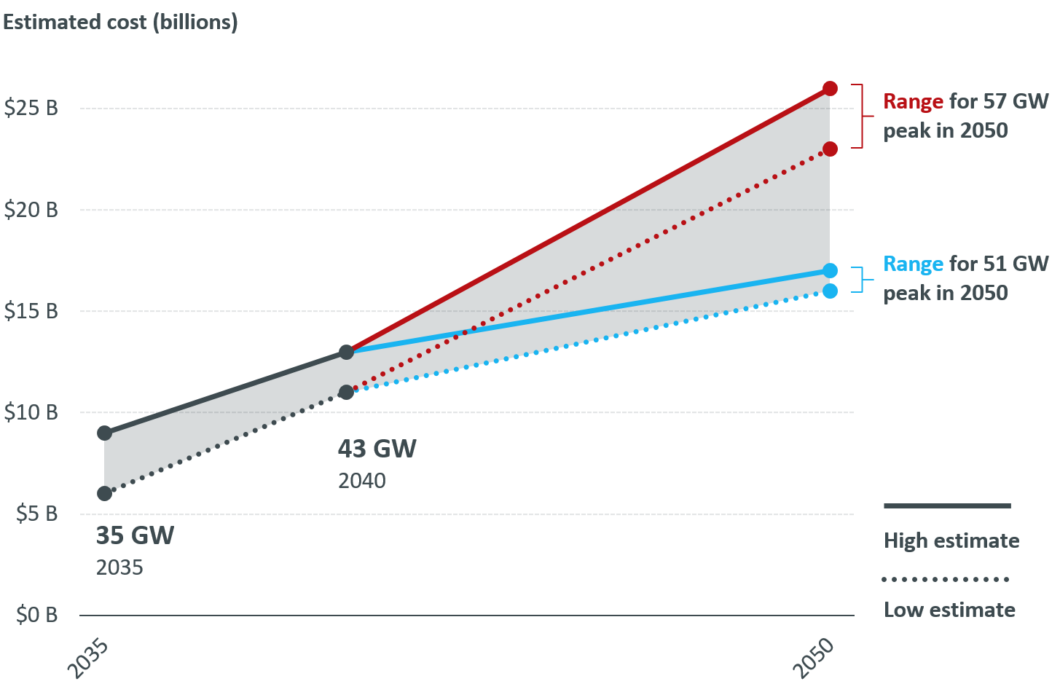
Cumulative costs to upgrade the transmission system could reach $17 billion to reliably serve a 51 GW peak in 2050, or $26 billion to support a 57 GW peak, the ISO’s report said. To reach those levels, the region’s annual investment over the next 26 years would need to roughly keep pace with or exceed the average spent each year over the past two decades.
The upgrades are needed to avoid overloading transmission lines and transformers as residents increasingly rely on electricity to heat buildings and power vehicles, and as offshore wind facilities and other renewable resources located far from homes and businesses produce a greater share of the region’s power. The study did not examine potential costs to upgrade the distribution system.
The study—the first the ISO has undertaken that examines the region’s transmission system in detail beyond the traditional 10-year planning horizon—is intended to inform stakeholders of the amount and type of transmission infrastructure necessary to ensure a reliable supply of cost-effective electricity for New England. The report includes sets of potential solutions, or roadmaps, designed to assist stakeholders in their efforts to facilitate the clean energy transition.
The ISO began working with the New England States Committee on Electricity (NESCOE) two years ago to develop the study’s objectives and methodology. The result is a pioneering assessment of how changes to the power grid due to state policies regarding electrification and decarbonization will affect transmission.
“The 2050 Transmission Study is an unprecedented look at the future of New England’s transmission system, and its findings will help stakeholders and the ISO make important decisions about improvements and pathways forward,” said Robert Ethier, ISO New England’s vice president of System Planning. “The ISO will continue to provide such forward-looking analyses in its role as the region’s Independent System Operator, and we will continue to collaborate with stakeholders working to ensure a smooth, reliable transition to an economy primarily powered by clean energy.”
Key takeaways
The report offers several high-level observations about the transmission-related challenges the grid may face in the decades ahead.
- Reducing peak load significantly reduces transmission cost. Upgrades would cost about $750 million to support each additional gigawatt of demand on the system for peaks between 28 GW and 51 GW. But much more investment is required for peaks that are any higher. After 51 GW, the cost doubles to $1.5 billion for every additional gigawatt of demand on the system, up to the 57 GW winter peak projected for full electrification of the heating and transportation sectors. The region could arrive at a 6 GW reduction through a significant increase in demand response and energy efficiency programs, through the use of stored fuels for heating on extremely cold days only, or other means discussed in the report.
- Targeting and prioritizing high-likelihood concerns is highly effective. The study identified “high-likelihood” transmission system concerns that could appear under a variety of conditions. Projects that address high-likelihood concerns are likely to bring the greatest benefit for the widest range of conditions as the clean energy transition accelerates.
- The region can make incremental upgrades as opportunities arise. The study also identified concerns that could be addressed by rebuilding existing transmission lines with larger conductors, rather than expanding the transmission system into new locations. Limiting new line construction by taking advantage of line rebuilds could minimize costs, especially in densely populated areas in southern New England.
- Generator locations matter. Exactly where new generators are built can have a significant impact on the transmission upgrades required for reliability. Locating power producers and connections to offshore wind closer to large population hubs will help reduce strain on the transmission system.
- Transformer capacity is crucial. The system’s existing transformers were not designed to handle the vast increases in demand associated with an electrified economy. Lead times for new transformers are often one to two years, so adding a large number in a short period of time could be difficult and costly. Nonetheless, adding transformers throughout the system could likely relieve overloads and support reliability.
- The All Options Pathway data showed that the three northern New England states (Maine, New Hampshire, and Vermont) tended not to peak at the same time as the region as a whole. To ensure that the worst-case conditions for the northern states were captured, a second summer evening peak snapshot was created, reflecting the hour in which load served from the transmission system was highest in the three northern states.
- The resulting loads in each snapshot were significantly higher than any loads seen to-date in New England, and rose significantly from 2035 to 2040 and from 2040 to 2050. The highest load modeled was the 2050 winter evening peak snapshot, at approximately 57 gigawatts (GW).
High-Likelihood Concerns: Northwestern Vermont Import
The 2050 Transmission Study found that importing power into northwestern Vermont is a high-likelihood concern, specifically with regard to the area around Burlington. The study’s observed overloads stemmed from the significant amount of forecasted load in the general area without a corresponding amount of local generation, combined with the lack of significant 345 kV transmission lines transferring power into the area.
These overloads were observed exclusively in the winter, when load is expected to be highest, as heating in the region becomes significantly more electrified. Overloads were observed primarily on 115 kV lines around the Burlington area, along with a 115 kV inter-area tie line between Plattsburgh, New York and the Sandbar substation in Milton, Vermont.
While the overloads did not appear in both summer and winter, many of them did appear in 2035, 2040, and 2050, indicating a high probability that they will occur even if load in 2050 is lower than assumed. These overloads were not heavily dependent on generation location, as there is no significant generation located in northwestern Vermont. Some new solar was assumed; however, since the overloads occurred after sunset during the winter peak, solar units were unable to provide power.
This region is also not ideal for connecting with larger generators or with significant imports like the HVDC connection with Canada assumed in southern Vermont, because northwestern Vermont does not have a strong connection to the 345 kV transmission system.
While more generation could help mitigate some of the concerns in the region, it would not be well-connected to other subregions and thus not particularly useful for exporting to those subregions when load is low in Vermont. With few transmission paths in this part of the state, any new, large generation or HVDC import into the area could require significant transmission upgrades.
The high-likelihood concerns observed in northwestern Vermont are dependent on the overall load growth in the area; however, they are not highly dependent on where that load growth is located station-by-station. As long as the load growth occurs somewhere in the general region, many of these overloads are expected to persist.
Four roadmaps were developed for solving the high-likelihood concerns observed in northwestern Vermont around the city of Burlington (See Draft Report page 33). These roadmaps were developed to provide the region’s stakeholders with a variety of examples of how these concerns might be mitigated.
As with the previous roadmaps, the ISO does not recommend any particular roadmap over another; each includes advantages and disadvantages. Collaboration between stakeholders and the region as a whole will help determine the best path forward.
The report released by ISO New England does not include a proposal by National Grid for a new, 1.2 gigawatt transmission line from Quebec through Vermont and New Hampshire called the Twin States Clean Energy Link. Supported by the US Department of Energy, that proposal was announced October 30, 2023.
The ISO report does discuss several other new transmission options for New England, including others in Vermont, New Hampshire and Maine, as well as that from new offshore wind generation.
Costs in context
The study presents estimated costs to strengthen the transmission system against thermal overloads over the next 26 years. The upgrades are not all needed today, and any construction would occur on a scale of decades—so these estimates should be viewed in the context of how much the region has historically spent on transmission system upgrades each year. The table below shows how the annual averages for the study’s estimates compare to investment so far this century to ensure reliability and replace aging equipment.
| Timeframe | Average Cost |
| 2002–2023 | $0.73 billion per year |
| 2024–2050 (51 GW peak) | $0.62 billion to $0.65 billion per year |
| 2024–2050 (57 GW peak) | $0.88 billion to $1.00 billion per year |
Many of the potential line rebuilds the study identified will also overlap with needs to repair or replace older equipment, known as asset condition projects, which means that some single projects can address these needs as well as system expansion.
The study estimates do not include adjustments for inflation, and they do not include costs for reliability projects needed to address voltage, stability, short-circuit, and other concerns outside of thermal overloads.
Total costs by year studied
Roadmaps
One of the study’s objectives involved developing sets of potential solutions for regions within New England that saw groupings of high-likelihood transmission concerns. These roadmaps—which address challenges in delivering electricity to densely populated areas in Greater Boston and northeastern Massachusetts, and to northwestern Vermont—are high-level plans that identify transmission upgrades needed to support future demand and satisfy reliability criteria.
While the roadmaps consider both the feasibility of construction and cost, they are not comprehensive or detailed plans for specific projects. In some cases they include conceptual projects that could help address concerns such as an offshore grid to send power from wind facilities to population centers.
Each roadmap consists of several major components, paired with rebuilds of existing lines and other elements to form a complete solution for the relevant region. In addition to areas in Massachusetts and northern New England, the study examined potential solutions in southwestern Connecticut.
The report does not recommend one roadmap over another. The intent of including multiple roadmaps is to provide a basis of comparison for decision-making by New England stakeholders.
About the study
In October 2020, NESCOE released the New England States’ Vision for a Clean, Affordable, and Reliable 21st Century Regional Electric Grid. The statement recommended that the ISO work with stakeholders to conduct a comprehensive, long-term regional transmission study. In response, the ISO sought approval from the Federal Energy Regulatory Commission (FERC) to incorporate a new transmission planning process that looks beyond the current 10-year planning horizon. This led to the 2050 Transmission Study, which is the first example of its kind within New England.
The ISO has coordinated with NESCOE throughout the project, introducing a scope of work, preliminary assumptions, and methodology in November 2021. The ISO presented results showing reliability concerns throughout spring and early summer 2022. Updates on proposed solutions followed in December 2022 and April 2023, and the ISO presented initial key takeaways and roadmap outlines in July 2023. The final report is expected in early 2024.
The ISO worked with NESCOE to develop key study assumptions based on the “All Options Pathway” described in Massachusetts 2050 Decarbonization Roadmap report, published in December 2020. The All Options Pathway provided two types of data input for the 2050 Transmission Study: New England’s expected hourly loads for all hours in a year for 2035, 2040, and 2050, and renewable and conventional energy capacity for the same years.
Next steps
The longer-term transmission study process is currently informational, and it does not include a formal mechanism for triggering the construction of new transmission projects.
The ISO began stakeholder discussions on the second phase of the new study process in October 2023. This phase is designed to create a process for the ISO and NESCOE to choose transmission system concerns to address, solicit transmission project proposals, and advance those proposals towards construction and operation. Stakeholder discussions on this second phase will continue throughout late 2023 and the first half of 2024. Depending on the timing of these changes to the ISO’s tariff, the results of the 2050 Transmission Study or other future longer-term transmission studies may inform this solution development process.
Source: ISO New England. 11.2.2023. Holyoke, MA.