

Bill is One Step Closer to Permanency
Vermont Business Magazine Vermont’s Universal School Meals bill has reached another essential milestone toward being enacted, with the Senate giving preliminary approval to the bill with a voice vote Friday.
If enacted, H.165 will continue access for more than 80,000 students to school breakfast and lunch, at no charge to their families.
According to the Vermont Agency of Education, an average of 38 percent of students across all supervisory unions during the 2019–2020 school 12 year qualified for free or reduced-price lunch.
The bill now returns to the House for final approval before heading to the desk of Governor Phil Scott.
Lawmakers shared support for the bill from the Senate floor Friday:
-
“I visited the local high school in my district,” Sen. Nader Hashim, a Democrat from Windham County, said. “I heard from kids who said their grades went up, their moods were more positive, and they were overall just doing better.”
-
“With this particular bill, all I’ve received is very positive phone calls and messages. It’s like, ‘Golly, we finally did something really right’,” Sen. Bobby Starr, a Democrat from Orleans/Essex County said.
-
Sen. Brian Campion, a Democrat from Bennington County, said “I think (Universal School Meals) is the best COVID recovery step this state has taken.”
-
Sen. Ruth Hardy, a Democrat from Addison County, said, “As a mom with kids still in school and a substitute teacher in schools, kids cannot learn if they have not eaten breakfast and lunch. This is just as important to kids' education as books and technologies and desks.”
“We’re so close to ending student hunger at school in Vermont forever,” Anore Horton, executive director of Hunger Free Vermont, the nonprofit leading the Universal School Meals charge, said after Friday’s vote. “Now it’s time to get permanent universal school meals over the finish line.”
School meals have been available to all Vermont students at no cost since March 2020, first through a federally funded COVID-19 waiver program that provided free breakfast and lunch for all students nationwide.
When federal programming ended, Vermont enacted its own yearlong program with the intent to make it permanent after collecting more data. If enacted, Vermont would be the sixth state to pass a Universal School Meals program, joining California, Maine, Colorado, Minnesota and New Mexico.
Joint Fiscal Office
Date: March 14, 2023
H.165 – An act relating to school food programs and universal school meals
As recommended by the House Committee on
Agriculture, Food Resiliency, and Forestry1
1https://legislature.vermont.gov/Documents/2024/WorkGroups/House%20Agricu...
Bill Summary
This bill creates ongoing State funding of school meals (breakfast and lunch) to all publicly funded students at no charge to students or families. Schools will be reimbursed for the provision of meals through funds from the Education Fund that will be appropriated as categorical aid. The current draft of the bill does not appropriate any funds for the program in Fiscal Year 2024.
Fiscal Impact
JFO estimates this bill will cost $29 million from the Education Fund in fiscal year 2024. Absent any other changes in policy, the base homestead yield and/or base non-homestead tax rate will need to be adjusted to account for the anticipated cost of this program.
As currently drafted, the bill does not include an appropriation for the provision of the universal school meals supplement (the reimbursement amount paid to school districts by the State) for fiscal year 2024. Without an appropriation, the Agency of Education would not have the spending authority to execute the program.
Background and Details
The following sections have a fiscal impact.
Section 2
Section 2 mandates that each public school provide daily breakfast and lunch to attending students at no cost to the students or their families. Section 2 also requires approved independent schools to provide daily breakfast and lunch at no cost to each student attending on public tuition if the independent chooses to participate in the universal meals program to drawdown the state funds.
JFO estimates the annual cost for the provision of universal school meals to all publicly funded students to be between $26 million and $33 million per year.
The actual cost heavily depends on four factors:
1. the percentage of students eligible for free and reduced lunch through the federal free and reduced school meal programs,
2. the average participation rate of students eating meals,
3. the difference between federal school reimbursement rates and
4. the number of eligible entities to receive the universal meals supplement.
The following are a few examples of how changes in these four factors would impact the cost of the program:
• A lower percentage of federal government program-eligible students would increase costs for the State because fewer federal dollars would be available.
• A higher participation rate of students eating meals would increase costs for the State.
• A larger difference between the federal reimbursement rate for meals and the local per meal cost would result in higher costs to the State.
• A higher number of eligible entities to receive the universal meals supplement would result in higher costs to the State.
For Fiscal Year 2024, JFO estimates the provision of universal breakfast and lunch to cost approximately $29 million. This estimate assumes 38% of students eligible for free and reduced-price meals programs and assumes participation rates of 45% for breakfast and 65% for lunch.
Section 3
Section 3 establishes the universal school meals supplement as an ongoing expenditure from the Education Fund in the form of categorical aid. Absent any other changes in policy, the base homestead yield and/or base non-homestead tax rate will need to be adjusted to account for the anticipated cost of this program.
Without adjusting any non-property tax revenue streams, establishing a universal school meals program as an ongoing obligation of the Education Fund would require increasing property taxes to fund the program and keep the Education Fund balanced. All else equal, funding universal school meals through property taxes would result in an approximate $0.03 increase on both the homestead and nonhomestead property tax rate.
Section 3 also outlines the eligible entities that would be available for the universal meals supplement. The more entities that are eligible for the universal school meals supplement, the higher the potential cost. Public school districts shall be eligible for the universal school meals supplement as long as the Agency of Education determines that the district “draws down the most possible federal funding for meals served in that program”. Nonprofit prequalified private prekindergarten providers that operate food programs shall also be eligible for the supplement if the provider operates a food program under a public-school school food authority. Approved independent schools that maximize access to federal funds for the cost of the school breakfast and lunch program shall also receive the reimbursement for students attending on public tuition.
Appendix:
The cost of the universal school meals program is dependent on several factors and assumptions. In its estimate the Joint Fiscal Office made assumptions regarding primary cost factors which include:
• The percentage of students eligible for the federal free and reduced school meals programs,
• the average participation rate of students eating meals, and
• the number of eligible entities that are eligible for the universal meals supplement influence the overall cost of the universal school meals program.
A lower percentage of students eligible for the federal programs leads to higher costs to the State. A higher participation rate also leads to higher costs to the State. A higher number of eligible entities also leads to higher costs to the State. The following table outlines the range of costs associated with different assumptions of these cost factors:
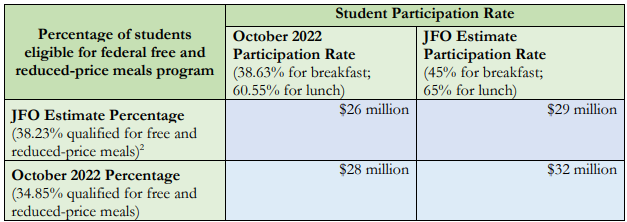
Note: The more students that qualify for free and reduced lunch, the more federal funding available to support the universal school meals program. The more students that eat school meals, the higher the cost of the universal school meals program. The modeling includes steady enrollment of nonprofit prequalified private prekindergarten providers that have been included in public school food authorities in recent years.
1) https://legislature.vermont.gov/Documents/2024/WorkGroups/House%20Agricu... 2023.pdf
2) JFO expects the percentage of students eligible for the federal free and reduced meals program to increase due to the Medicaid direct certification pilot in Vermont. JFO used the fall 2019 eligibility rate, which was higher than the fall 2022 eligibility rate at 38.23%
About Hunger Free Vermont: Hunger Free Vermont is a statewide nonprofit organization that works with state agencies and community groups to develop sustainable hunger solutions. Since 1993 Hunger Free Vermont’s outreach programs and advocacy have substantially enhanced Vermont’s nutrition safety net and increased access to nutritious foods.hungerfreevt.org
Source: MONTPELIER, Vermont (May 5, 2023) — Hunger Free Vermont. JFO, March 14, 2023.
