Large Percentage of Facilities Found to Have Substantial Noncompliance with Regulations, and Department Has Not Been Performing Annual Inspections Required By Law
To view the full report, with DAIL response, click HERE.
Vermont Business Magazine State Auditor Doug Hoffer released a new audit today examining the Department of Disabilities, Aging and Independent Living’s performance inspecting long-term care homes housing vulnerable older Vermonters. The audit found that across seven years DAIL, as the department is called, was not performing annual facility inspections as required by law and rarely used enforcement tools to address the problems they found.
 “Protecting the most vulnerable Vermonters is one of state government’s most sacred duties,” Hoffer said. “To put it plainly, DAIL’s efforts to ensure Vermonters living in assisted living and residential care facilities are safe have not been good enough. Inspections may have been interrupted during the height of COVID, but our review found systemic problems going back years before that.”
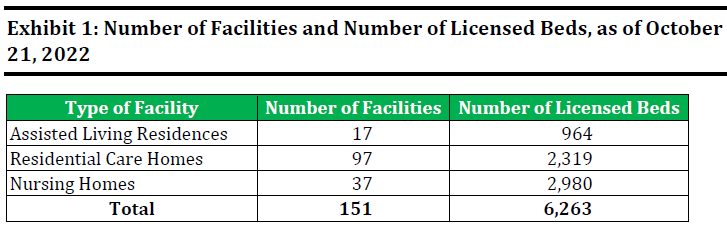
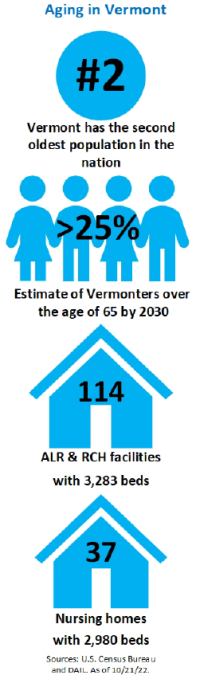
Vermont has three kinds of long-term care homes – nursing homes, assisted living residences (ALR), and residential care homes (RCH). Nursing homes are subject to federal oversight, while assisted living and residential care facilities are only subject to state regulation. The audit focused on the latter two types of facilities.
Hoffer added: “One of the most important things we learned in this audit is that DAIL responds much quicker and uses enforcement tools more frequently in nursing homes than when the exact same problems are found in assisted living and residential care facilities. This doesn’t make sense since Vermonters living in all three types of facilities are classified as vulnerable.”
Notable findings in the audit include:
- Of the 691 inspections DAIL conducted during the audit period, 53 percent detected substantial noncompliance, meaning the facility’s noncompliance risked residents’ wellbeing, or, in the most severe instances, the facility caused or was likely to cause serious injury, serious harm, impairment, or death.
- DAIL failed to inspect facilities as often as required by law; as a practice, they strove to inspect each facility every two years, but statute requires annual inspections. In fact, as of March 2, 2023, 11 facilities had not been inspected since 2018.
- When DAIL found problems that could cause injury or death, they revisited the facilities to verify that the problems were corrected, but it took them between 54 and 125 days to do so. For the next most severe deficiencies, DAIL did not follow up at all more than half the time and took between 35 and 148 days to go back when they did.
DAIL Often Identified Substantial Noncompliance and Did Not Conduct Inspections as Frequently as Required by Statute
DAIL identified substantial noncompliance in 53 percent of inspections of ALRs and RCHs. The two deficiencies that DAIL found most frequently were (1) the lack of a written or updated care plan for each resident and (2) the lack of documented annual training for staff. In addition, DAIL did not conduct licensure inspections annually, as statutorily required. As a result, no facility was inspected annually as required by law, and 15 facilities had not received any inspection since 2018. Finally, we found that DAIL did not finalize nine inspection reports.
Assisted Living Residences (ALR), Residential Care Homes (RCH)
DAIL Frequently Found Facilities Did Not Substantially Comply with Regulations
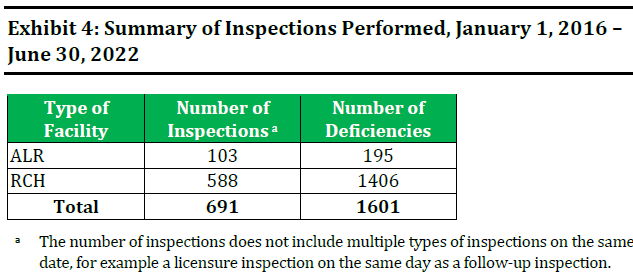
From January 1, 2016, through June 30, 2022, DAIL performed 691 inspections and identified 1,601 deficiencies, as shown in Exhibit 4. Of these inspections of all types, DAIL found 363 (53 percent) with substantial noncompliance (a D or higher in Exhibit 2). There may be additional deficiencies, but DAIL did not finalize all the inspection reports. DAIL found deficiencies ranging from complex issues, such as resident-on-resident physical abuse, to simple issues, such as failure to keep trash cans clean.
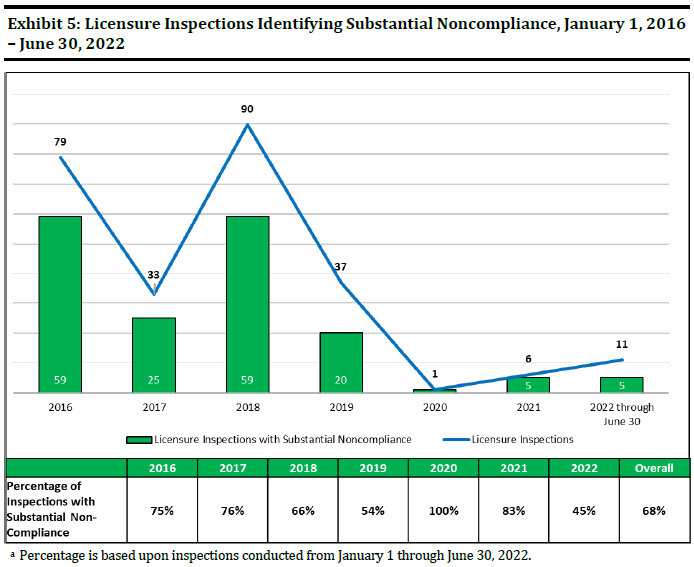
More than 68 percent of the time, DAIL identified deficiencies during the more thorough licensure inspections at the level where facilities did not substantially comply with regulations. Exhibit 5 below is a yearly comparison of the number of licensure inspections DAIL performed and the number of those inspections where DAIL identified facilities that did not substantially comply with regulations.
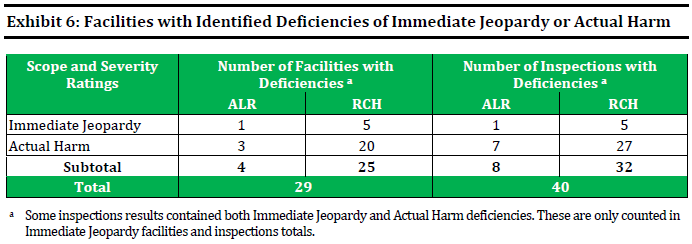
Between January 1, 2016, and June 30, 2022, DAIL inspectors found 29 facilities with deficiencies at the Actual Harm severity level or worse. Cumulatively, these facilities had 93 deficiencies at the Immediate Jeopardy and Actual Harm severity levels. Exhibit 6 is a summary of the number of inspections by facility type that had Immediate Jeopardy or Actual Harm deficiencies.
Examples of Immediate Jeopardy deficiencies that DAIL identified included:
- three instances where noncompliance with regulations contributed to resident deaths, and
- two facilities under the same ownership went nine months without a registered nurse.
Examples of Actual Harm deficiencies found included:
- the improper lifting or moving of residents leading to falls that resulted in injury or death,
- staff members abusing residents, and
- staff leaving a resident with a healing hip fracture on a couch overnight and not responding to cries for help.
Hoffer said: “I’ve had family members in long term care facilities, so I know how important this work is. Family members count on the state to make sure our peace of mind is not unfounded. Audits can make for dry reading -- to humanize it Vermonters should ask how they’d feel if it was their mother or father or grandparent in a facility that went years without inspection, or that repeatedly failed to meet safety requirements. I know Vermont can do better.”
DAIL Commissioner Monica White, as part of her detailed response (March 23, 2023), said: “We have been aware of and have acknowledged the need for increased regulator oversight of state licensed long-term care facilities. DAIL made a proposal to the Agency of Human Services in the spring of 2021, to acquire sufficient resources in that next budget cycle to enhance regulation oversight for state license long-term care facilities. The SFY23 Governor’s recommended budget, unveiled in January 2022, included a request for five new positions to create a state licensed regulatory unit within the Survey and Certification Unit of DAIL’s Division of Licensing and Protection to allow for increased oversight of state licensed long-term care facilities. The Legislature approved funding for these five additional positions in the SFY23 Big Bill (one Long Term Care Manager, three Nurse Surveyors, and on Administrative Assistant). DAIL has since created this new state licensed long-term care unit and has hired three Nurse Surveyors and one Long Term Care Manager to begin this work (the Administrative Assistant position will be filed shortly).
“I appreciate the work that your team did on this audit, although I respectfully suggest the title of this report could be interpreted as widespread failings, which is not the case (Department of Disabilities, Aging and Independent Living: DAIL Needs to Comply with Requirements for Timeliness of Inspections of Assisted Living Residences and Residential Care Homes, and Make Other Changes, to Ensure Vulnerable Vermonters Are Safe). The findings and recommendations of this State Auditor’s Office report do generally align with the direction in which the new long-term care regulator unit will proceed.”
She then goes on to provide a point-by-point response to the auditor’s report.
3.29.2023. MONTPELIER, VT – State Auditor Doug Hoffer
To support vital journalism, access our archives and get unique features like our award-winning profiles, Book of Lists & Business-to-Business Directory, subscribe HERE!