


Vermont Business Magazine State Auditor Doug Hoffer released a new report today highlighting potential risks to Vermont’s unique strategy to achieve universal broadband access.
The Vermont Community Broadband Board is overseeing the distribution of approximately $350 million to extend high speed internet to every unserved address in the state. At the local level, ten communications union districts (CUDs), which have been formed by groups of Vermont towns, are receiving the funds and partnering with private telecommunications companies to extend fiber to residential and business addresses and to provide service.
 “This effort represents one of the largest infrastructure projects in Vermont history,” said Hoffer. “Without the massive infusion of federal funds Vermont has received, we’d be looking at incremental progress, not a universal plan. It is precisely because of the once-in-a-lifetime nature of the level of funding that we can’t afford to make mistakes.”
The report identifies 10 risks the VCBB needs to mitigate to increase the likelihood that every Vermonter will have access to 100/100 Mbps service. The risks range from supply chain issues, to federal spending restrictions, to contract and governance oversight concerns.
The ten risks are:
- Some CUDs face a potential construction funding gap in calendar year 2024 which could halt construction mid-stride if additional funds are not identified
- CUDs may struggle to access needed construction materials
- Construction may be slowed by a lack of qualified construction workers
- The tension between the VCBB supporting the CUDs and ensuring they are viable risks allowing any weaknesses in CUD business plans to persist and deepen
- Reliance upon CUDs with varying levels of expertise and capacity may delay broadband service to some Vermonters, lead to increased spending, and establish inequitable policies and access
- With the exception of an early VCBB fiber purchase, CUDs have not been partnering for procurement of goods and services, risking higher costs and inferior outcomes
- Statutory confidentiality provisions shield some CUD decision-making from the VCBB, policymakers and residents of the member municipalities despite receiving tens of millions in public funds
- Lack of affordability definitions and requirements threaten to reduce service connections, undermine CUD business plans, and create regional inequities
- The firm the VCBB employs to evaluate CUD business plans has also consulted for a CUD and does not appear to be prohibited from consulting for others, raising conflict of interest risks
- A major federal funding program’s irrevocable letter of credit requirement is not designed for new and small telecommunications entities like CUDs
Hoffer added: “I know that many people, including hundreds of unpaid local volunteers, have been working extremely hard to fill in the broadband gaps left by the large corporate telecom companies. They’ve had to create new organizations, develop business plans, and hire contractors in short order. Our report is meant to support their work by flagging for them and state officials the things that could impede success. Far better to address these concerns before the next $250 million is spent than to regret unforced errors after the fact.”
Background
 Concluding that existing broadband providers failed to achieve universal, reliable, high-quality service, the Legislature sought to expand coverage through other means. In 2015, it authorized the creation of multi-municipality Communications Union Districts (CUDs). CUDs were intended to develop, coordinate, and implement broadband expansion in their respective territories, particularly where existing providers have not provided adequate service (or any service) that meets the needs of residents and businesses.
CUDs allow towns to join forces and aggregate demand for broadband infrastructure to create economies of scale while featuring an element of public accountability by virtue of representation of each member municipality on a CUD’s board of directors. There are now 10 CUDs in varying stages of development that together represent 214 municipalities.
State funding to further the CUDs’ efforts began in earnest with the arrival of COVID and the substantial federal funds that filled the state’s coffers. In June 2020, $800,000 from the CARES Act was made available to CUDs for planning activities. Separately, $12 million was granted to existing internet service providers to extend broadband service to unserved and underserved areas, prioritizing low-income households who needed high-speed internet access during the pandemic to learn remotely, telework, and access vital medical services. An additional $2 million was dedicated to help some Vermonters pay to connect their homes to existing, nearby fiberoptic lines. As a result of these investments, nearly 10,000 addresses gained access to high-speed broadband.
A year later, with funds from the federal American Rescue Plan (ARPA), the Legislature allocated $150 million to support CUDs’ buildout efforts. At the same time, they passed Act 71, the law that created the Vermont Community Broadband Board (VCBB) to coordinate, facilitate, and accelerate the implementation of the State’s universal broadband goals. The VCBB was entrusted with granting the initial $150 million to the CUDs.
First, the CUDs were to receive preconstruction grants from the VCBB to fund comprehensive studies of the infrastructure needed to create universal service in their geographic areas, and to develop business plans utilizing private partnerships with internet service provider (ISP) operating partners. Through subsequent construction grants, the CUDs would then be responsible for building out broadband infrastructure over the next several years according to their VCBB-approved plans. To future-proof the investments, only networks capable of at least 100 synchronous Mbps (100/100) would be funded (only fiberoptic lines are capable of reliably achieving that standard at this time).
In 2022, the Legislature committed an additional $95 million to the VCBB to support Act 71’s broadband goals. A minimum of an additional $100 million more, and as much as $250 million, is expected to be made available through the Infrastructure Investment and Jobs Act (IIJA) signed into law by President Biden in November 2021. This more than $350 million investment represents one of the largest infrastructure projects in Vermont history, rivaling rural electrification and the Interstate Highways.
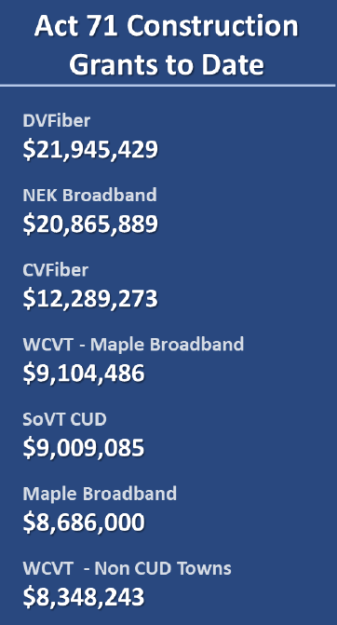
Since its inception, the VCBB has awarded $114.41 million in preconstruction and construction grants to the CUDs and spent an additional $9.85 million for the bulk purchase of materials to avoid supply chain issues and lower overall project costs. Six CUDs have commenced construction in their respective territories.

Investigative Report: An investigative report is a tool used to inform citizens, policymakers, and state agencies about issues that merit attention. It is not an audit and is not conducted under generally accepted government auditing standards. Unlike an audit, which contains formal recommendations, investigative reports include information and possible risk-mitigation strategies relevant to the topic that is the object of the inquiry.
The full report can be found here.
3.21.2023 MONTPELIER, VT – State Auditor