



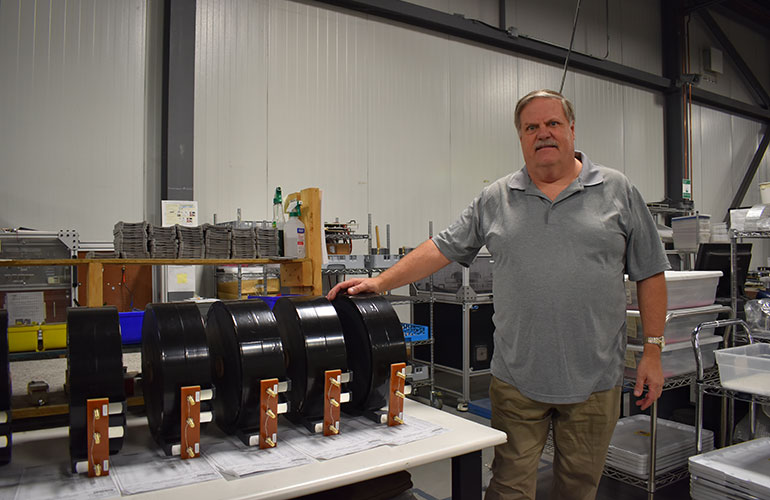
Photo: Ed Sawyer, CEO and former owner of Advanced Conversion. Photo by Danny Monahan.
Advanced Technologies: Exporting Business of the Year
In 1955, a young doctor was hanging a clock while standing on a toilet. He slipped, hit his head on the sink and was rendered unconscious. When he came to, he had a vison: a capacitor capable of powering a vehicle back in time or into the future
Time travel, as depicted in the “Back to the Future” trilogy of the 1980s, is, of course, a completely fictional concept. But Doc Brown’s vision of what capacitors are capable of is very much a modern-day reality.
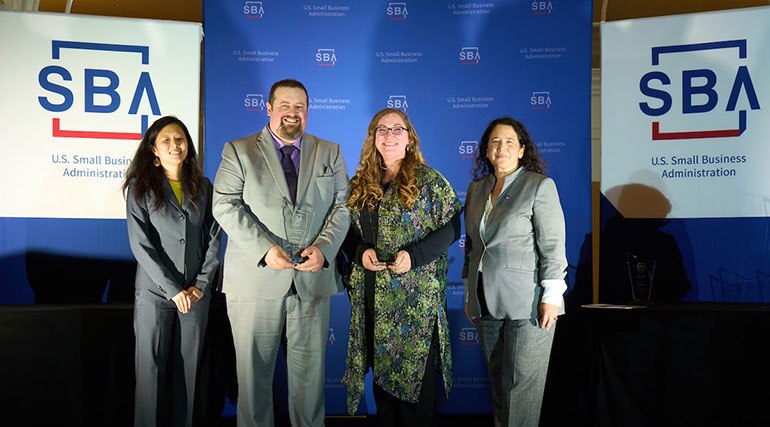
“We develop energy management systems centered around our unique capacitor technology,” said Ed Sawyer, CEO of Advanced Conversion, which was named the 2023 Vermont Exporting Business of the Year by the U.S. Small Business Administration. “These are used in grid, transportation, aviation, medical and industrial. Our customers make powertrains for mobility, aircraft, utility systems, solar energy, medical equipment and industrial equipment.”
A capacitor takes energy from a battery and stores it. Advanced Conversion manufactures the patented Power Ring Film Capacitor, which doesn’t overheat as much as traditional capacitors and is better suited to process large electrical currents.
Advanced Conversion and its 30 employees manufactured 50,000 capacitors in 2022. Each is made in Vermont, although the parts used to assemble the capacitors are imported. Once completed, the majority of capacitors are then exported; approximately one-third are sold in the U.S. and about 40% are sold in Asia.
“So many want to sell in Asia and have never been there. If you want to export, get yourself to the country you want to export to,” Sawyer advised. “Just like in the U.S., you have to get in front of your customer.”
An electrical engineer by trade, Sawyer ran electrical business for large corporations for most of his adult life. During this time, he lived in China for a year and traveled extensively throughout Asia, so he knew the market was ripe for exporting his product.

Photo: Ed Sawyer, CEO and former owner of Advanced Conversion. Photo by Danny Monahan.
In 2019, Sawyer launched Advanced Conversion with a business partner while securing the technology licenses to all patents, designs, data, products and processes held by SBE, the company who formerly provided the customer application solutions Advanced Conversion would be taking over.
For the last two years, Advanced Conversion has availed itself of the SBA’s State Trade Expansion Program, a federal-state partnership established to assist small businesses with export development. The grants fund compliance, export training and foreign trade missions. The Department of Economic Development, a division of the Vermont Agency of Commerce and Community Development, oversees and manages STEP grants in the Green Mountain State..
“I found out about STEP at a conference and have been using it ever since,” said Sawyer. “It’s a great program. We’ve participated in trade shows that STEP helped paid for.
“It’s one of the best ways for people to learn about our product. People walk the floor, see we have unique capacitors and often stop. Sounds pretty simple, but it’s very effective.”
A few months ago, Sawyer reached out to Electro Technik Industries, based in Clearwater, Florida, about the possibility of forming a business partnership.
“They said no,” Sawyer said, but they expressed an interest in purchasing Advanced Conversion. Soon after, a deal was struck, with the agreement that Sawyer would stay on as CEO.
“Nothing has changed,” Sawyer emphasized. “All are still employed, and we are actually hiring another half dozen employees to increase production.”
Measuring up: Thread of excellence runs through century-old tailor shop
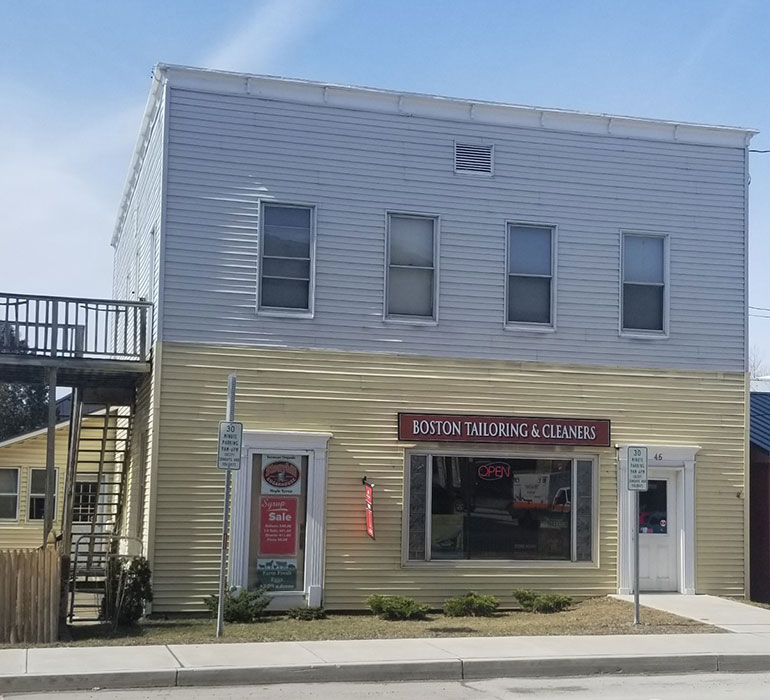
Photo: Boston Tailoring & Cleaners on Federal Street in St. Albans present day. Courtesy photo.
Boston Tailoring & Cleaners: Family-Owned Business of the Year
In 1914, a young Italian immigrant named Arthur DeMarinis purchased a building from the local railroad company in St. Albans, Vermont, and started a custom tailoring business, The Boston Tailoring Co.
More than a century later, the modest shop on Federal Street, now known as Boston Tailoring & Cleaning, is still in business — still owned by the same family and operating at its original location. In recognition, the company was named in May as the 2023 Vermont Family-Owned Business of the Year by the U.S. Small Business Administration.
“The business was started by my great-grandfather Arthur DeMarinis, then was taken over by my grandfather Edward, and then by my father and grandmother, John DeMarinis and Bernadette DeMarinis,” said Jennifer DeMarinis-Merritt, who has worked in the family business much of her life. “Now it is run by my father and mother, John and Sandy DeMarinis.”
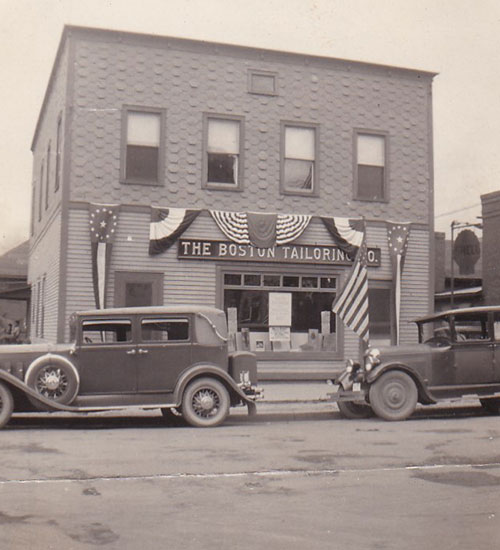
Photo: Boston Tailoring & Cleaners on Federal Street in St. Albans back in the day. Courtesy photo.
When 14-year-old Arthur immigrated to the United States from Naples, Italy, he was already a master tailor. He eventually settled in St. Albans and purchased the union meeting house, from which he would launch Boston Tailoring.
DeMarinis specialized in tailoring custom suits and other clothing for men and women. The family still has many of the shop’s original patterns used to cut suits in the 1920s and 1930s. It was around this time dry cleaning was introduced.
According to the U.S. Bureau of Labor Statistics, approximately 20% of small-business startups do not survive more than a year. Those business that manage to succeed, if they are fortunate, begin to develop a loyal clientelle or customer base.
And those that continue in business decade and after decade, like Boston Tailoring & Cleaners, eventually become a part of a town’s fabric.
“It’s a pretty rare thing these day to see a small businesses stick around this long and be owned and operated by the same family the entire time,” said DeMarinis-Merritt. “For me, it’s more than a business; its where I grew up, it’s my roots and it has taught me about the value of what hard work and what dedication can create. I love the history of our business and family.”
The DeMarinis family never had an inclination to branch out and expand the business at the height of Boston Tailoring & Cleaners’ popularity. They were always content being a single shop.
“Our philosophy was to stay a smaller mom-and-pop-style family business,” DeMarinis-Merritt said. “This has allowed us to be a face of our community and to know our customers and their wants and needs. We believe in quality over quantity.
“All of us at Boston Tailoring want to thank the SBA and express our gratitude for choosing us for this award,” she added. “We truly appreciate it. For years, my family built this business to what it is today. And though it has seen changes throughout the years, we have managed to stand the test of time and to be recognized with this award. It's an honor.”
Vermont man gathers thousands

Photo: Jeffrey Folb and Debra Baggish, owners of Vermont Gatherings. Photo by Danny Monahan.
Vermont Gatherings: Microenterprise of the Year
There is a fine line between it being a show and it being a community. Once an individual becomes a “play-tron” and no longer a patron, it’s more about the community, not just the show.
Play-trons is the term Jeff Folb, Vermont Gatherings owner and founder, uses when referring to all the regulars who come dressed in costumes when attending one of his fantastical festivals, as opposed to those who attend in civilian attire (like the writer of this article).
Vermont Gatherings is the area’s premier producer of local festivals. Its annual events include the Vermont Renaissance Faire, Winter Renaissance Faire, Steampunk Expo, Sci-Fi & Fantasy Expo, Living History Expo, and the Vermont Holiday Market. Although there are friends, family and his wife Debra helping out, Folb is Vermont Gatherings sole employee. He orchestrates all these events himself.
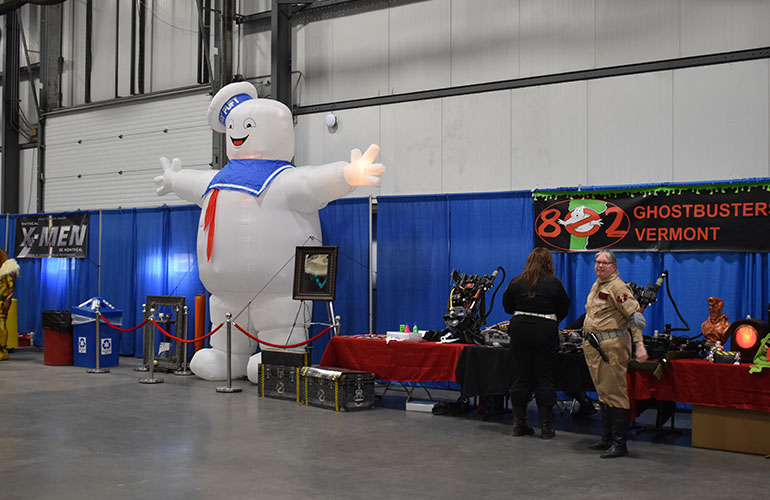
Photo: The Sci-Fi & Fantasy Expo. Photo by Danny Monahan.
“My festivals are places where you can get your geek on. Let me be clear, geek does not have a negative connotation with us” said Folb.
In April Vermont Gatherings hosted its 4th Annual Sci-Fi & Fantasy Expo at the Champlain Valley Exposition in Essex Junction. To many, it may seem like this would be a very niche market, but over the course of two days, the expo had about 5,000 attendees and more than 100 vendor booths. Many of those in attendance were play-trons. Among the attendees were Vikings, Storm Troopers, X-Men, Ghostbusters, Xenomorphs and countless other characters from videogames, comic books, TV and film. It’s quite a spectacle to see in person.
The Sci-Fi & Fantasy Expo isn’t even Vermont Gathering’s largest or most prominent event. That would be the Vermont Renaissance Faire.
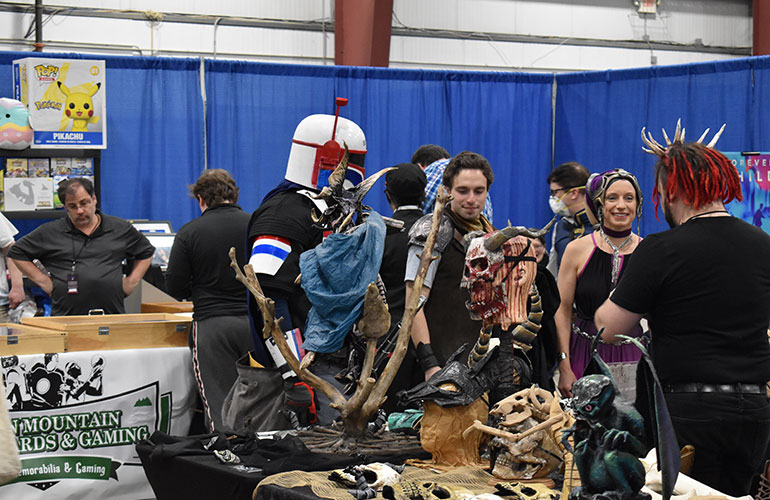
Photo: The Sci-Fi & Fantasy Expo. Photo by Danny Monahan.
Seven years ago, none of these shows existed. Folb and his wife, longtime play-trons, geeks and rennies (people who regularly attend renaissance faires) themselves, had the idea to produce a local renaissance faire because the closest one was three hours away and they felt Vermont needed more family-friendly events.
He has been involved in faires and festivals for more than 30 years, starting as a patron then becoming a playtron, a vendor and even doing stage combat. Before starting Vermont Gatherings, he managed a variety of businesses. He knew with both his business and geek backgrounds, he could make Vermont Gatherings work.
“This business is a part of my personal self and business self. I couldn’t do this if I was one or the other. If I was just a geek, I wouldn’t be able to host eight festivals a year and if I was just a businessman, I wouldn’t know what our patrons want. Funny thing is this is the first industry in 35 years I actually had a background in,” said Folb.
The first year the Vermont Renaissance Faire was held in Stowe, Folb expected attendance to be about 1,500. The attendance exceeded 4,000. Folb, the participants and the town were ecstatic with the turnout. It was then he knew it was only going to grow.
This year the 7th Annual Vermont Renaissance Faire is scheduled for June 24 to 25 in Stowe and expects to have about 8,000 in attendance with more than 100 vendors and dozens of performers.
However, success isn’t always a straight line. A small business that specializes in hosting in-person festivals was particularly hard hit when the pandemic started in early 2020. We got our first show of the year up and running and were then told everything would be closed for two weeks.
“So often it was kicking the can down the road. We were told many times by state officials that maybe we can host an event next month. Next month would come and be told the same thing again. It ended up being almost 18 months,” said Folb.
During this time, Vermont Gatherings received pandemic assistance through the Small Business Administration’s Shuttered Venue Operators Grant and Economic Injury Disaster Loan program. SVOG provided emergency grants to eligible live venues affected by COVID-19 and EIDL provided funding relief to small businesses that have suffered a substantial economic injury in a declared disaster area.
“The financial assistance from the SBA allowed us to survive until we were allowed to reopen in mid-2021. The Renaissance Faire in June 2021 was the first big show to open back up in the state. People were clamoring to come out, we had 1,000 more people through the gate than we did in 2019,” said Folb.
As difficult as the pandemic was for him, Folb felt the participants, mostly small, local crafters, artisans and performers were hit the worst.
“Although the patrons are important, I believe the participants are even more important. Patrons need a reason to come. The participants are a cottage industry and I want to support them 100%. If they are happy, the patrons will be happy and so will we. It’s great things are looking up now,” he said.
Going forward, Folb says he has no current plans to add anymore events; he only wants to grow Vermont Gatherings current events. As more patrons and play-trons come to each event, he will be able to support more artists, authors, creators, performers and merchants.
From book club to supergroup

Photo: From left, partners Yoon, Johnson, Meno, Hsiang, Smith and Meno. Photo by Danny Monahan.
CQ Strategies: Minority-Owned Business of the Year
It’s like a supergroup of advocates: Brian Hsiang, first-generation American and experiential education proponent; Ita Meno, housing inspector and LGBTQ+ activist; Sherwood Smith, DEI executive and former Peace Corps volunteer; Kathy Johnson, dialogue education teacher and gender equity advocate;. and Paul Suk-Hyun Yoon, school administrator and justice warrior.
Together, they are equal partners in CQ Strategies, a company formed to help organizations become more culturally proficient and equity-literate through education, resources and ongoing support. The group’s impact was validated this year when it was named 2023 Vermont Minority-Owned Business of the Year by the U.S. Small Business Administration.
The roots for CQ Strategies were planted 13 years ago when Tracey Tsugawa, a civil rights investigator with the Vermont Human Rights Commission, and Daniello Balón, director of diversity, education and engagement for the Burlington School District, formed a small book club centered around issues of equity.
In 2010, officials at the Burlington Office of Community and Economic Development approached members of the club to assist with an initiative to increase equity in city government. Tsugawa and Balón answered the call, and before long they helped found CQ Strategies.
Though they are no longer with the team, the others founding partners have carried on. Since 2010, the firm has worked with more than 250 organizations across New England, New York and Virginia, training more than 7,500 people and facilitating more than 500 workshops on such topics such as race, gender, class, and sexual orientation.
CQ selects its clients with great care.
“At our best, there is cultural change in the organizations we work with. We don’t want this work to be an add-on,” said Smith. “We want equity to be part of who they are. That is when we have real success. We don’t want the company to say we have checked that box for training or it’s just that time of year again to do this training. The organizations we are helping need to want to change.”
Since its founding, CQ’s level of service, reach and revenue has steadily increased. But it is the quality and impact of their work they take the most pride in.
“As an organization, we are determined to bring a deepened awareness and understanding of social justice, especially racial justice, to the community in ways that are practical and useful,” said Yoon. “We are grateful to work with so many different people across the region, and we hope our work will inspire others to help make the world a better place.”
Henry Parro set his sights on a state-of-the-art dream

Photo: Henry Parro, founder and owner of Parro’s Gun Shop in Waterbury, VT. Photos by Danny Monahan.
Parro’s Gun Shop: Veteran-Owned Business of the Year
Entering the store feels like entering an intimate Cabela's or Bass Pro Shop. The parking lot is spacious, the sales floor has high ceilings, the merchandise is meticulously displayed and there are military showpieces throughout that look like they belong in a museum.
Welcome to Parro’s Gun Shop, a 20,000-square-foot facility in Waterbury completed in 2021 where patrons come from hundreds of miles away.
“For 20 years I dreamed of having an indoor shooting range. At the time I was looking to expand and thought about building an addition at my previous store, but I knew if I wanted it done right, I was going to have to build a new facility, top to bottom,” said Henry Parro, founder and owner of Parro’s Gun Shop.
In 2016 five acres of commercial real estate became available about two hundred yards from the previous location, so he jumped at the opportunity and purchased the land. To build his new facility, Parro worked with Community National Bank and Granite State Development Corporation to secure a Small Business Administration 504 loan. The 504 Loan Program provides long-term, fixed rate financing of up to $5 million for the purchase or improvement of land, buildings and major equipment.
Besides building a firing range, this was an opportunity for Parro set up the shop the way he always wanted.
“I didn’t want to be a stereotypical gun shop. I wanted this to be a destination,” said Parro. “One thing I really wanted was something different. Parro traveled the US looking for that “different.” In Best Buy he noticed all the cell phones were on tethers, by brand. You can walk up and pick up a phone and compare it to the one next to it. I thought, why can’t I do that with handguns? So that is exactly what I did,” said Parro.
The new store has hundreds of firearms on display tethered so patrons can pick them up and get a feel for them. It also has a classroom for various firearm safety and training workshops. But the crown jewel is the 10 lane, 25-yard indoor shooting range. The state-of-the-art range is the first of its kind in Vermont open to the public, and allows shooters to practice in a safe, controlled environment year-round.
When Parro first started out in 1983 it was a much simpler operation. All he had was a card table and three handguns to sell.
“I never thought I’d be here today. I Always wanted to grow. It’s a dream every small business has and wants, but I didn’t think I’d end up here. I grew my business by selling three guns and then I’d buy four. I’d sell those four and turn around and buy five,” said Parro.

Photo: Henry Parro, founder and owner of Parro’s Gun Shop in Waterbury, VT. Photos by Danny Monahan.
Back then selling firearms was mostly a hobby. Parro was a newly appointed police officer in Waterbury and had recently left the service after being a Vermont National Guardsman for seven years.
“In high school I realized I had to do something with my life and decided to enlist in the Army. A recruiter convinced me and several friends to enlist in the Vermont National Guard. Several months later I was on a plane heading to Fort Knox. It was the service where I became goal-oriented and decided to make something of myself,” said Parro.
That first year Parro’s Gun Shop made about $10,000. It grew slowly but steadily in the first few years, but the store really started to take off when Parro became an authorized Glock Law Enforcement dealer. With his police background he started contacting police departments he had relationships with to try to convince them to convert their service revolvers to a more modern firearm, like the Glock.
“At first, they weren’t that receptive. When I tell people it was lightweight because a Glock has a polymer frame, many would say ‘the last time I bought a plastic gun, I was six years old.’ But at the time all the three-letter agencies were converting to Glock and that helped with the sell,” said Parro.
Glock became so popular with local police departments Parro’s sales started overflowing into other states. Word of mouth spread throughout the area, and he soon was selling throughout New England and New York. Parro’s now has two full-time employees selling Glocks to police agencies.
Today the gun shop is a multimillion-dollar enterprise with 27 employes, 60 percent of which are either Veterans, former law enforcement or both. It’s also the 40th year of business. Ruger is currently making a commemorative rifle for Parro’s 40th anniversary. Parro feels now that his business is right where he wants it, so he’d like to slow down and have his son take over the business.
Woman-powered PR is not all that bad

Junapr: Woman-Owned Business of the Year
#badassladygang
An apt description for a business with 16 employees (and growing), all of whom are women.
"It isn't deliberate. We have offered positions to men; it's one of those things where all of our employees are women," said Nicole Junas Ravlin, President & CEO of Junapr.
Ravlin has worked in public relations for more than 25 years, advising an array of clients about their communications and marketing strategies. In 2019, Ravlin decided she wanted an agency of her own and created Junapr. The new agency's three core areas are media relations, crisis communications, and strategic communications planning.
"In 2019, I thought I'd have maybe two to three employees and perhaps five to 10 clients," said Ravlin. "I didn't think in less than four years Junapr would be the size that it is now. There is a very good chance Junapr will be twice the size it is now. Each year I need to hire more employees."
Junapr has only been in business for four years, and its already the largest public relations firm in the state. Shortly after this interview, Junapr's footprint in the state grew even larger when it acquired the event planning firm Standing O along with its employees and hired some additional team members. And yes, all are women.
"Events and public relations are often tied together in the marketing mix," said Ravlin. "Being able to offer event services to our existing clients as part of our services is a great benefit to them. And, Standing O's clients now have access to a PR team who can help strategize how to market their events in a new way."
It hasn't all been smooth sailing. Junapr started at the end of 2019, and a few months later, just as the firm was starting to take off, everything came to a halt when the pandemic began.
"It's daunting enough starting your own company, starting from scratch with no clients. I knew that I would grow with my experience and reputation, but like everyone else, I never imagined a worldwide pandemic would be my greatest roadblock. PR needs were not a top priority for most companies. I was down to about two weeks of funds, and then all of a sudden, the pendulum swung the other way, and the phone started ringing off the hook. We've been growing ever since," said Ravlin.
During that period, Junapr secured a Paycheck Protection Program loan and an Economic Injury Disaster Loan through the Small Business Administration to help the firm get through the pandemic. PPP was a forgivable loan to help small businesses keep their workforce employed during the COVID-19 crisis, and EIDL provides funding relief to small businesses that have suffered a substantial economic injury in a declared disaster area.
As of 2023, Junapr has more than 30 clients, ranging in size from start-ups to international organizations. Junapr does little advertising, and most of its clients learn of the firm through word of mouth.
"One of our newest clients said a company they do business with couldn't stop gushing over Junapr and wanted to hire us immediately. Whoever heard of people praising a PR firm like that? It's a great feeling hearing people talk about your company like that," said Ravlin.
Junapr is also civic-minded. It is part of 1% for the Planet, a global movement inspiring businesses to support environmental solutions, contributing 1% of Junapr's revenue back to environmental causes. The firm has also donated more than $10,000 to Vermont Food Bank.
As this article was going to print, Ravlin reported that she hired Junapr's first male employee. "Our new teammate is excited to be part of the #BadAssLadyGang," said Ravlin. "We do not have plans to change the hashtag yet!"
Chair man took sitting down in a healthy direction
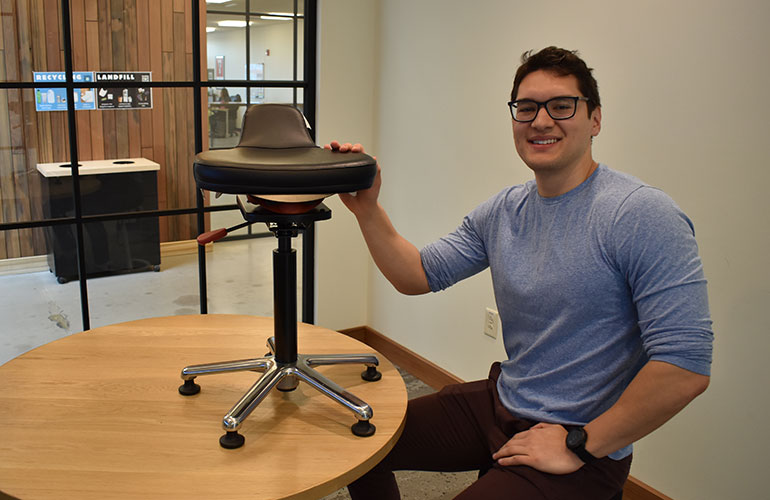
Photo: QOR360 COO and co-founder Lex Osler Vermont Young Entrepreneur of the Year. Photo by Danny Monahan.
Lex Osler: Young Entrepreneur of the Year
This year a small business in Vermont sold its 11,000th chair less than five years after starting the company in the family home.
“That number sounds crazy because it is, but it doesn’t feel as crazy as when we began. Starting in the basement of our home, I was assembling chairs by hand and then driving them to the post office. We have come a long way since then,” said Lex Osler, QOR360 chief operating officer and cofounder.
QOR360 makes revolutionary "active sitting" ergonomic chairs. Lex and his father, Dr. Turner Osler, cofounded QOR360 together and believe sedentary behavior is detrimental to one’s health, but by allowing you to move while you sit it offsets these negative health consequences. Not to mention it eases and relieves back pain.
The idea for a chair started with Turner, who is a surgeon by trade and became a research epidemiologist with the University of Vermont later in life. Running statistical models all day, Turner sat in a chair constantly and that is when he started to experience back pain. He tried several different styles of chair, but each one had its own shortcomings. Then he thought to himself, “I’m a doctor. I’ll figure this out myself.”

Photo: Lex and his father, Dr. Turner Osler, cofounded QOR360. Photo by Danny Monahan.
While Turner was sketching models for chairs, Lex was a premedical student at Cornell University. Although he was not a business major, Lex was becoming more interested in entrepreneurship. On a whim he entered a pitch contest.
Most of the students who entered the pitch contest were business majors or already had professional internships or ideas they had been working on for years, and then there was Lex with no business background whatsoever.
Lex’s pitch was an idea for an app for rheumatologists, where a user could tap on a human figure of the body and quickly enter notes faster than on a computer. The judges must have thought it was a good pitch because Lex won the competition. Then he started entering more pitch competitions and did well. He even started taking some business classes at Cornell. He realized he could help his father get his idea from the drawing board to production.
“I think of entrepreneurship a little differently. I think lots of people want to be an entrepreneur just to be one, and so they will pick an idea and just try to make it work. I never thought I would be an entrepreneur, I just thought this idea was important enough it had to be done, and I became an entrepreneur as a result. If I didn't think our product was revolutionary, I would be doing something else,” said Lex.
After graduating from Cornell, Lex came back to Vermont and helped his father launch the company out of their home. One night he had to assemble, box and ship over 20 chairs and Lex knew it was getting out of hand and they needed a professional manufacturer. It was Lex who found a partner in Morrisville, Vt. that could assemble, box, and ship chairs economically, and then set about growing an international market.
The international market has been a game changer for QOR360. As of 2023, QOR360 has shipped chairs to more than 45 countries on six continents. The company is working with distributors in South Korea, Taiwan, Japan, New Zealand and Israel.
“We are proud to be a Vermont-based company, but we never intended to be an international company. I love that we are bringing money from overseas to our home state. Maybe one day we'll be the next Ben & Jerry's,” said Lex with a wink and a smile.