by Timothy McQuiston, Vermont Business Magazine Governor Phil Scott today at his afternoon press conference announced that he had vetoed the Legislature's signature bill this session, H.217, which is related to child care funding and expansion. Scott emphasized that he a lawmakers have the same goal of what he calls "cradle to career" education. He also reiterated that he has pushed for a funding package that includes the online sales tax, now $56 million per year. But in his veto statement today, he balked at the "regressive" payroll deduction to be implemented to help pay for it and the overall cost, which will be $124.8 million in FY2025, when it's fully implemented.
Scott is likely facing an uphill battle in an effort to have his veto sustained. The measure passed comfortably over the two-thirds majority in both chambers. However, he could find some common ground on the funding structure, as the House supported an income tax provision. The governor seemed less opposed to that than the payroll deduction, if only just.
The separate issue with the child care plan is that it is not just for kids and parents. Business owners and economic development officials consistently rank a lack of child care, along with the workforce shortage and housing costs, as one of the biggest impediments to economic growth in Vermont, even above regulation and taxation.
Meanwhile, proponents of the bill were, of course, were "disappointed" by the governor's action, but not surprised.
See the governor's full statement and letter to lawmakers as well as reaction from legislative leadership and advocates, as well as Joint Fiscal Office financial breakdown, below.
Along with the H.217 veto, the governor signed into law the following bills, as passed by the General Assembly. There are still several bills up for his signature, which he will act on by the end of Wednesday.
On June 6, Governor Scott signed bills of the following titles:
- H.45, An act relating to abusive litigation filed against survivors of domestic abuse, stalking, or sexual assault
- H.94, An act relating to removing the Reach Up ratable reduction
- H.102, An act relating to the Art in State Buildings Program
- H.206, An act relating to miscellaneous changes affecting the duties of the Department of Vermont Health Access
- H.492, An act relating to setting the homestead property tax yields and the nonhomestead property tax rate
On June 6, Governor Scott returned without signature and vetoed H.217, An act relating to child care, early education, workers’ compensation, and unemployment insurance, and sent the following letter to the General Assembly:
The Honorable BetsyAnn Wrask
Clerk of the Vermont House of Representatives
State House
Montpelier, VT 05633
Dear Ms. Wrask:
Pursuant to Chapter II, Section 11 of the Vermont Constitution, I’m returning H.217, An act relating to childcare, early education, workers’ compensation, and unemployment insurance, without my signature because of my objections described herein:
Increasing the availability and affordability of childcare has been a priority throughout my time as Governor. In fact, in my first six years in office we doubled our investments in childcare and these appropriations would be substantially higher had previous legislatures supported fully funding my proposals.
I also put forward a plan in 2018 to dedicate tens of millions of dollars in new online sales tax revenue to childcare. If the Legislature had supported this proposal, we would be investing an additional $62 million this year alone, and much more in future years. And last year we expanded childcare subsidies to 350% of the federal poverty level. To put that in perspective, a four-member household (e.g., two adults and two children) earning $105,000 per year is currently eligible for subsidies.
Knowing the Legislature and I both wanted to “go big” on childcare this year, I dedicated $56 million in organic, ongoing base revenue growth to expand eligibility to families making up to 400% of the Federal Poverty Level (FPL). This would put Vermont at the top of the list of the most generous childcare states in the nation, giving households earning up to $120,000 per year access to support, and helping about 4,000 more kids.
When the Senate and House were at stalemate in May, my team offered legislative leaders another path, expanding subsidies even higher (to 450% of the Federal Poverty Level) and funding a 10 percent increase in provider rates, without relying on new and regressive taxes.
In total this compromise would have covered 6,000 more kids than our existing investment, helping families making up to $135,000 a year, and definitively establishing Vermont as the state most committed to affordable, accessible childcare for working families.
Unfortunately, there was no interest. Instead, the Legislature remained determined to raise a new tax. Ultimately landing on a regressive payroll tax that, if you are a lower income Vermonter already receiving free childcare, you will have to pay a tax, with no added benefit to you, so that families with higher incomes get support.
Vermont already has one of the highest tax burdens in the nation. The last thing we should be doing is making it worse. Raising new revenue from taxes and fees should be a last resort, not a first step.
Supporters of raising taxes and fees will always point to the relatively small amount raised for each individual program or service – trying to suggest it is not that much money. But that type of narrow here-and-there thinking adds up, year after year, and has made living in Vermont increasingly unaffordable.
For these reasons, I had to veto this regressive tax plan.
Sincerely,
/s/
Philip B. Scott
Governor
To view a complete list of action on bills passed during the 2023 legislative session, click here.
Senator Baruth Responds to Governor Scott's Veto of H.217, the Childcare Bill
"Phil Scott's veto of this year's historic childcare bill comes as no surprise, unfortunately. During his years in office, the Governor has talked about the need to expand and enrich our childcare offerings, but he has never been willing to address the problem at the scale it demands. H.217 represents an authentic, long-term solution to our childcare crisis by helping parents afford care and helping caregivers afford to stay in their profession.
"Fortunately, overwhelming majorities in the House and Senate have made it clear that the Governor's rhetoric on this issue will not be the last word. This bill will be our number one priority for the veto override session, at which time we will speak loudly, in the only way that matters in the end. We will vote to end the childcare deserts in our state, and we will vote to pay childcare professionals a respectable wage. Vermont's kids can't wait any longer."
Statement from Vermont Speaker of the House Jill Krowinski following Governor Scott’s veto of universal child care bill.
Today, Speaker of the House Representative Jill Krowinski addressed the action taken by Governor Scott to veto bill H.217, which had tri-partisan support in the House and would bring universal child care to Vermont families and businesses.
"For far too long, families across Vermont have struggled to balance taking care of their children while earning a paycheck. We must help those struggling by providing them with the necessary support to grow their careers while knowing that their children are safe and well-cared for by high-quality early educators. Without accessible child care we face significant losses of wages for Vermonters and tens of millions of dollars in business losses. Vermont cannot be a state that supports working families and a thriving economy without a child care system that is available to all.
"This issue is not limited to families with children; it greatly impacts all of our communities. Providing comprehensive child care solutions benefits our economy, supports working parents, fosters early education opportunities for our children, and ensures that our early education providers are paid a fair wage.
"The Governor vetoed a bill that would have cost an individual Vermonter, earning the median wage less than $1.00 dollar per week. That is a truly significant benefit for Vermonters at a minimal cost. This bill, along with base funding invested in the budget vetoed by the Governor, would allow for increases in child care subsidies, which would provide for families to find and afford quality care while guaranteeing higher wages for early childhood educators and staff.
"We cannot ignore the overwhelming support from Vermonters for this critical investment in our state. Thousands of child care providers, families, and business owners have advocated for the urgent need to have affordable and accessible child care. It is truly disappointing that the Governor chose to veto this investment in working families and our economy.
"While the Governor's veto represents a setback, it only strengthens our resolve to champion the well-being of our communities. We will continue to fight for affordable child care, recognizing its immense value to our families and the future of our great state."
The following is a statement from Aly Richards, CEO of Let’s Grow Kids on Governor Scott’s veto of the 2023 Child Care Bill:
“We are disappointed by Governor Scott’s decision to veto the 2023 Child Care Bill which was passed by an overwhelming supermajority in both the House and Senate with support from Republicans, Democrats, Progressives, and Independents. This bill is a direct example of what we can achieve with collaboration and when policymakers truly listen to the needs of their constituents. We are on the doorstep of being able to stabilize our child care sector while also investing in the future of our state, thanks to the efforts of lawmakers and child care champions in every corner of Vermont. On behalf of the tens of thousands of parents, grandparents, early childhood educators, and employers who are counting on this landmark bill to make Vermont more affordable, grow our economy and support our kids, we look forward to working with lawmakers to override this veto.”
Statement from Senate Democrats on the Childcare Bill Veto
Today Governor Scott vetoed H.217, the Childcare Bill, stymying tripartisan-backed and unprecedented investments to fix Vermont’s childcare system and support working families. Unfortunately, this serves as a walk back to the Governor’s previous commitments to promote equal access to childcare for all Vermont families, and to address the workforce shortage by bringing young families back into the fold.
The bill would make needed investments for both childcare providers to stay open and for families to more easily afford childcare. It would also expand eligibility of families to receive subsidies from the Child Care Financial Assistance Program, and increase reimbursement rates to childcare providers to help increase capacity, improve facilities, expand hours of operations, and to address gaps in service.
Overall H.217 would make Vermont a national leader in affordable childcare access, aiding children and families right now, attracting new families to Vermont and supporting future generations.
“We have heard loud and clear that access to affordable childcare is a priority for Vermonters, especially Vermont women,” said Senator Ruth Hardy. “With his veto of this historic legislation, the Governor has shown that he does not actually care about the well-being of Vermont’s families or employers. Nor does he care about making Vermont an affordable, viable place to raise a family or maintain a business. What he cares about is playing politics. I look forward to overriding this short-sighted veto.”
Now, H.217 will return to the Senate for the opportunity for a veto override vote.
JFO Bill Summary (read full report HERE)
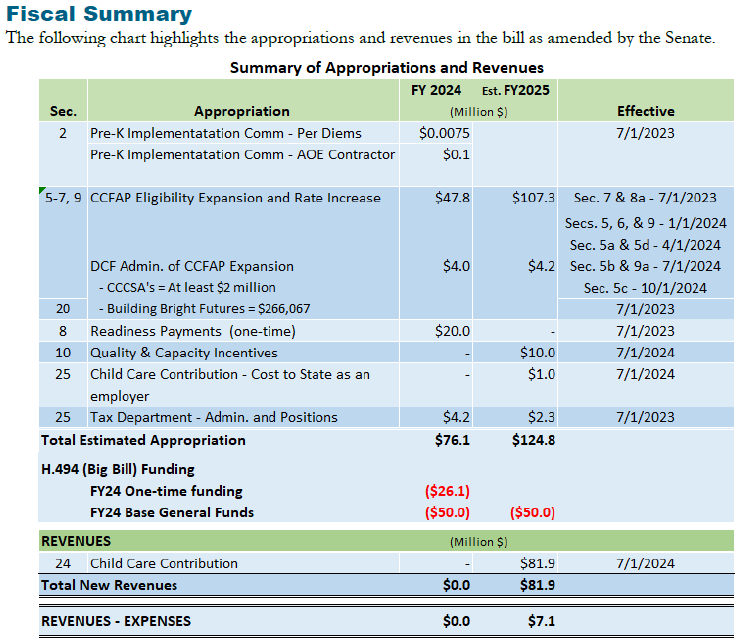
The bill as amended has two main parts: early care and education (sections 1 – 25) and workers compensation (sections 26 – 46). The bill would appropriate $76.1 million in fiscal year 2024 for the following:
• $107,500 to AOE to retain a contractor to assist the Prekindergarten Education Implementation Committee and pay per diem compensation and reimbursement of expenses for eligible members.
• $47.8 million to DCF to expand CCFAP eligibility and increase provider rates.
• $4 million to DCF to administer the adjustments to CCFAP.
• $20 million to DCF for one-time readiness payments to providers.
• $4.2 million to the Department of Taxes to be used for the implementation of a new payroll tax, including the establishment of 15 new permanent classified positions.
The bill would institute a new payroll tax, beginning in fiscal year 2025, called the Child Care Contribution. Revenues would be deposited into a new special fund, called the Child Care Contribution Fund.
The bill also takes into consideration a combination of one-time and base funding appropriated in H.494 (the “Big Bill”) to cover the estimated costs associated with this bill in fiscal year 2024.3 Annualized and other anticipated costs are estimated to be $124.8 million in fiscal year 2025.
Finally, the bill proposes to set the fiscal year 2024 workers’ compensation contribution rates at the same levels as for fiscal year 2023 and to establish in statutes that in any given year when the General Assembly does not establish workers’ compensation contribution rates, the rates would stay at the prior year’s levels.
The following sections of the bill as amended by the Senate would have fiscal impacts. See the chart on the last page for a summary of the appropriations and revenues in the bill as amended.
1) The bill as introduced was originally called “An act relating to miscellaneous workers’ compensation amendments.”
2) https://legislature.vermont.gov/bill/status/2024/H.217
Montpelier, Vt. - June 6, 2023.