


Photo: Matt Harrington, executive director of the Southwestern Vermont Chamber of Commerce in downtown Bennington. Photo: Baldwin Photography.
by Joyce Marcel, Vermont Business Magazine Bennington County hugs the New York State line so closely that it has, in the past, sort of suffered an identity crisis: Is it part of Vermont or a suburb of Albany?
Perhaps this is no longer a question. Post-COVID, Bennington appears to be flourishing. And flourishing with it is the Southwestern Vermont Chamber of Commerce, in no small part because of its executive director, the extremely young and popular Matt Harrington.
Since he was hired to run the organization — originally called the Bennington Chamber of Commerce — in 2016, at the surprising age of 30, Harrington, now 37, has expanded it from covering one town to encompassing 17. Not all those 17 towns are the same, of course.
“Some of those are very small towns like Shaftsbury and Pownal,” Harrington said. “Some don’t even have any population, like Greensboro or Searsburg. But then you also have Dorset, Manchester, Arlington and Bennington.”
A little history might be helpful here.
The Bennington Chamber of Commerce was founded in 1912, so it has been around, in one form or another, for a bit longer than a century. It was incorporated in 1959. From 1970 to the 2000s, it was known for the Bennington Antique Car Show. In 1995, its current signature event, the Southern Vermont Garlic and Herb Festival, now mostly called Garlic Fest, was founded in nearby Wilmington. When it outgrew Wilmington in 2008, the chamber bought it from its founders, phased out the car show and made it Bennington’s main event.
Then, when the Manchester Chamber of Commerce went broke, its members looked to Bennington, Harrington said.

Matt Harrington, executive director of the Southwestern Vermont Chamber of Commerce in downtown Bennington. Photo: Baldwin Photography.
“From 2017 to 2020, we started to accumulate members in Manchester and in the North Shire,” he said. “We started to put together a travel guidebook that represented the whole county. We were working with the shires brand to create a more regional approach to things. And obviously, we were offering services — dental and vision insurance, everything we could to support all 17 towns. And then in 2020, we officially changed our name and our brand and our logo from the Bennington Area Chamber to the Southwestern Vermont Chamber. And that’s our story.”
During this past post-pandemic year, Harrington has managed to attract 50 new businesses to the organization, bringing the total to 400 members.
“With other membership organizations, people are really looking at that dollar,” Harrington said. “Everybody is kind of rethinking their life after the pandemic. We’re just grateful that we added about 50 new members this year. I think it’s a testimony to southwestern Vermont. We successfully pulled off Garlic Fest, which is always a tough one. It brings about 7,500 people and 200 vendors to Bennington and puts in about $130,000 in downtown sales — all in one day. So, we’re entering the new year with optimism and with growth in the organization in terms of finances and membership. People are still moving into town, businesses are still opening, and people still want to belong to chambers of commerce.”
Statewide as well as in Bennington County, Harrington is a rising star, and so named by VermontBiz in 2017. He recently finished his chairmanship of the governor’s Travel and Recreation Council, and he is the vice chair of the Vermont Association of Chamber of Commerce Executives.
Harrington runs his chamber operation with a small staff consisting of a membership manager and an event manager. He has a total budget of approximately $550,000 a year.
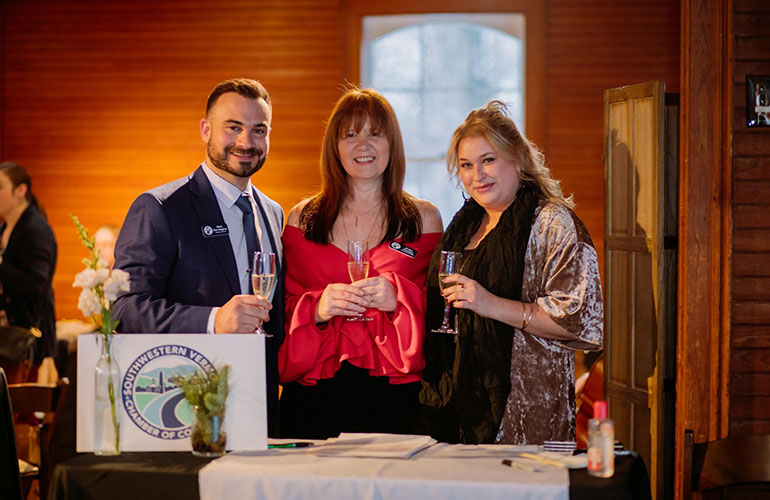
The Chamber staff in January during the first in-person annual meeting since the beginning of the pandemic. From left to right: Matt Harrington, executive director; Erika Floriani, membership manager; Mikaela Lewis, event manager. Photo courtesy of the Southwestern Vermont Chamber and Lorianna Weathers Photography.
“We also have a contract with the state of Vermont to run the welcome center on Highway 279,” Harrington said. “There’s only one or two other chambers that do that. We actually employ a manager there. And she directs eight to 10 part-time staff. I’m also managing that. The budget without the welcome center is about $350,000 a year. And then it’s about $200,000 to run the welcome center. That’s pretty much a pass-through. We’ll receive a grant from the state every year, and we’ll buy supplies and cleaning solution and that sort of thing.”
Harrington puts a great emphasis on attracting and supporting young entrepreneurs.
“When I first got to the chamber, Bennington had a young professional group and Manchester had a young professional group,” Harrington said. “Manchester’s young professional group kind of went defunct, and Bennington’s young professionals were heading that way. I knew I could do something about that. I propositioned my board and said, ‘Our members need workforce. We’re the second oldest state in the union. People are looking for new young families.’ We ended up taking the Bennington young professionals and the North Shire young professionals and combining them into their own organization. It’s now its own nonprofit.”
Renamed the Shires Young Professionals and given its own website, the organization appears to have been remarkably successful.
“We gave it a structure and a governance,” Harrington said. “And we have now been through one chair, and there’s a second chair who’s about to start her second year. At this point we keep going back and forth. Maybe they need more mentorship? Maybe they need professional development? But what we continue to find at the current moment is they just want to hang out in Vermont.”
There are many different types of chambers of commerce: international, national, regional and town, said Betsy Bishop, president of the Vermont Chamber of Commerce.
“There are something like 7,500 chambers across the world,” Bishop said. “Every single one of them is independently focused. They’re all separate nonprofits. And while they share a name, they do not share governance or budget or structure. There’s the US Chamber of Commerce, and there’s the Vermont Chamber of Commerce statewide. That’s me. And then there are 30 regional chambers or town chambers in Vermont.”
All of these chambers are working toward a common goal: economic growth, Bishop said.
“Our communities look different, but we all have the same goal,” she said. “My community is the entire state. The Southwest Regional Chamber of Commerce community is Bennington County. They all have separate bylaws, they all have independently elected boards, and there is no parent-child structure whatsoever.”
Bishop has known Harrington since he began his chamber job. She said he came with valuable experience in marketing and communications and had new ideas, which he immediately started to implement.
“Matt’s background was really valuable to the chamber ecosystem,” Bishop said. “As he continued, he brought in his new ideas, and they were successful helping other chamber leaders in other parts of the state. Right away, he came to the table with an energy that was super helpful. Within a really short period of time, he became a leader in our world.”
Harrington has never lost his energy or desire for new ideas, Bishop said.
“He still has the desire to bring the chamber organization and the businesses that they represent and the community forward,” Bishop said. “He still has that as his goal, and you see it every time you talk to him. One of the things that I’ve seen Matt do as a leader is work within the chamber structure to bring a greater level of professional development to chamber executive directors across the state. He sees being a chamber leader as a profession, as a nonprofit leader in this state. He makes sure that all of our peers have access to the current thinking, which helps us all develop programming that is successful and that businesses want and need to grow.”
Harrington is also a great collaborator, Bishop said.
“One of the ways the Vermont Chamber works with the Southwest Regional Chamber is through advocacy and legislation,” she said. “The Vermont Chamber has a full lobbying team at the Statehouse every day. Matt recognizes that as a resource for his members. He will tap into that to help his members understand issues and to connect them with the right people. Sometimes they can testify on a particular issue. So, we are able to collaborate and really partner around that area to expand those benefits.”
A true native, Harrington was born in Bennington but raised on the New York side of the border. Both of his parents had exceptional careers.
At a time when women didn’t lead businesses, his mother, Deborah Mackin, ran an extremely successful consulting group in North Bennington, doing leadership, development and organizational development on a national level for major corporations for 30 years. His father, Bob Harrington, is a well-known Bennington radio and television broadcaster.
The parents taught their kids well. Harrington’s brother Michael is currently commissioner of the Vermont Department of Labor. Prior to state government, he served as the economic and community development director for the town of Bennington.
The Bank of Bennington’s Shannon McLenithan, who has served on the chamber board for 10 years and is its incoming president, said she has nothing but praise for Harrington.
“I can’t say enough good about him,” said McLenithan, the bank’s senior vice president of residential lending. “He’s an amazing young talent. It’s been amazing to see the professional transformation and leadership he has brought to the organization. With his direction, the chamber has created a vision that continues to evolve. The climate of relevancy pushes us every day to a new territory.”
McLenithan said she is particularly impressed by the organization’s membership numbers.
“We have seen tremendous growth in the chamber in terms of members,” she said, “COVID certainly had a recent impact on those numbers; they came down a little bit. But we continue to see growth year over year.”
Harrington has added many new touches to the chamber universe, McLenithan said.
“He’s really done some neat things that were new to the chamber,” she said. “We’ve done Lunch & Learns, and Coffee & Conversations, which have been really helpful tools for business members. Whether it’s learning about health care benefits, how to market your business or strategic planning, Matt is able to find topics where members can have a one-hour conversation. People can chime in and learn something new.
“Business owners are so busy trying to run a business that sometimes they don’t have time to do the research on certain topics,” she added. “So, this is about finding more benefits for our members. Business owners aren’t going to stay members if they don’t find value in their annual memberships. Matt has really been more and more in touch with our members — more than we ever were before.”
Bennington business owner Nancy Koziol, founder and CEO of Couch + Cork, an innovative business that stages private wine tastings in people’s homes, said the word that best describes Harrington is “intuitive.”
“He really understands people,” said Koziol, a former Member of the Year at the chamber. “I think that’s one of the things that makes it so easy for him to develop a personal and a professional relationship with people. He’s also very inquisitive. He wants to learn. The wheels are always turning as far as what he can learn from people and how he can be helpful.”
Koziol said that when she started her business, Harrington became “almost a mentor to me.”
“It’s funny, because I wasn’t really a businessperson before I started my business,” she said. “Chambers of commerce, executive directors and nonprofits were just so foreign to me. And as I came into my own, Matt really helped me understand the business landscape and how to fit in locally. This community has a pretty established business community, and then there was me coming in as the disrupter and doing things very differently. I found Matt very easy to talk to, with a deep understanding of relationships and generations.”
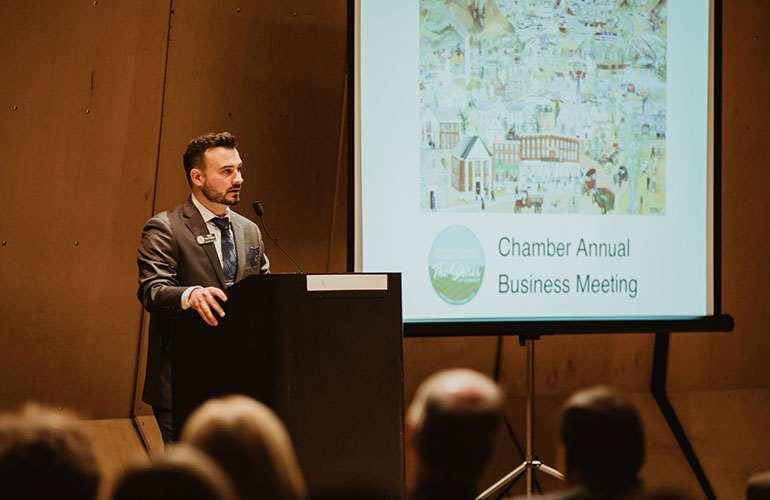
Matt Harrington welcomes members to the Southwestern Vermont Chamber of Commerce annual membership meeting in 2019. Photo courtesy Southwestern Vermont Chamber of Commerce.
Harrington taught Koziol new ways of appealing to younger prospective employees, who seek meaning in their work.
“When I started getting ready to hire staff, I was having a lot of trouble finding people in the age group that I was looking for,” Koziol said. “Matt looked at the job posting and said, ‘I don’t think that this resonates with young people.’ That got me thinking about being more mission-forward and values-forward instead of the traditional.
“Younger people are more interested in working for companies that are driven by their mission and their values, and maybe not so much by what the work itself is. They ask, ‘What is the point? Why are you solving the problem you’re solving? Why are you doing the thing that you’re doing? What’s important to you?’ For example, in our business we’re very big on inclusion, diversity and being mindful about social justice issues. But our job descriptions didn’t say that. They were kind of run-of-the mill. Now I know they need to be more personal, so the job resonates with people — that the work just isn’t working in wines, it’s also working to make the world a little bit better place.”
Harrington is extremely helpful as a connector, Koziol said.
“He’ll hear something in a meeting, then call me and say, ‘Hey, I met this person and I really feel like you two would work well together. I really think you should connect,’” Koziol said. “He regularly does that. And not just with me, he does it with everybody. He’s never just thinking about himself. He’s always thinking about his place as kind of a hub. He has a lot of responsibilities. He works with Vermont tourism, and he does stuff with the state — he’s constantly connecting people. For example, getting a liquor license was incredibly difficult for us because we are such an unusual business model. And Matt said, ‘Nope, here’s who you need to talk to.’ He got me in touch with the right person and we were able to just fly through the process.”
That makes Harrington a walking Rolodex, Koziol said.
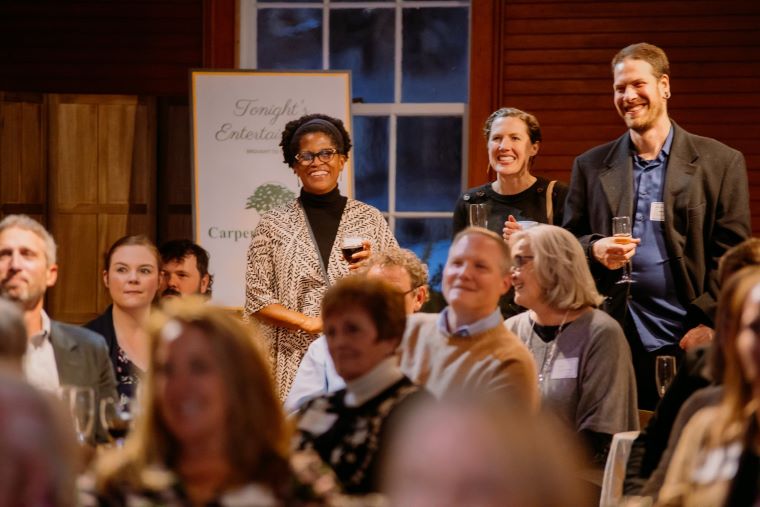
Over 120 member attend the Chamber's Annual Membership Meeting on January 27, 2023. Photo courtesy of the Southwestern Vermont Chamber and Lorianna Weathers Photography.
“He’s paying attention to who is the go-to person for whatever question you have,” she said. “You have a weird workers’ comp question? This is the person you ask. You have a question about particular type of software? This is who you go to. You need to change your health benefits? This is the person. He also understands who are the people that will work well together. In my case, it’s often people I wouldn’t normally cross paths with. But he is connected to so many different people that he’s able to forge these bonds and get people working together.”
Harrington is not afraid to get his hands dirty, Koziol added.
“He’s not just sitting in the office and waiting to be told what to do,” she said. “He drives the organization. He works really well with the leadership, but he’s also in the field doing the work. Take the Garlic Fest, which is probably our biggest event. People volunteer for it, but Matt’s there loading pickup trucks, carrying stuff and setting things up with us. He’s not sitting somewhere with a walkie-talkie, making sure that everything goes well.
“He really gets into the thick of the work,” she added. “I think it allows him, as an executive director, to have a deep understanding of our needs. He goes to the meetings. He checks in with his staff. He checks with his board. He’s very visible as a chamber executive director. He’s out in the community, meeting with people, checking in and helping out.”
Another person who values Harrington as a people-connector is Susan Plaisance, the long-time advertising sales manager at the Bennington Banner.
“Matt is an amazing partner,” Plaisance said. “When I go out and meet new businesses, the first thing I’m doing is introducing myself, because that’s what I get paid to do. But the second question I normally ask is, ‘Have you met Matt? Because if you haven’t, you need to.’”
Plaisance was especially impressed with the way Harrington guided the chamber through the pandemic.
“Matt has brought the chamber into the times that we’re living in right now,” she said. “The way he pivoted through COVID and kept that chamber going and got information out to the town was quite amazing. Everything the chamber did, he couldn’t do because of COVID, right? So, he partnered with our local hospital to do some live broadcasts once a week. There is a local TV station here, and if we needed local updates on what was going on with COVID, we were able to ask questions of the doctor. He had a lot of Zoom meetings with informative stuff that people needed to know. He got the word out to the chamber members about any available federal funds.
“Garlic Fest used to be a weekend event. But when COVID hit, he pivoted immediately and turned it into a downtown event with pods, where people could still get out and enjoy themselves. There were two stages, with a different band on each stage every 45 minutes. There were parking lots full of vendors. He had 125 volunteers show up to help put on the festival. I was one of them. It was remarkable how smoothly it all went. And he did that for two years. He’s just awesome at what he does. He’s a forward thinker. He’s constantly thinking about how something can be improved.”
‘A Perfect Hybrid’
Like many children of divorce, Harrington grew up shuttling between two homes — in his case, in two different states.
“That makes me a perfect hybrid for down here,” he said. “I was really raised in New York and went to New York public schools. My dad was a well-known radio broadcaster in Bennington. He did that for 40 years. He and my mother divorced in 1986, when I was 1 year old. I grew up with two sets of parents — my dad over in Bennington, who we would visit on the weekends, and my mom and my stepdad over in White Creek, NY, which is literally five minutes over the border.”
For 30 years, his mother, Deborah Mackin, ran her own consulting firm, New Directions, in North Bennington.
“It’s kind of a Vermont story,” Harrington said. “It was a boutique firm, small, with a couple of staff people. She built this great business out of nothing other than being frustrated with management and how people were leading in her first career. She ended up leaving that career and starting this business, and over the course of 30 years developed some key points I still use today.”
Mackin is nationally known for writing a pair of pivotal books on workplace teams, “The Team-Building Tool Kit” and a follow-up, “Keeping the Team Going.”
“These seminal books on implementing workplace teams and creating flat organizations in the 1990s led to clients including Coca-Cola, Keurig Green Mountain, Delta Faucet, Sanofi Pasteur, Alcoa, the US Navy and more,” Harrington said. “She traveled around working with different companies. I was a kid at that point, and I kind of digested a lot of the things that she would bring back home, like conflict resolution, team building and communication skills. She was a woman in Vermont running her own business in the 1980s and 1990s, which didn’t happen then as much as it does now.”
Harrington said his mother taught him and his brother the value of hard work.
“I’ll go back to the fact that she started her business in 1984,” Harrington said. “She’ll speak quite openly about how she was blackballed for being a woman, a single woman raising two sons and running her own business. ‘How dare she?’ And then thinking she could be a consultant. Not owning a retail shop. She wasn’t a seamstress. She was a business management consultant. I learned tenacity, focus and hard work from her.”
Both of Harrington’s parents had very strong communication skills.
“My father morphed out of radio and into TV,” Harrington said. “He was very well known for being a fair journalist. The further we get away from that era, we don’t find fair people who speak objectively about a problem and then let the people decide. From my dad’s perspective, I learned appreciation for diversity, appreciation for different ways of thinking and how to be fair about it.”
Harrington had lots of jobs growing up, and he appears to be proud of the fact that he wasn’t particularly good at any of them.
“One of my first jobs was as a dishwasher at the Vermont Steak House in Bennington; I was probably 15 or 16,” Harrington recalled. “I also got a job at the former Cambridge Hotel in Cambridge, NY, which is famous for creating pie à la mode. I worked for a restaurant a little bit later, when I was in Albany, just as a side job. And I realized it was not my thing. I wasn’t good at it. It wasn’t their fault.”
Then there was the year during college when he worked for a small manufacturing company in Hoosick Falls, NY.
“I still run into the guy who was my supervisor years later, and he’ll always just rail on me for the number of mistakes I made,” he said. “I dropped a bucket of paint from 20 feet up on the company car. I weed-whacked a whole section of the yard and ended up getting weed-whackers dermatitis for a week, which was boils on your skin. The point is that I worked very hard. I was likable. When my boss runs in to me today, he says, ‘You were one of my favorite employees, but man, you couldn’t pick up a shovel.’ So very early on, I was like, ‘OK, I’ve got to use my brain.’”
Harrington followed the family tradition of getting an education.
“My dad had a college education,” he said. “My mom and my stepdad had master’s degrees. I grew up in a very intellectual environment. My stepdad was a foreign language teacher, and my mom ran a business focused on business.
I grew up with an intellectual set of parents. I quickly realized I had to finish high school, go to college and get the kind of a position that allows me to use my brain.”
He went to the State University of New York in Oneonta, where he earned a degree in communication and a minor in business. He’s currently taking night courses at Siena College in Albany toward a master’s degree in business.
Out in the World
Harrington’s first job out of college was at a marketing firm in Albany.
“I had a big focus on marketing and advertising in school,” he said. “I joined a place called Media Logic over in Albany and moved there for a year. I was blessed and cursed by growing up with an entrepreneurial mom. I thought, ‘Just work really hard, do what you love, be passionate about it and everything’s good.’ When I got over to that larger marketing firm, there were about 90 people there. All things considered, it was a small company. But it was very corporate and hierarchical, and I just didn’t fit in.”
Harrington lasted nine months, during which time he was also doing small projects for his mother’s business.
“I was like, ‘Well, Mom, are you writing press releases?
“No,” she said.
“I said, ‘Well, do you have a social presence?’”
Back then it was 2009 or 2010. Facebook had just started. I was starting to help her on the weekends, doing all those things. And then it kind of serendipitously happened. She knew I was struggling with where I was working. She was coming into some more clients and had the money.
“She said, ‘Well, what do you think about joining me?’ And I was like, ‘Well, I’ve been thinking about it for a couple months now. But I was just waiting for you to say so.’ So that was the great transition. I started with her in 2010.”
Harrington was working in Bennington but living in Albany because he thought of himself as more of a city guy.
“I refused to move back to Bennington,” he said. “I said, ‘I’ll work for you, but I’m a metropolitan person. I’m going to live in Albany and commute daily.’ I did that for a little while, and I ended up moving to Clifton Park, NY, which I thought was closer. Instead of an hour drive, it was 55 minutes. And eventually I realized that traveling two hours a day really takes it out of you. And I said, ‘OK, I’ll move to Bennington.’ It was a great decision.”
Harrington discovered in himself a need for community; then he discovered how to create one.
“One thing I’ve learned time and time again, whether in high school college, Albany or Bennington, is that I want a community that works for me,” Harrington said. “I better show up. And there better be fun things for me to do. And there better be friends at my door. And there better be people I can meet.
“Moving back to Bennington, I realized that I had to create community for myself. I need to volunteer. I need to pick up some civic responsibility. I need be proactive in meeting people. I need to adjust my expectations, not expect the community in Bennington and in Vermont to adjust their expectations to me. And I think that that has served me well in the last 15 years. When I coach young professionals, I often tell them that the community you want is the community you create. But I had to go around that problem a couple of times.”
Harrington (along with his brother, for a time) worked for his mother until 2015, when Mackin decided to retire.
“I wasn’t in any condition to take it over,” Harrington said. “At that point, I was 29 years old. And this chamber job became available. I applied and got it and started in January 2016.”
Harrington retained a strong interest in his mother’s work in leadership development, team building and organizational strategy.
“I continue to love the work so much that I actually spun off my own consulting business, which still exists today,” he said. “It’s called Harrington Brands. I focus on culture change, leadership development and optimizing organizations. I usually have between five and 10 clients a year. I take my personal time to do everything from webinars and workshops to working with organizations on strategic planning, future visioning and leadership development.”
He combines his expertise in corporate development with his chamber work.
“I’ll be hired out to do strategic plans, or I’ll facilitate a group to rediscover a vision for a nonprofit or for profit,” Harrington said. “I’m finding that a lot of nonprofits need my work, especially now that I’ll be entering my seventh year at the chamber. I’m a little tried and tested. I think people look at the chamber and say, ‘Wow, you did that really well. What are some of the tools? How did you do that?’ And I say, ‘Well, actually, I’d be happy to help you with that.’ So that’s where the chamber business kind of picks up some of the extra work.”
Expanding the Chamber
Just about six months into his new job at the Bennington Chamber, the Manchester Chamber of Commerce went bankrupt.
“There is some theory that they had a very nice welcome center in the heart of Manchester,” Harrington said. “I think they were paying $60,000 a month or a year to rent it, which was just astronomical. And remember, during that whole time chambers were going through a very painful process because of health care. We used to administer health care for a lot of small businesses. Then Obamacare came along and wiped all that out. I’ll be honest, I think that was keeping half of the chambers alive. There were 50 chambers in Vermont, and now there are maybe 29 or 30.”
Manchester may have folded, but not Bennington. Why is that?
“I think we’re a bunch of blue-collar people who respect the dollar,” he said. “I think we had an extremely conservative board who managed their money well. They had a Bennington antique car show that kind of catapulted it through the ’90s and early 2000s. Then it purchased the Garlic Fest and started to shut down the car show. Garlic Fest was ramping up. They grew the Garlic Fest 260% before I got here. That is an amazing escalation of that festival. That festival makes up a third of my budget.”
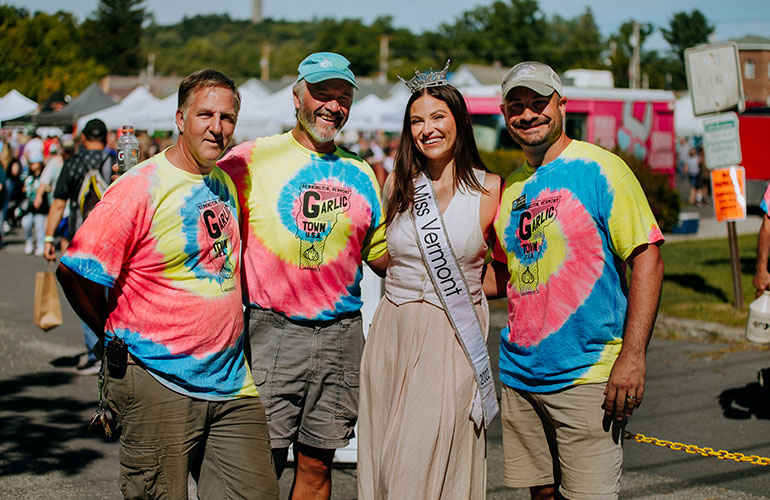 Photo: Matt Harrington with volunteers and Miss Vermont at Garlic Town USA 2022. Photo courtesy Southwestern Vermont Chamber of Commerce.
 Photo: Matt directing volunteers at Garlic Town USA 2021. Photo courtesy Southwestern Vermont Chamber of Commerce.
The Manchester chamber might have gone under, but many businesses still wanted services.
“A lot of the Manchester members were saying, ‘Who’s going to run our website? Who’s going to hand out the travel guide? Who’s going to greet visitors? What’s going to happen to our welcome center?’” Harrington said. “They mentioned they were bankrupt on a Friday, and the doors closed on Monday. Everybody who had paid their dues never got any money back. All their assets froze. The welcome center closed. Manchester goes into a panic. ‘Wait a minute, this is our huge travel season. What do you mean we don’t have a welcome center?’ You never want to be in that situation. I don’t think the dues of any Vermont chamber is high. I think they’re probably between $300 and $400 a year."
With the Manchester chamber closed, Harrington and his board stepped up and stepped in.
“We’re just helping Manchester members,” Harrington said. “We ended up floating their website. We ended up handing out the travel guides. We went to all the travel shows. We tried to come alongside them and piece them together and get them to the next year. Within that next year, my board voted to become a regional chamber.”
John Burnham is the executive director of the Manchester Business Association, a marketing organization that works closely with Harrington’s chamber. He said that Harrington’s vision truly helps to support business in the region.
“The organization covers the entire Bennington County, which includes both the North Shire and the South Shire,” Burnham said. “He was instrumental in getting that name change, to really incorporate the fact that the chamber represents businesses throughout the county. Then he worked closely with us and supported us. That relationship continues to grow. And his outreach, his support through his organization, his vision for the entire county versus just Bennington, is phenomenal. It’s great to work with him.”
Manchester is now going through a period of transition. Many of the name-brand outlet centers that drew tourist shoppers for decades have closed because of the competition of online shopping.
“We still have a strong group of designer outlets in Manchester, and we don’t anticipate them leaving anytime soon,” Burnham said. “The other stores are being filled in; it is a reinvention. The designer outlets were such a staple of this community, and people traveled to this area just for those designer outlets. We’re filling in those gaps with some unique experiences and businesses that you just can’t find anywhere else in Vermont — or New England, for that matter.”
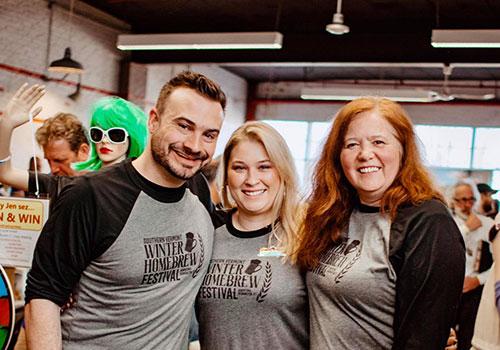
Matt with Chamber staff members Mikaela Lewis center Erika Floriani right during Winter Homebrew Festival. Photo courtesy Southwestern Vermont Chamber of Commerce.
He cited as examples a Japanese homeware store, a women’s boutique, an extension of the Vermont Flannel Company, and an arcade that offers 60 vintage pinball machines to play on.
“Those are just a few examples of unique, specialized experiences that you would only find here in Manchester, or in Vermont, in general,” Burnham said.
Harrington’s connection to the state Legislature, the Vermont Department of Tourism and Marketing and his brother’s Department of Labor ensures that the southwestern part of the state “doesn’t go unseen,” Burnham said.
“He’s a great voice, in that sense,” he said. “And he worked very hard to unite this whole county. That’s a pretty large swath of land to cover. But he manages to make sure he gets around to all the areas. And the events that had to stop because of COVID? He makes sure they come back to life. He sees the opportunity to revamp things that have existed before and make sure they fit with what’s going on today. He’s approachable, friendly and helpful, and he provides great leadership.”
Fighting Charges of Racism
After a two-year campaign of mostly online racial harassment forced former State Representative Kiah Morris from office in 2018 — and ultimately, from Bennington — the town gained a reputation in some circles as being racist and ultra-conservative. Harrington thinks the community has gotten “a bad rap” and been turned into “a punching bag.
“I think with Kiah Morris and a couple of others, it’s just really unfortunate,” he said. “Yes, we have a few bad apples. But once you start to gain that reputation, that reputation sticks with you. There are other racial things that happen throughout Vermont, throughout New England and throughout the US. Yet, for some reason, Bennington keeps ending up in The New York Times.
“But trust me,” he added, “Bennington knows this. And it has worked extremely hard to reform its police unit and make them a little bit more community minded. We went through a two-day diversity training at the state level for all chamber directors. The select board in Bennington has gone through extensive diversity training. Other institutions, like the hospital and the colleges, have done it. It definitely is in the forefront of our mind.”
According to Harrington, downtown Bennington is “buzzing.” The completion of Phase 1 of the $31 million revitalization of the historic Putnam Block — a vibrant, mixed-use development of offices, residences, restaurants and retail — has been a major game-changer for the town, Harrington said.
“It has spurred on massive economic development in Bennington at this moment,” he said. “What we have seen with the block being developed is other businesses investing in Bennington. One example? A group bought the former town garage, which was a dilapidated building used to store salt and equipment. They built a multimillion-dollar distillery, which is called the Village Garage at the moment.
“Across the street from the Putnam Block, a Manchester person purchased a building and inserted Farm Road Brewing. Up the road, somebody purchased the old former high school/middle school and started to turn that into a community center and apartments. Another person is buying two other factories to turn them into usable space. It’s been amazing over the last two, three, four years now. The Putnam project was a catalyst that gave permission to other people to invest.”
County Economic Development
Bennington County, like much of Vermont, is dealing with a housing shortage, supply-chain issues, a lack of child care and a workforce shortage. Having an influx of movie stars (Alex Baldwin; Susan Sarandon; and the new Marvel hero The Flash, also known as Ezra Miller, own homes in the area) neither helps nor hinders economic development. But economic development is happening all over the county.
“I’m confident about Bennington,” Harrington said. “Bennington’s got a kind of blue-collar, stubborn Vermont way about itself. It will survive. It will continue on. And I think we’re putting some polish on Bennington that is well-deserved and needed. Arlington is another area that all of a sudden, three or four restaurants have moved in there. Somebody purchased the old Arlington Inn and made it into a spa and boutique hotel. So even Arlington has become this neat little haven. But Manchester is going to be the one to watch in the next 10 years to see what people do with it.”
Providing affordable housing and a ready workforce are especially difficult challenges for Manchester, Harrington said.
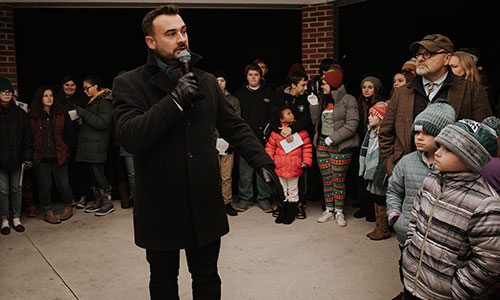
Matt Harrington welcomes crowds to the Chamber and Vets Home Holiday Tree Lighting in 2018. Photo courtesy Southwestern Vermont Chamber of Commerce.
“Residents swell to 30,000 to 40,000 people in summer and fall,” Harrington said. “It’s very service focused. You’ve got to have the bellhops; you’ve got to have the restaurant busboys. And they can’t live in Manchester; it’s too expensive. Also, we have to find them. If you look across the nation, everybody’s dealing with the lack of workers for a variety of reasons. But our job is to solve that for ourselves.”
There is power in being small, Harrington said.
“We are a small county and a small state,” he said. “And that potentially could be used for strength, like we did with COVID, where people were stuck in New York and Boston and these sweltering metropolitan areas. We saw a great exodus from those areas up into Vermont. We’re one of the first stops. Southern Vermont is so close to those areas that we should be the first one to welcome those people.”
Vermont needs to do more than attract people, Harrington said.
“I don’t know how much we’re talking about retention,” he said. “We’re all about attracting, attracting, attracting. Get people to move to Vermont. And because I’ve been in the front lines, I see people moving to Vermont, staying one year, saying ‘You have bad internet and bad cell phone service, and there’s no place to get lunch on a Monday or Tuesday. And I’m not getting paid what I would have gotten paid elsewhere.’ So, they leave.”
Harrington thinks the chamber has to grapple with these problems, not only by recruiting people but by providing them with better, more up-to-date services.
“We’ve got all the leaders in all the towns in the county knowing that these are problems,” he said. “What has me optimistic is that I think we will solve most of the problems in the next three to five years.”
The Future
Chambers don’t exist to solve marketing problems for small businesses, Harrington said.
“We’re not there to figure out their books for them,” he said. “We are here to be a partner. When they have a challenge or an issue, we’re here to help. If they’re looking for a permit to open, we can advocate for them, from small-town government all the way up to the governor.”
For chambers to attract and support new businesses, especially those run by young entrepreneurs, Harrington believes he and his staff must be good “connectors.”

Matt Harrington, executive director of the Southwestern Vermont Chamber of Commerce in downtown Bennington. Photo: Baldwin Photography.
“You’re hosting a party, you need flowers: Why don’t we connect you to a business that has flowers?” he said. “That’s the catalyst part, which is what we should be in the chamber. Technology is important. Yes, social media is important. But at some point, you need to walk through the front door and shake the business owner’s hand and say, ‘What keeps you up at night?’ We do roundtables throughout the year — that’s how I always start. Whether it happens to be staffing or HR problems, it’s OK. What can the chamber do to help you get a better night’s sleep?”
Residents must be mindful to not indiscriminately attack their public officials — a phenomenon we have seen more of over the past several years, Harrington said.
“We need to protect our civic leaders,” he said. “In every little community, for example, there’s a person who wants to file a Freedom of Information Act for the entire world, which bogs down either our election system or our community leaders. I think that is actually going to deter and discourage finding more civic leaders. But the different generations are trying to figure out how to make it worthwhile to give your time. That is something positive we can work on.”
Bennington County must also continue to welcome people of all races, religions, cultures and ethnicities, Harrington said. He praised the county’s embrace of Afghans who fled their homes and settled here after the Taliban took over their country.
“We need to be welcoming to people of Black and African descent,” Harrington said. “We need to be welcoming to Jews. We need to be welcoming to refugees and other immigrants. And we have to continue to be welcoming to city dwellers. Historically, you’re not a Vermonter until you’re eight generations in; we need to stop that. We want Vermonters for the first generation, especially if they’re going to add tax dollars and raise their family and use our schools. I don’t really care where they’re from. We need to make Vermont more accessible.”
One of Bennington County’s most important assets is its proximity to New York City, the Berkshires, Saratoga and Albany. But its greatest strength, according to Harrington? Being in Vermont.
“I take a drive up through Vermont for some conference or other,” Harrington said. “When the trees actually start to engulf you on some of those highways, you go, ‘Oh, right.’ This is when you’ve really hit the peak of Vermont. You’re in Middlebury. You’re in Brandon. You’re driving through those back roads. Then you get back in Bennington and it still feels like Vermont, but it’s definitely got some urban flair to it.”
Harrington intends on staying with the chamber; he’s found his sweet spot, and he knows it.
“Babe Ruth is famous for saying, ‘I swung at every pitch, I just happened to hit a quarter of them,’” he said. “And that happened to be the home run record. I’m not that guy. I’m not trying to hit for the stands every single time. I’m the one who wants to methodically get on base every time, and every now and then, hit a homer.”
Joyce Marcel is a journalist in southern Vermont. In 2017, she was named the best business magazine profile writer in the country by the Alliance of Area Business Publishers. She is married to Randy Holhut, the news editor/acting operations manager of The Commons, a weekly newspaper in Brattleboro.
