

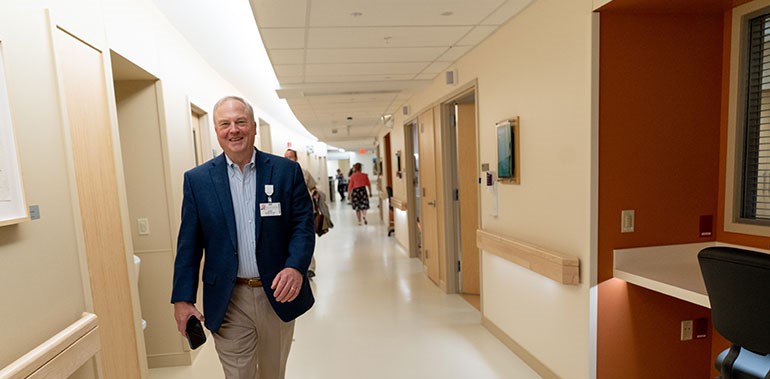
Photo: Dr John R Brumsted, the retiring president and CEO of the University of Vermont Health Network. Courtesy photo UVM Health Network.
by Joyce Marcel, Vermont Business Magazine Dr John R Brumsted, the retiring president and CEO of the University of Vermont Health Network — a network he has largely created — has his heart in two places: Vermont and New York's North Country. Perhaps that's why he has spent so much of his distinguished career joining the two regions together medically.
Brumsted retires from his position on November 27, 2022. His successor will be Sunil “Sunny” Eappen, MD, MBA, who comes from Brigham and Women’s Hospital in Boston, part of the Mass General Brigham network.
Apart from an early stint in rural New York with the US Public Health Service to help pay off his medical education, Brumsted, 69, has spent his entire 30-year career working at UVM.
“When I was growing up in academic medicine, people were bouncing all over, going from one academic medical center to the next one,” Brumsted told me.
But that's not the way it worked out for him.
“Every time I was at a point where I should have made the next move, an opportunity showed up here in our academic medical center that was a very interesting opportunity, and at least in the eyes of an academic physician, an upward move,” he said. “And so I had this incredibly varied career. I never had to leave Vermont or the North Country. I love both of those places, literally, to my very soul.”
When I interviewed Brumsted for this article, by Zoom, he was sitting in his Shelburne home office. I found him to be open, witty and deliberate. As we talked, I could not help but notice that he was sitting under a large and beautiful nature painting. When I asked, he said it was by Burlington artist Katherine Montstream. It turned out to be one of two paintings of hers that he owns; the other is in his home in the Adirondacks.
I think that might serve as a good metaphor for this story.
“I love the Adirondacks,” he said. “That's just part of who I am. But I also love Vermont, I love the outdoors, I love to ski, I love to hike, I love everything about it. I love the people. And so it was unbelievable that I have had this career where I got to do so much neat stuff, so much challenging stuff, work with so many incredibly interesting and dedicated people. And I never had to leave. It's not like I just sort of hunkered down and never saw the outside world. I'm not sure I've been to an academic medical center in each of the 50 states, but I bet I've been pretty darn close.”
 Photo: Dr John R Brumsted, the retiring president and CEO of the University of Vermont Health Network. Photo: Ryan Mercer.
Brumsted was named president and CEO of the not-for-profit UVM Medical Center and UVM Health Network on February 13, 2012, after serving in an interim role since August 2011. Before that, he served in a number of roles at the UVM Medical Center, including chief medical officer, chief quality officer, an earlier appointment as interim CEO, and senior associate dean for clinical affairs at the UVM Larner College of Medicine.
The network Brumsted created has 15,000 employees. Its partners in Vermont are: the flagship of the network, the UVM Medical Center in Burlington; the Central Vermont Medical Center in Berlin; Porter Medical Center in Middlebury; and Home Health & Hospice in Colchester. In New York, the partners are: The Alice Hyde Medical Center in Malone; Champlain Valley Physicians Hospital in Plattsburgh; and the Elizabethtown Community Hospital in Elizabethtown.
“I've said this in many forums,” he said. “I've never made a marketing call. Every place I've gone into, our team was asked to go to talk about what we were doing, tell them our philosophy and see if they would join.”
Brumsted took the top job at UVM with a clear vision.
“I told the board I wanted to do two things,” he told me. “Remember, this was 11 or 12 years ago. This region was under great stress and strain. It's hard scrabble here. It's a rural region. We need to pull together in a much more integrated fashion. All of the traditional health care delivery system feeds, in the end, to the academic medical center in Burlington. So I told them, 'We're going to develop an integrated delivery system if you hire me.' “
The second part of his vision was to end the fee-for-service model of payment. That's still a work in progress.
“You can't, in my view, survive and be an integrated system if everybody sticks with the fee-for-service method of reimbursement,” he said. “There are inherent problems with it. One is that there's a lot of competition for patients and for delivering health care. And that doesn't always mean that the care is delivered at the right time or at the right place.”
If medical practices must compete for patients to get the reimbursement that keeps the doors open, how can they develop an integrated system?
“So I said, 'We've got to get rid of that, too,'” he said. “We're going to do everything we can to move to more of a managed care capitation. And go figure, I've been jumping up and down about that in previous roles for the seven or eight years before that. And so they said, 'OK, let's see if you can do that.' And that was the mandate under which I was hired. And we've stuck with those two core philosophies: an integrated delivery system and a move to what's now called 'high-value care,' which means it's not fee-for-service. You're paid to take care of a population of patients' needs.”
These might be difficult concepts for a layperson to understand.
“Fee-for-service” is clear. It means if you get sick, you see a doctor. Then either you or your insurance is billed for the transaction. Or if you need your appendix out, the doctor and the hospital will send a bill to you or your insurance company.

Dr John R Brumsted, the retiring president and CEO of the University of Vermont Health Network. Courtesy photo UVM Health Network.
“If you're getting paid to do transactions, you do a lot of transactions,” Brumsted said. “I guess we pay attention to the preventive stuff, but the reimbursement for the preventive stuff is way less than if you need your hip done. But the mission of our not-for-profit organization is to improve the health of the communities we serve.”
Payers such as insurance companies and the federal government, Brumsted said, should consider the whole population the hospital serves, figure out how much it should cost to provide care to that population, and pay for that care — upfront.
“If you get paid to take care of the whole population, and you get paid up front, the healthier you keep the population and the better you do financially, I suppose, which totally meets our mission,” he said. “Medicare Advantage is a form of this. The companies that sell it get paid a lump sum by the federal government to take care of everybody's needs that are part of the group. They don't do it transaction by transaction. Essentially, rather than getting paid every time somebody needs something, you get paid in advance. And it emphasizes that you do everything you can so that they don't need expensive services. They don't need heart surgery. They don't need their hip replaced.”
The federal government is amenable to this form of payment, Brumsted said. So are many — but not all — health insurance companies.
“Some need to be convinced, and some haven't been convinced yet,” Brumsted said. “Most of the big players do develop these kinds of relationships. And Vermont has, over the past six years, had a very unique deal with the federal government through the Medicare program. It goes by the terrible name of the 'All-payer Model,' but essentially, for the population of Medicare and Medicaid beneficiaries that have a primary care doctor, in our broad network we do get prepaid. The money comes in and we provide the services. And particularly for Vermont Medicaid, it works incredibly well. There still are things that we can improve, but we're working with the federal government through the Agency of Human Services to try and extend that program for another five years.”
During the recent pandemic, Brumsted revisited his two mandates with his board.
“I took those two core philosophies back to our board of trustees and said, 'Are you still good with these as being our true north?'” he said. “And we went through a whole lot of the information we'd gotten from external sources to check and make sure that we were on the right path. They confirmed, 'Yeah, we're on this path.' And with those core philosophies, we have attracted clinical and administrative senior leadership from around the country who are very attracted to that transition away from fee-for-service medicine.”

Dr John Brumsted addresses the news media in front of UVMMC on March 12, 2020. The hospital had just admitted its first COVID-19 patient. No one was masked, as that protocol was yet to be issued. Brumsted had suggested the media spread out. They did not. "I'm not kidding," he said. Vermont Business Magazine photo.
Brumsted is far more than a hospital administrator. He's board-certified in obstetrics and gynecology and reproductive endocrinology and infertility, is a member of the UVM Medical Center's Department of Obstetrics and Gynecology and a tenured professor of obstetrics and gynecology at the Larner College of Medicine.
Once a physician's medical training is complete, they have a choice of roles. Among them are clinical practice, teaching, research and administration.
“I was very clinically and teaching-oriented,” Brumsted said. “So from the time I completed my training, right up until 2011, when I was asked to be the interim CEO of the then Fletcher Allen Health Care, I had a very active surgical and infertility practice. And even when I was CEO for the first couple of years, I didn't keep going to the operating room, but I did do consultations and work with residents and demos and training and that sort of stuff. So my entire career I was very active clinically.”
Allie Stickney is the chair of the UVM Health Network Board of Trustees, a board on which Brumsted also sits until his retirement. She has had a front-row seat as Brumsted built the health network. She calls him “focused” and “a very principled person who is also very kind.”
“He is committed to making sure people get the best health care possible,” Stickney told me. “And he has this wonderful vision for the kind of integrated health network that can be created. And we're in the process of trying to create that here in Vermont and the North Country in New York.”
Brumsted understands the problems that come with rural medicine, Stickney said.
“We're a group of six hospitals, a home health agency and a physicians group,” Stickney said. “And we've come together to try to provide the right care in the right place at the right time. People accessing health care close to home is the best way. That's what we want. But for folks who need to travel someplace for more specialized care, we want to be able to provide that through our health network.”
The day of the entrepreneurial physician seems to have ended.
“The one-doctor or even four-doctor practice in a small community is a very hard thing to do anymore,” Stickney said. “So I think there's a lot of realization that networks are the direction things are going.”
Building a health network does not happen without criticism. Some feel that hospitals, in their attempts to create networks, “gobble up” private practices, as has happened in Windham County. That is not the way the UVM Health Network was created.
In 2010, Hinesburg Family Medicine joined UVM Medical Center, and in 2014, Green Mountain Family Practice in Northfield joined Central Vermont Medical Center. Those are the only two.
“Building a network is not an arm-twisting saga,” Stickney said. “But there's no doubt that folks in smaller institutions or in smaller communities said, 'Am I gonna get swallowed up by the big gorilla?' And some in the larger organizations worried that their contributions would be overlooked. That's a constant dynamic in bringing organizations together. One has to pay attention to it. It's definitely a work in progress. And I think we've made a lot of progress.”
Making sure equity is built into the system is a vital part of providing rural care.
“It means that people, regardless of income or geography, color, or background, have had equal access to health care,” Stickney said. “That's something we've struggled with mightily, but it's something that is part of this mission.”
Stickney added that Brumsted has created a “culture of trust” with the board.
“The board does not get involved in operations,” she said. “And so we honestly don't know what goes on every day. We certainly look at lots of clinical and financial data, but how we work together has to be built on trust. And he has been excellent, just excellent, at building a culture of trust. He's not a withholder. He shares information, totally and completely, on any question we want to ask. He's not afraid to draw the line between management and governance. He's not afraid to say "no," but he's a real sharer of information.”
Speaking of the “big gorilla,” there's also the New York-Vermont piece, Stickney pointed out.
“We can't be too Vermont-centric because we've got colleagues on the New York side,” she said. “So one of the things that John brings to the table is his having been born and raised in New York and having spent time as a public health physician In rural New York. He actually has a really nice feel for what it's like to practice in a small town. And at the board level, he has been very good bringing both perspectives to the table.”
Brumsted is widely praised as a leader, said Dr Tucker Slingerland, a family physician who who serves as CEO of Hudson Headwaters Health Network in New York State. Hudson Headwaters is a network of 19 community health centers across 5,600 square miles of the Adirondacks and northeastern New York. It leans toward UVM, but is not part of its network.
Slingerland first met Brumsted when he was training at UVM and leaned on his advice later on when he found himself also building networks.
“First and foremost, I think he's a doctor” Slingerland said. “I think that's a key aspect of his leadership style. He is always thinking first of patients. A lot of his work was really management at the regional and statewide level. But first and foremost, he is a physician.”
Slingerland credits Brumsted for providing medical care to a very wide and underserved area.
“If the UVM Health Network was not in place, the North Country in New York would be profoundly vulnerable,” Slingerland said. “John appreciated that. In the end, there's quite a few folks who live over here. And they've also been a good source of patients for the medical center.”
Early Years
Brumsted grew up in Ithaca, NY, the son of a Cornell University faculty member.
“So I always grew up in a household that valued academics and the pursuit of knowledge,” he said. “It was a great place to grow up because of Cornell University being right there, obviously.”
His father was one of the first professors of conservation and natural resources.
“He got his PhD in the early ‘50s from Cornell in ecology,” Brumsted said. “At that point nobody really even tracked ecology. I remember, probably in the 1960s, my father being vehemently against our burning of fossil fuels, if you can believe that. In the '60s! People thought he was kind of wackadoodle from that perspective, but that was his thing. And he had an amazing career as a Cornell professor, mainly working to help mostly private landowners figure out how to preserve and manage their lands.”
Brumsted's mother, along with her two sisters and three brothers, grew up on a big farm in western New York. They all graduated from Cornell.
“And so graduating from Cornell was kind of a family affair,” Brumsted said.
The Brumsteds had four sons; Brumsted is the second-born. As he was growing up, his mother was "100% mom."
“But my mother also worked for the athletic departments, arranging athletic events,” he said.
Most of his friends' parents were working for Cornell.
“Our high school class, which at that point was close to 700 kids?” he said. “I bet half of them were from families that worked in the university setting. I never really, in my career, wanted to not be in an academic setting. I had a brief stint when I was in the Public Health Service for a few years that wasn't strictly an academic setting, but other than that, I've been associated with academic medicine.”
Besides education, his parents were passionate about service.
“They grew up during the Depression, and my mother grew up on that big farm,” he said. “They had a lot of connections with the community; they provided a lot of food for people who were getting through hard times. So I think service and giving back to others, and valuing what others have to say, are what I learned from them. Those are kind of tough lessons for a young guy, particularly one who goes into medicine. But I've gone back to that many, many times. Everybody has a story, everybody has something of value to say. That, particularly, was my mother, and she could be pretty direct if she caught you not listening to people or talking over them.”
Born with something of an entrepreneurial streak, by the time he was 14 or 15 Brumsted had his own landscaping business.
“Essentially, I had a whole cadre of people's lawns and sidewalks and gardens and things like that that I took care of, depending upon the season,” Brumsted said. “I loved the flexibility. I could do what I wanted to do as long as I made sure that their lawns were mowed and their sidewalks were shoveled. I did that right up until the time I went to college.”
For all of his family's connections to Cornell, Brumsted chose to go to college at Dartmouth University.
“I didn't go to Cornell undergraduate because I wanted to get out of town,” he said. “I'd been in Ithaca for 18 years, and I wanted out.”
It was at Dartmouth that the idea of a career in medicine “evolved,” he said.
“I was always incredibly interested in science,” he said. “And my grandmother's sister was one of the first women to graduate from medical school at the State University of New York upstate, in Syracuse. As far as I know, that's the only other physician in my family. And even when I was an undergraduate at Dartmouth, I was kind of torn between medicine and business. I remember walking toward the end of Dartmouth campus that has the medical school and the biology and chemistry buildings, and walked right past Tuck Drive, which goes down to the Tuck Business School. And on many occasions, I was thinking about the Robert Frost poem and which of those roads I would take. It only struck me 15 years ago that I ended up doing both. I'm sitting atop a pretty big organization. To me, it's more than a business, but there are huge business aspects. And I became a doctor, so go figure.”
He went to Dartmouth Medical School because he couldn't get into Cornell.
“I applied to a whole bunch of medical schools and I got into two — both of them off the waiting list,” he said. “When I was at Dartmouth, I had a pretty good time. I did hit the books, but obviously not hard enough. So I got into SUNY Buffalo and Dartmouth. And I decided to go to Dartmouth Medical School because at the time they were experimenting with what's normally a four-year course. They had compressed it to three years. I was enamored with working hard, but also getting medical school behind me so I could get on to the next aspects of training and being a physician. So I ended up going to Dartmouth. But I did apply to Cornell and they didn't let me in.”
US Health Service
Soon after he received his MD, Brumsted joined the US Public Health Service in Randolph, NY.
“I had to pay for medical school,” he said. “I had a National Health Service Corps Scholarship where they paid your tuition, they paid you a bit of a stipend, and you owed them a year back. I did a surgical internship at Hartford Hospital in Connecticut. After that internship, the US Public Health Service said that they weren't interested in having me complete my surgical training. They wanted me right then. I would have much preferred to complete my training and then go, but they took me. So I was a town doc in a small town of 3,000 or so in far southwestern New York State. Randolph is in essentially the northernmost reaches of the Appalachian Mountains. About 90 miles west you get to Erie, PA. And 90 miles northwest you got to Buffalo. So it was pretty long ride to get to a tertiary care hospital for folks from that community.”
Brumsted liked being a small-town doctor.
“I really enjoyed it,” he said. “And I wrestled mightily with staying or going and completing my training. And I think it was the just the knowledge of how little I knew and that I was doing on-the-job training that wouldn't serve that community very well. So I worked hard to get a replacement doc to come in and I came back to Vermont, to what is now the University of Vermont Medical Center, for my training in OB-GYN.”
In Vermont
Brumsted's first faculty job was in the subspecialty of reproductive endocrinology and infertility at UVM Medical Center.
“I did want to be in Vermont for my first faculty job,” he said. “One of my mentors, Dr Mark Gibson, had started the Division of Reproductive Endocrinology, and I was the second faculty member. So that was a unique opportunity to be sort of boots-on-the ground.”
Early in his career, Brumsted learned a hard lesson in how to manage change.
“I learned if you're moving big change, you have to make a very intentional assessment and decision on the organization's capacity to accept that change over a given course of time,” he said. “I really learned this in the 2004-05 timeframe, when I was charged with being the lead physician for our faculty practice, and all of the departments were kind of independent — OB-GYN was over here, surgery was over there, medicine was over there. I was charged to pull them together. And that was my vision as well — to have it really function as one large, multispecialty group sharing infrastructure. That, in and of itself, was a big change — to have the leadership come together and make joint decisions rather than making decisions for their own organizations.”
At the same time, he decided to change the compensation structure to equalize physician pay. Some of his advisers warned him that he was doing too much, too fast. He didn't listen.
“There was a tremendous pushback that went to the dean and the CEO, and they fired me,” he said. “Well, after that I practiced more and taught more and thought a lot about change and change management in a large organization. You have to think about the capacity for those that you're asking to change to accept, both in how much change you're pushing, and the timing. And I've thought about that so many times when we've done big things here.”
His time in the wilderness didn't last long.
“Then I got invited back to be the chief quality officer for them at the academic medical center, and ultimately became the chief medical officer, again over a broader scope of services, and then ultimately, this position,” he said.
Having an Impact
Having a positive impact is extremely important to Brumsted, who said that the doctor-patient relationship is one of the best relationships he has had.
“That one-on-one interaction, which I don't think can be surpassed, is what I've found in academic medicine,” he said. “And I pass this on to the many, many others that I've mentored. Being in academic medicine, you find ways to multiply what your impact can be.”
Another way to multiply impact is by teaching.
“The more people you teach in your specialty, they're going to go out and they're going to have an impact,” he said.
One of Brumsted's students was Slingerland, now of Hudson Headwaters. He was a family medicine resident under Brumsted at UVM and remembers how Brumsted ran the birthing unit.
“You rotate through labor and delivery,” Slingerland said. “At that point, John was one of the teaching attendants and provided coverage for nighttimes. I remember helping with at least one or two deliveries where John was also present. It's important to say that he has a lot of confidence in the people that work around him. I remember him being the kind of teacher who let the residents do a delivery and work through the issues that came up. He was always there to intervene if needed, but he had confidence in the people training under him. As long as I've known him, he's always exuded that confidence.”
Impact can also be achieved through research, Brumsted said. “You generate knowledge that spreads the impact and improves people's lives.”
But the greatest impact a physician might have might be in his chosen field, medical administration, he said.
“Particularly if you do it through the lens of a physician or a provider of the services,” he said. “You can have tremendous impact by administering, developing and sustaining programs that deliver health care.”
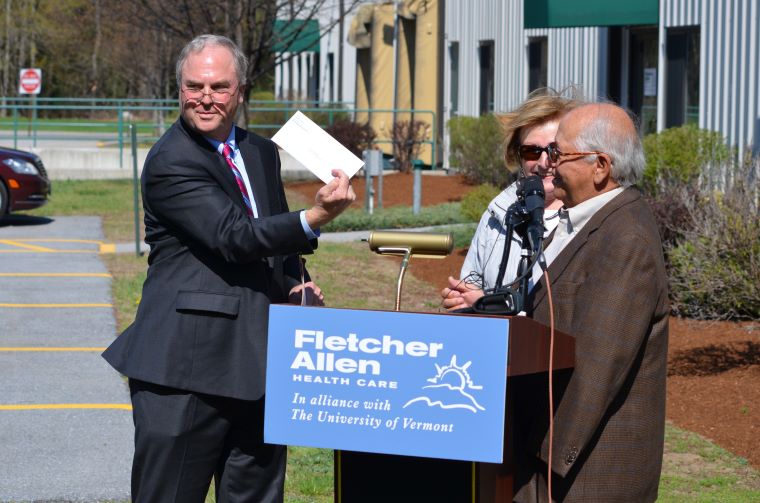
Dr Brumsted shows off the deed to the industrial park Holly Court in Williston, which was given to the hospital in May 2013 by philanthropists Holly and Bobby Miller. Vermont Business Magazine photo.
In the UVM Health Network, he's put 1,000 doctors and another 700 advanced practice people together.
“Obviously, I don't impact every single interaction that they have,” Brumsted said. “But I view that as a multiplier, just like teaching, just like doing research. Constructing and helping to shape how health care is delivered, and making sure that people do have access is, in my mind, directly related to that one-on-one impact that you have when you interact with a patient as a physician.”
Building a Network
The beginning stages of the UVM network started under Brumsted's predecessor, Dr Melinda Estes. The official announcement about the intent to affiliate was in December 2010.
By the time the due diligence process and regulatory review was completed, and the affiliation became official in October 2011, Brumsted was interim CEO.
“Before she left, Dr Estes had formed an association with Central Vermont Medical Center,” said board chair Stickney. “And they began the process of talking about how they could be linked by more than just sharing the ordering of supplies; how could they be linked in a meaningful way. Then when Dr Brumsted came in, he had that vision of creating an even larger network, and bringing in more hospitals, bringing in a physicians group. And eventually, there was the opportunity to link up with what had been known as the Visiting Nurse Association and now is known as UVM Home Health and Hospice. So it was really Dr Brumsted who articulated that it would be really important for us to make sure that all the people in our region have access to the best care possible.”
Because of declining reimbursements into the medical system, there have been pressures on a national level to merge hospitals into networks.
“What we decided to do was to try and include all of the hospitals and as many of the doctors that were employed by those hospitals into one system,” Brumsted said. “And do that around the hospitals that traditionally use the academic medical center in Burlington. The idea is to provide care locally — good access, high quality, and reasonable cost care — but not provide everything in every location.”
This might work well in a rural area where, if a patient cannot get the care they need locally, they can take the next step up and go to a networked hospital that provides the service they need.
“So at a small location, you make sure that their people have access to an emergency room, they have good access to primary care, they have good access to being able to get X-rays, and get lab work done,” Brumsted said. “Those sorts of things. But not every one of these community hospitals needs to have a full-fledged operating room, or needs to do orthopedic surgery. If somebody needs that, we can have them get those services elsewhere in our system. It makes a system much more efficient.”
When the system is working well, it delivers high-quality medical services across the region, Brumsted said. One thing that helps is having an electronic record system shared by everyone in the network.
“It's been difficult to pull this together,” he said. “But in April of this year, we completed putting the Epic electronic record system in all of our doctors' offices and all of our hospitals. So now anywhere in our network, we really are approaching a true system of care. A primary care doctor in Malone, NY, can go on Epic and get an online consultation from a kidney specialist in Burlington without the patient having to drive three and a half hours to Burlington. Unless, of course, that kidney specialist says, 'I've got to see this patient in the office.' And not infrequently, even before going over there, they can do a video visit.”
Remember that big gorilla? While Brumsted was building his network, the word on the street was that he would “gobble up” all the hospitals in the state.
“That was the talk,” Brumsted said. “And that's totally untrue. Again, I've never made a marketing call.”
Some health systems, like St Lawrence County in New York, declined to join the UVM network. But it still sends its patients to UVM when it needs to.
“They asked us to come and participate in the process to see if they wanted to join us,” Brumsted said. “They decided not to. They didn't really want to be as highly integrated.
COVID Comes to Vermont
Brumsted said that Vermont did almost everything right when the pandemic struck in March of 2020.
“I think we had superb leadership from Governor Scott on down, and we had Vermonters that actually cared about each other and so they listened and took some of the public health measures, like masking and vaccination, very seriously.”
Healthcare systems worked together valiantly to combat the disease.
“It really didn't matter what our organization or our affiliation was,” Brumsted said. “We did everything we could to work with state government. And again, that's on both sides of Lake Champlain. Champlain Valley Physicians Hospital was the lead vaccination center for six counties in northern New York. All activities were coordinated. As an example, we started having, right from the beginning, a daily call at four o'clock for leadership from all of our hospitals and our medical group. And we talked about what they have for patients, what they have for beds, what they have for protective equipment. What don't they have? So with all our supply chain issues we started sharing in the network, making sure everybody had N95 masks, everybody had enough gowns, enough gloves.”
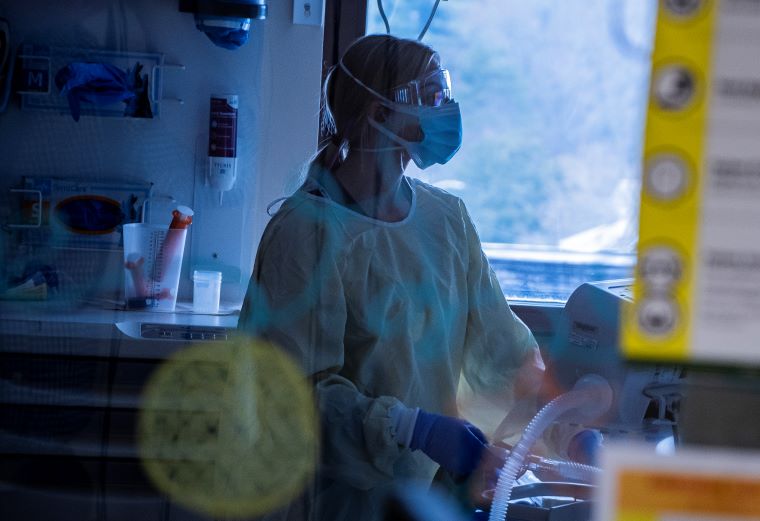
A nurse works in the ICU department treating COVID patients in December 2021, during a surge in COVID-related fatalities. Photo courtesy UVMMC.
The popularity of that four o'clock call grew in time.
“The amazing thing was that other hospital CEOs from around the North Country and Vermont, even if they weren't part of the UVM Health Network, started joining those calls,” Brumsted said. “We're not totally out of the pandemic yet, but from that experience, there is so much collaboration among the healthcare delivery system leadership around our region. It came from the necessity to work together. So we got all of that right.”
Still, he managed to come down with COVID.
“I had COVID the last week of March of 2022,” he said. “And I know the exact time, because we have quarterly board meetings. I was sitting right here in my home office during that quarterly board meeting. I was boosted and vaccinated. And then I went to get my hair cut in downtown Burlington. That's where I made the mistake. I had my mask on, but the guy said it's too hard to cut my hair that way, and we're past COVID anyway, and nobody wears a mask in there. Rather than leaving or saying, 'Could you just cut around it?' I took the mask off. Six days later? It was a bad case for 48 hours. It wasn't fun.”
In July of 2021, the UVM Medical Center was hit with a cyberattack that shut down its computers and cost the hospital approximately $60 million, although it was insured for about half of that.
“Those types of ransom attacks increasingly have hit health care because of the value of the information that they potentially can get,” Brumsted said. “And luckily, they didn't get any information from us. They wanted us to pay them money — I forget how many millions it was. And then they would give us the key to allow all of our servers and all of our laptops and everything to function again.”
The attack was apparently mounted by a group in Eastern Europe.

While the pandemic was still in full force, UVMMC was hit with a cyber attack, so it was back to paperwork, as much of the computer system was compromised. Photo courtesy UVMMC.
“We worked closely with the FBI and Interpol and places like that,” Brumsted said. “It was really a tough time because it is unbelievably frightening and frustrating to health care providers if you're blocked from providing the care that you want to give, because you can't access information. You don't even know in your scheduling system who's going to be showing up next week.”
The attack brought UVM national attention, Brumsted said, “because of how well we actually came out of it, and how quickly, even though it was a painful month and a half or two months.”
Now UVM Health Network people are being asked to speak at national forums about the lessons they learned from dealing with digital terrorism, he said.
Abortion Rights
After the Supreme Court gutted Roe v. Wade, Brumsted came out firmly on the side of women's right to choose.
“The US Supreme Court’s decision in Dobbs v. Jackson Women’s Health Organization — and the subsequent move by politicians in many states to curb or eliminate access to safe abortion services — undermines health care access for millions of people,” he wrote in VermontBiz.
And he issued this statement on June 24, 2022:
“As a health care safety net provider for more than 1 million people, including critical services that our patients cannot receive elsewhere in our region, the UVM Health Network supports preserving access to the full range of reproductive health care. Our policies and our practices regarding abortion services focus on the importance of the patient-provider relationship, and the right of patients to make their own health care decisions. Today’s ruling by the US Supreme Court in Dobbs v. Jackson Women’s Health Organization infringes on that long-established right, and will undermine access to important health care services across the nation. We will continue to stand up for reproductive health care rights and equitable access to that care.”
Medicare For All
Has the UVM system of upfront group payment written off the concept of a single-payer health care system, often called Medicare For All?
“I haven't written off much of anything,” Brumsted said. “Looking back at my career, I've been driven by actually making change, inhabiting the impactful and not just talking about it. And at least in my experience, big change for big groups of us humans requires an incremental approach. And so, Medicare For All, hey, know what that means? I have no idea. If you ask 50 politicians, I bet you get 50, or at least 49, different answers. Medicare for All, or single payer, is philosophically not such a bad idea. But how do you get there from here?”
Although Brumsted thinks fee-for-service is a terrible way to fund health care delivery, he warns that change cannot be sudden and comprehensive.
“You can't totally blow that up overnight,” he said. “It's been 15 percent to 20 percent of our economy for a long time. You have to bring change on incrementally. And so our approach to that right now is to have a deal with Medicare where they pre-pay us for services. We take a big step away from fee-for-service, and align as many of the doctors and providers around that as we possibly can. Is that an end point? Or is that a step towards something like Medicare For All? Philosophically, it's great to have these ideas. But let's get something done. Let's improve the system. That's what's driven me. In medical parlance, I'm surgically inclined. Find the problem and fix it. And if it takes multiple steps, then that's what it takes. I haven't written off Medicare for All. I don't particularly know specifically what it means.”
Brumsted said he has carefully studied the national health services in other countries; he found that they are all different.
“Even the National Health Service in Great Britain has, over the past two decades, developed a parallel for-profit system so that employers and individuals can actually buy insurance,” he said. “And in places like Switzerland and France and Germany, there is a national health service, but there are multiple insurance vendors that provide different ways to fund it. The details matter. Does that mean Medicare Advantage? Does that mean the kind of Medicare and services that people get with fee-for-service? Does that mean having extra coverage through private insurance that covers drugs and some of the other services? Medicare for All requires a lot of definition. And the funding obviously matters. But how it's actually done is very different in different places.”
The Future
On the whole, as he looks back, Brumsted said he is “reasonably satisfied” with the work he has done, especially with the creation of the UVM Health Network.
“We've made progress, but we have a long ways to go,” he said.
“There's always more we can do to coordinate and improve the care and the services that we provide. But we've come together. We've done big things, like all of us having the same electronic health records. We've come together so that we can prioritize and focus our investments, whether it's a new set of generators at Champlain Valley Physicians Hospital, or a building like the Miller building in Burlington. We have one IT department over all of our organizations. We have one HR department over all of our organizations. We've been able to transform and stabilize healthcare in some of the parts of our region where it was very unstable, like Ticonderoga, New York. But there is so much more to do to achieve the vision that wherever anybody touches any aspect of UVM Health Network, you get the absolute same care and quality of care than you do anywhere else in our network.”
Maintaining a standard of care becomes increasingly difficult today, when the nation is experiencing a shortage of doctors, nurses and other trained health care specialists.

Dr John R Brumsted, the retiring president and CEO of the University of Vermont Health Network. Photo: Ryan Mercer.
“There are not enough physicians being trained in this country,” Brumsted said. “I think the medical schools would readily train and educate more physicians. But there's a cap on graduate medical education, internships, and residencies. Those positions are funded largely by the federal government, and there have been caps on the number of positions that are funded for essentially my entire career. There have been predictions for several decades that we're just not going to have enough physicians trained and that's just coming to fruition at a time when we're seeing, in all sectors, a workforce crisis that also was predictable.”
It was predictable, for one thing, because it was clear that the Baby Boomers were going to age out of the workforce. But there were other predictable factors as well.
“We've had declining birth rates,” Brumsted said. “We've had immigration essentially totally shut down. Healthcare is a very tough life. We don't have enough nurses, doctors, cafeteria workers, environmental service workers — it's the same as some big manufacturing sectors.”
Brumsted said that attracting physicians to rural areas is part of what he feels he has accomplished with the network.
“Having been responsible for a large physician group for a lot of my years, I believe the physicians being trained today very much want to be part of a larger system,” he said. “Particularly if they can focus on what they really like to do, which is work with patients, help patients, and have a whole bunch of the other stuff that needs to be done taken care of, while they still have an input into how the care is actually delivered.”
Part of the reason to develop the UVM network, with a large medical group within it, was to provide that sort of support for physicians, he said.
“And you know, as a teaching hospital both in Plattsburgh and in Burlington, a large percentage of the doctors we train do settle in our region, particularly the primary care doctors,” he said. “So we're part of training our own, but it's a big issue, particularly for rural America. And we need to increase the use of very well-trained, capable physician's assistants, nurse practitioners and certified nurse midwives so those providers are working in a team. One physician can serve a lot more patients with that sort of team.”
After he retires, Brumsted plans to take a few months off to reflect on his experiences at UVM.
“We've learned a lot about building an integrated delivery system in a very rural environment,” he said. “And so I'm going to go back through a lot of things I've written about and collected as far as correspondence. I'm going to see if I think there are some things that are valuable to document and to talk about. Again, it goes back to my academic roots, which I really put on hold for the last decade. That's number one. And I have made no firm commitments because I think that there'll be other opportunities to have an impact.”
He also intends to spend time with his family.
“I have seven kids and step-kids,” he said. “I love my family, so I'll do some more of that. But you know, I haven't lost the burning ember to keep trying to have a positive impact and to serve. So we'll see how that plays out.”
Joyce Marcel is a journalist in southern Vermont. In 2017, she was named the best business magazine profile writer in the country by the Alliance of Area Business Publishers. She is married to Randy Holhut, the news editor/acting operations manager of The Commons, a weekly newspaper in Brattleboro.
