

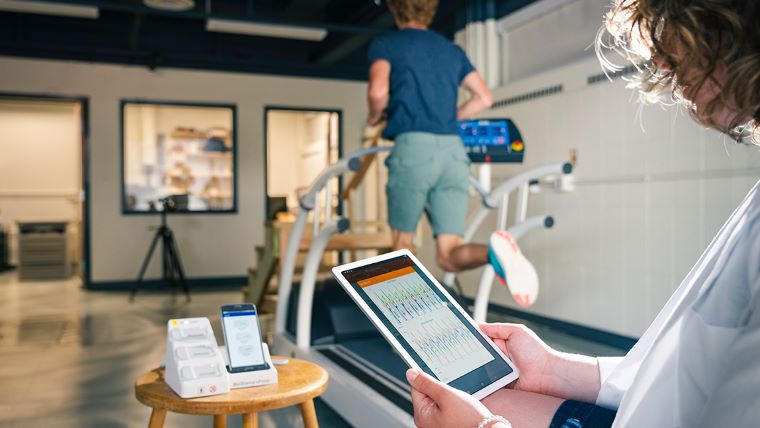
Photo credit is Bailey Beltramo: Fall risk detection is just one of many potential applications of the new Sensor Network’s efforts. As one of the health technology innovators involved in the network, UVM is at the forefront of revolutionizing patient care and positive outcomes.
Vermont Business Magazine A reduction in the number of falls that multiple sclerosis patients experience could someday be among the outcomes of the University of Vermont’s participation in Medidata’s Sensor Cloud Network.
“We are leveraging the tools and technology available in the Medidata Sensor Cloud Network to advance and accelerate our work in the development of fall risk detection algorithms in the multiple sclerosis population, a disease that affects 2.3 million patients worldwide, 50% of whom will experience a fall that negatively impacts their quality of life,” said Ryan McGinnis, director of UVM’s M-Sense Research Group, which develops innovative health technologies with partners in engineering, medicine, mental health and movement science.
UVM, along with eight other highly innovative organizations, is joining the Sensor Cloud Network as part of Medidata’s rapidly expanding approach to patient care.
Medidata, a Dassault Systèmes company, has announced that AliveCor, Aural Analytics, Biobeat, Blue Spark Technologies, Glooko, Indie Health, University of Arizona, Carnegie Mellon University, University of Rochester, and University of Vermont are now part of the first cross-sector collaboration focused on solving the challenges related to sensor integrations, standardization of sensor data, and the development of novel digital biomarkers and algorithms. These will help to create new digital endpoints that could translate into more effective treatments and better healthcare for patients. Fall risk detection is just one of many potential applications.
As one of the health technology innovators involved in the network, UVM is at the forefront of revolutionizing patient care and positive outcomes. The University has emerged as a leader in biomedical research in recent years, through its ABET-accredited Biomedical Engineering program, which is unique in its field because of its proximity to the University of Vermont Medical Center (UVMMC), and the launching of its vibrant Center for Biomedical Innovation.
Through its work with the Sensor Cloud Network, UVM builds upon its groundbreaking research in the biomedical arena.
The Sensor Cloud Network, which includes contract research organizations (CROs), device manufacturers, drug and vaccine developers, analytics companies, and academic institutions, creates opportunities for data scientists to refine, test and deliver physiological algorithms with clinical meaning at scale. Examples include refined motion parameters like gait, cardiovascular metrics, metabolic insights, and clinical grade speech analytics.
“The Sensor Cloud Network is allowing us to explore the combination of patient reported outcomes and medical grade wearables data in remote settings at scale to better understand this problem and to develop a digital intervention,” McGinnis said. McGinnis is an associate professor in the Department of Electrical and Biomedical Engineering in UVM’s College of Engineering and Mathematical Sciences.
Medidata is a wholly owned subsidiary of Dassault Systèmes, which with its 3DEXPERIENCE platform is positioned to lead the digital transformation of life sciences in the age of personalized medicine with the first end-to-end scientific and business platform, from research to commercialization.
“As the use of sensors in clinical trials is predicted to reach 50% by 20251, we are focused on making Medidata Sensor Cloud the industry standard for collecting and analyzing medical grade sensor data,” said Ben Schlatka, vice president, Digital Biomarker Solutions at Medidata. “We are excited to work with a diverse group of partners to help shape the future of patient data collection and analysis, and make Sensor Cloud the platform of choice for developing new digital biomarkers across a wide variety of therapeutic areas.”
1. Y. Jansen and G. Thornton, “Wearables & Big Data In Clinical Trials — Where Do We Stand?,” Clinical Leader, February 2020. https://www.clinicalleader.com/doc/wearables-big-data-in-clinical-trials-where-do-we-stand-0001.
About the College of Engineering and Mathematical Sciences (CEMS)
At the UVM CEMS, faculty and students don’t just solve for X; they are part of a larger equation and the CEMS community reflects that. Students view each other as collaborators, not competitors; stellar professors are also active scientists who bring new knowledge to the classroom and welcome undergrads into their labs. Team-based, hands-on learning and faculty mentoring, along with dedicated professional career advising are among the reasons 97% of CEM’s students are employed or continuing their education within six months of getting their degrees. Many also take advantage of UVM’s ten Accelerated Master’s options in STEM disciplines—earning a B.S. plus M.S. in just five years. Learn more at www.uvm.edu/cems.
About the University of Vermont
Since 1791, the University of Vermont has worked to move humankind forward. UVM’s strengths align with the most pressing needs of our time: the health of our societies and the health of our environment. Our size—large enough to offer a breadth of ideas, resources, and opportunities, yet intimate enough to enable close faculty-student mentorship across all levels of study—allows us to pursue these interconnected issues through cross-disciplinary research and collaboration. Providing an unparalleled educational experience for our students, and ensuring their success, are at the core of what we do. As one of the nation’s first land grant universities, UVM advances Vermont and the broader society through the discovery and application of new knowledge.
“UVM” is an abbreviation of the Latin Universitas Viridis Montis (in English, University of the Green Mountains).
About Medidata
Medidata is leading the digital transformation of life sciences, creating hope for millions of patients. Medidata helps generate the evidence and insights to help pharmaceutical, biotech, medical device and diagnostics companies, and academic researchers accelerate value, minimize risk, and optimize outcomes. More than one million registered users across 2,000+ customers and partners access the world's most trusted platform for clinical development, commercial, and real-world data. Medidata, a Dassault Systèmes company (Euronext Paris: FR0014003TT8, DSY.PA), is headquartered in New York City and has offices around the world to meet the needs of its customers. Learn more at www.medidata.com.
About Dassault Systèmes
Dassault Systèmes, the 3DEXPERIENCE Company, is a catalyst for human progress. We provide business and people with collaborative 3D virtual environments to imagine sustainable innovations. By creating virtual twin experiences of the real world with our 3DEXPERIENCE platform and applications, our customers push the boundaries of innovation, learning and production to achieve a more sustainable world for patients, citizens, and consumers. Dassault Systèmes brings value to more than 300,000 customers of all sizes, in all industries, in more than 140 countries. For more information, visit www.3ds.com
3DEXPERIENCE, the Compass icon, the 3DS logo, CATIA, BIOVIA, GEOVIA, SOLIDWORKS, 3DVIA, ENOVIA, NETVIBES, MEDIDATA, CENTRIC PLM, 3DEXCITE, SIMULIA, DELMIA, and IFWE are commercial trademarks or registered trademarks of Dassault Systèmes, a French “société européenne” (Versailles Commercial Register # B 322 306 440), or its subsidiaries in the United States and/or other countries.
Source: UVM BURLINGTON, Vt. — 7.13.2022
