


Raj Peter Bhakta. Courtesy photo.
by C.B. Hall, VermontBiz
Some 150 local residents packed the dining hall of Poultney's former Green Mountain College Thursday evening to hear entrepreneur Raj Peter Bhakta describe his plans to transform the 121-acre campus into a resort complex with seemingly everything that anyone could want – and the economic base that the struggling Rutland County town has longed for since the college closed its doors in 2019.
Through his LLC, Regenerative Land Holdings, Bhakta acquired the property at auction in 2020, for about $5 million.
Bhakta articulated his plans in chatty and often humorous opening remarks; but, having offered the carrot of his vision, he yielded the floor to his business partner, Leo Gibson, who presented the stick of what he termed "the bad news": The ambitious development venture, with its price tag in the $100 million range, is likely to come to naught without the moral and financial support of the town, the latter in the form of a tax stabilization initiative on which Poultney voters will vote on Town Meeting Day.
The ballot question, which Bhakta and his associates placed on the town meeting warning by petition, asks, "Shall the Town provide limited authority to the Selectboard to explore the possibility of entering into a tax stabilization agreement with Regenerative Land Holdings, LLC to promote [the development project], which agreement shall become effective upon ratification by a majority of those present and voting at an annual or special meeting warned for that purpose... ?" Under state law, a tax stabilization cannot last more than ten years.
Tax stabilization, Gibson said, "isn't a giveaway. It's not a free ride. It's a necessary tool" for reviving the campus property, which has for the most part fallen into disuse since the college closed. A brief PowerPoint told the attendees that the property needs massive infrastructure investments "to bring the campus into the 21st century." Without that infusion, the PowerPoint warned, "the campus will rot."
Thus far Bhakta has underwritten the venture with family reserves. "It's costing my family $2 million a year to keep the place up," he said.
When it took possession of the real estate, he said, Regenerative Land Holdings, as a profit-making company, took on property tax liabilities of a little over $100,000 a year, five times those of the college, which owned a few taxable residential properties in addition to its main campus parcels, which enjoyed the educational institution's tax exemption. VermontBiz was not able to immediatley corroborate the college's tax obligation.
Pressed on what might happen if the voters turned their thumbs down on the tax stabilization initiative, Bhakta stopped short of predicting doom, but did say that it would become "much more likely that this [project] won't happen."
Alluding to the ballot question, he told his listeners that his undertaking "will really require your support – and your active support."
In an interview after the meeting, he said that he and Gibson had also been soliciting help from the state.
"We've been in touch directly and indirectly with the governor and key members of his cabinet, as well as many legislators in the House and the Senate."
In his January state-of-the-state message, Governor Phil Scott urged the creation of "more tools to revitalize vacant, and once vibrant properties, including some of our shuttered campuses, like Green Mountain College."
Making It Palatable For Investment
In his opening presentation, Bhakta said that tax stabilization would "make this investment much more palatable" to potential financial backers. He also raised the possibility that, if his plans failed and he has to sell the campus, it might wind up in the hands of a religious institution which has demonstrated interest in acquiring it – and which would exercise its tax exemption. In his interview with VermontBiz, he declined to name the institution, but said it was "knocking on the door."
Bhakta said that, as an alternative to real estate taxes on assets to be built on the property, he was proposing his current $100,000 tax bill as a "base," to which a surcharge equivalent to a quarter of a percent of the development's gross revenues would be added – creating what might be termed a hybrid municipal tax on both property and income.
"If we hit the goals, this will mean an additional $50,000 in the near term," he calculated, assuming a revenue total of $20 million a year.
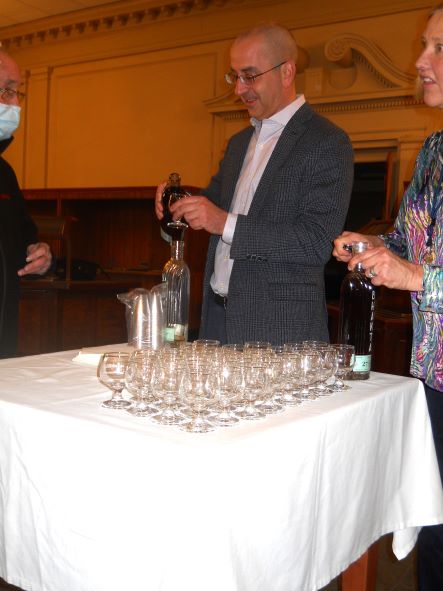 At the refreshment table, Jack-of-all-trades Leo Gibson handles the brandy: 90% apple brandy from Normandy and 10% grape brandy from Armagnac, France. C.B. Hall photo.
The very ambitious plans laid before the mostly supportive audience encompassed a 100-room luxury hotel fashioned out of existing college buildings, a convention space in another former college hall, a micro-distillery, an ice skating rink, 19 new residences, a post-graduate school for hospitality-related studies, eateries, a brewery, a coffee roasting plant, gardens, a chocolatier, and an equestrian center.
"We're going to blow it out of the water," he described the plans.
The meeting was dominated by a contrast between the vision of what he termed "a magical place" in a prospering town, and the unpleasant prospect of a campus degenerating into a useless relic and possibly winding up in the hands of a new and possibly tax-exempt owner who would make little or no contribution to the community's well-being.
The slide presentation foresaw the development project unfolding over seven years. In response to a question, Bhakta estimated that the completed complex would have a payroll "in the 100 to 200 range." Green Mountain College maintained a payroll of about 150.
Fulfillment of the plans will also necessitate a change in the property's current zoning to allow for mixed use of the campus and its approximately 450,000 square feet of floor space.
As it happens, Poultney's planning commission is in the midst of revising the town's zoning code, and has proposed changes called for by the loss of the college. Those changes would expand the uses allowable on the campus.
"Hard Work And Smarts"
In his opening presentation, the 46-year-old Bhakta began with his personal story, which includes selling cars, appearing on Donald Trump's reality-TV program, an entrepreneurial stint at Shoreham's WhistlePig distillery, and an unsuccessful run for Congress. ("I had a big defeat party," he quipped.)
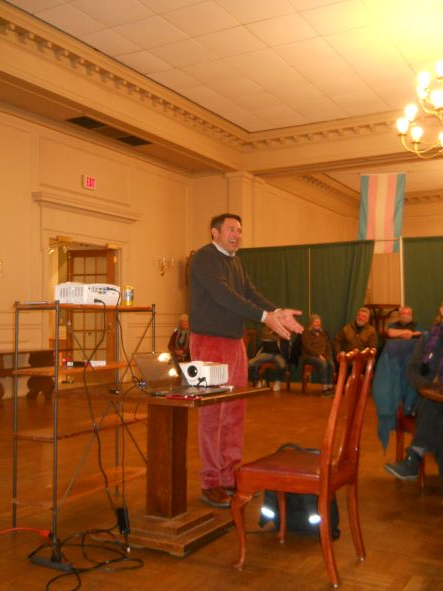 Raj Peter Bhakta presents his plans Thursday evening, February 24, 2022, at the former Green Mountain College in Poultney. Photo by C.B. Hall
He didn't shy away from a philosophical perspective, underlining his belief that "anyone can succeed through hard work and smarts in America," but also commenting that "part of [America's] happiness is beginning to die."
As he presented the matter, the development project is about "bringing things back to life," and reflects the commitment he and his family, who live across the street from the campus, have made to the community.
And while that message appeared to fall on mostly receptive ears, some attendees voiced skepticism during a question-and-answer session.
Resident and small-business owner Alex Hilliard asked how fair it was for Bhakta to get tax stabilization when people like her were struggling to put together their pennies to buy a house or launch a business.
Bhakta called her comment "a great question," and countered with a rising-tide-lifts-all-boats perspective. The successful revival of the campus which once represented the town's primary economic engine, he said, would bring Hilliard's business new clients.
Former selectman Ernie DeMatties rose in support of Bhakta's plan and the tax stabilization initiative, mourning the community's loss of Main Street businesses in recent years and asking those present, "What else do you want to do?... "If [Bhakta] fails, we won't be any worse off."
His rhetorical question placed the issue in its obvious context. The town, which lost just over 12 percent of its population between 2010 and 2020, hasn't many options for economic revival.
He effectively urged the town's citizens to place their bets on Bhakta, while the latter, through the ballot question, is placing his bets on them.
C.B. Hall is a freelance writer from Southern Vermont.
