

Report Confirms Vermonters’ Stories of Delays to Care and Calls for New Reporting and Transparency
Vermont Business Magazine The state team examining waits for health appointments released its findings today identifying lengthy wait times for Vermonters accessing certain specialty care.
Then-Secretary of the Agency of Human Services Michael Smith announced the probe last fall after Seven Days chronicled long waits for appointments. The Green Mountain Care Board and Vermont Department of Financial Regulation joined the inquiry soon after.
The three agencies began their work by convening public forums and soliciting written patient experiences that indicated waits for specialty care could be particularly long.
Medical providers from around the state were also invited to contribute. Providers confirmed the challenges Vermonters faced in accessing timely specialty care and expressed concern about patients in need of services.
Interim AHS Secretary Jenney Samuelson said that wait times preceded the COVID pandemic and were then exacerbated by them. Wait times were experienced regardless of health insurance type. She said that the pandemic also exacerbated chronic conditions, which will have a long-term effect on the health care system.
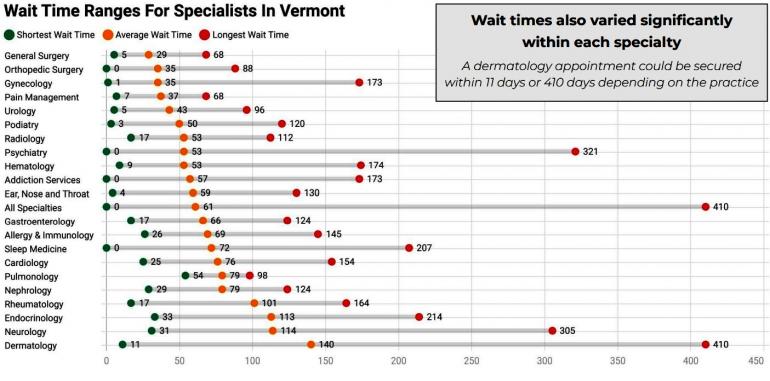
Wait times were longest for Endocrinology (average 113 days), Neurology (114 days) and Dermatology (140 days). A dermatology appointment could be secured within 11 days or 410 days depending on the practice.
The waits were shortest for General Surgery (29 days), Orthopedic Surgery (35 days) and Gynecology (35 days).
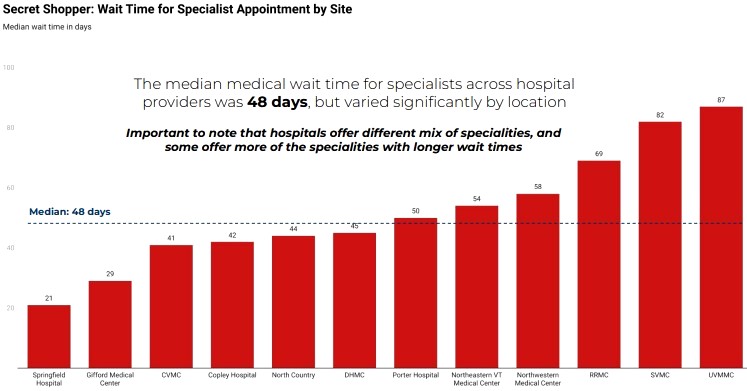
The median medical wait time for specialists across hospital providers was 48 days, but varied significantly by location. The report says it is important to note that hospitals offer different mix of specialties, and some offer more of the specialties with longer wait times.
With the system-wide average (including Dartmouth) at 48 days, UVMMC (87 days) had the longest median waits, with SVMC (82) and RRMC (69) next. Springfield (21), Gifford (29) and CVMC (41) had the shortest.
“This report gathers information from across the state through multiple methods and confirms the testimonials we received from community members and providers over the course of our evaluation,” said Ena Backus, Vermont’s Director of Health Care Reform. “We studied this issue during an unprecedented time of disruption and strain for the health care system and know the pandemic exacerbated system challenges. Nevertheless, health care providers have done everything in their power to meet Vermonters’ care needs and are national leaders in COVID-19 response. We look forward to working with our partners across independent clinics, hospitals, and the entire health care system to ensure every Vermonter can get care when they need it.”
The report includes detailed analyses of Vermont’s health care system using health claims data, chart audits, and a “Secret Shopper” where state employees made over 1,000 calls to seek appointments for 21 different specialties.
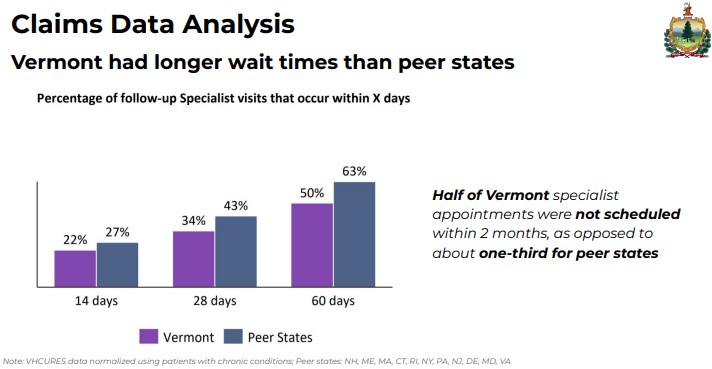
Claims data going back to 2016 reveal wait times were consistently long even before the COVID-19 pandemic.
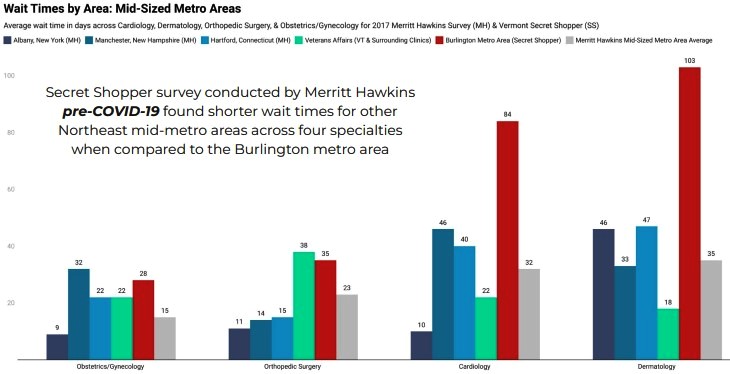
The chart audits and secret shopper calls revealed that certain specialties in Vermont, both private practice and hospital-affiliated, have considerably longer wait times than others – and the same was true within the same specialty for different providers.
The aging of Vermont’s provider community and the expected “tsunami” of delayed care brought on by the pandemic have the potential to exacerbate wait times into the future.
The report states that long waits for some specialty services existed prior to the COVID-19 pandemic and have likely been exacerbated by staffing shortages, new demands for care, and demand for previously deferred care.
Public Comments
Testimony
● 70 participants in public listening sessions
● Written testimony from 68 patients and caregivers comprising 76 pages
Common Themes
● Material impact to health and wellbeing
○ Approximately a third of patients described issues relating to pain, both physical and psychological, resulting from delayed care as well as declines in overall health
● Bureaucratic hurdles to making appointments
○ Complex referral processes, unique referral forms for each department, imaging and testing requirements before appointments can even be scheduled, lengthy packets to be filled out before an appointment
● Poor communication between hospitals and patients
○ Patients reported lost referrals adding unnecessary delays to scheduling, long waits for referrals to be triaged by the medical system, and a lack of follow up between specialists and the patient’s PCP
● Difficulty accessing psychiatric and eating disorder services, particularly for children
● Inequitable patient access
○ Time and resources, understanding of the medical system, health conditions, and transportation were all cited as factors influencing patients’ ability to advocate for themselves and navigate the health system
Provider Comments
Testimony
● Focus groups included 20 PCPs, 12 specialists, 5 mental health providers, and 8 referral coordinators
● Provider emails, 55 provider survey responses, and practice-level data
Common Themes
● Workforce shortages, high turnover, and recruitment challenges were commonly cited drivers of wait times in survey responses and focus groups
● Some providers expressed frustration with the consolidation of specialty services at tertiary care facilities, reducing ability to provide specialty care at regional hospitals
● Some providers cited inappropriate PCP referrals as well as unnecessary care by specialists as additional drivers
● Providers reported devoting increasing amounts of time to administrative tasks, such as entering data into EHR (electronic health record) systems and drafting prior authorization requests, leaving providers “shoehorning patients into 15-minute slots when there’s 40 minutes of work to do”
● Communication breakdowns between specialists and PCPs, exacerbated by poor interoperability of EHR systems
○ Administrative burden, operational challenges in the referral process, and lost referrals contribute to long lags in appointment scheduling
○ Consult notes do not regularly come back to the PCP
■ In 2021, 56% of consult notes returned to the PCP compared to 65% in 2019 (based on Blueprint chart auditing of 2,300+ PCP chart records)
“There is a clear urgency here,” said Susan Barrett, Executive Director of the Green Mountain Care Board. “This report begins a conversation about how to better serve Vermonters.”
The report lays out a series of recommendations to address wait times issues in Vermont.
Chief among these is for the Department of Financial Regulation to request authority from the Vermont Legislature to systematically collect wait times data and make it available to the public. The move would make Vermont unique among states in monitoring this issue.
Currently only Veterans Affairs hospitals regularly publish wait times estimates.
The report’s other recommendations include asking hospitals and health care entities to prioritize wait times at the highest levels, coordinate with each other to share successful strategies, and make operational changes to speed the referral process.
“It is critical for Vermont’s health care system and the state government to come together to make progress on this very important issue – the pandemic has shown just how much we can accomplish when working together for the betterment of Vermonters,” said Michael Pieciak, the Commissioner of the Department of Financial Regulation.
The state evaluation team also thanked health care providers, staff, and hospitals in the report for their tireless work to keep Vermonters safe during the pandemic.
“As we turn towards recovery and revitalization from the disruptions of COVID-19, we can address these challenges through transparency and collaboration,” said Backus. “If there’s a silver lining here, it’s that we can use this moment to reshape the health of our communities.”
Watch: https://t.co/IaRNZiA1Cc
See the report: https://dfr.vermont.gov/health-services-wait-times
2.16.2022. Montpelier, VT – Vermont Department of Financial Regulation