

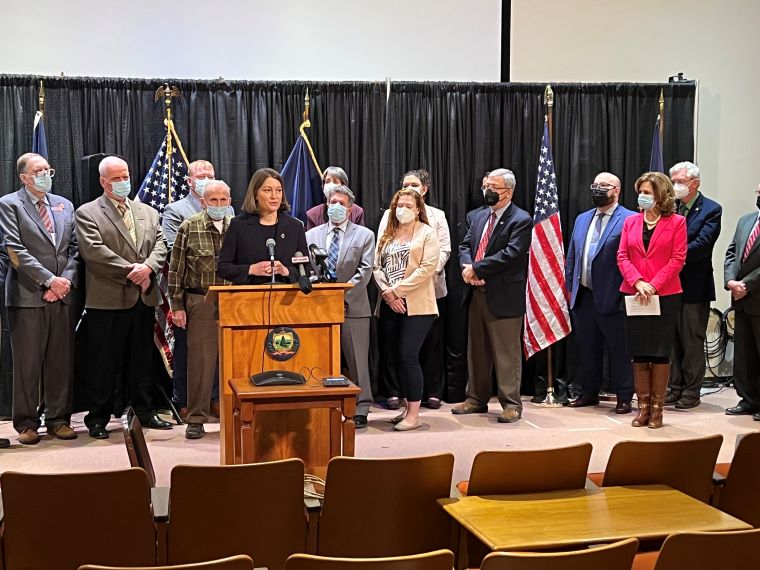
Lieutenant Governor Molly Gray speaks during the press conference supporting the elimination of the income tax on military retirement pay. To the far right in red is ACCD Secretary Lindsay Kurrle. Their statements and one from Governor Scott are below. Courtesy photo.
Vermont Business Magazine Governor Phil Scott and Lieutenant Governor Molly Gray today issued statements following a press conference held by a bipartisan group of elected officials, veterans, and Scott Administration officials in support of eliminating the state income tax on military retirement pay (H.71). Scott has pushed for this since becoming governor, but legislative leaders have resisted passing such a bill.
“Vermont is one of a just a handful of states remaining that fully tax military retirement pay. For the last five years, I’ve proposed it be fully eliminated in Vermont. I am encouraged by the growing bipartisan support for this cause and appreciate the Democratic, Republican, and independent legislators who are stepping up.
“This initiative is not just about supporting those who put their lives on the line for our country – it is a workforce and economic development tool. Veterans typically retire from the military at an early age with plans for a civilian career ahead of them. They bring with them significant skills learned in the military, which is why we desperately need to attract more of them to our state. Eliminating this tax is a great way to start with a significant return on investment.”
At the press conference, Agency of Commerce and Community Development Secretary Lindsay Kurrle and Department of Taxes Commissioner Craig Bolio delivered remarks.
Lieutenant Governor Molly Gray spoke at the press conference and issued a separate statement supporting the initiative, which also can be read below.
The press conference was organized by the National Guard and Veterans legislative caucus, which is co-chaired by Representative Lisa Hango (R-Berkshire), Representative Matt Birong (D-Vergennes) and Representative Laura Sibilia (I-Dover).
Others attending/participating remotely included:
- Sen. Brock
- Sen. Ram Hinsdale
- Sen. Collamore
- Rep. Fagan
- Reps. Morgan
- Rep. Page
- Rep. Leffler
- Rep. Donahue
- Rep. Goslant
- Governor’s Veterans Advisory Committee Chair Gary De Gasta
- Director of the Office of Veterans Affairs Bob Burke
Secretary Kurrle:
As you’ve heard, this tax relief package has a lot of benefits both to existing Vermonters and potential new residents.
The military pension and survivors benefits tax exemption dually serve to acknowledge the contributions of all who serve in our armed forces and as a tool we can use in recruiting critically needed workers to our state.
Not a week goes by that I don’t have a conversation with an employer or employer member organization where workforce (rather the lack of) isn’t raised. Employers are not only unable to grow and expand their operations, they are also challenged to meet current operational demands due to excessive job vacancies.
Wondering where we are going to find enough people to fill the thousands of job vacancies, that stretch through every single sector in our state is what keeps me up at night. It’s what keeps employers up at night.
Education and training are important, but alone are not going to solve our challenges. Especially when we don’t have enough people to educate and train! We have to recruit more working age people to our state.
We have deployed a variety of programs intended to help Vermonters find jobs or better jobs, and we have used a variety of tools to attract new workers to our state. There is no one silver bullet. We must use every tool in the recruitment toolbox.
According to the U.S. Department of Labor, approximately 200,000 women and men leave U.S. military service and return to life as civilians, each year. They have an important decision to make as they approach their separation date and plan for transitioning to civilian life. Where can they find good jobs in affordable and safe communities? Vermont is an attractive place to live and work, but we lack tax policy needed to compete with neighboring states.
How do we know this matters? We know this matters because my colleagues at the Vermont Department of Labor’s Workforce Development Division, in partnership with the VT National Guard, have initiated targeted recruitment efforts at Fort Drum in northern New York, by actively working with exiting service members and new veterans, who are at the height of their career and are able to offer Vermont employers some of the best work ethic, work product, skills and experience that we could ask for.
They know the military pension and survivors benefits tax exemption is an important tool that is missing from our recruitment toolbox that would no doubt help us recruit critically needed talent to our state. You heard Commissioner Bolio say Vermont is one of only three states that fully taxes military pensions. People have choices. We need this tool to bolster recruitment programs that are currently in place, and to support broadening the efforts.
We need to stop making it easy for highly skilled job seekers to choose anywhere but Vermont.
Commissioner Bolio:
I want to talk today about the comprehensive progressive $51.5 million tax relief package the Governor has proposed which impacts Vermont families, including military families, young workers, and retirees.
Exempting military retirement pay and survivor benefit income from state income tax is a key piece of the tax relief package.
Currently, Vermont is one of only three states that fully tax military pensions, meaning 47 states offer at least some exemption for military pension income, and many offer a full exemption or simply don’t have state income taxes at all.
Vermont is behind on the 8-ball on this.
Military retirees contribute to their communities and add to the economy of Vermont by bringing life-long incomes and healthcare, and eligibility for other veteran’s benefits such as the GI bill, small business loans, VA home loans, and more.
In an issue brief published by the Joint Fiscal Office last February, it was noted national data shows that 70% of military retirees retire between the ages of 35 and 50, which means most of these retirees, can join our civilian workforce and bring skills and experience to help with our workforce shortage.
And data from the Department of Defense shows that between 2016 and 2019, Vermont’s population of military retirees was essentially stagnant.
So, let’s join the 47 other states that don’t fully tax this income, and encourage more military retirees to stay here and come here.
I also want to highlight other elements of the Governor’s tax relief package that will benefit many Vermont families, including military families.
He’s proposed a dramatic expansion of Vermont’s Child and Dependent Care tax credit to help middle income families afford childcare.
He’s proposed expanding Vermont’s earned income tax credit to match the most generous fully refundable credit in the nation.
The package also includes a proposal to allow more military and civilian retirees alike to exclude their social security payments from state income taxes.
And the Governor is proposing strategic, targeted income tax credits to help address some of our most urgent workforce needs in nursing and childcare, as well as allowing all Vermonters to deduct all of their student loan interest paid on their taxes.
This is a good tax relief package. It is meaningful, it is progressive, and it will help provide relief to Vermonters through several different stages in their lives from being young workers, to being middle-income families, and ultimately being Vermont retirees.
We ask that the Legislature take the time to consider the Governor’s tax relief package thoughtfully, and we thank the National Guard and Veteran’s Affairs caucus for their interest in these proposals.
Lieutenant Governor Molly Gray Joins Vermont National Guard and Veterans Affairs Legislative Caucus in Renewed Call to Eliminate the Tax on Military Retirement Pay
Today, Lieutenant Governor Molly Gray joined the Vermont National Guard and Veterans Affairs Legislative Caucus and military families in renewing the call to eliminate the tax on military retirement pay.
In April of 2021, Gray and Governor Scott issued a joint commentary highlighting the importance of eliminating the tax on military retirement pay for growing Vermont’s workforce and economy.
“In August, President Biden brought the War in Afghanistan to a close, withdrawing U.S. troops after 21 years in the country. In the early years of the Iraq and Afghanistan conflicts, Vermont had more people serving than any other state per capita. Today, many of those who began serving in 2001, when the U.S. entered Afghanistan, are now eligible for partial retirement. These service members deserve our every support and Vermont should be a welcome home as they begin the next chapters of their careers,” said Lt. Governor Gray.
Vermont is home to some 4,000 military retirees and one of only three states in the U.S. that fully tax military pensions. Vermont is also home to more than 36,000 veterans.
Gray was joined by Vietnam veteran and retired Master Sgt. Bill Bandy of Moretown. Master Sgt. Bandy served over 20 years in the U.S. Army, including three tours in Vietnam, and has been awarded two Air Medals, two Bronze Star Medals, two Meritorious Service Medals, and a Commendation Medal.
“We also need to honor and support those military retirees who continue to choose Vermont as their home, despite other states having more benefits,” Gray said, “As the proud daughter of a Marine First Lieutenant and sister of a Marine Corporal, I know that supporting our military retirees is one step in what must be a larger effort to support those who have served and sacrificed for our state and nation. We must also ensure Vermonters have access to veteran’s benefits, we must support veteran owned businesses, and continue to center the voices of Vermont’s veterans in our daily work.”
Governor 2.2.2022. Montpelier www.vermont.gov